
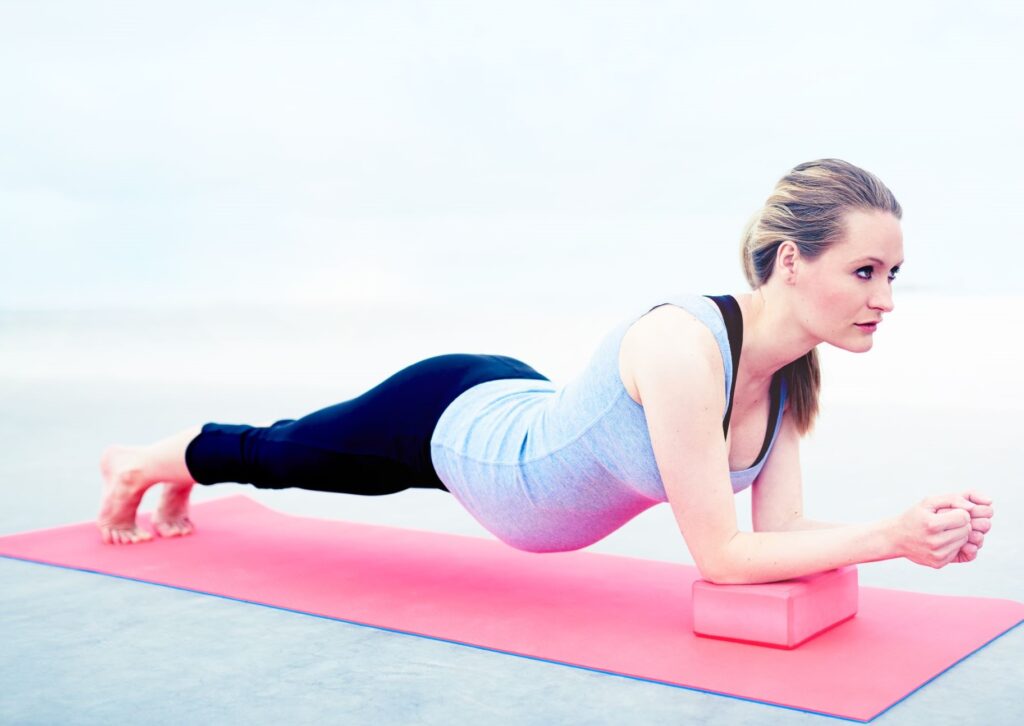
Building a strong, resilient core isn’t about a flat stomach. It’s about being able to lift your little one, stand tall at the end of a long day, and feel like yourself again.
There’s a moment — if you’re a mum, you’ll know exactly the one — where you reach down to scoop up your toddler, maybe with one arm while balancing a packed nappy bag on the other shoulder, and something in your lower back just quietly protests. Not a sharp pain, necessarily. More of a reminder. A gentle, insistent nudge that says: hey, something here needs attention.
I’ve been there. Most of us have. And for a long time, my instinct was to google “best ab exercises” and get to work. But what I wish someone had told me sooner — and what I now tell every woman who comes through the MotherFit community — is that core training for mums is a completely different conversation to what you’ll find in most fitness magazines. It’s slower. It’s more internal. And it starts in a place that nobody talks about nearly enough: the pelvic floor.
This isn’t just a fitness post. It’s a gentle, honest guide for every woman whose body has changed — through pregnancy, through birth, through the relentless physical labour of motherhood — and who wants to rebuild from the inside out, the right way.
The Foundation
Why a Strong Core is Vital for Women — and Especially Mums
Let’s talk about what the core actually is, because it’s so much more than the muscle you flex when someone catches you off guard at the pool. Your core is the entire muscular system of your torso — front, back, and sides. Think of it less like a six-pack and more like a corset that wraps your entire midsection, offering support and stability to everything you do.
When that system is strong and working well, your whole body moves better. When it’s weak — as it so often is after pregnancy and the early months of new motherhood — you’ll feel it in ways you might not even connect to your core at all. That aching lower back. The way you hunch forward when you’re exhausted. The slight heaviness or pressure after a busy day on your feet. All of that can trace back, in some way, to how well your core is functioning.
A strong core affects our overall health in ways that go far beyond aesthetics. Women with a well-conditioned core tend to have better balance and coordination, better breathing patterns, less chronic lower back pain, and — this is the one that surprises most people — a significantly easier time with the physical demands of everyday motherhood. Lifting car seats, carrying sleeping children from the car to their beds, hoisting an overtired three-year-old who absolutely refuses to walk: these are all core exercises in disguise. The question is whether your body is ready for them.
- 01
- A strong core supports spinal alignment, helping you stand tall and reducing the forward tilt that comes from prolonged sitting and caring for a newborn.
- 02
- Less Back Pain
- Core strength reduces compression on the spine, distributing load more evenly and giving your back the scaffolding it needs to stay pain-free.
- 03
- Functional Strength
- From lifting babies to carrying car seats, a strong core makes the physical demands of motherhood feel manageable rather than exhausting.
- 04
- Breathe Better
- Core muscles are deeply connected to your breathing mechanics. Strengthening them improves how you inhale, exhale, and manage intra-abdominal pressure.
Interestingly, a consistent core routine will also improve the way you breathe. The diaphragm — your primary breathing muscle — is considered part of the deep core system, along with your pelvic floor, transverse abdominis, and multifidus. When these muscles work together, everything from your posture to your stress response feels different. Calmer. More grounded. More you.
“Building a strong core isn’t about shrinking yourself. It’s about becoming more — more stable, more capable, more present in your body.”
— MotherFit Philosophy
And yes — a toned midsection is a beautiful side effect of all of this work. But it’s the side effect, not the goal. When the goal is function, confidence, and longevity, the results you achieve go so much deeper than what the mirror shows.
The Posture Connection — and Why It Matters More Than You Think
Here’s something that doesn’t get discussed enough: modern life is catastrophic for posture. Long hours at desks, hours spent on our phones, and the particular rounding that comes with breastfeeding and cradling a newborn — all of it contributes to a forward tilt of the pelvis and a curving of the spine that, over time, becomes our default position.
What happens is gradual. The pelvis begins to tilt forward — anteriorly, in clinical terms — which causes the lower back to arch, the hip flexors to shorten, and the glutes and abs to essentially switch off. The body compensates, other muscles overwork, and suddenly you find yourself with chronic lower back tightness that seems to come from nowhere.
Core exercises, done well, correct this. They re-engage the muscles that have gone dormant. They teach the pelvis to sit in neutral — not tucked, not tilted, just balanced. And they restore the spine’s natural curves so that it can do its job without undue compression or strain.
This is why the most effective core workout routines work all the muscles of the torso, not just the rectus abdominis (the “six-pack” muscle). Even weight distribution throughout the body is the goal — and that takes a full, 360-degree approach to training.
Before You Begin
The Conversation We Should All Be Having: Pelvic Floor First
I want to be very direct about this, because it matters so much: before you begin any kind of core workout — especially as a mum, especially post-birth — you need to give your pelvic floor the attention it deserves.
The pelvic floor is a group of muscles that sit at the base of your pelvis, like a hammock, supporting your bladder, uterus, and bowel. During pregnancy, these muscles are under enormous, sustained pressure from the growing weight of your baby. During birth, they go through an incredible stretch. And yet, in the months (and sometimes years) that follow, so many of us rush back into exercise without ever checking in with these foundational muscles first.
If you experience any of the following — leaking when you sneeze, cough, or jump; a feeling of pressure or heaviness in your pelvis; discomfort during exercise or intimacy; or any sense that something just doesn’t feel right internally — please address those symptoms before adding load to your core. These are signs that your pelvic floor needs targeted rehabilitation, and no amount of crunches or planks will fix that. In fact, they can make things worse.
A Note on Diastasis Recti
Diastasis recti — the separation of the two sides of the rectus abdominis muscle along the midline — is common during and after pregnancy, affecting a significant majority of women at some point in their third trimester. It varies widely in severity, and for many women it resolves naturally in the months post-birth.
If you suspect you have diastasis recti (you might notice a gap or a “doming” along the midline when you try to do a sit-up), please see a women’s health physiotherapist before beginning any core training programme. The right exercises can support healing; the wrong ones can hinder it. This isn’t about limiting you — it’s about getting you to your best, strongest self in the safest possible way.
Think of it as building a house. If the foundation isn’t sound, it doesn’t matter how beautiful the rest of the structure is. Fix the foundation first, and everything else follows.
The good news? Once you’ve built a strong pelvic floor — or had it assessed and treated if needed — the rest of the journey is genuinely exciting. You’ll notice the difference faster than you’d expect, and the exercises that follow will feel more effective, more connected, and more sustainable than anything you’ve tried before.
The Workout
Building a Strong Core with a Resistance Band
Now, the part you’ve been waiting for. These are some of my absolute favourite exercises for rebuilding the core — particularly for pregnant women and new mums. What makes them different from a standard ab workout is the integration: every movement works multiple layers of the core simultaneously, and the resistance band adds a beautiful element of challenge that takes things to a completely different level.
The band creates constant tension throughout each movement, which means your core has to work continuously — not just at the peak of the movement, but all the way through. For pregnant women especially, this kind of low-impact, controlled resistance training is ideal. It builds strength without jarring the body, keeps heart rate in a safe range, and can be modified easily as your bump grows.
Start with a light resistance band. These exercises are to be performed for 30 seconds each and repeated for 3 rounds. Here’s how I’d suggest approaching them:
1
Pallof Press to Knee (Right and Left Sides)
The Pallof press is a brilliant anti-rotation exercise that trains your core to resist movement rather than create it — which is exactly how the core works in real life. Attach your band to something stable at chest height and stand side-on. As you press the band away from your chest and lift the opposite knee, inhale to expand the chest and ribs while pressing the diaphragm downward. Exhale fully as you bring the knee up, deflating the ribcage and bracing through the core and pelvic floor. The combination of standing on one leg and resisting the band’s pull creates an incredibly effective deep core challenge. Perform on both sides — and don’t be surprised if you notice a significant difference between your dominant and non-dominant sides.
2
Overhead Band March
This one looks deceptively simple and is anything but. Hold the band overhead with both hands and begin marching on the spot, lifting alternate knees. The tension pulling you backwards means that to keep your ribs down and your torso tall, your deep core has to fire continuously. There’s no moment of rest here — this is one of those exercises that makes you realise just how much your core is always working, even when you’re not “doing abs.” Exhale with each march step. The exhale activates the pelvic floor and transverse abdominis automatically, providing internal support with every movement.
3
Hip Hinge with Band Pull-Overs
Stand with feet hip-width apart and hold the band with both hands extended overhead. As you hinge forward at the hips — maintaining a neutral spine — let the band come forward, then exhale as you pull it back and down in an arc towards your body. The focus here is the exhale and the conscious connection to your core as you draw the band towards you. Try to feel the movement initiating from your pelvic floor upwards — it’s a subtle shift, but it changes everything about how the exercise feels. This one is particularly wonderful for reconnecting with the posterior chain (glutes and lower back) while keeping the core deeply engaged throughout.
4
Squat with Band Row
Face the anchor point of your band and hold it with both hands at arm’s length. Sink into a slight squat — not too deep; the focus is squarely on the core, not the thighs — and inhale as you reach your arms forward. Then, as you exhale and pull the band towards your body in a row, rise slightly from the squat and consciously lift from the pelvic floor upwards through the core. The moment when the band comes towards you should feel like an internal zipping — a gathering of support from the base of the pelvis all the way up. This connection is what separates a core exercise from just a movement.
A word on breathing through all of these — it genuinely matters. The breath is the hidden conductor of the core system. When you inhale, your diaphragm descends and your pelvic floor naturally lowers with it. When you exhale, both rise, creating the internal pressure management that keeps your back and pelvic organs supported. Practising this breath-core connection during exercise is what builds the reflexive, automatic core stability that protects you in real life — not just when you’re thinking about it in the gym.
“The breath is the hidden conductor of the core system. Learning to use it is the difference between going through the motions and genuinely rebuilding your strength.”
These four exercises, done consistently and with proper breath and pelvic floor connection, will build a level of core strength and body awareness that translates directly into your daily life. You’ll notice it when you lift your baby, when you stand at the kitchen counter, when you walk. It becomes part of how you move through the world.
Consistency Over Intensity
How Often Should You Be Doing Core Exercises?
This is the question I get asked most often, and my answer is always the same: start slowly, and trust the process. The biggest mistake women make when they return to exercise — whether it’s during pregnancy or in the months after birth — is doing too much too soon. The motivation is there, the desire to feel strong again is real, but the body needs a different timeline than the mind wants to give it.
Here’s the progression I recommend to every woman in the MotherFit community:
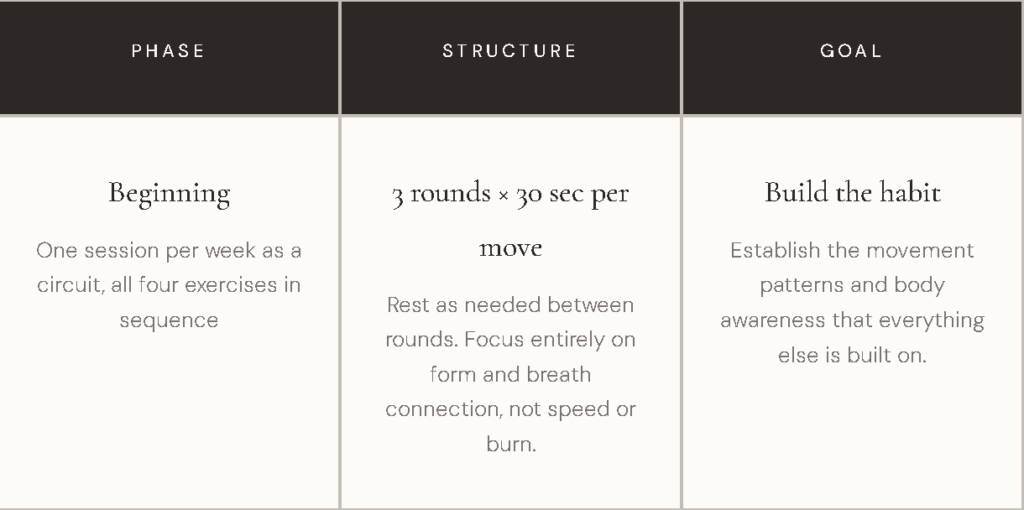
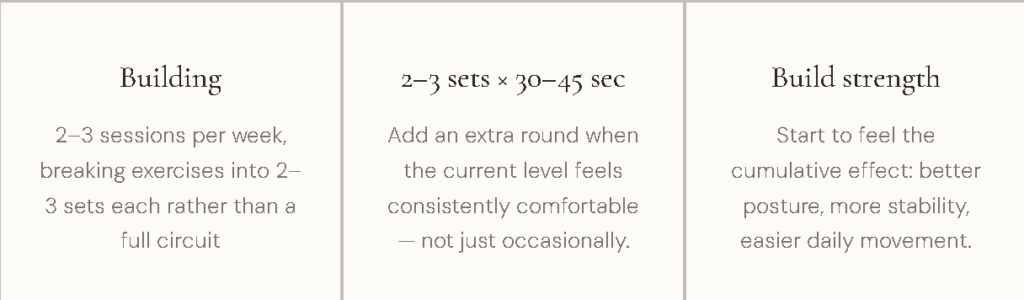
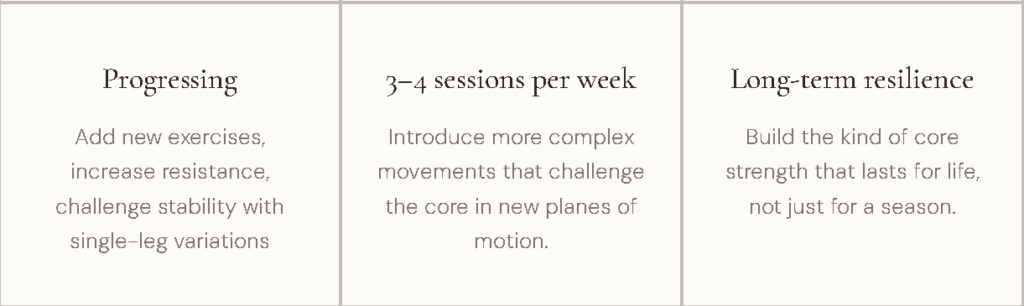
The most important thing to understand about this progression is that “easy” doesn’t mean “not working.” When an exercise feels manageable, that’s your nervous system having learned the movement — but the muscles are still being challenged, the breath patterns are still deepening, and the pelvic floor coordination is still improving. Don’t rush to make things harder the moment they stop feeling impossible.
That said, when you genuinely feel that a circuit has become comfortable — when you finish your third round and feel you could easily do a fourth — that’s your cue to add another round or introduce a new exercise. Progress should feel like stepping up a gentle staircase, not scaling a cliff face.
Listening to Your Body: The Most Important Exercise of All
I want to end this section with something that feels almost radical to say in a fitness context: rest is part of the programme. For women in pregnancy and the postnatal period especially, the body is doing extraordinary things. It’s building a human being, or recovering from building one, or nourishing one. That deserves respect.
If you finish a session and feel energised, that’s wonderful. If you feel tired — truly tired, not just “I worked hard” tired — that’s data. Listen to it. Take an extra rest day. Reduce the resistance on the band. Do one fewer round. None of that is failure; all of it is wisdom.
The women I see make the most remarkable progress are not the ones who train the hardest. They’re the ones who train the most consistently, with the most awareness, and who treat their body as a partner in the process rather than a project to be conquered.
A Final Thought
You Already Have Everything You Need to Begin
There’s a quiet revolution happening in how we talk about women’s fitness — a shift away from punishing workouts aimed at shrinking, and towards intelligent, intentional movement that builds women up. Core training, done the MotherFit way, is right at the heart of that revolution.
It asks you to slow down and tune in. To breathe. To notice. To build from the inside out, trusting that the external results will follow naturally when the internal foundations are in place. In a world that constantly tells women to do more, push harder, and be smaller, there’s something genuinely radical about an approach that says: start here. Start with the breath. Start with the pelvic floor. Start with one session a week and let that be enough.
Because it is enough. It’s more than enough. And over weeks and months, that quiet consistency adds up to something extraordinary: a body that feels strong, stable, and truly yours again.
That, to me, is what fitness is for.