
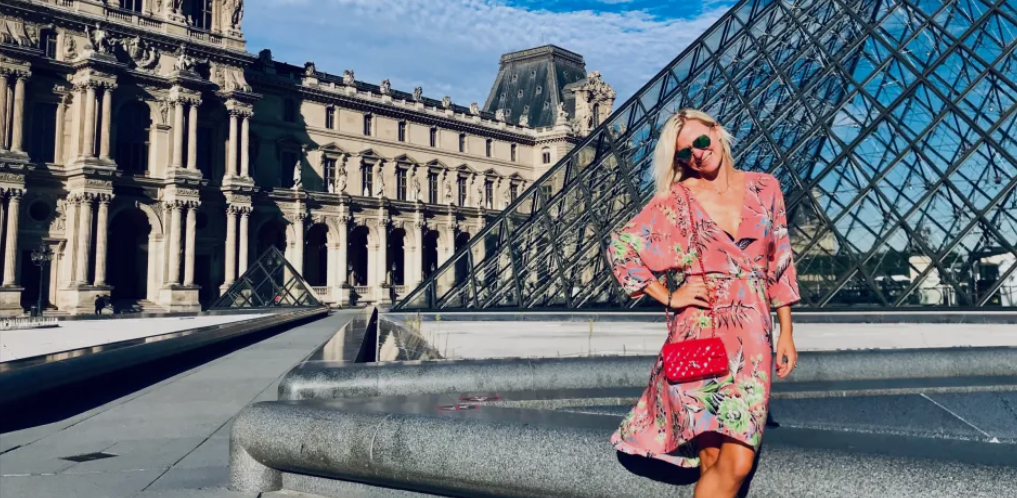
Golden hour terraces, hidden vintage ateliers, market flowers, and the particular feeling of a city that has never once tried too hard — and never had to
I wasn’t supposed to fall in love with Paris in summer. I had been warned — crowded, hot, full of tourists, the Parisians themselves all decamped to the South. I went anyway, with a slightly overpacked carry-on and a loose plan that amounted to mostly: eat well, wear linen, get a little lost.
Three summers later, I am still going back. Every June, something in me starts to orient itself northward and westward, like a migratory instinct I didn’t ask for and can’t quite explain. And I’ve spoken to enough women — from New York to Copenhagen, from Seoul to São Paulo — who feel the exact same quiet pull. Paris in summer is not the Paris of February fashion week, all structured coats and purposeful strides. It is softer than that. Warmer. More human. And paradoxically, it is the most stylish version of itself precisely because it has stopped trying so hard.
This is everything I wish someone had told me before my first summer in Paris — from the golden-light neighborhoods that feel like stepping into a Slim Aarons photograph, to the very specific way a French woman wears a slip dress that you will absolutely attempt to replicate, to the fashion, beauty, and lifestyle rituals that make a summer in the city feel less like a trip and more like a transformation.
The City That Invented the Art of Doing Nothing Beautifully
Let me say something that fashion editors don’t always like to admit: the most stylish thing you can do in Paris in summer is absolutely nothing. Not performative nothing — not the studied, Instagram-choreographed lounging that we’ve all scrolled past. I mean real, genuine, unhurried nothing. A café chair angled toward the street. A book you’re pretending to read. A glass of something cold and golden. An hour you’ve committed to wasting with full intention.
This is, I came to understand, the foundational lifestyle philosophy that undergirds everything Parisian style has ever produced. The French concept of flâner — to wander without destination, to observe without agenda — is not a tourist affectation. It is a genuine civic practice. And summer is when the city makes it irresistible.
By mid-June, the light in Paris does something almost theatrical. Golden hour begins around eight-thirty in the evening and stretches, impossibly, for nearly two hours. The Seine turns copper. The limestone buildings along Haussmann’s grand boulevards glow amber. Even the tourists look beautiful in it. I’ve photographed outfits in that light that would have looked perfectly ordinary anywhere else — a simple slip dress, white mules, a woven bag — and they came out looking like something from a 1970s Italian Vogue spread. The city is doing the work for you. The least you can do is show up in something that deserves it.
“The French concept of flâner — to wander without destination, to observe without agenda — is not a tourist affectation. It is a genuine civic practice. And summer is when the city makes it utterly irresistible.”
The parks fill up. The Canal Saint-Martin becomes the most beautifully curated outdoor living room you’ve ever seen, lined with people eating takeout Thai food and drinking natural wine from paper cups with an ease that should not be that hard to achieve and yet somehow always is, everywhere else. Jardin des Tuileries perfects the art of combining extreme formality — rigid geometry, stone urns, ranked chestnut trees — with total informality, because the green chairs are always scattered at odd angles toward whatever view the sitter wanted, and the sand underfoot means you will absolutely need to rethink your footwear choices.
Which brings me, naturally, to what to wear.
Dressing for a Parisian Summer: The Aesthetic Breakdown
There is a specific visual language to summer in Paris that has evolved considerably over the past few years, and if you’ve been paying attention to the style conversation on social media — the quiet luxury discourse, the clean girl aesthetic that has given way to something softer and more European, the resurgence of what some people are calling old money summer — you’ll recognize most of it. The difference is that in Paris, none of it is a trend. It is simply how people dress when the weather allows it.
The Uniform
If I had to describe the Parisian summer uniform — the one I see repeated with endless, beautiful variation across arrondissements and income brackets — it would be this: something that moves, something that breathes, and something that looks like it was chosen thoughtfully but not anxiously. A tailored linen trouser in camel or chalk white, worn with a simple tucked-in shirt. A bias-cut midi skirt in washed silk paired with a worn leather sandal. A wrap dress in a faded floral that has been through enough summers to look perfectly imperfect.
The 2026 mood, which I have been tracking with something bordering on obsession since January’s runway previews, leans heavily into what I’d call effortless construction — pieces that appear simple but are cut with real architectural intelligence. Think the kind of trousers that drape just so, the kind of top that somehow stays in place even when you’re cycling across a bridge. The maximalist dopamine dressing wave of a few years ago has receded, and what’s left feels cleaner, quieter, and honestly more interesting to me personally.
The clean girl aesthetic — that particular combination of low-maintenance beauty, simple dressing, and an almost aggressively healthy glow — has evolved in Paris into something I think of as its more emotionally complex older sister. It still values simplicity and skin. But it has added texture: a vintage scarf knotted loosely at the neck, a single piece of gold jewelry that is clearly antique and definitely has a story, worn leather that has been cared for instead of replaced.
The Paris Summer Edit: What Actually Gets Worn
- Washed linen in sand, ivory, terracotta, and old rose — not bright linen, not crisp linen, soft-laundered linen
- Bias-cut slips and midi skirts in deadstock silk or viscose — the kind that photograph beautifully in any light
- One pair of well-made leather sandals. Just one. You will wear them every single day.
- A structured straw bag — not the mass-produced raffia aesthetic, something with genuine craft behind it
- Lightweight tailored trousers in a neutral that works as a base for everything
- A single silk scarf that functions as a neck accessory, bag charm, or impromptu hair tie depending on the day
- At least one piece in a color that only makes sense in European light — dusty lavender, faded sage, the particular shade of warm beige that the French call nude but is somehow more interesting than what that word usually conjures
- Perfume. Always. The ritual of it matters as much as the scent.
The Bag Question
I want to talk about bags specifically because I think the conversation around Parisian style has done a disservice to the women who actually live there by over-indexing on certain very specific luxury signifiers — the mid-size flap, the recognizable monogram — that are, in reality, just one small part of a much more varied and interesting bag culture.
Yes, I have seen a Chanel classic in its natural habitat on the Île Saint-Louis, carried by a woman of a certain age in a way that suggested she had been carrying that particular bag since before some of us were born. And yes, it was extraordinary. But I have also seen — and been far more moved by — a Jacquemus rattan bucket worn over a striped top on the Canal Saint-Martin, a vintage Celine from the late nineties discovered at a Marché aux Puces stall for forty euros and worn with the quiet triumph of a woman who knows she won the day, and a completely unremarkable canvas tote from a Parisian bookshop being used as a primary handbag by someone whose overall outfit was so considered that the tote read as the most intentional choice she could have made.
The lesson, as with so much about Parisian style, is about relationship and context rather than prescription. What you carry matters less than how you carry it. Which is maddeningly vague advice that somehow becomes completely clear the moment you watch a French woman walk away from a café table.
The Neighborhoods That Will Rewire Your Aesthetic Entirely
Every city has its tourist circuit, and Paris is not exempt. The Eiffel Tower, Notre-Dame — now reconstructed and more beautiful for it, I will say — the Louvre, Montmartre. These are worth your time. They are also worth approximately one day of your time, after which I urge you to put away the must-see list and instead spend your remaining days getting deeply, productively, aesthetically lost.
The neighborhoods that have changed how I dress, how I think about interiors, how I understand the relationship between beauty and everyday life, are not the ones that appear in most travel guides. Or rather, they appear in travel guides but in the way that all places appear in travel guides — correctly described and completely misrepresented, because the point of them is an experience, not a description.
Le Marais: The Neighborhood That Sells You on Your Own Fantasy
I know. Le Marais is thoroughly on the tourist map. I am recommending it anyway, specifically for the vintage and concept stores concentrated in the streets around the Place des Vosges and threading north toward the Temple district. This is where the aesthetic conversation that drives a large portion of what appears on Pinterest boards titled “European Summer” and “Quiet Luxury Inspo” actually originates. Not in the major fashion houses, not in the department stores — in the small, precisely curated boutiques of Le Marais, where the owners have an almost terrifying ability to identify exactly what you didn’t know you needed.
I once spent three hours in a single street in the northern Marais, in the Haut-Marais neighborhood, and came away with a better understanding of color blocking than five years of following fashion accounts had given me. The shops there display clothes the way galleries display art — with space, with intention, with the conviction that the object merits contemplation. It is not a coincidence that this is also one of the most densely gallery-packed neighborhoods in a city that is embarrassingly full of art galleries.
What to look for: vintage French linen in washed-out pastels that you will absolutely not find anywhere else at any price. Ceramic jewelry — a trend I initially dismissed and am now completely converted to — particularly the work of small makers who sell through local boutiques rather than their own web presence. Concept stores selling the kind of home objects that make you immediately reconsider your entire apartment when you get home.
Oberkampf and Ménilmontant: Where the Real Paris Gets Dressed
If Le Marais has become a curated version of Parisian style, Oberkampf is where Parisian style happens unselfconsciously. This stretch of the 11th arrondissement — running roughly from the Oberkampf metro station up toward Ménilmontant and the Belleville border — is where younger Parisians actually live, actually shop, and actually develop the aesthetic opinions that eventually filter into the broader conversation.
The vintage stores here are less polished than the Marais boutiques and considerably cheaper for it. The terrasse cafés on summer evenings are packed with people who dress with the particular kind of thrown-together precision that takes genuine style to achieve — the ripped jeans with the perfect vintage blazer, the trainers with the silk dress, the visible bra strap treated as a design element rather than a wardrobe malfunction. This is where the rulebook gets pleasantly complicated.
I went to a summer Sunday market here on my second Paris trip and watched a woman choose between two nearly identical white shirts for about four minutes before selecting one, holding it at arm’s length, and then putting it back and buying a completely different shirt that I genuinely had not noticed was even there. The one she bought was marginally softer, I think, and had a collar that sat differently. The way she looked at it as she folded it into her bag suggested she knew exactly what she would wear it with and when. I thought about that woman for the rest of the day. I still think about her occasionally, honestly.
Île Saint-Louis: Slow Living in a City That Forgot to Stop
The smaller of the two islands in the Seine is, I am fairly convinced, one of the most beautiful urban neighborhoods in the world, and it has the particular quality of places that know exactly what they are and have no interest in becoming anything else. The main street, Rue Saint-Louis en l’Île, is a single narrow street of excellent cheese shops, wine caves, the world’s best ice cream, and a sense of time that operates at a different speed than the rest of Paris.
The lifestyle lesson I take from Île Saint-Louis every summer is this: choose a few things and do them exceptionally well. The island has essentially the same shops it has always had. It is not chasing trends. It is serving the same extremely good Berthillon ice cream it has been serving for decades, and the queue stretching down the street in summer suggests this philosophy is working out rather well. Apply this principle to your wardrobe. Apply it to your skincare routine. Apply it to your life, maybe.
“Paris in summer teaches you that restraint is not deprivation. It is the condition under which you actually notice what you have — and discover it was more than enough.”
The Beauty Rituals That Paris Will Quietly Insist You Adopt
Something happens to your beauty routine in Paris. It simplifies, almost against your will. Part of this is practical — the heat, the cobblestones, the pace of a day that involves significantly more walking than you anticipated — but part of it is something more atmospheric. The city has a particular aesthetic relationship with female appearance that is genuinely different from what I experience in London, New York, or Los Angeles, and I find myself adjusting to it within about forty-eight hours of arriving.
The dominant beauty code for summer 2026 in Paris leans strongly into what the beauty press has been calling soft glam and what I think of as strategic naturalness — the art of looking like you haven’t tried very hard when in fact the effort has simply been redirected. Less coverage, more skin. Less contouring, more glow. Less defined eye, more defined brow. The focus shifts from concealment to enhancement, from perfection to vitality.
Skin First, Always
French pharmacy culture is well-documented at this point, and I won’t pretend to be the first person to have discovered the particular excellence of La Roche-Posay SPF, the particular wisdom of Avène’s thermal water spray, or the particular pleasure of spending forty-five minutes in a Parisian pharmacie choosing between seven almost identical versions of the same facial mist. But I will say that the philosophy behind the products — skin health as the foundation for everything else — is one that has genuinely changed my approach at home.
In summer specifically, the skin-first approach means arriving with as clean and hydrated a base as possible and then building very lightly on top. Tinted moisturizer with SPF, not foundation. A touch of blush applied with fingers rather than a brush, so it sits in the skin rather than on it. A lip product that is mostly care with a wash of color. The overall effect should be — and I’ve heard Parisian women describe it this way — like you just came back from somewhere pleasant. A swim. A walk. A nap in golden light. Wherever you’ve just been, it’s done you good.
The Hair Situation
The specific hair aesthetic that Paris summer produces in me could best be described as beautifully defeated. The humidity, the walking, the habit of tying it up to eat and then forgetting to take it down properly — by day three, my hair has given up on being styled and arrived at something that looks, in the right light, almost intentional. Slightly wavy. Slightly textured. The kind of undone that takes twenty minutes to replicate with products in real life.
The actual French summer hair approach, to the extent that I’ve been able to observe it, involves significantly less heat styling than I would use at home and a much more generous relationship with texture spray, light oils, and the simple act of letting hair air dry in a loose bun and then taking it down. The result is what the beauty industry has been calling lived-in hair for years, but which in Paris is simply called having hair.
A note on the silk scarf: yes, it is a cliché. It is a cliché because it is genuinely useful and genuinely beautiful in summer heat, and I refuse to let its ubiquity on Pinterest boards diminish my enjoyment of it. Tie it at the nape of the neck over a low bun. Wrap it around a ponytail. Wear it as a headband if you’re feeling particularly channeling-1960s-Brigitte-Bardot about your day. It costs almost nothing from a vintage market, it solves the second-day hair problem elegantly, and it photographs in that golden Parisian light in a way that will make your followers extremely jealous, which is, I think we can admit, occasionally a legitimate aesthetic goal.
The Summer Beauty Edit: What to Pack, What to Buy There
- Pack from home: Your existing skincare routine — don’t experiment in a new climate. A tinted moisturizer with SPF 30+. One or two lip products, nothing more. Mascara you trust.
- Buy at the pharmacie: La Roche-Posay Anthelios sunscreen in whatever formula appeals to your skin type. Avène thermal spring water spray for midday refreshment. Bioderma Sensibio micellar water — not because you can’t get it elsewhere, but because buying it here costs about a third of what it does in airport beauty halls.
- The scent decision: One fragrance, chosen thoughtfully. Summer heat amplifies every note, which means your usual scent may read differently. Lighter, more citrus-forward, or the kind of dry floral that feels like warm skin rather than perfume counter.
- What to leave behind: Heavy coverage foundation. Complicated contouring. The expectation that you will replicate your at-home beauty routine. You won’t, and you’ll be more beautiful for it.
What You’ll Eat, and Why It Will Change How You Think About Food at Home
I am going to talk about food because it is inseparable from the Paris summer experience, and because I think the specific way Parisians approach eating in summer — the particular rhythms, the social rituals, the places — is as instructive as anything I’ve learned about fashion or beauty in the city. Also, honestly, because the food is extraordinary and I want to talk about it.
The Parisian approach to summer eating is characterized by one central principle: quality of ingredient over complexity of preparation. The tomato on your plate in August has been chosen because it is an excellent tomato, not because it came from a particularly fashionable source or because it has been prepared with unusual technique. The chicken at the rôtisserie on your corner is not doing anything except being very good chicken, roasted over its own juices and sold with potatoes that have absorbed every possible ounce of flavor from the dripping beneath them. The cheese course at dinner is cheese. The bread is bread. Everything is intensely, almost aggressively, itself.
This is, I have come to understand, a lifestyle philosophy masquerading as a culinary one. The same attention to essential quality, the same resistance to unnecessary complication, applies to clothes, to beauty, to the arrangement of a small apartment, to the way a woman walks down a street. Excellence at the fundamental level. Restraint in the additions. A deep suspicion of anything that requires extensive explanation to be worth your time.
The Markets
Every Parisian neighborhood has its market days, and I would put a weekend morning at a Parisian outdoor market among the single most aesthetically nourishing experiences available to a person with an interest in beauty, color, and the visual possibilities of everyday life. The Marché d’Aligre in the 12th. The Marché Raspail on Sundays in the 6th — particularly the organic market, which is frankly beautiful to look at even if you have no intention of cooking anything. The Marché des Enfants Rouges, the oldest covered market in Paris, in the Marais, which sells everything from Moroccan merguez to Japanese bento to excellent Breton crêpes and has been doing all of this since 1615.
I always buy flowers at the market. Always. This is, I have decided, non-negotiable as a life practice, and Paris is where I decided it. The flower stalls are extraordinary — abundantly stocked, reasonably priced by any comparison standard — and the particular pleasure of walking back to your apartment or hotel with peonies or dahlias or whatever is in impossibly gorgeous peak season is one of those small joys that costs very little and lands very hard. I now do this at home every Saturday and consider it one of the better habits Paris gave me.
The Social Rhythm You Didn’t Know You Needed
One of the most significant adjustments that Paris summer asks of you is temporal. The day runs differently. Lunch is real — a proper midday meal, not something consumed in front of a screen. The afternoon has a softness to it, an acknowledged lull during which the pace of the city seems to actually slow. Dinner doesn’t begin until eight or eight-thirty at the earliest, and the terrasse tables that line every café fill up with people who appear to have nowhere else to be and no interest in being anywhere else.
This is profoundly disorienting if you arrive from a culture of desk lunches and seven-PM dinner reservations and the relentless forward momentum of a productivity-optimized schedule. It is also, once you surrender to it, one of the most quietly radical things I have encountered in any city. The rhythm implies something about value — about which hours of the day are worth protecting, about what constitutes a well-spent afternoon, about the relationship between pleasure and what we tend to call productivity as though they were natural opposites rather than complementary states.
I think about this often when I’m back home and eating something forgettable at my desk. I think: this is not inevitable. Someone made a different choice about how to organize a day, and the choice became a culture, and the culture became a city that looks the way Paris looks. The causal relationship between lifestyle philosophy and aesthetic output has never felt more real to me than it does in Paris in summer.
22°CAverage June Temperature
10hDaily Light in Peak Summer
80+Vintage Markets & Brocantes
80Covered Passages to Explore
The Covered Passages: Paris’s Best-Kept Aesthetic Secret
If I could communicate only one genuinely underrated experience of a Paris summer to you, it would be the covered passages. These glass-roofed arcades, built in the early nineteenth century and predating the department store by several decades, are scattered across the 2nd and 9th arrondissements and represent a form of architecture and retail that exists essentially nowhere else in the world in this preserved, navigable form.
The Galerie Vivienne is the most beautiful — all mosaic floors and elaborate ironwork and the particular golden light that falls through the aged glass ceiling on summer afternoons. The Passage des Panoramas is the oldest and most pleasingly chaotic, full of stamp dealers and old-fashioned restaurants and a sense of time that has genuinely pooled in the corners. The Galerie Colbert, connected to the Bibliothèque Nationale, is so unreasonably grand that you keep expecting someone to ask what you’re doing there.
They are cool in the heat. They are quiet in comparison to the surrounding streets. They are full of the particular aesthetic pleasure of nineteenth-century Paris — a city that understood that beauty in everyday commerce was not a luxury but a basic courtesy owed to the people passing through. I always come back to this when I think about the current conversation around accessible luxury and quiet elegance and the design values that underpin the aesthetic movements of the mid-2020s. The Parisians sorted this out two hundred years ago and then built structures over it so you could walk through it on a Tuesday afternoon.
Practical Things I Wish Someone Had Told Me
I have been writing about Paris in summer in fairly elevated, experiential terms, which I do not apologize for but which I recognize is not entirely useful when you are standing in front of a suitcase trying to figure out what to pack. So here, without excessive romanticism, are the genuinely practical things that have made my Paris summers more comfortable, more beautiful, and more worth repeating.
On Shoes, Specifically
Paris is a walking city. The Metro is excellent, the taxis are fine, but the point of Paris is the streets, and the streets are cobblestoned in the most beautiful and most ankle-threatening possible way. I have learned this the hard way across multiple summers and multiple pairs of beautiful but structurally unsuitable footwear. The rules I now travel by: one pair of flat leather sandals, one pair of clean white leather sneakers, and the understanding that anything with a narrow heel will end one of two ways — left in the hotel, or the cause of an embarrassing incident on the Île de la Cité. Neither outcome is worth it.
The good news is that flat sandals in 2026 are experiencing a genuine aesthetic moment. The minimalist, well-crafted leather sandal — the kind with good arch support and the visual simplicity that allows it to work with everything — is exactly what every major designer and small leather goods maker has been producing, and it is exactly right for Paris in summer. This is one of those rare coincidences of trend and practicality that you should take full advantage of.
On What to Book and What to Leave to Chance
My strong advice: book your dinner reservations well in advance for any restaurant you specifically want, and leave everything else to chance. The Parisian approach to spontaneous eating — ducking into a place because it looks right, ordering whatever the chalk board says the kitchen felt like making today, paying what the prix-fixe asks — consistently produces better meals and better memories than the carefully planned ones. The exception is if you’ve been dreaming about a specific place for a specific reason, in which case, yes, book it, honor the dream.
Do not book any museums in advance except the Louvre, and even then, consider whether you want to spend your Paris summer inside a museum with thousands of other people rather than outside, in July light, doing something that requires fewer timed-entry tickets and significantly more wine. I say this as someone who loves museums deeply and visits them frequently. They will still be there in a less overwhelmingly crowded season.
On the Question of Language
Learn a few words of French. Not for any complicated cultural-respect reason, though that is also a valid reason, but because the experience of attempting French with a Parisian and receiving — as you almost always will — genuine warmth and enthusiasm in return is one of the more unexpectedly moving small interactions available to you. The reputation for Parisian coldness toward non-French speakers is both somewhat earned and dramatically overstated, and in my experience it dissolves instantly the moment you demonstrate any genuine engagement with the country’s actual language. A bonjour, a s’il vous plaît, an attempt at ordering in French that goes briefly and endearingly wrong — these are the social currencies of a city that values courtesy as an art form.
The Thing Paris Actually Teaches You About Yourself
I want to end where I think the real case for Paris in summer actually lives — not in the perfect outfit or the golden-light photograph or even the transformative dinner you’ll talk about for years. It lives in the quieter thing that happens when you’re in a city that has such a clear, confident, deeply rooted relationship with beauty and pleasure and everyday life that it makes you examine your own.
I am not the person who came back from her first Paris summer and overhauled her wardrobe (although I did buy a silk slip dress at a market in the Marais that I have worn approximately one hundred times since and will wear until it disintegrates). I am not the person who came back having had some grand revelation. What happened was smaller than that, and more lasting.
I started to take my own pleasure more seriously. I started to think about the quality of ordinary moments — the morning coffee, the walk to work, the way my apartment looks in afternoon light — as things worth attending to. I started to buy fewer, better things, not because Paris told me to, but because Paris showed me what it looked like when someone lived that way, in a city built on that conviction, and it looked like something I wanted.
The clean girl aesthetic that has dominated so much of the style conversation over the past few years has always been, at its core, about simplification — removing the unnecessary to make room for the essential. Paris in summer is that philosophy expressed in stone and light and the smell of jasmine coming over a courtyard wall at nine in the evening when the day has finally cooled. It is not a mood board. It is a way of being in the world that you get to practice for however many days you have, and that you take some part of home with you, tucked somewhere between your linen dress and your pharmacie purchases.
Go in June or September if you can. Go in July or August if you can’t. Go when the market peonies are peak and the terrasses are full and the light stays golden until ten o’clock and a woman at the table next to yours is wearing the simplest, most devastating white shirt you’ve ever seen and she caught you looking and she knows exactly why, and she smiles the way people smile when they know they’re right.
Go. It will do you an enormous amount of good.