
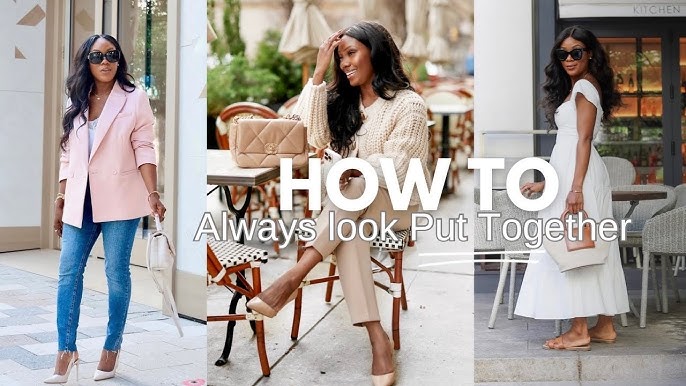
The definitive guide to making simple pieces look deliberate, elegant, and unmistakably yours — every single day of the week.
There’s a question I get asked more than any other, and it doesn’t come from where you might expect. It doesn’t come from women who don’t care about fashion. It comes from women who care deeply — women who follow all the right accounts, who save hundreds of pins, who know every trend and every aesthetic by name — and who still stand in front of a full wardrobe every morning feeling, somehow, like they have nothing to wear. The question, always phrased with a slight edge of genuine frustration, is this: “How do I make basics look like an actual outfit? How do I not just look… dressed?”
I’ve thought about this question for years. Not in a vague, hand-wavy way, but with the specific, slightly obsessive attention that I tend to bring to most things involving clothes. Because the truth is, I spent a long time on the wrong side of that question myself. My wardrobe was full — genuinely full, embarrassingly full — and I spent more mornings than I care to count pulling things out, trying them on, deciding nothing worked, and ending up in a version of the same slightly-uninspired outfit I’d worn the day before. It wasn’t a great feeling. Especially for someone who thought of herself as a person who cared about style.
What changed things for me wasn’t buying more. It wasn’t a wardrobe overhaul or a capsule wardrobe challenge or any of the other solutions the internet tends to suggest. What changed things was a shift in how I thought about basics — what they actually are, what they’re capable of, and the very specific, learnable techniques that separate a woman who looks polished in a white tee and trousers from a woman who looks like she just grabbed whatever was clean. Because those techniques are real. They are concrete. And once you know them, you cannot unknow them.
This is what this article is about. Not trends, not it-pieces, not the fifteen things you apparently need to buy right now. This is about the art of styling what you already have — or what you should thoughtfully acquire — so that every time you leave the house, you look and feel genuinely, effortlessly put together. Even on the Tuesdays when everything feels hard.
· · ·
First, Let’s Redefine What a “Basic” Actually Is
I want to address something important before we go any further, because I think the word “basic” carries a lot of baggage that doesn’t serve us well. In fashion circles — and especially in the kind of hyper-curated social media spaces where aesthetics are everything — “basic” has become something almost dismissive. A basic outfit. A basic wardrobe. The implication being: uncreative, generic, forgettable.
That is completely wrong, and I’d like to respectfully retire that usage. When I talk about basics in the context of this guide, I mean something very specific: a piece of clothing whose design is simple enough that it can function as a neutral building block within any outfit. A basic is not a mediocre piece. It is not a boring piece. It is a structurally versatile piece that, by virtue of its simplicity, has the capacity to be elevated, transformed, and made endlessly interesting by what surrounds it — by how it’s cut, how it’s proportioned, what it’s paired with, and how the entire combination is worn.
Think about it this way: a white shirt is a basic. A camel coat is a basic. A pair of perfectly fitted straight-leg trousers is a basic. None of those things are boring. In the right hands, they are among the most powerful and sophisticated garments in existence. The French have understood this for generations. The women who embody quiet luxury understand it now. The point of a basic is not that it disappears — it’s that it gives you a clean, beautiful surface on which to build something genuinely stylish.
“The most stylish women I know don’t have more interesting wardrobes than everyone else. They have a more intentional relationship with simpler pieces.”
So the first mental shift — and it’s the most important one — is to stop thinking of your basics as the parts of your wardrobe you put on when you’ve given up, and start thinking of them as the foundation of every look that makes you feel genuinely yourself. The canvas, not the afterthought.
The Non-Negotiable Basics: What Actually Belongs in an Elegant Wardrobe
Before we talk about how to style basics, we need to agree on which ones we’re actually talking about. Because not all basics are created equal, and one of the most common mistakes I see women make is investing energy in styling pieces that were never going to work from the outset — because the quality isn’t there, the fit is off, or the piece itself doesn’t belong in an elegant wardrobe at all.
Here are the basics that I consider genuinely foundational for the kind of effortlessly chic, put-together look we’re going for. Not an exhaustive list — your specific lifestyle will add and remove things — but these are the non-negotiables.
The White Shirt or Blouse
This is the piece that has earned its reputation as a wardrobe essential more thoroughly than perhaps anything else in fashion history, and it has done so because it genuinely deserves it. A good white shirt is staggering in its versatility. Tucked into wide-leg trousers, it’s polished. Left hanging loose over straight-leg jeans, it’s relaxed-chic. Half-tucked into a midi skirt, it has that particular undone elegance the French do so well. Worn open over a simple tank as a light layer, it creates effortless dimension. The key words here are “good white shirt” — not just any white shirt. The fabric matters enormously. You want something with weight and structure: a crisp cotton poplin, a soft Oxford cloth, a slightly sheer voile for warmer months. Not thin, not stiff — substantial. And the fit should be slightly generous, not oversized to the point of shapelessness, but with enough room to feel relaxed and intentional rather than fitted for its own sake.
The Perfect Trouser
I’ve talked elsewhere about the transformative power of a great trouser, and I’ll say it again here because it cannot be overstated. The right trouser — wide-leg or straight-cut, in a neutral, natural fabric — is the single piece most likely to make any outfit look intentional. The silhouette doing most of the work in 2026 is still the slightly high-waisted, wide-leg trouser in cream, ivory, warm grey, camel, or black. Worn with literally anything — a simple tee, a relaxed knit, a silk blouse, even a casual shirt — it immediately elevates the combination. The rules for trouser success: correct waist placement (sits naturally at or just above your natural waist), a hem that grazes the top of your shoe, and a fabric with enough weight to hang properly. Thin, limp fabric in a trouser is the enemy. Weight is the friend.
The Fine-Knit in a Neutral
The ribbed tank, the lightweight turtleneck, the simple fine-gauge crewneck — these are the knit basics that do quiet, essential work in every elegant wardrobe. They’re not sweaters as such; they’re more structural than that. The fine-knit creates a clean, slightly fitted layer that reads as more deliberate than a regular cotton tee without demanding much attention at all. In ivory, oatmeal, warm cream, or warm brown, it becomes one of the most versatile pieces you own. The moment I discovered the fine-ribbed tank as a proper wardrobe anchor — not just a layer to throw under things, but a deliberate first choice — my outfits became measurably more coherent.
The Midi Skirt
Not every wardrobe calls for a midi skirt, but for the kind of feminine, elegant aesthetic we’re working within, it is a profoundly useful basic. The key is in the silhouette and fabric: a slightly flared or A-line cut in a fabric with movement — silk, satin, bias-cut crepe, fine cotton — in a neutral or very muted tone. Ivory, champagne, warm cream, soft grey, dusty rose. The midi skirt is one of those pieces that makes an immediate aesthetic statement simply by existing, which means you need very little else. A simple knit tank and the midi skirt and a good flat is a complete, genuinely beautiful outfit. This is the economy of elegant dressing: one piece carries the look; the rest supports it quietly.
The Straight-Leg Jean
Within the broader elegant wardrobe, jeans can absolutely belong — but the way they’re integrated matters enormously. The silhouette that works best with an intentionally chic, polished aesthetic is the straight leg: not the skinny, not the wide-leg (that tends to read more casual), not the distressed, but the clean, dark or medium-wash, straight-cut jean that behaves almost like a trouser when paired thoughtfully. Dark indigo or a clean medium wash, no or minimal distressing, a length that works with both flat shoes and low boots. These are the jeans that earn their place in an elegant wardrobe.
The Real Reason Basics Look Boring (And How to Fix It)
Here’s the part most style guides skip over, and it’s the most important part of this whole conversation. There is a specific, diagnosable reason that basics look boring on most people, and it is not a lack of interesting pieces. It is a failure of what I’d call outfit architecture — the way the component parts of an outfit relate to each other in terms of proportion, texture, weight, and finish.
Let me explain with an example. Take a woman wearing straight-leg jeans, a white tee, and white sneakers. Now take another woman wearing the exact same combination. The first looks like she got dressed in two minutes without thinking. The second looks like she stepped out of an editorial. The jeans are the same. The tee is the same. The sneakers might even be the same brand. So what’s the difference?
It’s almost always a combination of five things: fit, proportion, texture play, the finishing detail, and how the outfit is actually worn. And here’s the beautiful part: none of these require you to buy anything. They require you to think differently about what you already have. Let me walk through each one.
Fit: The Thing That Changes Everything
I know everyone says this, and I know it can feel like received wisdom at this point — but it continues to be true precisely because it continues to be widely ignored. Fit is the single most powerful determinant of whether any piece of clothing looks expensive, intentional, and chic, or whether it looks like something you grabbed because it was there. And I am not talking about fitted in the sense of tight. I am talking about correct — in the specific sense that the piece sits on your body where it is designed to sit, moves with you where it is designed to move, and doesn’t do anything strange, boxy, droopy, or awkward anywhere.
The women who always look put together in basics are, almost without exception, wearing clothes that fit them correctly. This is sometimes a matter of buying the right size. But it’s more often a matter of tailoring — a word that sounds expensive and intimidating but is often neither. Taking a blazer in at the waist. Hemming trousers to the right length. Having a shirt taken in slightly at the sides. These alterations cost between ten and forty pounds in most cities and transform a piece entirely. A thirty-euro basic that fits perfectly will always look better than a three-hundred-euro investment piece that doesn’t.
“Fit is not about how the clothes conform to your body. It’s about how they move with it. There’s a meaningful difference, and your eye knows it immediately.”
Proportion: The Invisible Hand Behind Every Great Outfit
If fit is the foundation of a great outfit, proportion is the architecture. And within the world of basic pieces specifically, proportion is the technique that most reliably separates an outfit that looks like a combination of separate garments from one that looks like a considered, cohesive whole.
The basic principle — and it is genuinely simple once you see it — is this: within any outfit, there should be a deliberate relationship between volume and structure. Specifically, one looser or more voluminous piece should be balanced by one more fitted or structured piece. Wide-leg trousers with a slim, close-fitting knit. An oversized shirt with a neatly fitted trouser. A roomy, relaxed blazer with a simple fitted tank. A billowy midi skirt with a tucked-in ribbed top. This push and pull between volume and structure is what creates the visual interest and balance that makes an outfit look intentional rather than haphazard.
The mistake most women make with basics is creating what I think of as “same-energy” outfits — everything either fitted or everything relaxed, everything the same basic volume and weight. These outfits don’t fail exactly, but they also don’t sing. They read as dressed, not styled. The moment you introduce a deliberate contrast in proportion, everything becomes more dynamic, more interesting, and more elegant.
Texture: The Secret Layer of Sophistication
This is possibly the most underused technique in the basics-styling toolkit, and it’s the one I reach for most often when I want an outfit to feel special without adding anything complicated. Texture play — the deliberate combination of different fabric surfaces within a single outfit — adds a dimension of sensory richness that elevates simple pieces considerably. It’s the reason an all-cream outfit in cashmere, silk, and linen looks like a thousand pounds, while the same color combination in polyester blends looks flat and forgettable.
The combinations that work particularly well within an elegant, neutral palette: the subtle sheen of a satin midi skirt against the matte, ribbed texture of a fine knit top. The rough-smooth contrast of a slightly nubby linen jacket over a smooth silk camisole. The soft pile of a cashmere knit against the clean structure of a well-pressed cotton trouser. The leather of a bag or shoe against the softness of a wool coat. You’re not trying to create contrast for the sake of drama — you’re layering sensory richness that the eye reads as complexity and intentionality, even if no single piece is particularly special on its own.
The Texture Pairing Guide for Elegant Basics
Matte + Sheen: A ribbed merino knit with a satin skirt. A cotton tee with a silky, fluid trouser. The contrast is subtle but reads as unmistakably polished. The sheen elevates the matte; the matte grounds the sheen.
Soft + Structured: A cashmere top with a sharply pressed linen trouser. The soft and the structured in the same tonal palette creates an elegant tension that feels very contemporary.
Smooth + Textured: A simple smooth blouse with a slightly bouclé or nubby jacket. Or a smooth leather bag against a chunky-knit outfit. The textured piece adds visual interest; the smooth piece adds refinement.
Draped + Stiff: A fluid, draped skirt with a crisp white shirt. The drape and the structure balance each other in a way that looks deliberately considered, even though the pieces themselves are completely basic.
The Finishing Detail: Small Things, Large Impact
This is the element that I think about as the outfit’s punctuation. An outfit without a finishing detail is a sentence without an ending — it just trails off. The finishing detail is the element that closes the loop, that signals to the eye: this is intentional. I thought about this. I made choices.
Finishing details are almost never dramatic. They’re small and specific. It might be the way a shirt is tucked — fully, half, or in a French tuck where just the front hem is loosely tucked and the rest is left out. It might be a single piece of jewelry: a fine gold chain, a small sculptural ring, an interesting earring that adds just enough personality to lift the neutrality of everything else. It might be a scarf — tied loosely around the neck, folded softly in a bag handle, knotted into a belt loop. It might be the choice of bag: not necessarily expensive, but the right shape and proportion for the outfit. And it might be the shoes — the specific choice that makes the outfit feel modern and real rather than simply correct.
None of these things are complicated. All of them require a moment of intention — a pause before you leave the house to ask: what does this outfit need? What would make it feel complete? That pause, applied consistently, is the single most powerful habit a well-dressed woman can have. Because most outfits are not undone by bad pieces. They’re undone by the absence of a final thought.
· · ·
The Techniques That Make Basics Look Expensive
Beyond the foundational principles of fit, proportion, texture, and finishing, there are specific styling techniques that, applied to basic pieces, reliably produce results that look far more expensive and deliberate than the pieces themselves. These are the moves I return to again and again — the ones I see on every woman whose style I’ve ever genuinely admired.
The Art of the Tuck
We touched on this in the finishing detail section, but it deserves its own moment because it is genuinely one of the most transformative and most underestimated techniques in everyday dressing. The way you tuck — or don’t tuck — a shirt or top changes the entire proportional story of an outfit.
The full tuck, with a shirt or blouse completely tucked into the waistband of a trouser or skirt, creates a clean, polished, put-together silhouette that reads as intentional and structured. It works brilliantly with wide-leg trousers and high-waisted skirts, particularly when the tucked piece is slightly oversize — the slight bunching at the waist adds softness and stops the whole thing from looking too stiff.
The French tuck — that specific move popularized partly by stylists and partly by a generation of women who understood instinctively that the front-in, back-out tuck creates a beautifully casual elegance — is the one I use most often. It establishes a waistline without the fullness of a full tuck, and it has a particularly effective relationship with wide-leg trousers: the slight definition at the front allows the trouser to read as its best self, while the relaxed back maintains the easy, unconstructed energy that makes the whole look feel modern and lived-in.
The no-tuck with deliberate drape is the third option, and it’s the most nuanced. An oversized shirt or knit left fully untucked only looks intentional — rather than like you forgot to tuck it in — when the silhouette of the piece itself is interesting enough to stand on its own. A great oversized shirt in a beautiful fabric, left long and layered over fitted trousers or tucked-in only enough to suggest a waist, can look extraordinary. The key is in the fabric and the proportions: the piece needs to hang, not hug.
The Rolled Sleeve
This sounds laughably simple. I promise you it is not. The sleeve roll — specifically on a shirt or blouse, specifically done to a particular length and in a particular way — is one of those tiny, high-impact finishing moves that quietly signals “I know what I’m doing” in the same way that a well-placed scarf or a perfect shoe does. A single, clean, slightly below-elbow roll on a white shirt sleeve does something to the whole outfit that is genuinely difficult to explain but completely obvious when you see it. It creates a sense of ease and casualness that is paradoxically quite deliberate. It suggests a woman who is comfortable, unencumbered, and who has better things to think about than whether her sleeves are exactly right — and who therefore looks effortlessly stylish. Do not underestimate the sleeve roll.
The Collar Moment
Within the 2026 fashion landscape, the collar has re-emerged as one of the most interesting styling opportunities in the basic wardrobe. Whether it’s the open collar of a loosely buttoned shirt, the popped collar of an oversized jacket or coat, or the layered collar of a shirt worn under a fine knit — the way collars are handled in an outfit contributes enormously to its overall energy and intentionality. An open collar, three or four buttons undone on a white shirt, with the collar laid flat and slightly spread, communicates ease and confidence. A shirt collar layered over the neck of a knit adds that particular Parisian layering energy that has been on every mood board for the past several years and shows no sign of going anywhere. And a slightly popped collar on a lightweight jacket or trench creates a kind of studied insouciance that is very current and very effective.
The Monochrome Effect
One of the most reliably beautiful and effortlessly chic techniques for styling basics is the one-tone or closely tonal outfit — where every piece in the look is in the same color family, differentiated only by shade and texture. This works extraordinarily well within the warm neutral palette that defines the elegant basics aesthetic: all cream in different weights and fabrics; all camel from ivory at one end to deep tan at the other; all warm grey with different textural expressions. The effect is sophisticated, slightly fashion-forward, and — here’s the practical beauty of it — completely easy. When everything matches in tone, there is no wrong combination. You cannot get it wrong. The outfit makes decisions for you.
The reason the tonal approach looks so expensive is that it forces the eye to focus on texture, silhouette, and quality rather than color contrast or pattern. When there’s nothing bright or clashing to look at, the quality of the fabric, the elegance of the cut, and the thoughtfulness of the proportions become the whole story. Which means that a tonal cream outfit in genuinely beautiful fabrics looks extraordinary, while the same combination in cheap synthetics looks merely beige. The technique rewards quality. Another reason to invest carefully and buy less.
Coffee & errands
The Effortless Morning Look
Ivory fine-knit tank, wide-leg linen trousers in warm cream, leather loafers, tan top-handle bag. One thin gold chain. Hair in a low twist. Nothing complicated; everything chosen.
Work & meetings
The Polished-Relaxed Edit
Clean white shirt (French-tucked), straight-leg dark jean, a structured caramel blazer, pointed leather mule. Small sculptural earring. Rolled sleeves. The jean reads as trouser here, not denim.
Lunch & city days
The Silk Midi Moment
Soft ivory satin midi skirt, ribbed merino turtleneck in oatmeal, white leather sneaker, small rectangular bag. Everything in the same warm cream family. Feels intentional without trying.
Evening & dinner
The Elevated Simple
Wide-leg black trouser, silk or satin camisole in champagne, longline cardigan in warm ivory. Ballet flat in soft leather. The camisole’s sheen against the cardigan’s softness does all the work.
How to Build Outfits Like a Stylist: The Three-Layer Method
I want to give you a concrete, repeatable framework for building outfits from basics — because the women who always look put together are not spontaneously generating great looks from scratch each morning. They have a process. It might be instinctive for them now, embedded through years of practice, but it is a learnable, teachable method. I call it the three-layer method, and once you start using it, outfit building becomes considerably less stressful and considerably more satisfying.
01
The Foundation: Your Dominant Piece
Every great outfit starts with one dominant piece — the piece that sets the tonal, textural, and proportional tone for everything else. This is usually your trouser or skirt (the bottom) if it’s a strong silhouette, or your outer layer (the jacket or coat) if it’s particularly distinctive. Everything else builds from here. Ask yourself: what is the most interesting or intentional piece in this outfit? That’s your foundation. Start there and let everything else respond to it.
02
The Support Layer: What Completes the Silhouette
The support layer is whatever you add to complete the silhouette around your dominant piece. If your dominant piece is a wide-leg trouser, the support layer is the top you wear with it — which should be fitted enough to balance the volume of the trouser. If your dominant piece is a bold outer layer, the support is the outfit beneath — which should be relatively simple and tonal, letting the outer layer do its work. The support layer should never compete with the dominant piece for attention. Its job is to make the dominant piece look better.
03
The Finish: Shoes, Bag, and the One Detail
The finish is where the outfit becomes personal. Shoes and bag should generally stay within the same color temperature as the outfit — warm neutrals with warm neutrals, cool tones with cool tones — though a deliberately unexpected choice here can be the most interesting element of the whole look. Then: the one detail. One piece of jewelry, or one small styling move (the tuck, the collar, the sleeve roll), that signals intention. Not two details, not three. One. The edit is the elegance.
The Role of Color: Why Neutrals Are Not Boring
I want to spend a moment defending the neutral palette, because I know that for some women — especially those who grew up loving color and pattern and have felt the elegant basics aesthetic as a kind of restriction rather than a liberation — the commitment to a warm, muted color story can feel like giving something up. I understand that feeling. And I want to offer a different way of thinking about it.
The neutral palette of elegant basics is not boring. It is not the absence of color. It is a very specific, very deliberate color story that happens to be extraordinarily flattering, extraordinarily versatile, and extraordinarily rich when executed in quality fabrics. Ivory is not just white. It is the color of good paper and old silk and fresh cream. Camel is not just beige. It is the color of warm sand in afternoon light and aged leather and the inside of a croissant. Warm grey is not just grey. It is the color of winter clouds over Paris and the patina of old cobblestones and the inside of an oyster shell.
These are beautiful colors. Complex colors. Colors that change throughout the day as the light changes, that develop character as fabrics age and soften. And the reason they work so well in the elegant basics wardrobe is precisely because they are not shouting for attention. They create a visual language of quiet coherence, where the quality of the fabric, the elegance of the silhouette, and the thoughtfulness of the styling become the whole conversation. The neutrals are not the background. They are the subject.
That said, accent color absolutely has a role within this palette — it just plays a different role than it does in a more maximalist wardrobe. Within an elegant basics wardrobe, an accent color is not a focal point. It’s a warmth, a personality note, a breath of something personal within the overall composition. Dusty rose as a shoe. Soft sage as a knit. A warm cognac bag against a cream outfit. These accents do not shout. They whisper. And because everything else is quiet around them, that whisper is clearly heard.
The Beauty Dimension: Looking Put Together Beyond the Clothes
A truly put-together look is not just about what you’re wearing. It’s about the whole picture — and within that picture, the face and the way you carry yourself are at least as important as the outfit. This is something that the most stylish women understand deeply: that you can be wearing the most beautiful basics in the world and still not look fully assembled if your skin is dull, your hair is rushed, and your posture is telling a different story than your clothes.
The beauty approach that I believe complements the elegant basics aesthetic most authentically is the one that has been gradually crystallizing under various labels — clean girl, soft glam, skin-first — into a clear, coherent philosophy. And the philosophy is this: the goal is not to look made up. The goal is to look cared for. There is a meaningful difference. Made up implies transformation, artifice, a face that is a project. Cared for implies health, intention, a face that has been thought about and tended to with respect.
In practice, this means: serious skincare as the foundation of everything else. A good daily ritual — cleanser, a vitamin C or active serum, moisturiser, SPF — that over time produces the kind of skin that needs minimal makeup to look beautiful. A light-to-medium coverage base that evens and illuminates without masking. Blush — cream blush, particularly, in a peach-rose or warm berry, applied to the apples of the cheeks and swept upward — is the single product I would save if forced to keep only one, because nothing else in the beauty toolkit adds the same quality of healthy, lit-from-within warmth in a single step. A clean brow, mascara in brown-black rather than harsh black for a softer result, and a lip product that enhances rather than transforms — a tinted balm, a satin nude, a barely-there gloss. That’s the whole look. Twenty minutes that look effortless because they’re designed to.
“The most beautiful makeup is the kind that makes people think you’re not wearing any — and then wonder why you look so good.”
For hair: the elegant basics aesthetic tends toward styles that have that same quality of deliberate ease that we’re pursuing in the clothes. The low bun with a few pieces escaping at the temples. The simple middle part with clean, smooth hair falling loose. The half-up with a tortoiseshell clip. The low chignon held with something beautiful — a small bow, a silk scarf, an interesting pin. None of these styles require hours at a salon. All of them require a moment of care — a brush-through, a little smoothing, a deliberate choice. That moment is what separates hair that looks accidentally messy from hair that looks intentionally relaxed.
Accessories: The Edit That Makes or Breaks the Basics
I want to talk about accessories at some length here because they are, within the elegant basics framework, doing more work than they might appear to. When the clothes are simple — and deliberately so — the accessories are not decoration. They are the styling. The bag, the shoes, the jewelry, the scarf: these are the elements that take a well-fitted, beautifully proportioned basics outfit from “well dressed” to “memorably chic.” And the wrong accessories can unravel an otherwise excellent look in a single choice.
The principle I apply to accessories within this aesthetic is the same principle I apply to editing generally: less, and better. The tendency when dressing in basics is to compensate for the simplicity of the clothes by piling on accessories — multiple jewelry pieces, a statement bag, interesting shoes all at once. The result is almost always too busy, and it works against the quiet elegance that makes the aesthetic so compelling. The edit is the elegance. Choose one element to carry the accessory weight of the look, and let everything else play a supporting role.
Jewelry: The One Rule
One piece that does something, and everything else that supports it quietly. That’s the rule. If you’re wearing a beautiful sculptural earring, the necklace should be delicate or absent. If you’re wearing a stack of fine rings, the earrings should be small. If you’re wearing a significant necklace, no other jewelry is needed. This is not about minimalism for its own sake — it’s about allowing each chosen piece to be seen and appreciated. Within an elegant basics wardrobe, jewelry should feel like the most personal element of the look: the place where your specific taste and personality come through most clearly. Give it the space it deserves to be noticed.
The metals that align most naturally with the warm neutral palette: gold, whether yellow gold or the slightly more contemporary warm rose gold, works beautifully with ivory, cream, camel, and blush tones. Silver reads cooler and is slightly harder to place within the warmest versions of this palette — though it can be extraordinary with cool whites and greige. And the increasing prevalence of mixed-metal and oxidized pieces gives considerable flexibility for those who love a less conventional jewelry aesthetic.
Shoes: The Choice That Dates or Elevates
Within an elegant basics outfit, the shoe is often the most visually decisive element — the detail that either makes the whole thing feel contemporary and intentional, or that dates it and grounds it in a less interesting time. The shoe choices that are most consistent with the elegant basics aesthetic in 2026: the leather loafer (in cognac, black, tan, or ivory, with or without a slight platform), the pointed ballet flat in soft leather or satin, the clean leather sneaker in white or ivory, the ankle boot or knee-high boot in a low stack heel and warm leather tone, and the simple leather slide or mule for warmer months.
What connects all of these: they are recognizably quality in their material and construction; they are proportionally considered in relation to what’s being worn above them; and they feel contemporary without being trend-specific enough to date quickly. The loafer and the ballet flat, in particular, feel as though they belong to no specific era — they exist in a kind of stylistic timelessness that the elegant basics aesthetic aspires to in everything.
The Bag as Architectural Detail
Within a neutral, basics-led outfit, the bag is the element I think of as the architectural detail — the piece that adds visual structure, weight, and interest to the overall composition in a way that jewelry and shoes, for all their importance, cannot quite achieve. The shape of the bag, the way it’s held or carried, and the way it relates proportionally to the outfit are all considerations worth taking seriously.
The shapes that work most consistently within this aesthetic: the structured top-handle bag that sits like a small architectural object and communicates unmistakable quality; the slightly slouchy, unstructured hobo or bucket in a beautiful soft leather for days when the outfit is more relaxed; the boxy, sculptural shoulder bag that has become one of the defining bag shapes of the mid-2020s; and the elegant tote in a quality leather or waxed canvas for days that require genuine practicality without sacrificing style. What you’re looking for in all of these is the same thing you’re looking for in the clothes: quality of material, considered proportion, and a design that is interesting without being trendy.
· · ·
Morning Routines and the Psychology of Getting Dressed Well
There’s a dimension to this that goes beyond technique, and I’d feel dishonest not addressing it — because looking put together consistently, day after day, is not just a function of having the right pieces and knowing the right styling moves. It’s a function of how you approach the act of getting dressed in the first place.
Most women who struggle to look put together are not lacking knowledge. They’re lacking the morning conditions in which good dressing decisions can be made. They’re rushed. Their wardrobe is disorganized or overfull. They’re making decisions on zero creative bandwidth at 7am after five hours of sleep and before coffee. And they’re attempting to build outfits from scratch every single morning, which is — even for people who love fashion — a genuinely hard thing to do well under those conditions.
The women who consistently look put together have, consciously or not, built systems that remove decision-making friction from the morning routine. They know what works in their wardrobe because they’ve tried combinations before and edited out the things that don’t. They have a general sense of several reliable outfit formulas — specific combinations they return to, riff on, and trust. They’ve thought about the week’s schedule on Sunday evening and considered what they’ll need. And they’ve organized their wardrobe so that what they want is easy to find, clearly visible, and accessible in the two minutes they have to make a decision.
None of this is glamorous. All of it is profoundly effective. The fantasy of effortless style — the idea that the most beautiful woman you’ve ever seen dressed that way spontaneously, without thought or system — is just that: a fantasy. Behind effortless style is always the presence of enough prior thought that the decision feels effortless in the moment. The effort has already happened. You just don’t see it.
How Social Media and the 2026 Aesthetic Conversation Changed the Way We Think About Basics
It’s worth acknowledging explicitly how much the broader fashion conversation — and specifically the way it plays out across Pinterest, Instagram, and TikTok — has shaped the renewed appreciation for basics and the elegant, careful approach to dressing that this guide is built around. Because I think there’s something genuinely interesting happening right now in the collective visual imagination of style-conscious women, and it goes deeper than any single trend.
The quiet luxury movement that gained such momentum a few years ago has not, as some predicted, faded away. It has evolved. It has grown up, deepened, and broadened into something more encompassing — less about the specific signifiers of old-money dressing and more about the underlying values that quiet luxury represented: quality over quantity, longevity over novelty, a sense of personal style that is independent of the trend cycle. The women who have most fully absorbed these values are now building wardrobes that feel genuinely personal, genuinely edited, and genuinely timeless — and at the center of those wardrobes are, almost always, beautifully chosen basics.
Pinterest, in particular, has played a fascinating role in the revival of interest in elegant, carefully styled simple dressing. The platform’s visual format — the curated board, the mood, the aesthetic coherence — creates a kind of template for the kind of wardrobe thinking we’ve been discussing throughout this article. When you save a hundred images of women who look effortlessly chic in neutral basics, you begin to absorb, almost unconsciously, the specific visual grammar that produces those results: the proportions, the textures, the finishing details, the particular quality of ease-with-intention. Pinterest is, in this sense, one of the best styling education tools available — not because it tells you what to buy, but because it teaches your eye what to see.
TikTok’s contribution has been slightly different: a democratization of the styling conversation that has made the techniques and principles of elegant dressing feel accessible rather than aspirational in an alienating way. The “what I wear in a week” format, the styling tutorial, the outfit formula video — all of these have normalized the idea that dressing well is a learnable skill rather than an innate gift. That it can be broken down, analyzed, and taught. This guide is, in some ways, an extension of that spirit: the conviction that every woman can learn to look genuinely, consistently put together, regardless of where she’s starting from.
The Long Game: Building a Wardrobe You Love for Years, Not Seasons
I want to close with something that I think is the most important and also the most liberating idea in this whole conversation. The approach to basics that we’ve been discussing is not a trend. It will not be irrelevant in two years. It is not going to require you to rebuild from scratch next autumn when the fashion cycle turns. It is, if you build it with care and intentionality, a wardrobe that gets better with time — that deepens, that refines, that becomes more you with every piece you add and every season you wear it.
This is the real promise of elegant basics dressing: not that you’ll look fashionable, but that you’ll look stylish. Not that you’ll be current, but that you’ll be yourself. And the difference between those two things is enormous. Fashion is external — it’s what the industry and the algorithm decide matters this season. Style is internal — it’s what you’ve decided matters to you, full stop, independent of what anyone else is doing.
Building toward style rather than fashion means making different decisions. It means asking different questions at the point of purchase. Not “is this trending?” but “will I want this in three years?” Not “does this look interesting?” but “does this fit correctly and make me feel good?” Not “is this affordable?” but “is this worth the price I’m paying for what I’m getting?” These questions feel harder than they are, because they require you to know yourself — to have a clear enough sense of who you are and what you value aesthetically to evaluate a piece on its own terms rather than against external validation.
But here’s the beautiful thing: the more you practice this kind of intentional dressing, the clearer your own aesthetic voice becomes. Each well-considered purchase reinforces your sense of what works and what doesn’t. Each morning spent building an outfit from reliable basics deepens your intuitive understanding of proportion, texture, and finish. Each look that makes you feel genuinely good as you walk out the door strengthens your trust in your own eye. It is a virtuous cycle. And it starts, every time, with the basics.
“You don’t need more clothes. You need a better relationship with the ones you already have.”
That’s the whole thing, really. That is what this article has been working toward, and what the most elegantly dressed women I know have understood for years. The secret to always looking put together is not more — more pieces, more trends, more spending, more variety. It’s more intention, more knowledge, more care, and more trust in the quiet, powerful beauty of simplicity, done well.
You already have most of what you need. Now you know what to do with it.
· · ·
A Final Note: The Outfit That Will Never Let You Down
Because I always find it grounding to end in the specific, here is the outfit I reach for when I need to look genuinely, unambiguously put together with minimum effort and maximum confidence. It has never once failed me in three years of regular deployment. I offer it not as a prescription but as an example of everything this guide has been trying to say:
Wide-leg trousers in ivory or warm cream. A fine-gauge ribbed knit in the same family — slightly more textured, slightly more matte than the trousers. The front hem of the knit French-tucked into the waistband; the rest left loose. Leather loafers in cognac or tan. A small top-handle bag in a warm leather. One pair of small gold hoop earrings. A coat thrown over the shoulders if the weather demands it — camel, belted loosely. Hair low and slightly undone. Skin clean and luminous; cream blush high on the cheekbones. That’s it.
It takes eight minutes to assemble. It looks like it took twenty. It photographs beautifully, it sits comfortably, it moves well, and it photographs beautifully in any light. Every piece in it is a basic. The whole thing is quietly, irreducibly elegant. And that — exactly that — is what we’re after.
Veloria Femme
Wardrobe editor, chronic over-thinker about proportion and fabric, and deeply committed to the idea that dressing well is one of the smaller, more accessible forms of joy. Based in London. Currently wearing ivory trousers and a very good knit.