
Elegant Women Streetwear · Fitness & Lifestyle · 2026 Edition
By The Editorial Team at Elegant Streetwear
I want to tell you about a Tuesday morning that changed things for me. It was early — embarrassingly early, the kind of early that feels almost aggressive — and I was standing in my kitchen in my pyjamas, holding a coffee that was still too hot to drink, looking at my phone. Somewhere between checking my messages and idly scrolling, I landed on a video of a woman doing the most beautiful, controlled series of movements in what appeared to be her living room. No gym equipment. No athletic facility in the background. Just her, a clear patch of floor, morning light coming through a window, and this extraordinary physical capability that seemed to coexist perfectly with her absolutely impeccable style.
I watched it four times. Then I put down my coffee and tried to do something — anything — and discovered, not for the first time in my life, that the gap between watching someone do something beautifully and actually being able to do it yourself is a humbling and occasionally hilarious place to live.
That Tuesday morning was about a year ago. What happened in the months since — the gradual, non-linear, sometimes frustrating and frequently rewarding process of building a genuine home workout practice from absolutely nothing — is what I want to share with you today. Not a before-and-after transformation story, because I’ve always been suspicious of those. But a real, detailed, honest guide to working out at home without equipment that was written from lived experience rather than assembled from fitness industry talking points.
What I’ve found, and what I think you’ll find too, is that working out without equipment is not a lesser version of ‘real’ exercise. It’s not a consolation prize for women who can’t afford a gym or don’t have time for one. Done correctly, with intention and intelligence, bodyweight training is extraordinarily effective — it builds strength, improves posture in ways that will change how you look in clothes, creates that particular lean, controlled physicality that you’ve probably seen on the women whose fitness content you follow, and does all of this without requiring you to leave your home or purchase a single piece of equipment.
But first, let’s talk about something nobody in the fitness industry wants to discuss: why getting started is so much harder than anyone admits, and what to do about it.
The Real Reason Starting Is Hard (And Why It Has Nothing to Do With Willpower)
The fitness industry has built an extraordinarily successful business on the premise that if you’re not working out, it’s because you lack motivation or discipline. Buy this programme. Find your why. Set your alarm. Post an accountability photo. And then, when that doesn’t work — when you buy the programme and follow it for eight days and then quietly abandon it — they’re ready with the next promise, the next product, the next angle on the same fundamental message: try harder.
I spent years believing this about myself. That I was someone who simply didn’t have the fitness gene, the self-discipline that other women seemed to possess effortlessly. I watched friends go running at six in the morning with what appeared to be genuine enthusiasm and felt a combination of admiration and bafflement. I signed up for gym memberships I didn’t use, downloaded apps I didn’t open, bought trainers I wore precisely once.
What I’ve come to understand is that the problem was almost never willpower. It was friction. The gym was twenty minutes away and required a bag and a shower and a commute. The class was at a fixed time that didn’t reliably work with my life. The programme required equipment I didn’t have or movements I didn’t know how to do. Every single one of these things sounds minor in isolation, and together they create a barrier that is, for most people most of the time, insurmountable.
Home workouts without equipment solve the friction problem almost completely. Your living room is never more than thirty seconds from wherever you are in your home. Your workout requires no bag, no commute, no parking, no waiting for equipment. You can do it in whatever you want to wear, at whatever time actually works for you, for whatever duration fits the day you’re actually having rather than the day you planned.
This sounds like I’m lowering the bar. I’m not. I’m making the bar reachable, which is an entirely different thing. A twenty-minute home workout that you actually do, consistently, three or four times a week for months — that will transform your body and your energy and your relationship with yourself in ways that the theoretical six-days-a-week gym programme that you never quite manage will not.
A twenty-minute workout you actually do is worth infinitely more than the perfect sixty-minute session you never quite get around to. Consistency is the only metric that matters.
Setting Up Your Space: Creating an Environment That Makes You Want to Move
Before we talk about exercises, I want to talk about space — because where you work out affects how you work out far more than most fitness content acknowledges.
I know, I know. The whole point of home workouts is that they don’t require any specific setup. You just roll out of bed and do them, right? Well, sort of. The reality is that your environment communicates something to you before you’ve done a single thing. A cluttered, dim corner of a room that doesn’t have enough space for you to fully extend your arms creates a very different emotional experience than a clear, bright area with a little bit of beauty in it.
You don’t need a dedicated home gym. You need approximately two metres by two metres of clear floor space — which most rooms have if you move a coffee table and push back the sofa slightly. What you can add that costs very little but changes everything is intentionality. Good lighting, which in practical terms means near a window if possible, or a lamp that you position to make the space feel warm and inviting rather than clinical. A small diffuser with something that makes you feel good — eucalyptus for energy, lavender if you’re working out in the evening, the kind of thing that has become deeply embedded in the wellness aesthetic that’s all over our collective visual culture right now for very good reason.
Your workout outfit matters more than people will tell you. There is something psychologically real about putting on actual workout clothes — even if they’re beautiful, even if they’re the kind of high-quality leggings and soft sports bra that are currently at the intersection of the clean girl aesthetic and genuine athletic function — that signals to your brain that this is what we’re doing now. The clothes are a ritual. Rituals, it turns out, are one of the most powerful tools we have for making behaviour consistent.
The current aesthetic for home workout wear is exactly where I want to live: neutral, quality, considered. Think earth-toned seamless leggings in a fabric that genuinely holds you in without being uncomfortable. A matching sports bra or a soft fitted crop top. Maybe a lightweight quarter-zip for the warm-up and cool-down. The kind of outfit that you’d be genuinely content to run a quick errand in after your session without feeling like you’re wearing gym clothes in public — because the line between athletic wear and elevated casual wear has genuinely dissolved in 2026, and the best pieces reflect that beautifully.
Put on music that makes you feel powerful and beautiful. This is perhaps the most underrated workout optimisation strategy available to us. There is a neurological reason why the right music makes physical effort feel easier, more pleasurable, more worth doing. Create a playlist that makes you feel like the most capable, attractive, energised version of yourself. Return to it every time you work out until it becomes associated, on a level beneath conscious thought, with the feeling of strength.
Understanding Your Body: What Bodyweight Training Actually Does and Why It Works
Let me talk briefly about the science — not in a textbook way, but in a way that will actually change how you think about what you’re doing and why.
Bodyweight training works through the same fundamental principle as every other form of strength training: progressive overload. You ask your muscles to do something slightly harder than they’re used to, they adapt, they get stronger. The difference with bodyweight training is that instead of adding weight to a barbell to increase difficulty, you change the angle, the tempo, the range of motion, the number of repetitions, or the complexity of the movement pattern.
This is actually a more sophisticated system than it might initially appear. A push-up, for instance, is not simply an exercise — it’s an entire progression of exercises, from a modified version on your knees through a standard push-up to an elevated feet push-up to a single-arm variation, each representing a significantly different challenge. Understanding this spectrum is what allows you to keep making progress over months and years without ever needing to add external weight.
What bodyweight training does to your body over consistent practice is this: it builds functional strength — the kind that improves how you move through your actual daily life, that makes carrying groceries easier, that has you standing taller and moving with more ease and grace. It improves your body composition in the direction most women are looking for: less fat, more lean muscle tissue, a more defined and controlled physical presence. It dramatically improves posture — perhaps the single change that has the most visible impact on how you look and carry yourself — because most bodyweight exercises engage the core and posterior chain muscles that are chronically underworked in women who sit for much of their day.
And it’s kind to your joints in a way that loaded exercise isn’t always. For women who’ve experienced knee discomfort running, or shoulder issues from gym machines, bodyweight training offers a way to build strength progressively without the compressive forces that can aggravate those issues.
The Hormonal Element Nobody Talks About Enough
For women specifically, the relationship between exercise and hormones is worth understanding — not because you need to become a biology expert, but because understanding it contextualises some of what you’ll experience and helps you work with your body rather than against it.
Our bodies are cyclical in a way that men’s bodies fundamentally are not, and our energy, strength, mood, and recovery capacity fluctuate across the month in patterns that, once you start paying attention to them, become genuinely useful information. Many women find that the first half of their cycle, from menstruation through ovulation, is when they feel strongest, most energetic, and most capable of pushing harder and recovering quickly. The second half often brings lower energy, more need for rest, and sometimes a genuine reduction in strength.
Working with this rather than fighting it — training harder in the first phase, prioritising gentler movement and recovery in the second — is not laziness. It’s intelligence. And it’s an approach that’s been gathering momentum in the wellness and fitness communities I respect most.
The Warm-Up: The Part Everyone Skips and Everyone Should Do
I’m going to be very direct about this: skipping the warm-up is how you get hurt, and getting hurt is the most efficient way to end your workout habit before it’s established. I know it’s tempting. The warm-up feels like bureaucracy. You just want to get to the actual exercise, especially if you only have twenty minutes and the warm-up is going to take five of them.
But the warm-up is not separate from the workout — it is the beginning of the workout. It’s the phase where you bring your body and your mind into the same place, where you elevate your body temperature, increase blood flow to the muscles you’re about to use, and prepare your joints for the ranges of motion they’re about to experience. Done properly, it genuinely changes the quality of every minute that follows.
A good home warm-up takes five to eight minutes and costs you nothing. Begin with thirty seconds of simply marching on the spot with high knees, getting your blood moving and your breathing slightly elevated. Follow that with slow, deliberate hip circles — hands on your hips, feet hip-width apart, drawing large circles with your pelvis in each direction. Your hips carry so much tension and so much habitual restriction from sitting, and this simple movement begins to open that up.
Add some shoulder rolls and arm circles to warm the upper body. Move into gentle spinal rotations — arms extended to the sides, rotating your torso left and right while keeping your hips still, feeling the articulation through each vertebra. Then some leg swings, holding onto something if you need to, swinging each leg forward and back and then side to side, warming the hip joint through its full range.
Finish with thirty seconds of easy jumping jacks or, if you’re in an apartment and jumping feels antisocial, step-touch side to side with big arm movements. By the end of this sequence, you should feel warm, slightly breathless, and ready. That’s the signal. That’s when you begin.
The Core Programme: Your Essential Eight Exercises
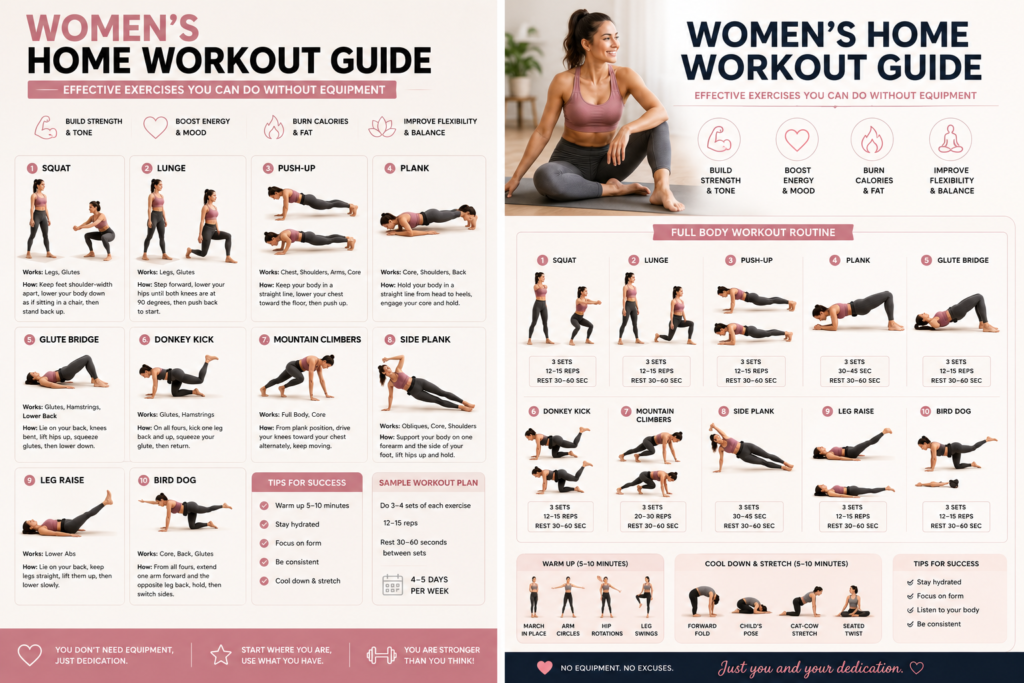
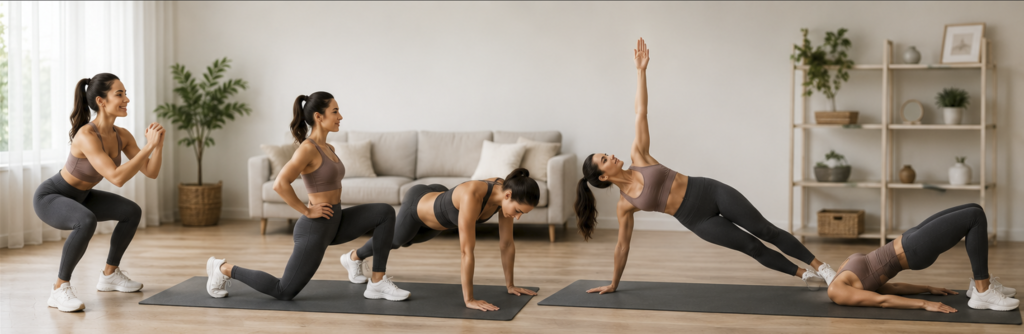
What follows is the foundation of a complete, effective home workout programme built entirely from bodyweight exercises. These eight movements, practised with genuine attention to form and progressed intelligently over time, are genuinely sufficient to transform your fitness. I’ve chosen them because together they cover every major muscle group, they’re accessible to most fitness levels with modifications, and they’re exercises you can continue to improve at for years.
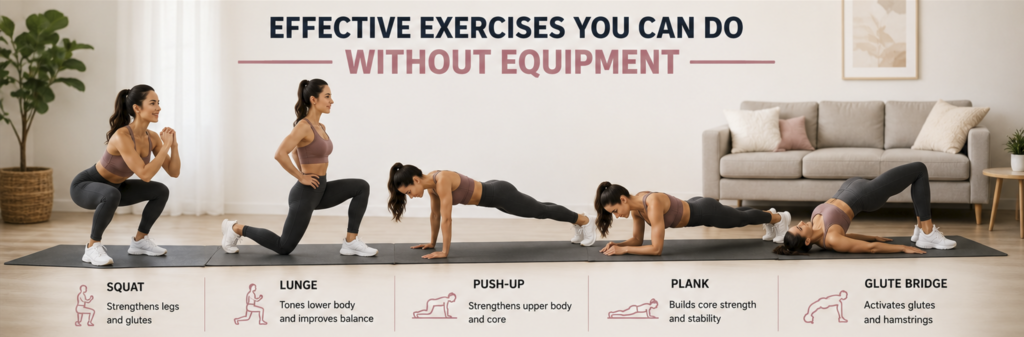
1. The Squat — Your Foundation Movement
If I had to nominate a single most important exercise for women, the squat would be a serious contender. It works the glutes, quads, hamstrings, and core simultaneously. It’s a pattern your body was designed for — sitting down and standing up is, at its essence, a squat — and strengthening it translates directly and immediately to how your body moves and looks.
Stand with your feet slightly wider than hip-width apart, toes turned out just slightly — about fifteen to thirty degrees, whatever feels natural for your hip structure. Keeping your chest lifted and your weight through your whole foot (not just your toes), hinge at the hips and bend your knees, lowering yourself as if sitting back into a chair that’s just slightly behind you. The depth you reach will depend on your current mobility, and that’s completely fine — go as deep as you can while keeping your heels on the floor and your lower back from rounding.
Push through your feet to return to standing, squeezing your glutes at the top. That’s one repetition. Begin with three sets of twelve to fifteen, resting sixty to ninety seconds between sets.
The progression here is beautiful in its simplicity: once bodyweight squats feel straightforward, you can make them more challenging by adding a pulse at the bottom (holding the lowest position and doing small up-down movements), by slowing the descent dramatically (a four-second lowering phase creates significantly more work for the muscle), by adding a jump at the top for cardiovascular intensity, or eventually by progressing toward single-leg variations like the Bulgarian split squat.
2. The Push-Up — For Strength That Shows
The push-up is one of the most misunderstood exercises in women’s fitness. It’s frequently treated as something to aspire to eventually, something for the advanced class, a goal rather than a starting point. And this framing has discouraged enormous numbers of women from doing one of the best upper body exercises available to them.
The modified push-up — performed with knees on the floor — is not a lesser version of a push-up. It’s the same movement pattern, working the same muscles, providing the same quality of training stimulus. It’s where most people, regardless of gender, should begin. There is no shame in it. There is only the intelligent practice of meeting your body where it is.
For a modified push-up: begin in a kneeling position, hands slightly wider than shoulder-width, fingers pointing forward or very slightly outward. Your body should form a straight line from your knees to your crown — don’t let your hips pike upward or your lower back sag. Lower your chest toward the floor by bending your elbows, keeping them tracking back and slightly out rather than flaring wide. Push back up to your starting position. Keep your core gently engaged throughout, your neck in line with your spine.
When you can do three sets of fifteen modified push-ups comfortably, you’re ready to progress to a full push-up — the same movement from your toes. The transition is dramatic for many women: what felt easy on knees suddenly feels enormously difficult from toes. That’s completely normal. Reduce your reps and build back up. The strength is there; it just needs time to express itself in the new position.
3. The Glute Bridge — The Movement That Changes Everything
I want to talk about the glute bridge with genuine enthusiasm, because few exercises have had as visible an impact on how I feel and look as this one. It targets the gluteus maximus and medius, the hamstrings, and the lower back — all muscles that are critically underworked in most women’s lives and that, when strengthened, change your posture, your movement quality, and the shape of your body in genuinely noticeable ways.
Lie on your back with your knees bent and feet flat on the floor, hip-width apart. Your feet should be close enough to your body that if you reach down, you can just graze your heels with your fingertips. Press through your feet and squeeze your glutes to lift your hips off the floor, forming a straight line from your shoulders to your knees. Hold at the top for a full second — really squeeze, don’t rush through the top — and then lower with control.
The detail that separates an effective glute bridge from an ineffective one is the squeeze at the top. Many women perform this exercise with momentum rather than muscle, bouncing their hips up and down without the gluteal muscles doing the work they should be. Slow it down. Think about consciously squeezing your glutes at the top as if you’re trying to crack a walnut between them (yes, really — this is the cue that actually works). Hold for two to three seconds. Lower in four counts. Feel the difference.
Begin with three sets of fifteen. Progress to single-leg variations, where one leg is extended and you’re performing the bridge from one foot — an extraordinarily challenging and effective variation that will humble you quickly and reward you dramatically.
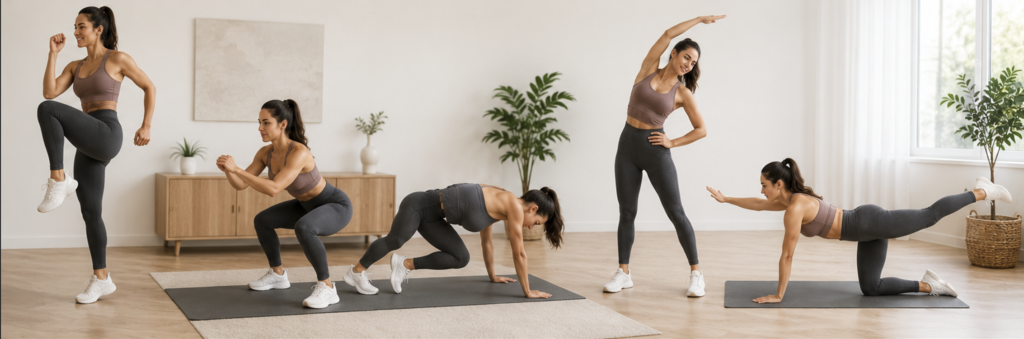
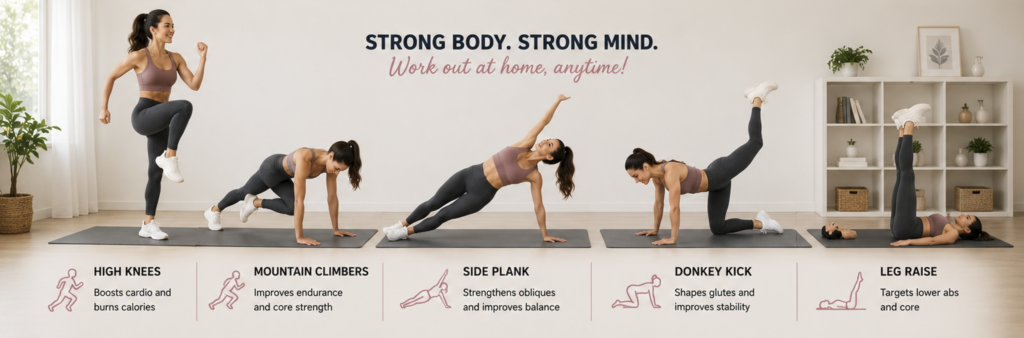
4. The Plank — Your Entire Core in One Position
The plank is having a cultural moment that I think is entirely justified. It’s appearing in every wellness aesthetic, every ‘morning routine’ video, every beautiful athleisure content creator’s practice, and the reason is simple: it works extraordinarily well. It engages the entire anterior core — not just the surface muscles of the abdomen but the deep stabilising muscles, the obliques, the muscles that support your spine — plus the shoulders, chest, and glutes.
The form is everything. Begin in a push-up position: hands directly under your shoulders, body forming a straight line from crown to heel, feet hip-width apart. If a full plank isn’t accessible yet, drop to your forearms instead of your hands — a forearm plank is slightly less demanding on the wrists and upper body, which makes it a genuinely useful starting point rather than a modification to be embarrassed about.
What makes or breaks a plank is what’s happening in the middle. Squeeze your glutes. Gently draw your navel toward your spine. Keep your hips level — neither piked up toward the ceiling nor sagging toward the floor. Breathe — this sounds obvious until you’re actually in a plank and discover you’ve been holding your breath. Keep your gaze on the floor, neck in neutral, jaw relaxed.
Begin with twenty to thirty seconds and rest. The goal is not to hold as long as possible with compromised form — it’s to hold with perfect form for whatever duration you can manage. Three rounds of thirty seconds with excellent form is far more valuable than one round of ninety seconds where your hips have sagged and your neck has craned for the last sixty.
5. Reverse Lunges — Elegant, Effective, and Kind to Your Knees
The lunge is one of those exercises that looks deceptively simple and reveals itself, upon actual execution, to be quite demanding and quite technical. For home workouts, I recommend the reverse lunge over the forward lunge, particularly for beginners — it’s gentler on the knees and allows for better balance and control.
Stand with feet hip-width apart. Step one foot directly backward, lowering your back knee toward the floor while keeping your front shin vertical and your torso upright. Both knees should be at approximately ninety degrees at the bottom, though this will depend on your step length — experiment to find what works for your proportions. Push through your front foot to return to standing.
The muscle you’re primarily building here is the glute of the front leg, along with the quads and hamstrings. The demand on balance is also significant — which is itself a form of strength training, engaging the stabilising muscles around the ankle, knee, and hip.
Twelve repetitions on each side, three sets. Progress by adding a knee drive at the top — after stepping back and lowering, drive your back knee up toward your chest as you return to standing, a dynamic element that adds both challenge and a cardio component. Eventually, progress to a static lunge, holding the split stance and pulsing at the bottom, which creates extraordinary endurance demands on the working muscles.
6. Mountain Climbers — Where Strength Meets Cardio
If you want one exercise that simultaneously builds core strength, shoulder stability, hip flexor endurance, and cardiovascular fitness — mountain climbers are it. They appear in virtually every effective HIIT home workout for very good reason: they’re efficient in a way that few movements are.
Begin in a plank position — hands under shoulders, body in a straight line. From there, drive one knee toward your chest while keeping your hips level and your core engaged, then return it and drive the other knee. Done slowly, this is a controlled core exercise. Done quickly, alternating legs as if running in place in your plank position, it becomes a genuinely cardiovascular challenge.
For beginners, begin slowly. The temptation is to go fast immediately — mountain climbers look faster when they’re done quickly in the videos you watch — but form completely breaks down at speed when you’re new to the movement. The hips lift, the lower back takes over, the shoulders creep toward the ears. Learn the pattern slowly first, then build speed over weeks as the coordination becomes automatic.
Twenty to thirty seconds of mountain climbers in a workout circuit is sufficient to elevate your heart rate significantly. In a HIIT format, paired with rest periods, they’re one of the most efficient fat-burning and conditioning exercises in your repertoire.
7. Superman — The Posterior Chain Exercise You Didn’t Know You Needed
The Superman exercise is named for the position it puts you in — lying face down on the floor, arms extended overhead, simultaneously lifting your arms and legs off the ground as if flying — and it targets the muscles of the posterior chain: the lower back, glutes, and hamstrings. These are muscles that are chronically underworked in most women’s lives and that, when they’re weak, contribute to the lower back pain, poor posture, and limited hip extension that affects so many of us.
Lie face down with your arms extended overhead and your legs straight. From this position, simultaneously lift your arms, chest, and legs off the floor, engaging your glutes and lower back. Hold for two to three seconds, then lower with control. That’s one repetition.
Begin with ten repetitions and rest. The goal is not height — you don’t need to lift dramatically high — but contraction. Think about squeezing your glutes and lengthening through the crown of your head and your heels simultaneously, as if someone is gently pulling you in both directions.
This exercise will feel almost embarrassingly easy for the first few repetitions, and then, around repetition seven or eight, your lower back and glutes will remind you that they have not, in fact, been getting adequate exercise. That sensation — not pain, but the deep fatiguing burn of working muscles — is exactly what you’re after.
8. Tricep Dips Using a Chair — For Arms That Feel as Strong as They Look
The tricep dip is our one exercise that uses a piece of furniture rather than just the floor, and it’s worth including because the triceps — the muscles on the back of the upper arm — are disproportionately neglected in most women’s training and disproportionately visible in how the arms look and feel.
Sit on the edge of a sturdy chair or sofa, hands gripping the edge beside your hips, fingers pointing forward. Walk your feet forward until your hips are off the seat and your body is supported by your hands. Your knees can be bent at ninety degrees (less challenging) or extended further forward (more challenging). Lower your body by bending your elbows until your upper arms are roughly parallel to the floor, then push back up by straightening your elbows. Throughout the movement, keep your back close to the chair — the elbows should bend straight back, not flare out to the sides.
Ten to twelve repetitions, three sets. As you get stronger, extend your legs further to increase the load. Eventually, elevate your feet on another chair to make the movement significantly more demanding.
Building Your Weekly Schedule: How to Put It All Together
Having eight great exercises is one thing. Knowing how to sequence them into an effective weekly practice is another, and this is where many home workout guides fail the women following them — they provide exercises but not a coherent structure, leaving you to figure out how many times a week, in what order, with what rest, combining what with what.
Here is a structure that has worked beautifully for me and that is grounded in sound training principles. Three to four workouts per week is the sweet spot for most women starting out — enough to make progress, not so much that you’re perpetually exhausted and unable to recover.
The Full-Body Circuit: Your Three-Day Option
If you prefer simplicity — the same workout, three days a week, with rest days in between — a full-body circuit approach is elegant and effective. Choose five or six of the eight exercises. Perform each for the prescribed repetitions with minimal rest between exercises. Rest for two minutes at the end of the circuit. Repeat the circuit two to three times in total.
A sample circuit might look like this: twelve squats, ten push-ups (modified or full), fifteen glute bridges, twenty seconds of mountain climbers, ten reverse lunges each side, then a thirty-second plank. Rest two minutes. Repeat. Three rounds of this, including your warm-up and cool-down, takes approximately thirty-five to forty minutes and is genuinely comprehensive.
Upper and Lower Split: Your Four-Day Option
If you want to work out four times a week and prefer to give muscle groups a little more focused attention, an upper/lower split is both effective and efficient. Day one focuses on upper body — push-ups, tricep dips, planks, mountain climbers. Day two focuses on lower body — squats, lunges, glute bridges, supermans. Day three is rest or gentle movement. Day four repeats upper, day five repeats lower. Two rest days across the week.
This approach allows each muscle group forty-eight to seventy-two hours of recovery between sessions, which is the window during which the actual adaptation and strengthening occurs. Many women find this split allows them to work harder in each session — the focused muscle groups are fully recovered, and there’s something psychologically satisfying about knowing today is a leg day or today is an upper body day.
The HIIT Option: When You Have Twenty Minutes and Nothing Else
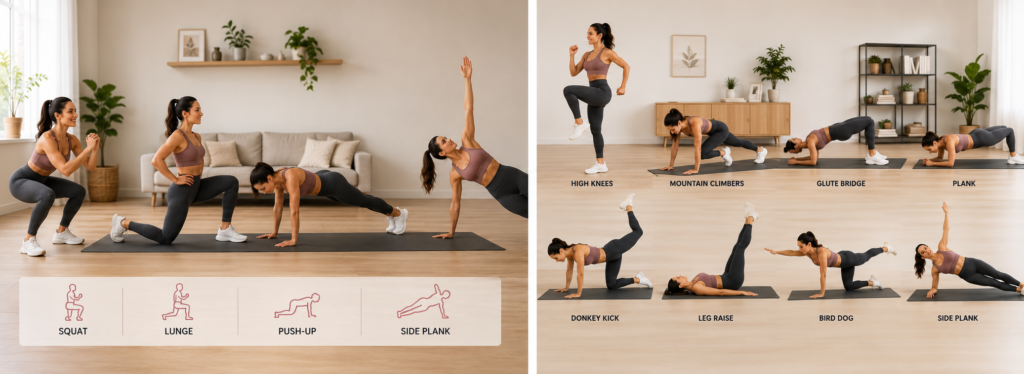
HIIT — High Intensity Interval Training — is the format that has genuinely transformed home workout culture, and for good reason: it’s extraordinarily time-efficient. Done properly, a twenty-minute HIIT session produces adaptations in cardiovascular fitness and body composition that rival much longer moderate-intensity workouts.
The structure is simple: periods of high-intensity work alternating with periods of rest. A classic ratio for beginners is thirty seconds on, thirty seconds off. As you get fitter, you can shift to forty seconds on, twenty seconds off, or forty-five and fifteen for those really challenging sessions.
Choose four to six exercises from the list above, particularly the ones with a cardiovascular element: squats, mountain climbers, reverse lunges with knee drives, push-ups performed quickly, glute bridges done as explosive hip thrusts. Rotate through them in thirty-second work periods. Eight rounds total is a complete HIIT workout of approximately twenty-five minutes including your warm-up.
The caveat here is important: HIIT done three or four times a week is too much for most people, particularly beginners. The high-intensity nature of these sessions creates significant demand on the central nervous system and the muscular system, both of which need time to recover. One or two HIIT sessions per week, combined with slower, more strength-focused sessions, is the balanced approach that produces the best long-term results.
The Cool-Down: The Gift You Give Yourself After Every Session
I have become slightly evangelical about the cool-down, and I make no apologies for this. A proper cool-down is one of those small practices that, accumulated over months, makes an enormous difference to how your body feels, how you recover between sessions, and how likely you are to remain injury-free enough to keep your practice consistent.
The cool-down serves several purposes. It gradually brings your heart rate back to resting. It prevents blood from pooling in the muscles you’ve been working, which reduces next-day soreness. It’s when your muscles are most warm and receptive to lengthening, making it the most effective time to work on flexibility. And — perhaps most importantly — it’s a transition. It marks the end of the work and the beginning of the rest. It teaches your nervous system to shift from sympathetic (active, stressed) to parasympathetic (calm, recovering) state, which has benefits that extend well beyond the workout itself.
A good cool-down takes five to ten minutes. Begin with two minutes of gentle walking in place, bringing your breathing down. Move into a standing quad stretch — holding one foot behind you, balancing on the other leg, feeling the stretch through the front of the thigh. Hold each side for thirty seconds. Then a standing hip flexor stretch: step one foot forward into a lunge and sink low, feeling the stretch in the hip of the back leg. Thirty seconds each side.
Move to the floor for a glute stretch — lying on your back, crossing one ankle over the opposite knee, gently drawing both legs toward your chest until you feel a deep stretch through the outer glute and hip. The figure-four position, as this is sometimes called, is one of the most therapeutic things you can do for a body that spends any time sitting. Then a child’s pose, sinking back onto your heels with arms extended forward, breathing deeply for a full minute. Finally, lie flat on your back in what yoga calls savasana — arms slightly away from your body, eyes closed, breathing naturally — for two to three minutes.
This is not wasted time. This is the practice completing itself.
Nutrition and Recovery: The Part of Fitness That Happens Off the Mat
I want to be careful here, because nutrition is a topic where I have strong feelings and where the internet has caused enormous harm to women’s relationships with food, and the last thing I want to do is add to that.
So let me say first: I’m not going to give you a meal plan. I’m not going to suggest cutting carbohydrates or tracking macros or eating in a specific window or eliminating food groups. Those approaches work for some women in some contexts, and they cause real damage in others. Nutrition is individual in ways that exercise is not, and anyone who tells you there’s one right way to eat for every woman’s body is selling something.
What I will say is that exercise and nutrition are, ultimately, a system — they work together, and what you eat affects how your workouts feel and how well you recover from them. In the most general and genuinely non-prescriptive terms: eating enough protein supports muscle building and recovery. Eating enough carbohydrates provides the energy to train with intensity. Being adequately hydrated affects performance more than almost any other single variable. And eating in ways that feel good to you — pleasurable, satisfying, not laden with guilt or restriction — is more important for long-term health than any specific dietary approach.
Sleep, on the other hand, I will be direct about: it is the most underrated performance-enhancing tool available to you. The research on this is unambiguous. Sleep is when your body repairs muscle tissue, consolidates motor learning (the coordination and technique you’ve been practising in your workouts), regulates the hormones that govern appetite and energy expenditure, and essentially does all of the actual adaptation that your training stimulus has called for. Insufficient sleep undermines every other health and fitness intervention you could possibly make.
Seven to nine hours for most adults. Not as a goal for exceptional nights, but as a standard. The women whose health and fitness and skin and mood you admire are, with very high likelihood, sleeping enough. That’s not a coincidence.
Active Recovery and Gentle Movement
Rest days don’t need to mean stationary days. Active recovery — gentle movement that doesn’t create additional training stress but keeps the body mobile and the blood flowing — is one of the most valuable things you can incorporate into your week. A twenty-minute walk, ideally outside and ideally without headphones occasionally so that you can actually be present in the world. A gentle yoga session from YouTube. Some stretching while watching television in the evening. Swimming if you have access to it.
The goal of active recovery days is to facilitate the process that’s happening in your muscles without adding to the workload. Think of it as kindness toward yourself, which is, when you examine it, what the best approach to fitness always is.
The Mental Game: Building a Practice That Lasts Beyond the First Month
Here’s what nobody tells you about building a workout habit: the first two weeks are not representative of anything. They’re either significantly harder than the long term will be, or significantly easier, depending on your personality and the novelty effect. What matters is what happens in weeks three through twelve — when the novelty has worn off and the results haven’t quite materialised yet and life has started to insert its usual complications.
That window — what I think of as the valley between starting and habit — is where most workout resolutions go to die. The strategies that get you through it are the same strategies that build any other sustainable habit: removing friction (which we’ve already addressed by choosing home workouts), making it rewarding in the short term (not just in the theoretical long term), connecting it to your identity, and being genuinely compassionate with yourself about imperfection.
Let’s talk about making it rewarding in the short term, because this is where I think most fitness culture completely fails women. We’re told to focus on the long-term results — the body we’ll have in twelve weeks, the strength we’ll build over months — and while those outcomes are real and worth pursuing, they’re too distant to reliably motivate behaviour in the moment. You need reasons to work out today that aren’t about who you might be in three months.
The immediate reasons are real and plentiful, and noticing them changes everything. The particular clarity of mind that follows a workout — that quality of calm alertness that makes everything feel more manageable. The way your energy is higher for hours afterward. The way you sleep better on the nights after you’ve moved your body. The satisfaction, genuinely available to you at the end of every single session regardless of how imperfect the session was, of having done something kind and valuable for yourself. These are not small things. They’re the actual texture of a life that includes consistent movement.
The goal is not a perfect workout record. The goal is to become someone who moves her body regularly and finds genuine pleasure in it. That identity is built one ordinary session at a time.
On Perfectionism and the Missing Session
I want to address the perfectionism question directly, because it affects so many women and because the fitness industry — in its obsession with streaks and transformation challenges and never-miss-a-Monday urgency — actively exacerbates it.
You will miss sessions. You will have weeks where life intrudes — illness, work, travel, the kind of emotional exhaustion that makes even getting dressed feel like an achievement — and your workout practice temporarily disappears. This is not failure. This is being human.
The most important thing you can do after missing a session, or a week, or even longer, is to return without drama. Not with elaborate recommitment rituals or compensatory sessions twice as long as usual or punitive calorie restriction or any of the other ways we’ve learned to punish ourselves for imperfection. Just return. Do the workout. Resume the practice as if the gap were a parenthesis rather than a verdict.
The women who maintain fitness practices for years and decades are not the ones who never miss a session. They’re the ones who have made returning so automatic and so undramatic that missing a week doesn’t threaten the identity they’ve built. They’re someone who works out. The specific sessions are details within that larger story.
Progressing Your Practice: How to Keep Getting Stronger
At some point — probably around the six to eight week mark, though it varies — the workouts that challenged you initially will begin to feel manageable. This is excellent news: it means you’ve gotten stronger. It also means it’s time to make your workouts harder, because the adaptation that produces continued improvement only happens when you continue to challenge your body beyond its current capacity.
The progression strategies available to you without any equipment are more varied than most people realise, and understanding them will allow you to keep making progress essentially indefinitely.
Tempo manipulation is perhaps the most underused progression tool. Slowing the lowering phase of any exercise — squats, push-ups, lunges, glute bridges — from one count to four counts dramatically increases the difficulty without changing any other variable. The muscle is under tension for longer, working harder, demanding more from both the muscular and nervous systems. A four-second descent in a squat is genuinely challenging for most people regardless of fitness level.
Volume progression is the most straightforward: simply do more repetitions or more sets as the current amount becomes comfortable. If you’re doing three sets of twelve squats and they feel easy, move to three sets of fifteen, then three sets of twenty, then add a fourth set.
Movement complexity is where progression gets genuinely interesting. Each exercise in our core eight has harder variations: squats progress to jump squats, to pistol squat progressions. Push-ups progress from modified to full to elevated feet to single-arm progressions. Glute bridges progress to single-leg bridges, to elevated single-leg bridges. Lunges progress to walking lunges, to jumping lunges. Each progression represents months of meaningful work without ever needing a piece of equipment.
Finally, rest period manipulation: shortening the rest between sets increases cardiovascular demand and muscular endurance. Moving from ninety seconds of rest to sixty seconds, then to forty-five, then to thirty seconds, turns the same workout into something significantly more demanding.
Adding Mindful Movement: Yoga and Pilates Elements for the Modern Woman
Something that’s been happening in the wellness and fitness spaces I find most interesting is a beautiful convergence of strength training, yoga, and Pilates influences into a unified approach to movement that is more effective and more pleasurable than any of them in isolation. This isn’t a trend — or if it is, it’s one of those trends that’s actually pointing toward something true.
The Pilates aesthetic has permeated modern fitness culture in a way that reflects something real about what women are looking for: controlled, intentional movement that creates strength and shape without bulk, that improves posture and movement quality, that has a meditative quality in its focus on precision and breath. The ‘Pilates body’ that’s discussed endlessly on social media is not achieved exclusively through Pilates, but the principles of Pilates — core engagement, spinal articulation, breath coordination, attention to every movement — are genuinely transformative when applied to any workout practice.
Adding some Pilates-inspired elements to your home workout practice doesn’t require a reformer or a studio membership. Simple floor-based Pilates exercises — the hundred, the single-leg stretch, the double-leg stretch, the teaser when you’re ready for it — can be learned from excellent free resources online and integrated into your existing routine as a finisher or a standalone session.
Yoga, even in its most basic form, offers something that strength training alone cannot: intentional flexibility work, breathwork that trains the nervous system toward parasympathetic dominance, and a quality of presence and self-awareness that translates beautifully to how you live beyond the mat. Even fifteen minutes of simple yoga at the end of a strength session — or as a standalone practice on a recovery day — accumulates into something genuinely meaningful over months.
What I’m describing is not the Instagram-perfect version of yoga with the beautiful backdrop and the extraordinary flexibility. I’m describing the humble, practical version: rolling out whatever space you have, following along with a YouTube video that meets you at your actual level, doing the best approximation of the poses that your body can manage today. That version — done consistently, without performance, without comparison — is exactly as valuable as the photogenic kind.
The Aesthetic of Wellness: Looking Good While You Work Out at Home
I want to spend a few pages on something that sits at the intersection of fitness and style, because for women who care about both — which includes, I think, virtually everyone reading this — the aesthetic dimension of working out matters and deserves to be taken seriously rather than apologised for.
The clean girl workout aesthetic has been one of the most pervasive and genuinely appealing visual trends of the past few years, and it shows no sign of abating. There’s a coherence to it that I find genuinely inspiring rather than aspirational in the exhausting way: a pair of perfectly fitted neutral leggings, a matching sports bra or soft crop top, clean hair in a low bun or a slicked-back pony, minimal jewellery (stud earrings, a delicate chain that stays on), dewy skin that looks beautiful whether or not it has any product on it. The aesthetic communicates health, intention, a kind of effortless physical confidence that is itself motivating.
What’s most interesting about this aesthetic in 2026 is how thoroughly it has left ‘workout clothes’ behind and entered the broader language of daily style. The best pieces in this category are designed to transition — from morning workout to school run to coffee meeting without requiring a complete change of clothes. The rise of what’s being called ‘activewear-first’ dressing, where the athletic piece is the starting point and everything else is layered around it, is one of those cultural shifts that, once you notice it, you see everywhere.
The specific pieces that are working beautifully right now in this space include seamless ribbed leggings in earth tones — camel, taupe, sage, terracotta — that have a quality of fabric and construction that reads as elevated rather than purely athletic. A soft, oversized sweatshirt in a matching or tonal neutral that goes on over the sports bra for the warm-up and comes off mid-workout. A lightweight cross-trainer that manages to be genuinely functional while looking beautiful enough to wear with the rest of the outfit for the rest of the day.
The hair and beauty element of the workout aesthetic is its own conversation, and one I find genuinely interesting. The skin that looks best during and after a workout is skin that has been cared for over time: well moisturised, protected from sun, given the kind of consistent routine that shows up in a glow that isn’t product-dependent. The ‘no-makeup workout look’ that photographs so beautifully is, in reality, usually the look of excellent skincare on bare skin — and that’s worth noting, because it’s something available to every woman with a consistent routine and the patience to let it work.
Tracking Progress Without the Scale: Measuring What Actually Matters
The fitness industry has an extraordinarily unhealthy fixation on body weight as the primary metric of progress, and this has caused significant harm to the relationship many women have with their bodies and with exercise. Weight is a crude and often misleading indicator of what’s actually happening in your body, particularly in the early weeks of a strength training programme when you may be simultaneously losing fat and gaining muscle — and the scale might not move at all while your body composition is changing significantly.
There are better ways to measure what’s happening, and cultivating them will serve your motivation and your relationship with your body far better than a number on a scale.
Performance metrics are the most honest and encouraging form of progress tracking available to you. Can you do more push-ups than you could four weeks ago? Can you hold a plank for longer? Are your squats lower, your lunges steadier, your mountain climbers faster? These improvements are unambiguous evidence that your body is getting stronger, regardless of what the scale shows.
How your clothes fit is more informative than your weight, because it integrates changes in body composition in a way that a single number cannot. The jeans that felt tight in the waist three months ago, the blouse that now sits differently across the shoulders, the dress that seems to hang better — these are real measurements of real change.
Energy and mood are perhaps the most meaningful progress markers of all, because they reflect the effect of your practice on your actual lived experience. If you’re sleeping better, if you feel more resilient in stressful situations, if you have more energy across the day, if your mood is more consistently stable — these are outcomes of your fitness practice that are arguably more valuable than any physical change.
Photographs, taken consistently in the same light and the same clothing at the same time of day, can show changes that are invisible in the mirror. The mirror, looked at every day, doesn’t show you gradual change — our brains adjust too quickly to our own reflection. A photograph from eight weeks ago does.
When Things Get Hard: Staying the Course Through Plateaus and Difficult Weeks
There will be periods when progress seems to stall. You’ll do the workouts, eat well, sleep enough, and yet nothing seems to be changing. You’ll feel less motivated than you did when you started. The novelty will have completely worn off and the results will feel less dramatic than they did in the beginning. This is not failure. This is a fitness plateau, and it happens to everyone.
Plateaus occur for a simple reason: your body has adapted to what you’re doing. The stimulus that created progress initially is no longer challenging enough to create further adaptation. The solution is equally simple in concept, if occasionally requiring creativity in execution: change something.
Change the exercises. Change the order. Change the tempo. Change the rest periods. Add a new movement you haven’t tried before. Reduce your rest periods significantly. Add an extra set to every exercise. Do a workout at a different time of day. The specific change matters less than the fact of the change — your body and your brain both respond to novelty, and introducing it consistently keeps the adaptation process moving.
But beyond the practical, I want to say something about the psychology of the difficult period that I think is important: the women who sustain fitness practices for years are not the ones for whom it’s always easy or always exciting. They’re the ones who have made peace with the ordinary nature of most sessions. They understand that not every workout will feel like a breakthrough, that most sessions will feel fairly unremarkable, that the magic of consistent practice is cumulative and quiet and absolutely real.
The difficult week — the week where you’re tired and unmotivated and the workout feels like a chore — that week, if you do the workout anyway, is actually building something more valuable than the easy week. It’s building the proof that your practice isn’t conditional on feeling like it. That’s the foundation everything else is built on.
A Final Word: What This Is Actually About
I’ve spent a great deal of this guide talking about exercises and schedules and nutrition and progression strategies, and I want to close by zooming out — because the exercises are the vehicle, not the destination.
What a consistent home workout practice actually does, over time, is change your relationship with your own body. Not necessarily your body’s shape, though that often changes too. But the relationship — from one of management and criticism and vague dissatisfaction, which is the default mode that most women in our culture navigate, to one of something approaching partnership. Respect. Even, eventually, appreciation.
When you can feel yourself getting stronger — when the push-up that was impossible eight weeks ago is now something you do fifteen times and feel good about, when you stand up from your chair and notice that your lower back doesn’t ache the way it used to, when you catch your reflection and recognise the way you’re carrying yourself differently — something shifts in how you inhabit your body. It stops being a problem to be solved and starts being something you live in more comfortably, more joyfully, more at ease.
That shift is, in my experience, the real benefit of consistent exercise. More than the physical changes, more than the health outcomes, more than any aesthetic improvement — it’s the change in relationship. And it’s available to you. Not in twelve weeks, not after you’ve reached a particular size or shape or weight, but right now, starting with the very next time you clear a patch of floor and do something kind and strong and intentional with your body.
That’s all this is, really. Doing something kind for yourself, consistently, over time. The rest takes care of itself.
This article is part of the Elegant Women Streetwear lifestyle and wellness editorial series. We publish new pieces regularly on movement, beauty, style, and the art of living well. We’d love to have you with us.