
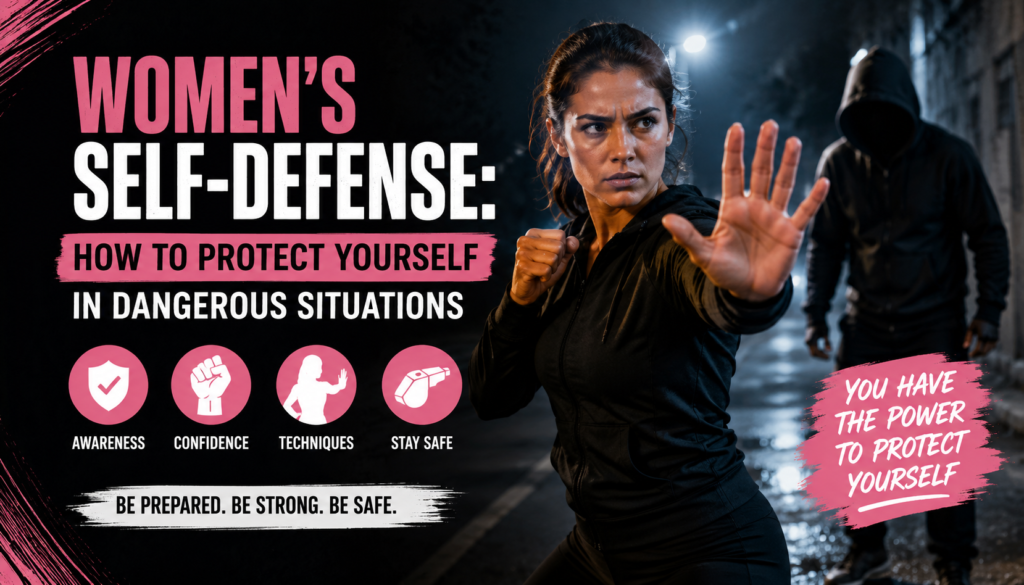
A calm, practical guide to awareness, boundaries, and staying safe — because the goal of self-defense is never to win a fight. It’s to get home.
Introduction: Redefining What Self-Defense Really Means
When most people hear the phrase “self-defense,” they picture something cinematic: a woman throwing a perfect punch, flipping an attacker over her shoulder, walking away unscathed while the threat lies defeated on the ground. It’s a compelling image, but it’s also a misleading one — and it can quietly do harm. It sets up an impossible standard, and it puts the focus in exactly the wrong place.
Real self-defense is not about becoming someone who can “win” a physical confrontation. It’s about reducing the chances that a dangerous situation ever reaches that point, and if it does, getting out of it as fast as possible. The martial arts instructors, police trainers, and violence-prevention researchers who study this field for a living generally agree on one core principle: the best physical technique is the one you never need to use. Escape beats engagement. Distance beats defense. Getting to help beats getting the upper hand.
This article is built around that principle. It will not teach you how to “beat” an attacker, because that is the wrong goal and, frankly, an unreliable one — attackers often have the advantages of surprise, size, and premeditation. Instead, it will walk you through the layers of protection that actually keep people safe in the real world: awareness, boundary-setting, verbal skills, de-escalation, environmental planning, and — only as a last resort — physical actions whose sole purpose is to create an opening to run.
Idrotherapy *GET PAID ON REBILLS EACH MONTH*
Deliverable
Unlock Your Skin’s Potential With A Single Product Designed For Mature Skin
Acting without any toxicological dangers, Idrotherapy is alternative to retinol
One more thing before we start, because it matters more than almost anything else in this article: if something happens to you, it is not because you failed to follow a tip on this list. Responsibility for violence lies entirely with the person who commits it. Nothing here should ever be read as a checklist for what a victim “should have done.” These are tools to add to your life, not a measuring stick to judge yourself — or anyone else — against after the fact.
With that foundation in place, let’s talk about what self-defense actually looks like when you strip away the movie version.
1. What Self-Defense Actually Means
It’s a System, Not a Single Skill
Self-defense professionals often describe personal safety as a layered system, sometimes visualized as concentric circles or a pyramid:
-
Awareness — noticing your surroundings and the people in them before anything happens.
-
Prevention and boundaries — reducing risk through decisions, routines, and clearly communicated limits.
-
De-escalation and verbal defense — using your voice and posture to defuse a situation before it becomes physical.
-
Escape and avoidance — recognizing exits, creating distance, and leaving before a threat can close in.
-
Physical action — used only when everything above has failed or isn’t possible, and used specifically to create a window to escape.
Notice where physical technique sits: last. Not because it’s unimportant, but because it’s the layer you hope never to need, and the one with the least reliable payoff. A five-minute head start out the door is worth more than a well-thrown strike against someone who is bigger, stronger, or armed.
Self-Defense Is Not About “Toughness”
You do not need to be strong, athletic, aggressive, or trained in martial arts to practice good self-defense. Some of the most protective habits — locking your car door before you start driving, texting a friend your live location, trusting a bad feeling enough to leave a party early — require no physical skill at all. They require only awareness and permission to prioritize your own safety, even when doing so feels inconvenient or “rude.”
Self-Defense Is Not Paranoia
There’s a difference between hypervigilance that drains your quality of life and situational awareness that becomes second nature, like checking your mirrors while driving. The goal of everything in this guide is to build habits that eventually require very little conscious effort — so you can walk through the world alert but not anxious, prepared but not fearful.
2. Understanding the Real Landscape of Risk
It helps to know what the data actually says, because it often runs counter to the popular narrative of a masked stranger jumping out of a dark alley.
-
According to the Rape, Abuse & Incest National Network (RAINN), which draws on U.S. Department of Justice victimization data, roughly 8 in 10 rapes and sexual assaults are committed by someone the victim already knows — a partner, ex-partner, acquaintance, friend, family member, or coworker — not a stranger.
-
The Centers for Disease Control and Prevention’s National Intimate Partner and Sexual Violence Survey (NISVS) found that more than 1 in 3 women in the U.S. will experience contact sexual violence, physical violence, and/or stalking by an intimate partner during their lifetime.
-
Most sexual assaults happen in a residence — the victim’s own home, the perpetrator’s home, or the home of someone they both know — not in public spaces.
Why does this matter for a self-defense guide? Because it reframes the picture. If most danger comes from people already inside your social circle, then awareness of strangers is only part of the picture. Boundary-setting, trusting your gut around people you know, and having an exit plan for your own relationships and social situations are just as central to self-defense as knowing how to spot a suspicious figure on a dark street.
This doesn’t mean stranger danger is a myth — it does happen, and public-safety awareness still matters enormously, especially in situations like walking alone, using rideshares, or traveling. It means a complete self-defense mindset covers both: the unpredictable stranger and the person you already trust who crosses a line.
3. Situational Awareness: Your First and Best Tool
Awareness is often called the foundation of all self-defense, and for good reason: nearly every other skill in this guide depends on noticing something before it becomes a crisis.
The Color Code of Awareness
A widely taught framework, originally developed for military and law enforcement training by Jeff Cooper, breaks awareness into simple “conditions.” It’s a useful mental model:
-
Condition White — Complete unawareness. Absorbed in your phone, headphones in both ears, not scanning your environment at all. This is appropriate at home with the doors locked, but risky almost anywhere else.
-
Condition Yellow — Relaxed but alert. You’re going about your day normally, but part of your attention is on your surroundings: who’s near you, what the exits are, whether anything feels off. This is the state you want to default to in public.
-
Condition Orange — Focused attention on a specific potential threat. Something has caught your attention — a person following your route, someone lingering too long, an unfamiliar car — and you’re actively watching and planning a response.
-
Condition Red — Action mode. The threat has become real and immediate, and you are executing your plan: leaving, calling for help, or, if unavoidable, physically defending yourself.
The goal isn’t to live in Orange or Red — that’s exhausting and unsustainable. The goal is to spend most of your time in a comfortable Yellow, so that a shift to Orange happens quickly and naturally when something warrants it, giving you the maximum amount of time to respond.
Practical Awareness Habits
-
Limit divided attention in transitional spaces. Parking lots, stairwells, ATMs, and building entrances/exits are statistically higher-risk because they’re transitional — you’re briefly alone, distracted, and often have your hands full. Save the phone scrolling for once you’re inside and settled.
-
Scan before you commit. Before walking into a stairwell, alley, or parking structure, glance ahead. Before getting into your car, glance underneath and into the back seat. These take two seconds and become automatic with practice.
-
Notice baseline behavior, then notice deviations from it. In any environment, most people are moving with a purpose — toward a destination, at a steady pace, with attention on their own business. Someone who doesn’t fit that pattern — lingering without reason, moving to match your pace, watching you rather than their own surroundings — is worth noticing, not panicking about, just noticing.
-
Keep your hands as free as possible. Juggling bags, a coffee, and a phone all in one hand isn’t just inconvenient; it also limits your ability to react, open a door quickly, or use your phone in an emergency.
-
Position yourself with information in mind. In restaurants, waiting rooms, or public transit, a seat that faces the entrance and gives you a view of the room isn’t paranoid — it’s simply informed. Many people naturally do this without realizing it’s a safety habit.
-
Trust peripheral vision and hearing. You don’t need to stare directly at someone to register that they’re there. Awareness doesn’t require making a scene or looking anxious; a relaxed, casual scan of a room communicates confidence, not fear.
Awareness at Home
Awareness doesn’t stop once you’re indoors. A surprising number of assaults happen in or near a victim’s own residence, so a few habits are worth building into your routine:
-
Get in the practice of locking doors immediately upon entering, rather than “later,” and check that windows and secondary entrances (garage doors, sliding doors, balconies) are secured before bed.
-
If you live alone, consider not broadcasting that fact to strangers or new acquaintances — delivery instructions, small talk, and social media can all unintentionally reveal it.
-
Know your neighbors, even casually. A neighbor who recognizes your routine is more likely to notice — and act on — something unusual.
-
Keep exterior lighting in working order; well-lit entrances are one of the simplest, most effective deterrents against opportunistic intrusion.
Awareness in the Digital Age
Modern situational awareness also includes your online footprint. Posting real-time location tags, predictable routines (the same coffee shop every morning at 7 a.m.), or travel plans publicly can provide a roadmap to anyone with bad intentions — including people you know. This doesn’t mean living a locked-down, joyless online life; it means being thoughtful about what is public and when it’s posted (after the fact, rather than in real time, is a simple and effective adjustment).
4. Recognizing Dangerous Situations and Warning Signs
Predatory behavior — whether from a stranger or someone known to you — often follows recognizable patterns. Learning them doesn’t mean you’ll spot every threat, but it substantially improves your odds of catching one early, when your options are still wide open.
Signs in Strangers or Unfamiliar Situations
-
Testing behavior. Predators frequently test boundaries in small ways before escalating — standing slightly too close, “accidentally” brushing against you, asking a personal question, or making a comment designed to gauge whether you’ll object. How a person reacts to a small pushback (with respect, or with anger/persistence) tells you a great deal.
-
Forced teaming. This is language that manufactures a false sense of “we’re in this together” — “we’re both stuck here,” “we should look out for each other,” “let’s get out of the rain together” — used to create premature trust and lower your guard.
-
Charm and niceness used as a tool. Genuine kindness doesn’t require your compliance. Be cautious of anyone whose friendliness comes with pressure — insisting on helping you when you’ve declined, refusing to take “no” for an answer on something small (carrying your bag, walking you somewhere), or escalating flattery quickly.
-
Too many details, too fast. Someone who volunteers excessive personal information early (“I just got out of a bad breakup,” “I’m new in town and don’t know anyone”) may be trying to manufacture intimacy or sympathy quickly, a known manipulation tactic.
-
Discounting the word “no.” Anyone who responds to a clear boundary by negotiating, guilt-tripping, joking it away, or simply ignoring it is showing you — directly — how they treat boundaries. Believe that information.
-
Loitering without clear purpose near your car, home, workplace, or routine locations.
-
Someone matching your pace or route in a way that seems more than coincidental, especially if it persists after you change direction.
Signs in People You Know
Because most violence against women comes from someone familiar, these signs deserve equal attention:
-
Escalating control disguised as care — wanting to know your location at all times, discouraging you from seeing friends or family, monitoring your phone or social media, framing controlling behavior as “because I love you.”
-
Jealousy presented as a compliment. Excessive jealousy is often reframed by the person exhibiting it (or excused by others) as evidence of love, when it is, in fact, a control mechanism.
-
Isolation. A slow narrowing of your support network — subtle criticism of friends and family, guilt trips about time spent away, conflicts that always seem to arise around your other relationships.
-
Minimizing or mocking your boundaries. Rolling their eyes when you say no, treating your limits as a joke or an overreaction, or punishing you (with silence, anger, or guilt) for asserting one.
-
Rapid escalation of commitment. Moving unusually fast toward exclusivity, moving in together, or major relationship milestones, which can be a way of locking in access and control before red flags become obvious.
-
A pattern of blaming others for their own behavior, including previous partners, which often previews how they’ll eventually describe you.
-
Explosive anger, even if never directed at you (yet) — punching walls, breaking objects, road rage. How someone handles anger in low-stakes situations is a preview of how they may handle it in high-stakes ones.
Warning Signs in Environments
-
Poorly lit entrances, stairwells, or parking areas.
-
Isolated locations with no other people or few sightlines (from windows, businesses, or passing traffic).
-
Locations with limited cell signal.
-
Situations where you feel pressured to go somewhere private that you didn’t plan or agree to in advance.
None of these signs guarantee danger, and their absence doesn’t guarantee safety. They are pattern indicators, not proof. But patterns are useful precisely because they let you respond to a trend, rather than waiting for undeniable, and often too-late, certainty.
5. Trusting Your Instincts
One of the most consistent findings across studies of violent encounters — and a central theme of Gavin de Becker’s widely referenced book The Gift of Fear — is that survivors very often report having sensed something was wrong before anything happened, and then talked themselves out of acting on it.
Why We Override Our Own Instincts
Social conditioning, particularly for women, frequently rewards politeness over self-protection. Many women are raised to prioritize not seeming rude, not causing a scene, not hurting someone’s feelings, and not overreacting — even when their gut is sending a clear signal. This conditioning is powerful, and unlearning it is one of the single most protective things you can do.
Common phrases people use to talk themselves out of listening to intuition:
-
“I’m probably just being paranoid.”
-
“He seems nice, I don’t want to be rude.”
-
“I don’t want to make a scene.”
-
“It’s probably nothing.”
-
“I already said I’d go, I can’t back out now.”
Every one of these is a moment where safety is being traded for social comfort. Reversing that trade — even imperfectly, even awkwardly — is a skill worth building deliberately.
What Intuition Actually Is
Fear and intuition aren’t magic. They’re your brain rapidly processing patterns — body language, tone, incongruent behavior, environmental cues — faster than your conscious mind can articulate them. That’s why a “gut feeling” can arrive before you can explain why you have it. The feeling is data. It deserves to be treated as such, even without a fully formed explanation.
Practicing Instinct-Trust
-
Give yourself permission to act on discomfort without justification. You do not need a defensible reason to leave a conversation, cross the street, decline to get in an elevator with someone, or end a date early. “I have a bad feeling” is enough.
-
Notice the difference between anxiety and instinct. General anxiety tends to be diffuse and ongoing; instinctual fear tends to be specific and situational, triggered by something in front of you right now. Both are worth respecting, but recognizing the distinction can help you calibrate your response.
-
Rehearse the exit line in advance. Decide ahead of time on a phrase you’ll use to leave a situation without needing to explain yourself: “I have to go, something came up.” “I’m not feeling well, I need to head out.” Practicing it in low-stakes moments makes it easier to deploy under pressure.
-
Resist the urge to explain your discomfort to the person causing it. You don’t owe an uncomfortable person a debate about why you’re leaving. Debating gives them an opening to talk you out of your own instinct.
6. Setting and Maintaining Personal Boundaries
Boundaries are the everyday, ongoing version of self-defense — the practice of clearly defining what is and isn’t acceptable, and holding that line even under social pressure.
Boundaries Are Not Rude
One of the most common obstacles to boundary-setting is the fear of seeming unkind. But a boundary is simply information about your own limits — it says nothing negative about the other person unless they choose to react badly to it, in which case that reaction is telling you something important about them, not you.
Physical Boundaries
-
You do not have to accept a hug, handshake, or any physical contact you don’t want, regardless of the context (a work event, a family gathering, a first date).
-
“I’m not a hugger” or simply extending a hand instead is a complete sentence. It doesn’t require an apology or a lengthy explanation.
-
If someone violates your physical space after being told not to, that is meaningful information about how they treat boundaries generally.
Verbal and Social Boundaries
-
You are allowed to end conversations, leave gatherings early, or decline invitations without providing a detailed justification.
-
“No” is a complete sentence. It does not need to be softened into an essay of excuses to be valid.
-
You can change your mind. Agreeing to something earlier does not obligate you to follow through on it — including dates, physical intimacy, rides, or plans of any kind.
Digital Boundaries
-
You are not obligated to respond immediately to messages, share your location on demand, or explain why you didn’t answer right away.
-
You can block, mute, or limit contact with anyone — including people you know — without needing their permission or agreement first.
How to Communicate a Boundary Clearly
The most effective boundary statements share three traits: they are calm, direct, and free of extended justification.
Formula: “I’m not comfortable with [X]. I need [Y].”
Examples:
-
“I’m not comfortable continuing this conversation. I’m going to head home now.”
-
“I need you to stop texting me.”
-
“I’m not going to come inside. I’ll say goodnight here.”
Avoid over-explaining, apologizing repeatedly, or offering a menu of excuses — each additional justification is an opening for negotiation. A boundary stated once, calmly and clearly, is more effective than one buried in ten sentences of hedging.
Holding the Boundary When It’s Tested
Many people will accept a boundary the first time it’s stated. Some will push back, test it, or try to negotiate. When that happens:
-
Repeat the boundary using the same or similar words, without adding new justifications (“broken record” technique). “I understand, but I’m still not comfortable with that.”
-
Reduce engagement, don’t increase it. Long debates give a boundary-tester leverage. Short, calm repetition denies them material to work with.
-
Be willing to disengage entirely — end the call, leave the room, walk away — if the boundary continues to be ignored. A boundary that can’t be enforced isn’t really a boundary.
7. Verbal Self-Defense
Verbal skills are among the most underrated self-defense tools, largely because they aren’t as visible or dramatic as a physical technique — but they resolve the overwhelming majority of tense situations before anything physical happens.
The Goal of Verbal Self-Defense
The purpose is not to “win” an argument, humiliate someone, or prove a point. The purpose is to create the best possible conditions for you to leave safely. That sometimes means being assertive and direct, and it sometimes means being calm, agreeable, and non-confrontational — the right approach depends entirely on the situation, not on a fixed script.
Assertive Communication
Assertiveness sits between passivity (avoiding conflict at the cost of your own needs) and aggression (escalating conflict in a way that raises risk). It looks like:
-
Firm, clear language delivered without shouting or excessive emotion: “Stop.” “Back up.” “I said no.”
-
Direct eye contact and a strong stance, which project confidence even if you don’t feel it internally. Body language often communicates as much as words.
-
A lowered, steady voice rather than a high, rushed, or apologetic tone, which tends to be read (consciously or not) as more authoritative and less negotiable.
-
Using the other person’s name or a direct address, which interrupts an autopilot script a harasser might be running and forces individual acknowledgment: “Sir, back away from me.”
Verbal Self-Defense With Strangers in Public
-
A loud, direct statement can interrupt an escalating situation by drawing attention: “I don’t know this person. Please help me” or simply “Back away from me” said loudly and clearly. Predators generally prefer situations without witnesses; making a scene works against their goals.
-
Naming the behavior out loud can be disarming: “You’re standing too close to me. Move back.” This removes any ambiguity and makes it clear you’ve noticed and won’t ignore it.
-
Enlisting bystanders directly and specifically is more effective than a general cry for help. Point at one person: “You, in the red jacket — call 911.” Diffuse responsibility (“someone help me”) often results in no one acting, a well-documented phenomenon called the bystander effect; a direct, individual request breaks through it.
De-escalation Language
If a physical confrontation seems to be building and your priority is buying time to escape, calm and non-provoking language can help, even though it may feel counterintuitive:
-
Avoid language that challenges someone’s ego or dignity, which can escalate anger (avoid insults, mockery, or “tough” posturing).
-
Use a calm, lower tone rather than matching heightened emotion.
-
Give the person a face-saving way to back down where possible: “I don’t want any trouble, I’m just going to go.”
-
Buy time while looking for an exit, rather than trying to resolve or “win” the interaction.
The right verbal strategy depends entirely on context: with a stranger in public, loud and attention-drawing may be safest. With someone volatile who could escalate to violence at any provocation, calm and non-confrontational may be safest. There is no single “correct” verbal script — the skill is reading the situation and adjusting.
Verbal Self-Defense With Someone You Know
Verbal boundaries with a partner, family member, friend, or coworker require a different tone than those with a stranger, but the underlying skill is the same: clarity without excessive justification.
-
Name the behavior, not the character. “When you raise your voice like that, I need you to stop” tends to land better and de-escalate faster than “You’re being abusive,” which can trigger defensiveness and escalate rather than resolve the moment — even though, in some cases, naming a pattern accurately and directly is also appropriate and necessary.
-
Use “I” statements to reduce defensiveness where the goal is genuinely to de-escalate rather than confront: “I feel unsafe when this happens” is harder to argue with than “You always do this.”
-
Recognize when de-escalation isn’t the appropriate goal. In situations involving ongoing coercive control or abuse, the priority may shift from “resolving the conversation” to “getting out safely,” in which case calm compliance in the moment, followed by leaving and seeking help afterward, can be the safest strategy — even if it doesn’t look like “standing your ground” in the moment. Safety, not principle, is the measure of success.
8. De-Escalation Techniques
De-escalation is the practice of reducing tension in a charged interaction before it turns physical. It draws heavily from crisis intervention and hostage-negotiation research, adapted here for everyday situations.
Core Principles
-
Create physical space when possible. Distance reduces the perceived threat on both sides and gives you more reaction time.
-
Keep your hands visible and open, at roughly chest height, palms slightly out. This posture is non-threatening and also functionally useful — it’s ready to block or push if needed, without appearing aggressive.
-
Avoid sudden movements, which can be misread as an attack and provoke a reactive response.
-
Don’t corner someone (and don’t let yourself be cornered). A person who feels trapped is more likely to become unpredictable or violent. This works both ways — always keep your own exit accessible.
-
Validate without agreeing, when dealing with someone who is emotionally escalated: “I hear that you’re upset” doesn’t mean “you’re right,” but it can lower the emotional temperature enough to create an opening.
-
Slow the pace. Anxious or angry people often speak fast; deliberately slowing your own speech and movement can have a calming, almost contagious effect on the interaction.
-
Have an exit in mind before you need it. De-escalation is not the goal in itself — it’s a tool to buy time and space so you can leave. Never let a calm conversation lull you into losing track of where the doors are.
When De-Escalation Isn’t the Right Tool
De-escalation works on people capable of being reasoned with in the moment. It is far less reliable — and shouldn’t be relied upon — in situations involving:
-
Someone under the influence of substances that impair judgment.
-
Someone in a psychotic or highly dissociated state.
-
Someone whose stated goal is explicitly to harm you (in these cases, the priority shifts immediately to escape, not negotiation).
If you sense de-escalation isn’t working or isn’t appropriate, don’t keep trying it past the point of usefulness — pivot to escape.
9. Exits and Escape Routes
Environmental awareness pays off most clearly here: knowing your way out of a space is often more valuable than any other single skill in this guide.
Building the Habit
-
Identify exits automatically upon entering any space — a restaurant, a party, a building, a rideshare. This becomes second nature with repetition, much like locating the emergency exits on an airplane.
-
Note more than one exit when possible. A single exit that could be blocked by a threat is a vulnerability; a mental map of two or three ways out gives you options.
-
Pay attention to what’s between you and the exit. A clear, direct exit is more valuable than a “closer” one that requires navigating around furniture, crowds, or the person you may need to get away from.
-
In vehicles, park facing outward when possible so you can drive away without needing to reverse or maneuver, and choose spots near lighting and activity over the closest-to-the-door spot in a dim, empty area.
Escaping a Building or Room
-
Move toward the exit at a normal pace when possible — sprinting immediately can sometimes provoke pursuit before you’re clear, though a genuine emergency justifies moving as fast as you safely can.
-
If a door is your goal, commit to it. Hesitating partway, or turning back to check on a situation, wastes the head start you’ve built.
-
Once outside, keep moving toward people, light, and open businesses rather than stopping nearby. Distance and visibility both work in your favor.
Escaping a Vehicle Situation
-
If you’re a passenger and feel unsafe, ask to be let out in a public, well-lit area — a gas station, a store, anywhere with visible people — rather than waiting until a “convenient” stop.
-
If a car is following you while you’re driving, do not drive home — you don’t want to reveal where you live. Instead, drive to a police station, fire station, or busy, well-lit public location and, if possible, call 911 en route.
-
If someone is trying to get into your car at a stoplight or in traffic, drive away as soon as it’s safely possible, even if that means bending a minor traffic rule (a slow rolling turn, pulling briefly onto a shoulder) — property and traffic laws matter far less than your safety.
Escaping on Foot
-
Move toward the nearest open business, group of people, or well-lit area rather than continuing along the most isolated route “because it’s shorter.”
-
If you believe you’re being followed, cross the street, change direction, or enter a public space to see whether the behavior persists — this both tests the situation and moves you toward safety regardless of the outcome.
-
Yelling “Fire!” is sometimes taught as more effective than “Help!” at drawing immediate attention, because it triggers a different, more universal response (self-preservation, not just concern) — but any loud, attention-drawing shout is far better than staying silent.
The “Get to the Door” Principle in a Home
If a threat is inside your home — an intruder, or an escalating situation with someone you know — your first priority is getting yourself (and any children or dependents with you) toward an exit or a room with a lockable door and a phone, not confronting the threat. A locked bathroom or bedroom door, combined with a call to 911, is a more reliable safety strategy than direct confrontation in almost every scenario.
10. What To Do During a Physical Attack
This section exists because sometimes, despite every layer of prevention, a physical confrontation happens anyway. Everything here is built around one goal: creating an opportunity to escape, not winning a fight. You are not trying to overpower, punish, or subdue anyone — you are trying to get away and get to safety.
The Mindset Shift
In a genuine attack, hesitation is often the biggest obstacle — not lack of strength or skill. Many self-defense instructors emphasize that the switch from passive/frozen to actively resisting is the single most important moment. This is sometimes taught as “permission to fight” — giving yourself explicit, advance permission to be loud, to hurt someone, to break rules of politeness, because your safety outweighs all of that.
General Principles
-
Make noise. Screaming serves two purposes: it may draw help, and it can startle an attacker, buying you a critical half-second.
-
Target vulnerable areas only to create an opening to escape, not to cause maximum injury as an end in itself. Common target areas taught in reputable self-defense courses include the eyes, throat, and groin — areas where even a smaller or less-trained person can cause enough disruption to create a gap.
-
Use whatever is available — keys, a bag, a phone, an elbow, a knee — rather than assuming you need a “proper” weapon or technique.
-
The moment an opening appears, take it and run. Do not stay to see whether the attacker is fully incapacitated. Your job is to leave, not to confirm the outcome of the confrontation.
-
If grabbed, move toward the attacker’s thumb, which is typically the weakest point of a grip, rather than pulling straight back against their full strength.
-
If pinned on the ground, use your legs, which are generally stronger than an attacker’s arms, to create distance — a well-placed knee or kick from the ground can be surprisingly effective for someone significantly smaller than their attacker.
-
If a weapon is involved, prioritizing compliance to avoid immediate harm may be the safest option, depending on the specific circumstances — this is a judgment call that depends entirely on the situation, and no guide can make it for you in advance. Getting away safely, even without “winning,” is still a successful outcome.
After Creating Distance
-
Run toward people, light, noise, and open businesses — not toward isolation.
-
Call 911 as soon as you’re safe enough to do so, even if you’re not sure you’ll press charges or file a report; getting immediate medical and safety support matters regardless of what happens legally afterward.
-
Do not go home alone if the attacker knows where you live and you’re unsure of their location — go to a police station, a friend’s home, or another safe, populated place first.
Common Physical Techniques Taught in Reputable Courses (Overview Only)
This is not a substitute for hands-on training, which teaches these movements safely and correctly under supervision — but a general overview can help demystify what these classes actually cover, since the reality is far less dramatic and far more practical than popular media suggests:
-
Palm-heel strikes to the nose or chin are often taught in place of a closed-fist punch, because they carry a much lower risk of the striker injuring her own hand — an important consideration, since an injured hand can end your ability to keep fighting or to run.
-
Elbow strikes are frequently emphasized because the elbow is one of the hardest, most durable parts of the body, and elbow strikes work well at close range, which is exactly the range most real attacks occur at (unlike the wide spacing usually shown in movies).
-
Stomping on the instep or shin is a low-effort, high-effect technique that requires very little strength or training and works well against a grab from behind.
-
A knee strike to the groin is commonly taught as an equalizing technique against a larger attacker, precisely because it doesn’t depend on the defender’s size or strength.
-
Basic grip releases, such as rotating toward an attacker’s thumb when a wrist is grabbed, are taught because they exploit simple mechanics (the thumb is the weak point of a closed grip) rather than requiring strength to overpower the hold.
None of these techniques are about inflicting maximum damage — they’re about creating a two- or three-second window in which an attacker’s grip loosens, their balance is disrupted, or their attention shifts, which is exactly the window needed to run.
A Note on Self-Defense Classes
Reputable self-defense courses — such as those modeled on IMPACT/Prepare’s methodology, or programs offered through many universities, YWCAs, and community centers — combine physical technique with scenario-based practice under adrenaline, which research suggests is more effective than technique drilled in a calm, low-stress classroom alone. If you’re interested in building physical confidence, look for a class that includes full-force, padded-attacker scenario training rather than only static technique repetition. This kind of training also builds something important beyond technique: it rehearses the decision to act without hesitation, which is often the real barrier in a genuine emergency.
11. Special Situations Worth Planning For
Public Transportation
-
Sit near the driver or conductor when possible, and near other passengers rather than in an empty section.
-
If someone makes you uncomfortable, moving seats, changing cars, or exiting at the next stop and waiting for the following one are all reasonable, low-cost responses.
-
Loudly naming unwanted behavior (“Stop touching me”) on a crowded train or bus draws immediate attention and social pressure, which is usually more effective than a quiet request.
Elevators
-
If someone makes you uneasy while waiting for an elevator, it’s reasonable to let it go by and wait for the next one, or take the stairs.
-
Once inside, standing near the control panel gives you the fastest access to the alarm and floor buttons.
Being Followed While Driving
-
Do not stop, even at a “safe-looking” location, until you reach somewhere with visible people and, ideally, cameras — a police station, fire station, hospital, or a busy, well-lit business.
-
Making a few turns that don’t lead home can help confirm whether you’re actually being followed versus coincidentally traveling the same direction.
First Dates and Meeting New People
-
Meeting in a public place for the first several interactions, arranging your own transportation there and back, and telling a friend the details (who, where, when) are all low-effort, high-value habits.
-
A version of a “check-in” plan — a friend who texts you partway through, with a pre-agreed word or phrase that means “call me with an excuse to leave” — is widely recommended and easy to set up.
Social Gatherings and Parties
-
Watching your own drink from pour to finish, and declining anything you didn’t personally see made, protects against tampering.
-
Arriving and leaving with people you trust, or at minimum letting someone know your plans, reduces the risk of an isolated, unmonitored departure.
12. Supporting Others: Bystander Intervention
Self-defense isn’t only about protecting yourself — the same awareness and skills apply when you notice someone else in an uncomfortable or unsafe situation. Bystander intervention training, now taught on many college campuses and in many workplaces, generally organizes response options into what’s called the “5 D’s”:
-
Direct. Address the situation head-on: “Hey, are you okay?” or “That’s not okay, back off.” This works best when you feel reasonably safe doing so and the situation isn’t escalated to the point of volatility.
-
Distract. Create a diversion that interrupts the interaction without confrontation — ask the person who seems uncomfortable for directions, “accidentally” spill a drink, ask to borrow their phone. This gives them a natural opening to step away.
-
Delegate. Find someone with more authority or resources to help — a bartender, security guard, store manager, or bus driver — rather than intervening directly yourself.
-
Document. If it’s safe to do so and someone else is already actively helping, recording a phone-camera video (with the involved person’s permission, when possible, to use afterward) can be useful for later reporting, but documentation should never replace direct help when no one else is stepping in.
-
Delay. If you can’t act in the moment, check in afterward: “I saw what happened back there — are you alright? Do you want to walk somewhere together?” A delayed check-in still matters and is often deeply appreciated.
Knowing these options in advance makes it far more likely you’ll actually act when you see something concerning, rather than freezing — a phenomenon known as the bystander effect, where people are paradoxically less likely to help the more witnesses are present, because everyone assumes someone else will step in. Deciding in advance to be the one who acts is itself a form of preparation.
13. Turning These Skills Into Lasting Habits
Reading about awareness, boundaries, and de-escalation is a starting point, but these skills only become reliable under pressure if they’re practiced enough to become close to automatic — the same way a driver doesn’t consciously think through every step of checking mirrors before changing lanes.
Start Small and Low-Stakes
-
Practice stating a small boundary in a low-risk setting — declining a sample at a store, saying no to an unwanted invitation — simply to build the muscle of saying it out loud without over-explaining.
-
Practice scanning a room for exits every time you enter a new space for a few weeks, until it happens without conscious effort.
-
Say your “exit line” out loud a few times when you’re alone, so it doesn’t feel foreign or awkward if you ever need to use it under stress.
Rehearse Scenarios Mentally
Visualization is a legitimate and well-supported training tool, used extensively in sports psychology and by first responders. Spending even a few minutes occasionally imagining how you’d respond to a specific scenario — someone won’t leave you alone at a bar, a rideshare driver takes a wrong turn, someone is walking too closely behind you at night — measurably improves real-world response time and confidence, because your brain has already built a rough template for the response instead of starting from zero.
Revisit and Update Your Habits
Awareness habits should evolve as your life does — a new commute, a new city, a new relationship, a new season of life (for instance, evenings getting darker earlier) are all natural check-in points to reassess your routines, routes, and plans.
Give Yourself Grace
No one executes every principle in this guide perfectly, every time, for their entire life. The goal isn’t flawless vigilance — it’s building enough of these habits that your baseline safety improves, while still living a full, engaged, connected life. Self-defense is meant to expand your freedom to move through the world, not shrink it.
14. After a Dangerous Situation: What Comes Next
If you’ve experienced a threatening or violent situation, what happens afterward matters, too.
-
Get to safety first, physically and immediately — this takes priority over everything else, including documentation.
-
Seek medical care if there’s any possibility of injury, even if it seems minor; some injuries and forms of harm aren’t immediately obvious.
-
Reach out to a hotline or advocate — organizations like RAINN (1-800-656-4673) and the National Domestic Violence Hotline (1-800-799-7233) offer free, confidential support and can help you think through next steps at your own pace, with no obligation to report to police if you’re not ready to.
-
You are never obligated to report, prosecute, or take any particular action to have your experience be valid or worthy of support. Support services exist for you regardless of what you decide to do next.
-
Lean on your support system. Isolation after a frightening event is common but tends to make recovery harder; trusted friends, family, or professional counselors can help you process what happened.
Frequently Asked Questions
Q: Do I need to take a self-defense class to be prepared? A physical self-defense class can build confidence and useful reflexes, but it is one layer among several. Awareness, boundary-setting, and de-escalation skills — all of which can be learned without any physical training — do the majority of the protective work in most situations.
Q: Is it true that fighting back always makes things worse? There’s no universal answer, and no guide should claim otherwise. Research on this question is genuinely mixed and highly situational — it depends on the type of threat, whether a weapon is present, the environment, and many other factors. What’s consistently supported is that resistance (verbal, evasive, or physical) is associated with a lower likelihood of a completed assault in many circumstances, but every situation is different, and the person in it is the only one positioned to judge in the moment. No outcome — resisting or not — is ever the victim’s fault.
Q: Should I carry a weapon like pepper spray or a personal alarm? Many people choose to carry these tools, and they can be genuinely useful, particularly personal alarms, which require no proximity to a threat and can startle an attacker while drawing attention. If you carry pepper spray or any similar item, familiarity with how to use it under stress (through practice, not just reading the instructions) matters far more than simply owning it. Always check your local laws, since regulations on such items vary by location.
Q: What if the danger comes from someone I love or live with? This is unfortunately common, and it requires different planning than stranger danger — including a safety plan for leaving safely, documentation of any threatening behavior, and support from domestic violence advocates who specialize in exactly this situation. The National Domestic Violence Hotline (1-800-799-7233) is trained specifically for these circumstances and can help build a plan tailored to your situation.
Q: I feel like I overreact to harmless situations sometimes. How do I know when a feeling is worth acting on? You don’t need certainty to act on discomfort — that’s actually the whole point. Leaving a situation that turns out to have been harmless costs you very little; staying in one that wasn’t can cost a great deal. There is no penalty for “false alarms” in your own safety planning.
Q: Is it my fault if I ignored a warning sign and something happened? No. Warning signs are patterns that can help you notice danger sooner, not a contract you’re required to perfectly execute. Perpetrators are responsible for their actions, full stop — regardless of what a victim did or didn’t notice, wear, say, or do beforehand.
Key Takeaways
-
Self-defense is a layered system — awareness, boundaries, verbal skills, de-escalation, and escape — with physical technique as the last, least relied-upon layer.
-
Most violence against women comes from someone known to the victim, not a stranger, which means boundary-setting within relationships is as important as public safety awareness.
-
Trusting your instincts, even without a clear justification, is one of the most protective habits you can build.
-
Clear, calm, repeated boundaries are more effective than long explanations or apologies.
-
If a physical attack happens, the goal is to create an opening and escape — not to win or subdue anyone.
-
Responsibility for violence always belongs to the person who commits it, never to the person who experienced it.
Sources and Further Reading
-
RAINN (Rape, Abuse & Incest National Network) — Statistics and support: rainn.org | National Sexual Assault Hotline: 1-800-656-4673
-
National Domestic Violence Hotline: thehotline.org | 1-800-799-7233
-
Centers for Disease Control and Prevention, National Intimate Partner and Sexual Violence Survey (NISVS): cdc.gov/nisvs
-
National Center for Victims of Crime: victimsofcrime.org
-
Gavin de Becker, The Gift of Fear: Survival Signals That Protect Us From Violence — a widely cited foundational text on trusting intuition as a safety tool.
-
IMPACT Personal Safety / Prepare Inc. — scenario-based self-defense training programs: impactpersonalsafety.org and prepareinc.com
-
National Sexual Violence Resource Center (NSVRC): nsvrc.org
-
U.S. Department of Justice, Bureau of Justice Statistics — National Crime Victimization Survey: bjs.ojp.gov
If you are in immediate danger, call 911 (or your local emergency number). If you need confidential support at any hour, the hotlines listed above are free and available 24/7.