
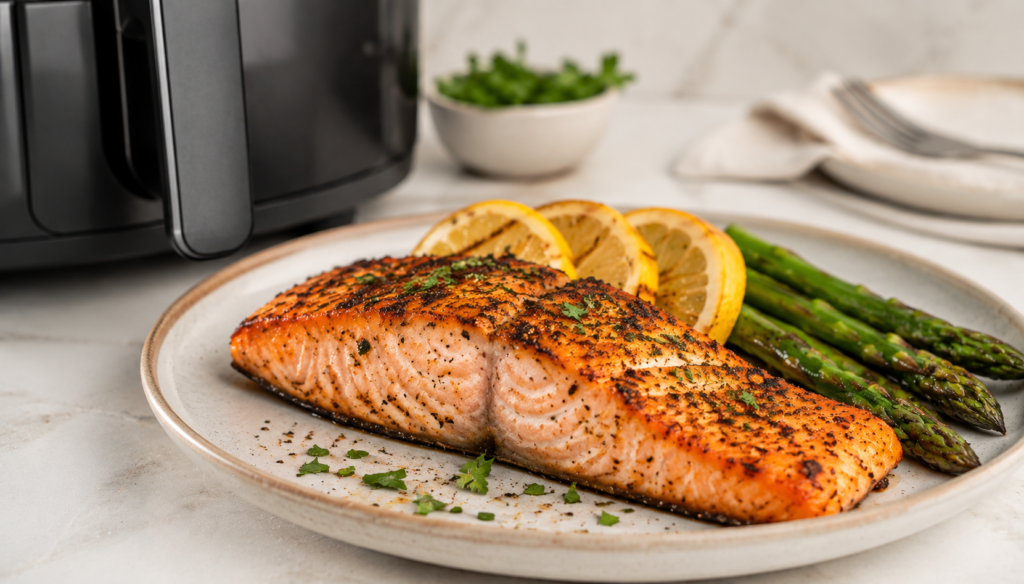
Meta description: A dependable, troubleshooting-focused guide to air fryer salmon — covering timing, temperature, thickness, and fixes for every common problem. Primary keyword: foolproof air fryer salmon Secondary keywords: perfect air fryer salmon every time, air fryer salmon troubleshooting, reliable air fryer salmon recipe, air fryer salmon tips
There’s a version of air fryer salmon that goes wrong in a dozen small, specific ways — dry in the center, pale and unbrowned on top, stuck stubbornly to the basket, or perfectly cooked one week and disappointingly overdone the next, despite following what feels like the exact same recipe. If that sounds familiar, the good news is that salmon isn’t actually unpredictable — air fryers are just more variable between models than most recipes account for, and small differences in fillet thickness, starting temperature, and technique compound into results that can feel inconsistent even when you’re doing most things right.
This guide is built specifically to address that inconsistency: not just a recipe, but a systematic look at every variable that affects the outcome, along with specific fixes for the most common problems people run into. No guarantee here will claim “perfect every single time” — no recipe honestly can, given how much air fryer models vary — but this is about as close to reliable as home cooking for a genuinely finicky protein gets.
How to Choose Salmon
Start with fillets that look moist and vibrant, without dull or discolored patches, and that have been stored properly (kept cold, ideally on ice at the counter if purchased that way). Center-cut fillets of consistent thickness are considerably easier to cook reliably than irregular pieces with a thick end tapering to a thin one, since the latter essentially guarantees uneven doneness across a single fillet.
How to Prepare Salmon
Preparation matters more than most people expect. Remove the fish from the refrigerator 10 to 15 minutes before cooking to take the edge off its chill, which supports more even cooking. Check for and remove any pin bones. Above all, pat the fillets thoroughly dry with paper towels — press firmly, on both sides, until the surface genuinely feels dry rather than just less wet. This single step affects browning, sticking, and overall texture more than almost any other variable in this guide.
How to Season It
A simple approach — salt, pepper, a light coating of oil, and any dry seasoning of choice (garlic powder, smoked paprika, dried herbs) — works reliably and lets you troubleshoot other variables without an elaborate marinade complicating the picture. Once you’ve got the core technique dialed in for your specific air fryer, layering in more complex seasonings or marinades (covered in the flavor section below) becomes much easier to do successfully.
How to Prepare the Air Fryer
Before adding the salmon, make sure the basket is clean and, ideally, lightly oiled or sprayed to reduce sticking, particularly important for delicate proteins like fish that can tear if stuck. If your model has a removable basket insert, double-check it’s seated properly, since a loosely fitted basket can affect airflow and, in turn, cooking evenness.
Whether Preheating Is Necessary
This is genuinely one of the more model-dependent variables in air fryer cooking. Some air fryers heat up so quickly (within a minute or two) that preheating makes little practical difference; others, particularly larger models or those with less powerful heating elements, benefit meaningfully from a 3-to-5-minute preheat, since starting the fish in a fully heated environment supports more consistent, predictable cooking times. If you’re not sure how your specific model behaves, err on the side of preheating — it costs a few extra minutes and removes one variable from the troubleshooting equation.
Correct Temperature Considerations
400°F (200°C) remains the most broadly reliable temperature for salmon across most air fryer models, striking a good balance between fast enough browning and enough time for the interior to cook through evenly. For unusually thick fillets (over 1.5 inches), dropping to 375°F and extending the time slightly gives the center more opportunity to catch up without over-browning the exterior in the meantime.
Cooking-Time Variables
Cooking time for salmon depends on several factors beyond the basic temperature setting: fillet thickness (the single biggest factor), whether the fish started cold from the refrigerator or had a chance to sit out briefly, whether it’s fresh or previously frozen (frozen fish, even when thawed, sometimes cooks slightly differently due to structural changes from freezing), and the specific air fryer model’s actual heat output, which can vary meaningfully even between units of the same model. As a starting range: 7 to 10 minutes at 400°F for a standard 1-inch fillet, with thinner or thicker fillets adjusted proportionally.
Fillet Thickness
This deserves emphasis because it’s the variable most likely to throw off an otherwise-careful approach. A ¾-inch fillet and a 1.5-inch fillet are, functionally, two different cooking problems, even if they came from the same fish and weigh roughly the same. Measuring the thickest part of your specific fillet with a ruler (genuinely — this takes ten seconds and removes a lot of guesswork) and adjusting time accordingly is more reliable than assuming a recipe’s stated time applies universally.
Fresh Versus Frozen Salmon
Fresh salmon offers the most predictable results since there’s no thawing process to account for. Frozen salmon, thawed properly overnight in the refrigerator, performs almost identically to fresh, provided it’s patted extremely dry afterward, since thawed fish tends to release more surface moisture than fish that was never frozen. Cooking directly from frozen is possible in many air fryers but requires roughly 50 percent more cooking time and tends to produce less even results — a reasonable option in a pinch, but not the most reliable path to a consistently great outcome.
Skin-On Versus Skinless
Skin-on fillets, cooked skin-side down, offer a bit of a buffer against overcooking on that side, plus the bonus of crispy skin if prepared properly (dried thoroughly, cooked directly against the basket). Skinless fillets cook a touch more uniformly on both sides but lack that textural contrast. Neither is more or less reliable in terms of achieving good doneness — the choice is really about preference.
How to Check Doneness
An instant-read thermometer, inserted into the thickest part of the fillet, is the single most reliable tool in this entire guide, and if there’s one piece of equipment worth owning for consistent salmon, it’s this. The USDA’s recommended safe internal temperature for fish is 145°F; many home cooks prefer pulling salmon at 125 to 130°F and allowing a short rest, during which carryover cooking brings the temperature up further, producing a more tender, moist result. Whichever target you choose, verifying with a thermometer removes almost all of the guesswork that leads to inconsistent results.
How to Avoid Dry Salmon
Dryness is overwhelmingly a function of time in the heat exceeding what the fillet actually needed. The fix is straightforward, if occasionally tedious: start checking doneness a couple of minutes before you expect the fish to be ready, and use a thermometer rather than a fixed cooking time or purely visual cues. If you find your salmon consistently comes out dry using a specific recipe’s stated time, that’s useful information — it means your particular air fryer runs hotter than the recipe assumed, and you should simply reduce the time by a minute or two going forward.
How to Avoid Raw or Undercooked Salmon
Undercooking is less common than overcooking but does happen, typically with thicker fillets cooked at a high temperature for too short a time based on a recipe written for thinner fillets. If your thermometer shows the fish hasn’t reached your target temperature, simply return it to the air fryer for another minute or two — there’s no harm in continuing to cook fish that needs more time, and it’s a far better outcome than serving something undercooked out of impatience.
How to Achieve Even Cooking
Even cooking depends primarily on consistent fillet thickness (trimming or selecting pieces of similar size when cooking multiple fillets together) and avoiding overcrowding, since pieces placed too close together or overlapping will cook unevenly as airflow gets blocked between them. Leaving visible space around each piece in the basket supports more uniform results across the whole batch.
How to Prevent Sticking
A light coating of oil on both the fish and the basket itself addresses most sticking issues. If sticking persists despite this, check whether your basket’s non-stick coating has worn down over time (a common issue with heavily used air fryers), in which case a slightly more generous coating of oil, or a piece of perforated parchment paper designed for air fryer use, can help.
How to Achieve Attractive Browning
Good browning depends on three things working together: a thoroughly dried surface (moisture is the biggest obstacle to browning), enough oil to support the Maillard reaction without drowning the surface, and sufficient heat and time for that reaction to actually occur before the fish is fully cooked through. If your salmon consistently comes out pale despite being properly cooked internally, the fish likely wasn’t dried thoroughly enough beforehand, or too little oil was used.
How to Create Flavorful Crusts
Beyond basic seasoning, a light coating of something with a bit of texture — a thin layer of grated Parmesan mixed with breadcrumbs, or a light dusting of a spice blend pressed gently into the fish — can create a more substantial, flavorful crust, though this does add a small amount of additional preparation compared to a simple oil-and-seasoning approach.
How to Use Marinades and Glazes
Marinate briefly (15 to 20 minutes maximum for most acidic marinades, to avoid the acid beginning to affect the fish’s texture), then pat the fillet dry again before cooking, since a wet, marinade-soaked surface won’t brown well. Glazes with sugar content (honey, maple syrup, teriyaki sauce) are best applied during the last 2 to 3 minutes of cooking rather than at the start, since sugars can burn if exposed to high heat for the full cooking time.
How to Adapt the Recipe to Different Air Fryer Models
This is genuinely one of the most underappreciated sources of inconsistency in air fryer cooking generally, not just for salmon. Basket-style air fryers, oven-style air fryers, and different wattages all heat somewhat differently, even at the “same” temperature setting. The most practical approach is to treat any recipe’s stated time and temperature as a starting point rather than a guarantee, and to keep a mental (or literal, written) note of how your specific machine tends to run — if you consistently find your salmon done a minute or two earlier than a recipe suggests, that’s valuable calibration information for future cooking, not a sign you’re doing something wrong.
Troubleshooting Common Problems
What to Do If Salmon Cooks Too Quickly
If you notice the exterior developing color very rapidly, before you’d expect the interior to be anywhere close to done, your air fryer likely runs hot relative to its displayed temperature. For future attempts, try lowering the set temperature by 15 to 25 degrees, or checking doneness noticeably earlier than the recipe’s suggested time.
What to Do If Salmon Is Still Undercooked
Simply return it to the air fryer for additional 1-to-2-minute increments, checking temperature after each, until it reaches your target. There’s no downside to this approach beyond a few extra minutes, and it’s a far better outcome than serving undercooked fish.
What to Do If the Outside Browns Too Quickly
If the surface is browning well before the interior is done, try reducing the temperature slightly for the remainder of the cooking time, or loosely tenting a small piece of foil over the fillet to slow further browning while the interior continues cooking.
What to Do If the Salmon Becomes Dry
Once salmon has overcooked, there’s unfortunately no way to reverse the dryness in that particular batch — the moisture loss has already occurred. The useful response is forward-looking: reduce cooking time by a minute or two next time, and commit to checking with a thermometer a bit earlier in the process.
Best Sauces
A simple herb butter (softened butter mixed with chopped herbs and a squeeze of lemon, melted over the finished fillet), a light yogurt-dill sauce, or a quick soy-ginger glaze all pair well without overwhelming the fish’s natural flavor.
Best Side Dishes
Roasted or air-fried vegetables (asparagus, broccoli, green beans), a simple grain like rice or quinoa, or a light salad all complement salmon’s richness without much additional cooking effort, particularly if prepared in the same air fryer either before or immediately after the fish.
Complete Meal Combinations
A dependable combination: salmon, air-fried asparagus (cooked for a few minutes right after the salmon comes out, using the still-hot basket), and a quick-cooking grain like couscous or pre-cooked rice, assembled into a complete dinner within about 20 to 25 minutes total.
Meal Preparation
Season fillets in advance and store them, covered, in the refrigerator for up to a day before cooking, which streamlines the actual cooking process on a busy evening to little more than placing the fish in the basket and setting a timer.
Storage
Store cooked salmon in an airtight container in the refrigerator for up to 3 days.
Reheating
Reheat gently — a low oven or air fryer at a reduced temperature (around 300°F) for a few minutes preserves moisture considerably better than a microwave, which tends to overcook the exterior of already-cooked fish before the center is even warmed.
Leftover Salmon
Flaked leftover salmon works well in salads, folded into pasta, or added cold to a grain bowl, offering an easy way to use leftovers without needing to reheat the fish at all.
The Core Recipe
Foolproof Air Fryer Salmon Serves 2 | Prep time: 5 minutes | Cook time: 8–10 minutes
Ingredients:
-
2 salmon fillets (6 ounces each, about 1 inch thick)
-
1 tablespoon olive oil, plus extra for the basket
-
½ teaspoon salt
-
¼ teaspoon black pepper
-
¼ teaspoon garlic powder
-
Lemon wedges, for serving
Instructions:
-
Measure the thickness of your fillets — this determines your cooking time more than anything else.
-
Pat the fillets completely dry with paper towels.
-
Rub with olive oil and season evenly with salt, pepper, and garlic powder.
-
Lightly oil the air fryer basket. Preheat to 400°F for 3 minutes if your model benefits from preheating.
-
Place fillets in the basket with space between them, skin-side down if applicable.
-
Cook for 7 minutes, then check the internal temperature with a thermometer. Continue in 1-minute increments as needed until reaching 125–130°F (for a more tender result) or 145°F (per USDA guidance).
-
Let rest 2 to 3 minutes before serving with lemon.
Storage: Refrigerate in an airtight container for up to 3 days. Reheating: Gently reheat at 300°F for a few minutes, or serve cold in a salad. Substitutions: Any neutral oil works in place of olive oil; dried herbs can replace garlic powder for a different flavor profile.
Every air fryer runs a little differently, so treat these times as a dependable starting point and adjust based on your own machine’s behavior over a couple of attempts.
Key Takeaways
-
Fillet thickness, more than any other single factor, determines appropriate cooking time — measure it rather than guessing.
-
A thermometer is the most reliable tool for consistent results, removing the guesswork that leads to dry or undercooked salmon.
-
Patting the fish thoroughly dry before cooking is essential for good browning and reduced sticking.
-
Every air fryer model runs slightly differently; treat recipe times as a starting point and calibrate based on your own machine over a few uses.
-
Most common problems — dryness, poor browning, sticking — trace back to a small number of fixable variables: moisture, oil, and time.
Frequently Asked Questions
Why does my air fryer salmon come out different every time even though I follow the same recipe? This is usually due to variation in fillet thickness between batches, or your air fryer’s actual heat output shifting slightly over time. Measuring thickness and using a thermometer for verification addresses most of this inconsistency.
Should I flip salmon halfway through cooking? For most standard fillets, flipping isn’t necessary, since circulating air cooks fish fairly evenly without it. Very thick fillets may benefit from a flip partway through.
What’s the most common reason salmon sticks to the basket? Insufficient oil on the fish, the basket, or both. A light coating on each generally resolves this.
How do I know if my air fryer runs hotter or cooler than the temperature I set? If your food consistently finishes earlier or later than recipes suggest, that’s a sign your specific unit runs slightly hot or cool relative to its displayed temperature — adjust future cooking times accordingly.
Can I use this method for other types of fish? Yes, with adjustments — leaner, thinner fish like tilapia or cod generally need less time than salmon, so check doneness earlier and use a thermometer to confirm.
Final Thoughts
Consistency with air fryer salmon comes less from finding the one “perfect” recipe and more from understanding the handful of variables — thickness, moisture, temperature, and your own machine’s particular quirks — that actually drive the outcome. Once you’ve cooked salmon in your specific air fryer a few times with a thermometer in hand, you’ll likely find yourself needing it less and less, simply because you’ve calibrated your sense of timing to your own equipment. That’s really what “foolproof” means in a home kitchen: not a guarantee, but a method reliable enough that surprises become the exception rather than the rule.