
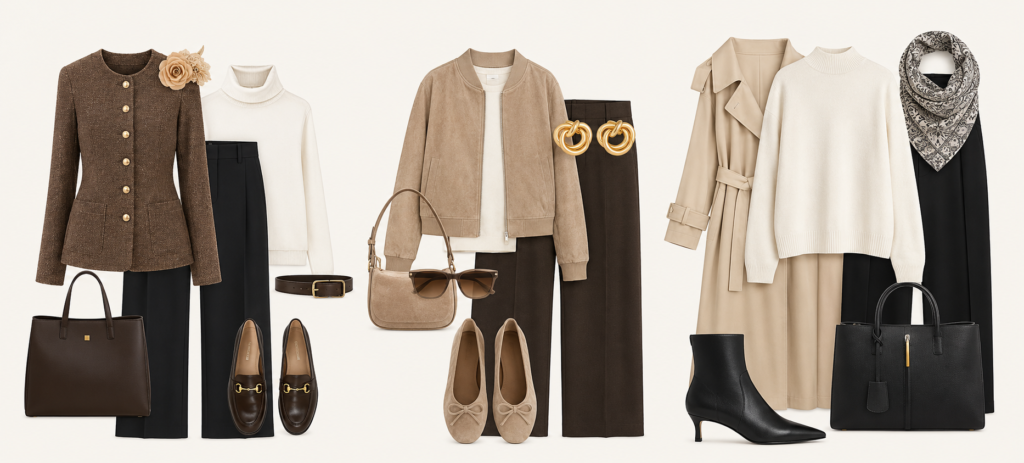
By the editors of Elegant Women Streetwear | Style & Fashion | May 2026
I want to tell you something that took me an embarrassingly long time to understand about fashion, considering how much time I’ve spent thinking about it.
The most stylish women I know — and I mean genuinely stylish, the kind of stylish that makes you glance twice across a room and then try to figure out what exactly you’re looking at — are almost never wearing anything remarkable. Their wardrobe, when you actually break it down piece by piece, is shockingly ordinary. A white tee. Dark jeans. A blazer in a neutral. A simple slip dress. A loafer. Things you own. Things I own. Things that, assembled by most of us on most mornings, produce an outfit that is perfectly fine and nothing more.
And yet somehow, on these women, the exact same pieces produce something that reads as effortless. Chic. Considered. The kind of dressed that makes people ask who you’re wearing and feel slightly confused when the answer is nothing you wouldn’t find at a shopping center on a Sunday afternoon.
What’s the difference?
That question occupied a significant portion of my thinking for about three years before I started to actually understand the answer. And the answer is not a secret formula, not a specific product, not a particular body type or skin tone or bone structure. It’s a set of principles — consistent, learnable, applicable to whatever you own right now — that transform the experience of basic dressing from adequacy into genuine style.
This is what I’ve figured out. And I’m going to share all of it with you, in detail, because fashion knowledge hoarded is fashion knowledge wasted, and because I think every woman deserves to walk out of her house feeling extraordinary in the things she already has.
Why “Basics” Have a Bad Reputation They Don’t Deserve
Let me start by rehabilitating the concept of the basic piece, because I think it’s been maligned in a way that’s done real harm to how women dress.
The word “basic” in fashion has absorbed, over the past decade or so, a secondary meaning that has nothing to do with simplicity and everything to do with ordinariness in its pejorative sense. To call someone “basic” in the cultural shorthand that developed around 2014 and persisted far longer than it deserved is to say they’re unoriginal, interchangeable, lacking in individuality. A person who drinks pumpkin spice lattes and wears UGG boots and follows trends without filtering them through any personal point of view.
This meaning has leaked into how we relate to basic wardrobe pieces, and the result is a subtle but real shame around simplicity. Women who build their wardrobes from genuinely beautiful, genuinely simple pieces sometimes feel compelled to justify this — to explain that yes, it’s a white tee, but it’s this particular white tee, as if the simplicity itself requires defense.
It doesn’t. It never did.
The basic piece — in its proper, pre-cultural-corruption meaning — is the foundation of every genuinely great wardrobe in the history of fashion. The white shirt. The well-cut trouser. The quality knit. The minimal dress. The clean shoe. These are not the things you wear when you have nothing to wear. They are the things you wear when you know exactly what you’re doing.
Coco Chanel built an empire on the removal of complexity. The French woman whose style we’ve collectively fetishized for decades wears, by most accounts, a truly limited number of pieces in an extremely consistent palette. The quiet luxury movement that has defined the aesthetic conversation of the past several years is, at its philosophical core, a vindication of the basic piece: fewer things, simpler things, better things, worn with absolute conviction.
So before we get into the how — before we talk about the specific techniques for making basics look extraordinary — I want to offer this as the foundational reframe: the basic piece is not your fallback. It is your foundation. And foundations, properly understood, are where everything interesting gets built.
The White Tee: The Most Underestimated Piece in Fashion
I’m going to start with the white tee because it is simultaneously the most accessible basic in existence and the one where the distance between doing it adequately and doing it brilliantly is greatest. The gap between a fine white tee situation and a genuinely stunning white tee situation is almost invisible in terms of the individual pieces and almost impossible to miss in terms of the overall effect.
Let me walk you through what I’ve learned about making a white tee the center of an outfit that gets noticed.
First, the tee itself. This is where most people stop paying attention, and it’s where the whole thing rises or falls. Not all white tees are equivalent, not remotely, and the differences that matter are subtler than price. What you’re looking for: a fabric with genuine weight — not so heavy that it stops breathing, but heavy enough to have presence, to fall rather than cling, to hold its shape after washing. A pima cotton or a slightly thicker jersey rather than the thin, almost see-through cotton that looks fine on the hanger and immediately wrong on a body. The neckline is critical — a crew that sits correctly (not too wide, not too tight, sitting naturally at the collarbone), or a V that’s deep enough to be intentional without being exposing. And the fit: not oversized in the way that reads as carelessness, but with a specific ease that reads as deliberate. This usually means going one size up from your true size and then, if necessary, having the hem or sleeves slightly altered. The arms should not be tight. The fabric should not strain across the chest. It should look like it chose you.
That tee — that specific, quality, correctly-fitting tee — with a pair of straight-leg dark wash jeans and a loafer, is an outfit. Not a comfortable placeholder for an outfit. An actual outfit, worn by women on the streets of Milan and Copenhagen and New York who are being photographed because they look extraordinary in something technically unremarkable.
What makes it work? The fit and quality of each individual piece doing its job completely. The proportions between them — the tee slightly tucked in front, creating a waist suggestion without the rigidity of a full tuck; the jean hitting the ankle at exactly the right point; the loafer adding structure at the base. And the white — genuinely white, cared-for, not yellowing or greying, startling in its cleanliness.
Now: elevate the white tee situation further. Same tee, same jeans, add a long single-chain necklace in gold. The gold against the white creates a warmth and intention that changes the whole reading of the outfit. Or: same tee, different bottom — a tailored midi skirt in camel or chocolate brown. The skirt does the work that the jeans do but differently, more femininely, with a quality of occasion that the denim doesn’t have. Or: the tee under a really beautiful blazer, the collar just visible above the lapel, as if the blazer was thrown on over something you were already wearing perfectly.
The white tee is not a canvas. It is the painting. The other pieces are the frame.
The Blazer: The Single Piece That Does More Work Than Any Other
If I had to choose one piece that has transformed my ability to look put together from any collection of basics, it would be the blazer. Without hesitation, without qualification. The blazer is the single most powerful styling tool available, and it is also — in its best form — a classic that requires no trend allegiance and no particular occasion to justify wearing.
Here’s what a blazer does structurally to an outfit: it provides a vertical line, which elongates. It gives the outfit a clear shoulder, which adds strength and definition. It introduces a lapel, which frames the face in a way that no other garment element does. It creates a layering opportunity that adds visual depth to even the simplest combination underneath. And it communicates, instantly and universally, a quality of intention — that the person wearing it made a deliberate choice this morning, showed up on purpose.
The blazer I reach for most consistently is what I’d call the relaxed tailored: not the structured, formfitting blazer of a business suit, which has its place but that place is increasingly narrow, and not the fully oversized blazer that can be wonderful but requires more specific proportional management. The relaxed tailored blazer sits at the intersection — it has clear structure at the shoulder and a proper lapel, but it’s cut with a slight ease through the body that allows it to be worn open over anything without looking stiff. In a neutral — camel, charcoal, ivory, a warm off-white — it works with virtually everything.
What I do with a blazer, specifically, over basics:
Over a white tee and straight-leg jeans, the blazer takes the outfit from weekend to workday to dinner without changing anything else. This is the combination that the clean girl aesthetic built an entire visual vocabulary around, and it’s been refined in 2025 and 2026 into something sharper, more specific — the blazer slightly longer than it used to be, in a fabric with real weight and presence, the tee barely visible at the collar, the jeans with enough structure that they hold their own against the blazer’s tailoring.
Over a simple slip dress, the blazer becomes the tool that takes the dress from evening-only to all-day. I wear a silk or satin slip dress with a well-cut blazer thrown over it — not fully on, just resting on the shoulders or one shoulder — and the combination is extraordinary. The femininity of the dress against the structure of the blazer creates a contrast that reads as effortlessly sophisticated. This is a street style staple for good reason: it works every time, on every body.
Over a turtleneck in autumn and winter: same principle, different texture. The turtleneck provides the warmth; the blazer provides the structure. Together they’re an outfit for a serious and beautiful person.
The blazer also introduces the possibility of what I think of as the “editorial shoulder” — wearing it slightly off the shoulders, or letting it rest at the crook of the arms, or layering it open over a full outfit rather than as the top layer. These ways of wearing require a blazer with enough structure to hold a shape when not fully on, which is another argument for quality: a well-made blazer is not a garment that collapses without body support. It has a presence of its own.
Proportion: The Invisible Architecture of Every Great Outfit
Here is the thing that I think more women need to hear, because it’s the principle behind virtually every successful styling of basic pieces and it’s almost never explicitly taught: proportion is everything.
More than color. More than brand. More than the individual quality of any single piece. The relationship between pieces in an outfit — the ratio of fitted to relaxed, the distribution of volume, the relationship between lengths and widths — determines whether those pieces read as an intentional whole or a collection of individual items that happen to be on the same body.
The basics that look extraordinary in photographs and in real life have almost always been assembled with an intuitive understanding of proportion — often unconscious, often developed through years of paying attention. But it’s not magic. It’s a learnable principle, and once you understand it, you apply it automatically.
The core rule is simple: balance volume. If the top has volume — oversized, relaxed, generous in its cut — the bottom should be fitted, or at least more fitted than the top. The wide-leg trouser with an oversized tee requires the tee to be tucked or cropped so that the volume of the trouser reads as intentional rather than overwhelming. The oversized blazer wants a slim pant or a fitted skirt underneath so that there’s a clear definition of the body somewhere in the outfit. The full midi skirt wants a fitted tee or tank on top so that the skirt’s volume can be the entire point.
The opposite is equally true: when the bottom has structure and fit — a slim trouser, a pencil-line midi, a straight-leg jean — the top can afford to be slightly more generous without losing the outfit’s coherence.
Where I see this go wrong most consistently: oversized top with wide-leg trousers and no tuck and no break in the silhouette. It’s a very common combination, and it almost never reads as intentional on a body that isn’t a certain very specific shape. The fix is always simple: tuck the top somewhere. Not necessarily fully — a half-tuck, a front-only tuck, even just blousing the top slightly by tucking then pulling a little forward — creates the visual break at the waist that tells the eye where the body is and makes the outfit make sense.
Length proportion is the other major element. Hem lengths in relationship to each other — where the top ends and where the bottom begins — create either harmony or dissonance, and the difference is visible immediately. The top that ends at the widest part of the hip is almost never flattering; it ends at exactly the point where the eye is drawn, in exactly the wrong way. The top that ends above the hip, or well below at the thigh, creates lines that work with the body rather than bisecting it at its widest horizontal plane.
None of this requires a fashion degree. It requires looking at yourself in a full-length mirror — the full-length mirror is non-negotiable and I can’t stress this enough, because we dress in fragments and live in whole bodies — and asking simply: where does my eye go first, and is that where I want it to go?
The Power of the Tuck (And Why It Changes Literally Everything)
Speaking of tucking: I want to give this its own section because it’s the single most impactful free styling technique available and it’s also the one most women either skip entirely or execute in a way that doesn’t unlock its full potential.
Tucking a top into a bottom does several things simultaneously. It defines the waist, which is the narrowest part of the torso and therefore the point where the body looks most proportioned. It shortens the visual length of the top, which is almost always desirable unless the top is specifically designed to be a longline. It creates a distinction between top and bottom that gives the outfit a defined structure — rather than garment flowing into garment without clear delineation, you have a clear upper half and lower half, a shape that the eye reads as intentional.
But not all tucks are equal, and the kind of tuck you do changes the register of the outfit significantly.
The full tuck — all the way around, shirt completely into the waistband — is the most formal and most precise. It works beautifully with high-waisted trousers and a fitted shirt, particularly when the shirt has some texture or interesting fabric quality. It can look very polished, occasionally slightly over-done, and benefits from being paired with something that loosens the formality slightly: open collar, subtle jewelry, a really relaxed shoe.
The half-tuck or French tuck — tucking just the front center portion of the shirt into the waistband and leaving the sides and back loose — is the more casual, more editorial version. It’s the technique that’s most commonly used in the kind of elevated everyday styling that defines the quiet luxury and clean girl aesthetics. It creates the waist definition of a full tuck without the tidiness, which allows for a more relaxed reading of the overall outfit. I use this almost exclusively when wearing a tee or a casual shirt with trousers or jeans — the combination of structure (the trouser) and ease (the partially untucked tee) creates the exactly right balance.
The side tuck — tucking just one side of the shirt — is a more advanced move and one that I’ll be honest, I only reach for when an outfit feels too symmetrical and needs a small element of visual interest. It can look extremely good and also look deeply accidental, and the line between the two is fabric quality and intentionality. If you’re going to side-tuck, the fabric needs to have enough weight to stay where you put it and drape correctly; a light jersey that keeps coming untucked defeats the purpose.
One tucking secret I’ve absorbed over years of trying things: the best tuck usually requires some adjustment throughout the day. This is normal. The tuck that stays perfectly positioned from morning to evening is rarer than the one that needs a quick refresh in the afternoon. Accept this, do the refresh, and stop expecting your clothes to behave like they’re sewn to your body.
Color Minimalism: The Art of Building a Palette That Does the Work for You
One of the most effective and least discussed techniques for making basics look extraordinary is developing a coherent personal color palette — a small set of colors that work together, that work on you specifically, and that you apply with enough consistency that your outfits develop a visual logic of their own.
This is different from following a trend color palette or from wearing exclusively neutrals. It’s the more personal, more specific practice of understanding what colors make your skin come alive, what shades your existing pieces share without forcing, and what hue or temperature the clothes you’re naturally drawn to have in common.
My own palette has evolved over about three years of paying attention. I’ve discovered that I’m drawn consistently to warm neutrals — ivory rather than pure white, camel rather than tan, cream, oat, warm chocolate — with occasional depth in dusty rather than saturated shades. A dusty sage. A wine rather than a red. A soft terracotta. Nothing with much blue undertone; my colouring doesn’t respond well to cool shades in the ways it does to warm ones.
This palette emerged from observation rather than intention, and that’s how the most useful personal palettes develop. Looking at the pieces you reach for consistently and noticing what they have in common. Looking at the photographs of yourself that you actually like and noticing what you’re wearing in them. These data points are more honest than any colour analysis.
Once you have a palette — even a loose, approximate one — several things happen to the experience of wearing basics. First, everything goes with everything, which eliminates the decision fatigue of outfit construction almost entirely. Second, your outfits develop a tonal coherence that reads as intentional even when it’s effortless, because you’re working within a color story rather than making random combinations. Third, you stop buying things that don’t belong to your palette, which is one of the most effective wardrobe editing tools available: if you don’t know where it goes, you don’t buy it.
The tonal outfit — dressing head to toe in variations of a single color — is one of the most powerful expressions of this principle, and one that’s been increasingly prevalent in both high fashion and street style in 2025 and 2026. An entirely cream or ivory outfit — ivory linen trouser, ivory silk tank, ivory or camel sandal — is not boring. It’s quietly radical in its commitment. It elongates. It unifies. It reads as extremely considered. And it’s produced entirely from the most basic pieces imaginable.
The contrast approach works within a palette too: your two or three most consistently worn neutrals can be paired against each other with full confidence. Ivory against camel. Chocolate against cream. Oat against dusty sage. These are not loud combinations but they have depth and warmth in a way that same-color combinations don’t, and they’re produced without any real effort once you know your palette.
Fabric Quality: The Investment That Transforms Every Basic
I want to talk about money now, specifically and honestly, because the subject of quality basics and their cost is one where I think women are often given either unhelpfully elitist advice (spend whatever it takes, the expensive one is always better) or unhelpfully wishful advice (the cheap version is just as good if you know what to look for). The truth, as always, is somewhere in between and worth being specific about.
Fabric quality matters more for basics than for any other category of clothing, for a simple and important reason: when a garment has no embellishment, no print, no complex silhouette, no trend element doing visual work, the fabric is the entire point. There’s nothing else. The white tee lives or dies on the quality of the cotton it’s made from. The cashmere knit is extraordinary or ordinary based almost entirely on the fineness and weight of the fibres. The silk slip is luminous or flat depending on the momme weight of the silk and how it was processed.
This means that if you’re going to spend money on anything fashion-related, spend it on the basics first. Not on the party dress you’ll wear three times. Not on the trend piece that will read as dated in eighteen months. On the things you wear daily, in the pieces that the rest of your wardrobe depends on.
What to look for, specifically, when evaluating fabric quality: touch, which is more reliable than you might expect — quality fabrics have a weight and a density that communicate themselves immediately to your hands, while cheap fabrics tend to feel thin, papery, or plasticky in a way that’s hard to ignore. Drape, which is how the fabric behaves when it’s hanging rather than stretched — quality fabric moves with intention, pooling and folding in ways that look controlled rather than collapsing or puckering. And the weave or knit density, which you can see by holding the fabric up to light — a quality fabric has density that prevents the bleed-through that makes cheap white fabric see-through and cheap dark fabric shiny.
Specific fabric investments worth making: a really excellent cashmere knit, in ivory or camel or a shade specific to your palette. This is the piece where quality is most immediately felt and most visibly expressed. Even a single quality cashmere sweater — worn with jeans or trousers or a silk skirt — elevates every combination it enters. The difference between good cashmere and cheap cashmere is so significant that I’d rather own one of the former than five of the latter.
A well-made linen shirt or trouser, in a fabric that’s dense enough to drape without transparency. Linen quality varies enormously, and the best version — structured, dense, slightly matte — is worth seeking out because it behaves completely differently from cheap linen, which wrinkles into illegibility and loses its shape within hours of being ironed.
Quality denim, where the weight of the fabric determines how the jeans hold their shape across a full day. Good denim has a stiffness when you first put it on that softens with body heat into a perfect fit; cheap denim is already soft and stays soft, which means it stretches and bags in ways that the good version doesn’t.
And the silk or silk-adjacent fabric for the slip dress or camisole, where the weight — the momme count — determines whether the fabric falls with grace or clings with static. Under about 16 momme, silk becomes flimsy and slightly see-through; above it, it has the liquidity and presence that makes it worth owning.
The Shoe Conversation: Why Your Footwear Is Deciding Your Outfit
I’ve been quietly building toward this section throughout the piece because I think shoes are where more styling decisions succeed or fail than any other single element, and where the difference between putting together basics and styling basics is most clearly demonstrated.
The wrong shoe doesn’t just fail to contribute to an outfit. It actively works against it. It sends a signal that contradicts everything else the outfit is saying, and the contradiction registers, consciously or not, as incoherence. An otherwise excellent outfit — the quality tee, the well-cut trouser, the right proportions — with the wrong shoe reads as unfinished. As if someone got 90% of the way there and then grabbed whatever was nearest to the door.
What makes a shoe right for a basic outfit? It’s about the register — the level of formality or casualness that the shoe communicates — matching and occasionally complementing the register of the rest of the outfit. The wide-leg linen trouser has a casual elegance that calls for a shoe in the same register: a flat leather sandal, a clean minimal sneaker, a low-heeled mule. A chunky platform sneaker is in a different register entirely and the disconnect reads immediately, not as interesting contrast but as incompleteness.
The shoes that do the most work with basics, consistently, in my experience:
The pointed-toe flat — in leather, in nude or black or a warm tan — which adds a specificity and intentionality to the foot that a round-toe flat doesn’t. The point is the detail. It sharpens the silhouette in a way that’s particularly effective with wide-leg trousers or midi skirts, where the narrowness of the shoe creates a visual contrast with the volume above it.
The loafer, which has become the shoe of the moment in elegant streetwear and for very good reason: it has enough presence to read as chosen rather than defaulted to, it works across an enormous range of occasions and outfit registers, and it comes in enough variations — the penny loafer, the horse-bit loafer, the chunky sole loafer — that there’s a version for every aesthetic inflection.
The kitten heel or block-heeled mule, which adds the elevation that changes an outfit’s proportions and occasion-appropriateness without the commitment or the physical demand of a full heel. A small heel on a mule or a slingback takes jeans from daytime to evening, takes a midi skirt from casual to dinner, takes the silk slip dress from bedroom to restaurant. The elevation is perhaps two centimeters of work and a disproportionate shift in how everything above it reads.
And the white leather sneaker, which is the elegant streetwear’s foundational shoe: clean, minimal, quality, and capable of the kind of contrast-that-works — casual shoe, elevated outfit — that defines the whole aesthetic. The sneaker must be genuinely white, genuinely leather (or leather-look that convinces), and genuinely clean. A grey or dingy sneaker does the opposite of what a white sneaker is supposed to do.
Accessories: The Finishing Vocabulary of Every Basic Outfit
Accessories are where the personal voice enters the basic outfit, and where the difference between someone who has style and someone who merely has clothes becomes most visible. Basics, by definition, have no voice of their own — they’re deliberately neutral, deliberately simple. The accessories are where you speak.
But speaking through accessories requires knowing what you actually want to say, and this is where a lot of women either overcrowd (adding multiple competing accessories that cancel each other out) or underspeak (adding nothing and leaving the outfit with no personality whatsoever). The skill — and it is a learnable skill — is in choosing one or two accessories that add precisely the right amount of statement without disrupting the outfit’s underlying coherence.
Gold jewelry is where I start almost every outfit, because it’s the most versatile and the most reliably flattering of all the jewelry options and because it works with virtually every neutral palette. The specific gold pieces that do the most work: a set of small-to-medium hoops that can be worn alone or stacked with studs. A fine chain necklace — single or layered, the layering done with chains of slightly different lengths to create texture without chaos. A simple cuff or set of bangles in a warm gold. These are not statement pieces in the traditional sense; they’re vocabulary pieces, the small words that make the sentence make sense.
The statement earring is the exception — the one piece in the jewelry category where more is occasionally appropriate and often transformative. When the outfit is very simple and very neutral — the tonal look, the white-on-white, the basics at their most minimal — a sculptural earring in gold or something with presence creates the focal point that the outfit needs. The earring becomes the thing the eye goes to, the thing that gives the woman wearing it an individual quality. And it costs almost nothing in terms of the outfit’s overall weight because a strong earring can replace every other piece of jewelry completely.
The bag is the other major accessory decision, and I want to make an argument I’ve been building toward for a while: the bag is worth the investment more than almost any other single item because it is the accessory that most consistently touches every outfit. The shoes change. The jewelry varies. The bag goes everywhere. A really excellent bag — in a quality leather, in a color that belongs to your palette, in a shape that works for your actual life — will do more for the sum of your outfits across a year than almost anything else you could buy.
The scarves and belts that I’d add as the third category: both are incredible multipliers of basic outfits and both are chronically underused. A beautiful silk scarf — worn at the neck, in the hair, tied through a bag handle — adds color and texture and a quality of European ease to any basic outfit. A well-chosen belt — in leather, in a cognac or tan that works with your palette — can define a waistline, add structure to an oversized layer, and introduce a visual detail that makes a simple outfit look composed.
The Clean Girl Aesthetic and What It Actually Requires
The clean girl aesthetic — which has been influential enough and long-lasting enough to have moved well past trend into something that genuinely qualifies as a lasting style philosophy — is, at its core, an advanced practice of styling basics. And it’s worth unpacking what it actually requires, because I think the aesthetic has been misunderstood in ways that make it seem either more effortful or less achievable than it actually is.
The clean girl, properly understood, is not about literal cleanliness (though clean clothes and clear skin are part of the visual). She’s not about being makeup-free or minimal or even particularly neutral. She’s about a quality of coherence — a put-together quality that comes from the sense that every element of her appearance has been considered, even when the individual elements are completely simple.
What this actually requires in practice:
Skin that looks cared for. This is the baseline, and it’s worth taking seriously. The clean girl aesthetic was always skin-forward — the luminous, clearly tended, alive-looking skin that works as the visual foundation for minimal everything else. In 2026, this aesthetic has evolved from its original very matte, very glass-skin direction toward something warmer and more individual — a cream blush placed high, a gloss, a skin that looks like a woman who sleeps enough and drinks water and uses the three or four skincare products that actually do something for her specifically. The soft glam version of clean girl adds a mascara, a defined brow, and occasionally a very fine liner — not to add drama but to add definition, to give the face the same precision that the clothes have.
Hair that is clearly something rather than simply uncertain. The clean girl’s hair is not messy because she didn’t try — it’s undone because she chose undone. The sleek bun is sleek. The low ponytail is smooth. The loose waves are conditioned and deliberate. Even when the hair is up in the most casual possible way, there’s a quality of intention behind it. This is achievable by anyone, and it usually comes down to having a clean base — freshly washed or properly refreshed — and then making a clear choice rather than just pulling the hair somewhere.
A palette, as I described earlier. The clean girl’s palette is one of her most defining characteristics: it’s usually narrow, usually warm, usually built from a few shades that she knows work on her and that she applies with enough consistency that her outfits have a visual signature. You don’t need to be minimalist. You need to be coherent.
And the quality I keep returning to: the intention behind every element. This is what makes the clean girl’s simple outfit look styled rather than merely dressed. It’s not about effort — she’s not spending more time than anyone else. It’s about the quality of attention she’s bringing, the sense that she’s showing up for her own appearance rather than moving through it.
Building Your Capsule: The Basics Worth Actually Owning
I want to spend time here being specific, because a piece about basics that doesn’t get specific about which basics would be doing you a disservice.
The pieces I consider genuinely foundational — the ones I’d rebuild from if I were starting over — in roughly the order I’d acquire them:
The white tee in the best quality you can access, in a fabric with weight and a fit with ease. One version in a true white, one in a slightly warm ivory, because they do different things with different palettes and neither is a duplicate. These are the first thing you pull over almost everything, the piece that makes every other piece look slightly less complicated.
The straight-leg or wide-leg trouser in a dark neutral — dark indigo denim, dark chocolate linen, deep charcoal in a quality ponte or cotton. The trouser that reads as dressed even when paired with the most casual top. One pair is a start; two pairs in different fabrications is a wardrobe.
The blazer I described in detail earlier — relaxed tailored, in a warm neutral, in a fabric with presence. This is the single most multiplying piece in the basic wardrobe and worth a significant investment because it will be the thing you reach for every time something needs to be upgraded.
The cashmere or quality-knit sweater, in the shade that does most for your colouring. One crew, one V-neck or scoop, in your two most-used shades. These replace the white tee for cooler months and add a texture that changes the entire feel of any outfit they enter.
The midi skirt — in a fabric that moves. A silk or satin, or a heavy cotton in a bias cut. This is the piece that takes anything casual above it and makes it dinner; the piece that pairs with the blazer for a particularly elegant moment; the piece that proves, more than any other, that a simple garment in a beautiful fabric is more powerful than a complicated garment in an ordinary one.
The slip dress, in a shade belonging to your palette. Worn alone in summer, layered under the blazer or with a fine-knit cardigan in other seasons, this is the one-piece solution to almost any occasion.
And then the shoes: the loafer in cognac or black, the white leather sneaker, the minimal flat sandal, the small-heeled mule. Four shoes that cover the full range of basic outfit occasions without redundancy.
That’s a wardrobe. Not a complete one, not a final one, but a foundation so strong that every additional piece you add will work because it’s joining a coherent system rather than contributing to a chaotic accumulation.
The Mirror Moment: Making Yourself Look Before You Leave
Here’s the habit that I think has done more for the quality of my daily dressing than any other single thing: looking at myself in a full-length mirror, completely, before I leave the house. Not a quick glance at a partial reflection in the bathroom mirror while I’m brushing my teeth. A full look, from head to toe, with enough time to actually register what I see.
This sounds obvious. It is not universal. I went through a long period of dressing in fragments — seeing my top in the bathroom mirror, checking my shoes in the entryway, and never actually seeing the full outfit as an entity. The result was outfits that were individually reasonable and occasionally wrong as a whole.
The full-length mirror look takes thirty seconds and it tells you immediately whether the proportions are working, whether the tuck is right, whether the shoe is landing correctly, whether the accessories are doing their job or fighting each other. It also tells you something more subjective and more important: whether you look like yourself. Whether the outfit is an expression of who you are on this specific day, or whether you’ve assembled something technically fine that doesn’t feel like anything.
Trust that second-order feeling. The “this is technically fine but something’s off” sense is almost always accurate, and it almost always has a specific fixable cause if you’re willing to stand in front of the mirror long enough to identify it. A different shoe. The tuck adjusted. One accessory removed. The blazer on rather than draped. These are thirty-second fixes that transform “fine” into “actually great.”
The mirror also — and this matters enormously — gives you the opportunity to see yourself positively before the day has a chance to do otherwise. To take in the full picture of a woman who has gotten dressed with intention, in pieces she loves, in a way that expresses something true about her, and to simply appreciate that before moving on. This is not vanity. It’s a daily practice of inhabiting yourself with some measure of grace.
Style Over Time: How Basics Build a Signature
The last thing I want to say — and I think it’s the most important — is that the relationship between a woman and her basics evolves, and the evolution is one of the most satisfying things about fashion done this way.
When you commit to basics, to quality and simplicity and personal palette and proportion, you’re not buying an aesthetic for a season. You’re building a signature. Over months and years, the way you put things together becomes recognizable — to others, but more importantly to yourself. You develop a shorthand with your own wardrobe. You know, without thinking, that this goes with this, that these proportions work on you, that this color does what you need it to do today.
This is what the women whose style I described at the beginning have developed: not a formula or a trend allegiance, but a genuine relationship with their own taste, expressed through pieces so simple that the simplicity itself becomes the statement. The white tee is not a white tee; it’s her white tee, worn the way she wears it, with the things she puts with it, in the proportion she’s perfected. It’s recognizable. It’s hers.
That’s what I’m working toward, and what I hope you’ll work toward too. Not a more expensive wardrobe or a trendier one or a more curated-for-the-internet one. A more you one. A wardrobe that is a genuine expression of your specific taste, your specific body, your specific life, assembled from pieces so simple that they require no explanation and so well-considered that they need none.
That’s the whole art. That’s what it means to style basics to look put together.
You already have most of what you need. Now it’s just a matter of learning to see it.
One Last Thought, and It’s the Most Honest One
I want to end with something that I don’t see enough in fashion writing, because fashion writing tends to exist in the aspirational register and rarely stops to acknowledge the gap between aspiration and reality: the days when you get it wrong, and what those days mean.
You will get dressed and look in the mirror and it will be off. The proportions will be wrong, or the color will be wrong, or the shoe will be fighting the outfit rather than supporting it, or you’ll just feel like yourself in it and you won’t be able to say why. This will happen. It happens to me. It happens to every woman whose style I admire.
What matters on those days is not perfection but the practice. The practice of trying, of thinking about it, of caring about how you show up in your own life. The practice of noticing and adjusting and trying again. Of taking the thirty seconds in front of the mirror rather than skipping it. Of choosing the piece you love over the piece you merely tolerate.
Because the looked-at life is a more beautiful life than the overlooked one. The outfit chosen with care is a more satisfying outfit than the one grabbed in haste, even when both look similar from the outside. The woman who is present in her own appearance — not vain, not obsessed, but attentive, caring, engaged — is a woman who is, in some small daily way, taking herself seriously.
And that seriousness — that quality of caring about the small expressions of who you are — is the most essential ingredient in looking put together. More than any basic. More than any technique. More than any palette or proportion or perfectly chosen shoe.
It’s just you, paying attention to yourself. And that’s always been enough.