
By the editors of Elegant Women Streetwear | Beauty & Lifestyle | May 2026
There is a photograph of me from about four years ago that I keep returning to. Not because it’s particularly flattering — actually, it’s the opposite of that — but because it’s honest in a way that most photographs I was taking of myself at the time weren’t. I’m sitting at a café table in the afternoon light, not posed, not ready for it, caught mid-conversation by someone who thought the moment was worth keeping. I’m wearing what I wore every day in that period of my life: a full face of carefully constructed makeup. Foundation that matched my skin perfectly. Concealer in all the right places. A contour so well-blended it looked effortless. Eyes with four products minimum. A lip in whatever shade I’d decided was the right one.
I look at that photograph now and what I see is a woman doing a very skilled impression of herself. A woman whose face is technically excellent. Whose makeup, objectively, is well done. And who looks, in the particular honesty of a candid photograph, like someone wearing a very sophisticated mask.
I’m not saying the mask was wrong. I’m saying it had become involuntary. I had stopped making choices about how I presented my face and started operating on autopilot — an autopilot calibrated to a version of myself that was a bit smoother, a bit more constructed, a bit more finished than the actual daily version. And somewhere in that autopilot, I had lost something I’ve been slowly, carefully recovering ever since: the feeling of confidence that comes not from looking perfect, but from looking genuinely like yourself.
That recovery is the subject of this piece. Not “how to look bare-faced and brave” — I am not interested in bare-faced-as-a-statement any more than I’m interested in full-coverage-as-a-statement. I am interested in something much more specific and, I think, much more useful: the art of natural makeup that actually does something. That enhances rather than reconstructs. That makes you look like a better version of the face you were born with rather than a different face entirely. That produces the particular confidence of a woman who knows herself well enough to express rather than conceal.
This is what natural makeup, done properly, actually is. And over the next seven thousand or so words, I’m going to tell you everything I know about doing it.
The Natural Makeup Misconception That’s Been Holding Everyone Back
Before we get into techniques and products and the specific magic of a well-applied cream blush, I need to address a misconception that I see everywhere and that causes real harm to women’s relationship with their own faces: the idea that natural makeup means less makeup or worse makeup.
It doesn’t. Natural makeup is not about being minimal in terms of effort or skill. It’s about being minimal in terms of visibility. The goal is a face where the makeup disappears into the skin rather than sitting on top of it — where the result looks like what you’d look like if everything just happened to be going extremely well for you. Great sleep, great hydration, great genetics, great genes. That. Not a bare face. A good face.
This distinction matters because it changes how you approach your products and techniques. When you’re going for visible coverage, you work down — you lay products on the skin in layers, building from the outside in. When you’re going for natural enhancement, you work with — you choose products that move with the skin, blend into it, disappear into its texture rather than sitting above it. The techniques are different. The product choices are different. The result is completely different.
The other misconception worth dismantling: that natural makeup is less high-maintenance or less skilled than full glam. This is not true, and if anything, the reverse is sometimes the case. Achieving a convincingly natural face — where the products are invisible but their effect is clearly present — requires more precision in some ways than achieving a full glam face, because there’s nowhere to hide. A full glam face can absorb small imperfections into its overall drama. A natural face cannot. Every product has to be exactly right: blended past the point where a bolder look would stop, placed with precision, chosen for its ability to disappear.
The natural makeup woman of 2026 is not someone who has given up on beauty or opted out of aesthetics. She has developed a more sophisticated relationship with both — one that’s anchored in self-knowledge and expressed with specific, considered, practiced skill. She knows her face. She knows what it needs and what it doesn’t. And she applies precisely that, nothing more.
That’s the goal. Let’s talk about how to get there.
Starting With Skin: Why the Foundation Comes Before the Foundation
Every natural makeup look is built on skin, and skin that hasn’t been tended to properly is the thing that makes natural makeup fail. When skin is dry, the products sit in patches. When skin is oily in the unbalanced way that comes from dehydration or an over-stripped barrier, they move. When skin is uneven in texture from congestion or dryness or old dead cells, even the most beautifully applied product looks slightly off. The skin preparation step is not the warm-up act. It is the show.
I want to walk through the morning skin prep that sets up a natural makeup look properly, because it’s specific and it matters.
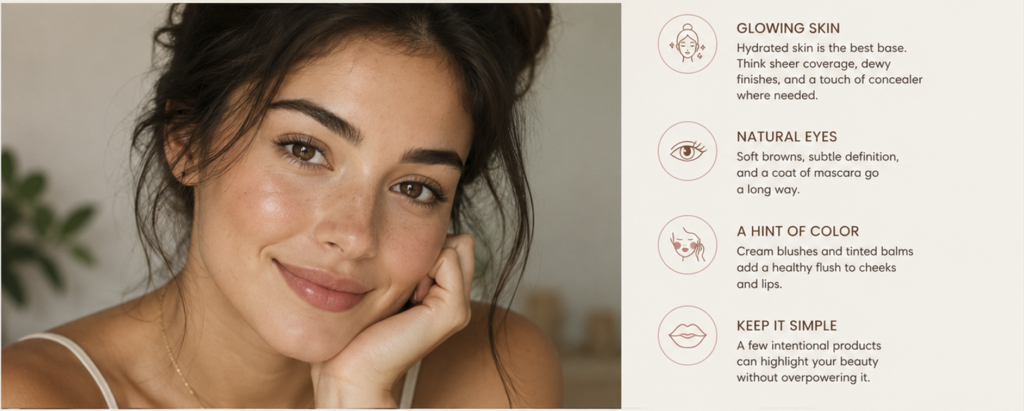
Start with a gentle cleanse — and in the morning, this often means the most minimal possible cleanse. Unless you went to bed wearing something heavy or your skin produces significant oil overnight, your morning cleanse should be barely a cleanse at all. Cool water and clean hands, or at most a micellar water on a cotton pad. The goal is to remove whatever accumulated overnight without stripping the skin you’re about to apply products to.
The next step is the one that most directly influences how makeup wears: a good hydrating serum with hyaluronic acid, niacinamide, or both. These are the ingredients that actually fill the skin with moisture rather than just sitting on top of it, and the difference in how foundation and skin-tint products apply on well-hydrated skin versus dehydrated skin is genuinely startling once you’ve seen the contrast. Well-hydrated skin accepts product beautifully — it blends, it sets, it stays. Dehydrated skin repels product in a way that makes everything look cakey and emphasizes every fine line.
After the serum has absorbed — genuinely absorbed, give it ninety seconds — a moisturizer that suits your skin type. For natural makeup purposes, this moisturizer needs to be compatible with the makeup products you’ll apply over it. The main thing to avoid: heavy silicone-based moisturizers under silicone-free foundations, or vice versa, because the mismatch creates a slightly separating quality that makes natural makeup look anything but. For the most seamless skin, I look for moisturizers with a semi-matte to satin finish rather than a high-shine one, which makes the skin prep and the skin products work together rather than at cross purposes.
Then sunscreen — and I’ll say this for the thousandth time because it’s the truth and it needs repeating: SPF every morning, non-negotiable, before everything else goes on. The SPF I use for natural makeup days specifically is a mineral one with a slightly brightening finish rather than a flat matte, because the subtle luminosity it adds works with the skin rather than creating an ashy underlayer for color products to sit on.
This four-step prep takes about three minutes once you’ve done it enough times to stop thinking about it. What it produces is a canvas that accepts natural makeup in a way that no amount of product can compensate for if the prep has been skipped.
Now: primers. My relationship with primers is complicated, and I think the natural makeup approach to them is different from what most beauty writing suggests. The traditional primer-as-pore-filler is not your friend in natural makeup. Heavy silicone primers do exactly what they’re designed to do — fill texture and create a smooth surface — and the surface they create is not skin. It’s a layer above skin, and it’s this layer that makes foundation look, eventually, slightly mask-like. For natural makeup, I prefer a hydrating primer (essentially an extra shot of moisture and a slight tackiness that helps products adhere) or, in many cases, no primer at all. When the skin prep has been done properly, the skin itself is the primer.
The Skin Product Conversation: Tints, Foundations, and Knowing the Difference
The category of skin products has exploded in the past few years in a way that’s both exciting and slightly overwhelming. The traditional distinction between foundation (full coverage, designed to cover) and tinted moisturizer (light coverage, designed to enhance) has been complicated by the arrival of a dozen intermediate categories: skin tints, serum foundations, buildable-coverage foundations, “your skin but better” products that seem designed to do everything for everyone.
I want to cut through this with something simple: for natural makeup, the product you want is the one that looks most like skin when you look at it closely. Not skin with everything covered. Skin with its texture and variation present, just improved. Your pores should still be visible, your skin’s natural variation in tone still present in a quieted way. If the product fully obscures the texture of your skin when you hold your arm up to the light, it’s too much for natural makeup.
In practice, this usually means choosing something in the lighter end of the coverage spectrum. A skin tint or a tinted SPF for days when your skin is behaving well and just needs a unifying touch. A serum foundation — the category that applies as a serum and builds coverage through layers rather than being heavy from the start — for days when a bit more evening is needed. A light-to-medium foundation, applied with a damp sponge rather than a brush (the sponge pressing products into the skin rather than across it, which is the difference between natural and painted), for days when actual coverage is needed but the goal is still for that coverage to disappear.
The application method is, I would argue, more important than the product choice for natural makeup. The same foundation applied with a damp beauty sponge using pressing and bouncing motions versus applied with a dense brush using sweeping motions will look like two different products. The sponge application leaves the skin’s texture visible and the product seamlessly integrated; the brush application, no matter how well done, has a slightly more finished quality. For natural makeup, finish the brush-work and go back in with the sponge. Always the sponge last.
Shade and undertone deserve a dedicated paragraph because getting them wrong is the single thing most likely to make natural makeup look unnatural. The wrong shade — even slightly wrong — creates a visible line at the jaw, a neck that’s a different color from the face, an overall impression of wearing a product rather than having good skin. In 2026, with the quality and range of shade matching tools available — both in stores and through apps — there’s no excuse for wearing the wrong shade, and I’d encourage every woman who hasn’t had a professional shade match in the past year to have one. Skin changes seasonally and with age; the shade you’ve been buying for three years may not be the shade you actually need today.
Undertone matters as much as shade depth. A pink-undertone product on a yellow-undertone skin makes the face look slightly grey; a yellow-undertone product on a pink-undertone skin can look muddy. The warm-cool-neutral undertone classification that most products use is a blunt instrument, but it’s still an important one. The specific thing I look for: when the product is on my skin, does it look like more of my skin or does it look like something on my skin? If it’s the latter, the undertone is probably wrong even if the depth is right.
Concealer as Sculptor: Using It Precisely Rather Than Extensively
The concealer conversation in natural makeup is one of my favorites to have because it’s where I think the philosophy of enhancement versus coverage is most clearly demonstrated — and where the difference between natural-looking and slightly mask-like is most determined.
The instinct with concealer, particularly for women who have been taught that concealer’s job is to cover, is to apply it broadly. Under the entire eye. Across every blemish. On every area of redness. The result is a face where the coverage is technically thorough and the impression is of slightly unrealistic skin — the too-perfect blending that reads as work, as intervention.
The natural makeup approach to concealer is surgical rather than broad. The goal is to address specific issues — the darkness directly under the eye, the active blemish, the area of significant redness — rather than to create an even canvas. Because here’s the thing that took me a long time to understand: some variation in skin tone is normal and natural, and the eye reads it as such. The slight warmth at the cheekbones, the very slight dimming at the temples, the mild colour variations that healthy skin has — these are not problems to be solved. They’re what skin looks like when it’s being skin. Covering them completely produces the subtle wrongness of the mask.
Under-eye concealer specifically: I apply it in an inverted triangle shape — the point toward the cheek, the top edge following the lower lash line — and I blend it with my ring finger using gentle patting motions (never dragging, because the under-eye skin is the most delicate on the face and dragging pulls it in ways that create fine lines over time). The triangle application covers the darkness that’s actually visible — the inner corner shadow, the dark pigmentation that runs from under the lash line toward the cheek — without powdering or deadening the whole under-eye area.
The concealer shade for under eyes needs to be a half-shade to a shade lighter than your foundation, with a slightly peachy or warm undertone — the warmth counteracts the blue or purple tones of under-eye shadow in a way that pure light shades don’t. Too yellow looks muddy; too light looks like highlighter territory. The warm peachy light that matches the inner corner of most people’s eyes and blends imperceptibly into the skin: this is what you’re looking for.
For blemishes: a small, precise application directly on the blemish, concealer shade matched as closely as possible to skin tone, blended at the edges only and not in the centre. The instinct is to blend everything out; the natural makeup technique is to leave the center of the concealer dense (where it’s doing the covering work) and blend only the perimeter (where it’s meeting the skin). This produces coverage that disappears at the edges — naturally integrated — rather than coverage that’s been blended into a transparent wash that doesn’t actually cover anything.
Setting concealer — particularly under the eye, where creasing is the enemy of natural-looking makeup — is an art form in itself. The technique that consistently produces the most natural result: a very small amount of translucent powder pressed (not swept) onto the concealer with a damp beauty sponge or a dense mini brush, then lightly brushed away to remove any excess. This sets without caking, prevents creasing without creating the dry, almost-old-skin effect that heavy powder setting produces. The under-eye should look like skin — slightly luminous, slightly alive — not like it’s been powdered matte.
Blush: The Most Transformative Product in Natural Makeup
I have a strongly held opinion about blush, and it’s this: blush is the most transformative product in the natural makeup toolkit, and it is also the one most frequently either skipped entirely or applied in a way that makes it look like a stripe rather than life.
The right blush, in the right place, applied in the right way, does something to a face that no other product replicates. It makes you look warm. Alive. Like someone who has just been in fresh air, or who has been laughing, or who is happy to be where they are. It creates a quality of health and vitality that’s instantly read as attractive — not because attractiveness is the goal of makeup, but because the biological signals of health and vitality are what a well-placed blush mimics.
In 2026, the blush conversation has moved definitively toward cream and liquid formulations over powder, and I think this represents a genuine improvement in how most people experience blush. Cream blush blends into the skin rather than sitting on top of it, which means it reads as inherent rather than applied — exactly what natural makeup is trying to achieve. Powder blush, particularly when applied over full-coverage foundation, can have a slightly theatrical quality. Cream blush on skin-tinted skin looks like a person.
The colour selection for natural blush: this is more personal than almost any other makeup choice because blush colour is one of the things most significantly affected by individual skin tone and undertone. The general principle I apply: find the shade that your cheeks actually go when you’ve been out in cold air or when you’re slightly warm — that flushed, real colour — and replicate that. For most women, this is somewhere in the spectrum from peachy-pink to berry depending on how cool or warm the natural flush reads. Too orange reads as sunburn; too pink reads as artificial. The right shade is the one that makes people not notice you’re wearing blush, just that you look alive.
Placement is where natural blush technique diverges most sharply from traditional technique. The old advice — smile, apply to the apples of the cheeks — produces a blush that sits in a horizontal stripe across the face, which photographs as artificial and reads in real life as slightly clown-adjacent. The placement that reads as natural: slightly higher on the face, closer to the temples, starting at a point roughly beneath the outer corner of the eye and blending back and very slightly up toward the hairline. This placement follows the natural flush pattern of the face — blush gathers highest when you’re warm or exhilarated, not at the apple — and creates a lifting, brightening effect rather than a horizontal bar.
For application: with cream blush, I use my fingers. This is the technique I resisted for a long time because it seemed imprecise, and it is the technique I will now defend passionately because the body warmth of the fingers helps the product melt into the skin in a way no brush or sponge can replicate. Tap, press, blend out. Concentrate the color at the placement point and let it diffuse naturally toward the edges with very little blending effort needed.
Sun-kissed blush — extending the blush slightly across the nose and onto the forehead — is the 2026 evolution of this technique that I’ve been integrating into natural everyday looks with results I find deeply satisfying. It mimics the sun’s effect on the face in a way that reads as completely real, adds warmth to the overall look, and does something beautiful to the way the nose and face read in photographs. Applied with a very light hand in a slightly bronzy-pink, it’s one of the things that makes a natural makeup face look like it’s been somewhere wonderful recently.
The Eye Look That Makes Natural Makeup Work: Soft Definition Without Drama
The eyes in a natural makeup look are where the most nuance lives — because the goal is definition without drama, which is a harder target than either end of the spectrum. Full drama is easy to achieve; everyone knows how to add. Truly bare eyes are easy: add nothing. But the soft definition that makes the eyes look slightly larger, slightly brighter, slightly more present, without looking like any specific product has been applied — this requires specificity.
Here’s my current everyday eye approach, built over years of trying things that looked good on the tutorial and wrong on my face.
The brow is first and it’s the thing that matters most. I’ve said this before and I’ll keep saying it: a well-groomed, naturally shaped brow is worth more to the face than almost any other makeup decision. The 2026 brow is not the sharp, heavily filled brow of a few years ago and it’s not the bare-as-possible brow of the generation before that. It’s the natural brow — your actual brow, shaped slightly at the underside to remove stray hairs and define the line, with a little product to fill sparse areas and fix hairs in place. Nothing more. The brow product should be the same colour as your actual brow hair or one shade lighter. Darker reads as drawn. And the finish should be matte-to-slightly-textured rather than waxy, because the goal is a brow that looks like hair rather than a brow that looks like a product.
Mascara is the second most impactful eye product in a natural look and also the one I see most often used in ways that undermine the natural effect. The instinct is to build mascara until the lashes are as defined and volumised as possible — which, taken to its natural conclusion, produces lashes that read as false rather than real, which is the opposite of natural. For the natural everyday look, two or three coats of a good mascara — applied properly, meaning wiggling the wand at the root and then combing through to the tip, and letting each coat dry before applying the next — produce definition without the spidery quality that signals over-application. The lashes should look like great lashes, not like a lash product.
Eyeliner, when I use it for natural looks, is always brown rather than black. Black liner on a natural face creates a contrast that reads as added, as artificial. Brown — particularly a warm or espresso brown — mimics the natural variation in colour around the eye and adds definition in a way that’s almost invisible as liner. A very thin line, tight against the upper lash line, smudged almost immediately with a finger or a cotton bud so that it reads as a shadow rather than a line. This is the line that makes eyes look more defined without making them look lined. It’s a technique that sounds basic and produces results that I don’t know how to achieve any other way.
Eye shadow in a natural look: I default to one or two neutral shades maximum, applied where shade naturally exists on the eye. The very slightest deepening of the outer corner and the crease, in a matte shade one or two steps deeper than your skin tone. No shimmer in natural daylight makeup — shimmer catches light in a way that reads as applied, as an intervention. The matte neutral shadow is genuinely invisible in most lighting and creates depth that makes the eye look more three-dimensional, more expressive.
The inner corner highlight — a tiny touch of something very slightly luminous at the very inner corner of the eye, where the tear duct is — is the secret touch that I find most reliably brightening. It mimics the natural reflective quality of a well-rested eye, where the inner corner catches light slightly more than the rest. In natural makeup, this is done with a very small amount of a champagne or peach-toned highlighter or even a light-reflecting concealer tapped with the ring finger. Very small. Often less than you think.
The Lip: Completing a Natural Look Without Losing the Natural
The lip in a natural makeup look has gone through a beautiful evolution in the past few years, and the current iteration — the 2026 version of natural lip — is my favourite it’s ever been.
For a long time, “natural lip” in beauty culture meant either a nude that was close to your skin tone (often deeply unflattering, often producing the illusion of no lip at all) or a tinted balm that added the palest suggestion of colour without actually doing anything interesting. These approaches prioritised the literal naturalness of the lip — no visible product, maximum natural appearance — at the cost of actually making the lip look good.
The current understanding of natural lip is more sophisticated than that, and it comes directly from the skin-first beauty philosophy that’s defined the past several years. A natural lip is not a lip with no product. It’s a lip that looks naturally beautiful — full, healthy, with the slight variation in colour that a real lip has (slightly darker toward the outer edges, slightly warmer at the centre), and with a finish that reads as alive rather than coated.
The product that does this most effectively, in my experience: a sheer lipstick or a tinted lip balm in a shade that enhances your natural lip colour by a single step. Not dramatically different — not a different colour, not a different tone — just more of what’s already there. If your natural lip is a muted rose, find a sheer rose that intensifies it. If it’s more peachy, find a sheer peachy nude. The shade that makes people look at your lips and think “her lips look incredible” rather than “she’s wearing lipstick” is the one that’s closest to your own lip’s natural colour, amplified.
The gloss has made a full and enthusiastic return in 2026, and for natural everyday makeup I think it’s one of the most useful tools available. A clear gloss, or a gloss with a very slight tint, applied over the natural lip or over a sheer lipstick base, produces a plumpness and luminosity that reads as natural precisely because it’s so reflective — it mimics the moisture of a natural lip. The finish is not costume-y or dramatic; it’s the lip that looks like it just took a sip of water.
Lip liner in natural makeup: I’ve come back to it in the past year, used in a very specific way. Not to overdraw or redefine the lip — which is the traditional liner use and which never reads as natural regardless of execution — but to prevent the feathering that some sheers and glosses have when worn alone. A liner matched exactly to the lip tone (not the product tone, the actual lip tone) traced just inside the natural lip line, then blended inward with a finger, is genuinely invisible in the final look and does the structural work that keeps a sheer lip looking clean rather than bleeding. This is the liner technique I wish someone had told me about ten years ago.
The Power of Setting: How Natural Makeup Stays Natural All Day
Here’s a section that most natural makeup guides skip, and it’s the one that makes the difference between a natural look at 8 a.m. and a natural look at 6 p.m. after a full day of existence: setting.
Natural makeup needs setting just as much as full glam does, and arguably the requirements are more specific, because the goal of setting is to fix without changing the quality of the makeup. You want it to stay where you put it without becoming any more matte or any more powdered or any more heavily finished than it already is.
The setting spray is the hero of natural makeup, and I’ve tried enough to have opinions. The ones I trust: water-based sprays with a fine mist that close the pores of skin-prep and foundation products without altering the skin’s finish. Applied in an X and then a T pattern across the face, from a distance of about thirty centimetres, then allowed to dry rather than pressed or fanned in. The setting spray should make your face look slightly more like your face than it did before — refreshed rather than sealed, real rather than fixed.
Powder setting, which natural makeup does sometimes require — particularly in the T-zone, particularly in summer, particularly for women whose skin runs oily — should be applied with the minimum possible amount of product and as precisely as possible. A large, fluffy brush for the entire face produces a powdered finish; a small, precise brush for specific areas produces a set-without-being-visible finish. I powder only where I need it — directly above the upper lip, on the centre of the forehead, on the chin — and I use a very finely milled translucent powder that has no brightening or colour-correcting agent in it, because both of those things are visible in natural light in a way that works against the natural effect.
The baking technique — applying powder generously under the eyes, leaving it for five to ten minutes, then dusting it away — which dominated makeup tutorials for years, is not a natural makeup technique. I want to be explicit about this because I see it recommended broadly and it consistently produces a powdered, dry effect under the eye that reads as age and as product simultaneously. For natural makeup, set the under eye with a tiny amount of powder, pressed not swept, and move on.
Mid-day refreshing — the art of maintaining natural makeup through a full day — is its own skill. The tool I’ve found most effective: a facial mist applied over makeup as needed, which refreshes the skin and re-activates any setting spray without adding more product. For touch-ups, I add a very small amount of concealer where it’s genuinely needed and nothing else. The full face touch-up is almost always worse than leaving natural makeup alone; most things can be recovered with a mist and very precise concealer application.
The Clean Girl Aesthetic Meets Soft Glam: Finding Your Natural Makeup Signature
It would be impossible to write about natural makeup in 2026 without talking about the aesthetic universe it’s embedded in — specifically the clean girl aesthetic that has been one of the dominant visual languages of the past few years, and its slightly more dressed-up sister, soft glam.
The clean girl look — which began as a very specific, very social media aesthetic (slicked bun, gold hoops, barely-there skin, luminous everything) and has evolved since into something more nuanced and more individual — is the aesthetic that made the skin-first approach to beauty mainstream. It prioritised the look of health and effort-disguised-as-effortlessness over drama, and in doing so, it shifted the beauty conversation in a direction that I think has been genuinely good for how women relate to their faces.
The evolution of clean girl in 2025 and 2026 is warmer and more personal than the original. The glass skin has softened into luminous skin. The completely blank canvas has admitted some brow definition, a slightly deeper blush, an occasional interesting lip. The gold hoops remain, because gold hoops are eternal and I will hear no arguments. What’s stayed constant throughout is the underlying philosophy: skin over coverage, enhancement over transformation, a face that looks like it belongs to someone rather than a face that looks like it was assembled.
Soft glam occupies the slightly more elevated version of this space — the natural makeup look that’s been turned up just enough to be unmistakably beautiful rather than unmistakably minimal. The soft glam woman wears mascara and means it. She might have a blush that’s a shade more noticeable than the clean girl’s. Her lip might be a slightly more deliberate rose rather than a tinted balm. But the foundation is still skin-close, the eye shadow is still muted, and the overall impression is still a woman who looks remarkably good rather than a woman who is wearing remarkable makeup.
Finding where you land on this spectrum — how much is right for your face, your style, your daily life — is one of the most interesting and most personal aspects of natural makeup development. My current daily look is closer to soft glam than clean girl: I want my blush to be visible, I want my mascara to be doing something, and I want my brows to look polished. But I want none of it to be discussable as makeup. The goal is a face that’s clearly had something done to it and completely mysterious about what.
Season and Occasion: How Natural Makeup Shifts Without Changing Its Character
Natural makeup is not a single formula applied uniformly across all seasons and occasions. It’s a philosophy — enhancement over transformation, skin over coverage — that gets expressed differently depending on the context. Understanding how to shift your natural look for different situations without abandoning its essential character is one of the things that distinguishes women who have genuinely developed their makeup identity.
In summer, natural makeup gets simpler and warmer. The skin prep becomes even more critical — heat and humidity require a lighter skin product, often a skin tint over SPF alone — and the blush moves toward the bronzy-peachy sun-kissed version I described earlier. A clear gloss and a minimal eye make the most of summer skin without fighting the season. The goal in summer is the face that looks like it’s been somewhere beautiful, which is a genuinely achievable goal when the skin prep has been done and the products are light enough to not melt.
In autumn and winter, natural makeup can afford a slightly deeper, warmer expression. A dusty rose blush instead of the peachy flush. A sheer berry on the lip. A slightly more defined eye — not dramatically, just the inner corner highlight replaced by a slightly more present shadow at the crease. These adjustments read as seasonal rather than as more makeup; they shift with the light and the palette of the clothes and the general quality of the season.
For the work day: I keep the eye very clean — the brow, a minimal shadow, the mascara — and concentrate the natural enhancement on the skin and blush. A face that reads as put-together and alive without reading as done-up is the target. The clean girl-adjacent look that suggests competence and attention without suggesting significant mirror time.
For evenings and occasions where a natural look is still appropriate but slightly more elevated: the lip does the lifting work. A slightly deeper sheer lipstick, something in a dusty rose or a warm berry that’s still sheer but has more presence than the everyday balm, elevates a natural face to occasion-appropriate without anything else changing. This is the principle of single-element elevation — the same face, one note warmer, one note more intentional — and it’s the most efficient tool for moving natural makeup across the formality spectrum.
Tools and Techniques That Make the Difference
I want to spend time on the tools because I think they’re where natural makeup technique gets made or unmade, and because the right tool for the job is genuinely not interchangeable with the available tool for the job.
The damp beauty sponge is the most important tool in natural makeup. I’ve said this already and I’ll keep coming back to it because it’s the single thing that most consistently separates natural-looking skin application from applied-looking skin application. The key: genuinely damp, not slightly damp. Squeeze it under water until it expands fully, then squeeze the excess water out until it’s damp through but not dripping. Then use it for every skin product — foundation, concealer, blush if you’re using a liquid, setting powder pressed (not swept). The pressing and bouncing motion into the skin rather than across it is the technique that deposits product where you want it and leaves the skin’s texture visible above it.
Fingers, as I mentioned in the blush section, are underrated tools. The body warmth of fingers helps cream products melt into the skin in a way no other tool replicates. For cream blush, for foundation in the final blend, for brow products when you want them very natural — fingers are often the right tool.
The fan brush for setting powder is a tool I adopted relatively recently and now can’t imagine working without. It’s the brush that allows you to dust powder across a large area with very light, very even coverage — the opposite of the dense, layered coverage of a traditional powder brush. A fan brush pass across the face in the T-zone with a tiny amount of translucent powder sets without powdering, which is exactly what natural makeup needs.
Lash curlers: I know many women skip these, and I understand why — they’re faintly alarming-looking objects and seem to demand a precision I’m not always sure I have at 7 a.m. But a good lash curler, used before mascara on clean lashes, changes the eye in a way that nothing else does. Curled lashes open the eye, creating a brightness and alertness that reads as life rather than mascara. For natural makeup, where the mascara itself is intended to be relatively minimal, the curl does work that additional mascara coats would do clumsily. Curl first, always.
The Emotional Dimension: What Natural Makeup Gives Back to You
I want to get personal here, because I think the emotional relationship between a woman and her makeup is worth taking seriously, and because the shift to natural makeup — for those of us who’ve made that shift — involves something more than just product changes.
When I was wearing the full face I described at the beginning of this piece, I was also — and I understood this only in retrospect — managing a complicated relationship with my own face. The makeup was, in part, a correction exercise: finding what I perceived as wrong and fixing it, layering up until the face in the mirror matched some internal standard of sufficient. And while the result was technically skilled, it came from a place of negotiation with my own appearance rather than relationship with it.
The shift to natural makeup forced a different kind of relationship with my face. Natural makeup doesn’t hide; it enhances. And to enhance something, you have to actually see it first — see it without the scaffolding of coverage, understand what it actually looks like, develop a genuinely friendly relationship with its realities. The texture, the tone, the features as they actually are rather than as they’re being managed. This was, honestly, uncomfortable at first. I’m not going to pretend it wasn’t.
What came out the other side was something I didn’t expect: actual confidence. Not the confidence-as-performance of the well-constructed face, which I’d been confusing for years with the real thing, but the quieter, steadier confidence of a woman who has made peace with her face. Who knows what it looks like and likes it anyway — likes it more for knowing it, actually. Who shows up in rooms not defended behind a full face of coverage but genuinely present, genuinely herself.
This is the confidence that natural makeup, done properly, gives back. Not the confidence of looking perfect. The confidence of looking real and choosing to enhance that reality with care and skill. These are completely different things, and the second one is significantly more powerful.
The relationship between natural makeup and the broader aesthetic values of our cultural moment — the quiet luxury, the clean girl philosophy, the movement toward authenticity and considered simplicity in everything from fashion to interior design — is not coincidental. All of these aesthetics are expressions of the same underlying shift: away from more as a value in itself, toward better. Away from construction, toward enhancement. Away from the performed version of a life, toward the genuine one, brought to its most beautiful expression.
Natural makeup is this philosophy applied to the face. And the face, more than any other part of our presentation, is where that philosophy either genuinely lives or merely performs.
Building Your Natural Makeup Wardrobe: The Edit Worth Making
Rather than a comprehensive product list, I want to offer you a framework for editing your makeup collection toward the natural approach — because most women who are transitioning to natural makeup don’t need to buy more things. They need to curate what they have and understand it differently.
Go through your skin products and hold each one up to a light. Does it look like skin through the coverage, or does it look like a layer over skin? Keep the ones that look like skin or commit to using them in smaller amounts than you currently do. Retire the ones that will never look natural regardless of technique.
Find your one cream blush that reads closest to your natural flush and make it your daily blush for thirty days. This single-product commitment will teach you more about blush placement and application than any tutorial, because you’ll iterate on the same canvas daily until you’ve truly understood it.
Invest in one good mascara — one, not five — that produces the lash result you want and master it completely before adding anything. Mascara technique is underestimated and over-complicated; truly understanding one product produces better results than casually using several.
Edit your lip product collection to three: a tinted balm for lowest maintenance, a sheer lipstick in your best natural-enhancement shade, and a gloss that works with both. These three cover the full range of natural lip needs without the confusion of a drawer full of options you don’t fully understand.
And the brow product: this should be matched to your actual brow hair colour, applied in hair-like strokes rather than filled in as a shape, and set with a clear gel. These three choices — colour match, hair-like application, gel set — are the difference between a natural brow and a drawn one.
The Last Thing, and It’s the One That Matters Most
I want to end where we began: with the photograph of the woman in the café, and with what I see when I look at it now versus what I saw when I first really examined it.
What I see now is a woman who was good at many things. Who had developed a real skill with makeup and applied it consistently and well. Who looked, in most contexts, exactly as she’d designed herself to look. And who was, underneath all that careful construction, waiting to be seen in a slightly more honest form.
The natural makeup approach I’ve been describing in this piece is not a philosophy of less. It’s a philosophy of truer. Of choosing products and techniques that bring your face forward rather than substituting something else. Of making the mirror a place where you meet yourself rather than manage yourself.
What you gain in that shift is not small. You gain time — the time that used to go into the construction of a face that needed more maintenance, more touch-ups, more monitoring. You gain confidence — the kind I described earlier, the steady kind, the kind that isn’t dependent on how the application went this morning. You gain a face that people respond to as yours — warm, recognisable, present — rather than as a version of you they’re being presented with.
And on the days when everything is working — when the skin prep was right and the tint blended perfectly and the blush is exactly where you meant it and the mascara is separating rather than clumping and the lip is the exact shade that makes your whole face come alive — on those days, you look at yourself in the mirror and you feel the very specific satisfaction of having done something well. Of having made something beautiful out of what you started with.
That feeling — not the feeling of having hidden something, but of having revealed something — is the confidence that natural makeup is built to produce. And it is, in my experience, one of the best feelings that the small daily art of getting ready can give you.
That’s what I want for you. That’s what all of this has been for.
Go look at your face in good light. Really look. Then decide what it needs — just what it needs, precisely what it needs — and give it that. Beautifully. Skillfully. With the steady hand of a woman who has made peace with what she’s working with and learned to make it extraordinary.
You already have everything you need.