
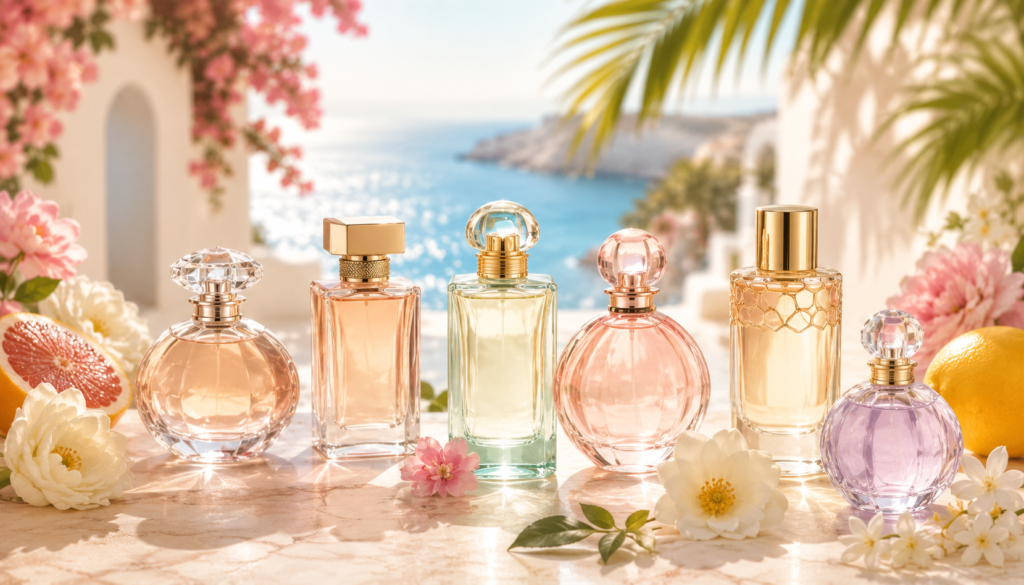
Why Summer Asks Something Completely Different From Your Perfume
Heat changes everything about how fragrance behaves, and once you understand that, the whole category of “summer perfume” stops feeling like a marketing gimmick and starts feeling like genuine chemistry. Perfume is, at its core, a combination of aromatic molecules suspended in alcohol and oil, and those molecules evaporate at different rates depending on temperature. In cooler months, your skin holds onto scent more slowly, which is exactly why heavier, deeper fragrances — the vanillas, the woods, the rich ambers — feel so right in winter. They need that slower evaporation to unfold properly, to take you through their full story instead of just blasting the top notes and disappearing.
Summer heat speeds everything up. Your skin is warmer, your pores are more open, you’re sweating more even if you can’t feel it, and all of that means heavier perfumes don’t just smell different in summer — they often smell worse. That gorgeous amber that felt so sophisticated in November can turn cloying, almost suffocating, against hot summer skin. This is why so many of us instinctively reach for lighter, brighter scents once the temperature climbs, even before we consciously understand why. Our bodies are doing the chemistry homework for us.
This is also why citrus, aquatic, and light floral notes dominate the summer fragrance conversation every single year. They’re built to perform in heat — to lift rather than linger too heavily, to feel like a breeze rather than a blanket. Top notes like bergamot, mandarin, and grapefruit are designed to evaporate quickly and brightly, which in cold weather might feel almost too fleeting, but in summer heat becomes exactly the right pacing. You get a beautiful initial burst, then a graceful fade into something softer, and the whole thing repeats again with your next reapplication rather than sitting heavy on your skin all day.
The Quiet Luxury of Smelling Like Clean Skin and Sunlight
If you’ve spent any time on Pinterest or TikTok over the last couple of years building out aesthetic boards — and I know plenty of you have, because I have too, more hours than I’d like to admit — you’ve probably noticed fragrance has quietly become part of the broader quiet luxury, clean girl conversation in a way it never quite was before. The “skin scent” trend, the obsession with fragrances that smell like an elevated, intentional version of your own warm skin rather than something loud and separate from you, fits perfectly into everything else that aesthetic represents: understated confidence, nothing trying too hard, the sense that you don’t need to announce yourself to be noticed.
I think this shift says something genuinely true about where a lot of us are emotionally right now, the same way I talked about quiet luxury clothing representing an exhaustion with noise. We’re tired of fragrances that walk into a room before we do, the kind that linger in elevators long after the person wearing them has left. There’s something almost aggressive about a scent that demands attention like that, and increasingly, the perfumes that feel most aspirational, most “her,” are the ones that require someone to lean in close to actually catch them — a hug, a quiet conversation, someone resting their head on your shoulder. That intimacy, that restraint, feels like the olfactory equivalent of a perfectly cut blazer in a soft neutral: confident enough not to need volume.
This is part of why musk-forward, slightly skin-like fragrances have become such a defining thread of 2026’s beauty conversation, alongside the soft glam, dewy-skin makeup trend I’m sure you’ve noticed everywhere. Both movements are really telling the same story from different angles: less performance, more presence. A glowing, barely-there base instead of a full matte face. A warm, skin-like fragrance instead of a loud, separate-feeling one. They’re two expressions of the same underlying mood, and once you notice that connection, it becomes almost impossible to think about your beauty routine as separate categories instead of one cohesive feeling you’re building.
The Scent Families Every Summer Wardrobe Needs (And Why I Think in Categories, Not Just Bottles)
I want to walk you through how I actually think about summer fragrance, because I’ve found that thinking in scent families rather than chasing individual bottles has completely changed how confidently I shop and how much I actually enjoy the perfumes I own. Once you understand the broad categories and what each one is genuinely good for — not just what’s trending, but what actually serves a purpose in your life — choosing a new bottle stops feeling like guesswork and starts feeling like building a wardrobe with real intention, the same way I think about clothing.
Citrus colognes are the absolute backbone of warm-weather fragrance, and I don’t think they get enough credit for how versatile and genuinely sophisticated they are. There’s a reason the citrus cologne format — built around bergamot, lemon, orange blossom, sometimes a touch of neroli — has remained a beauty industry staple for generations, with houses like Jo Malone building entire identities around the format. Citrus scents read as instantly clean, instantly fresh, the olfactory version of a crisp white shirt. They’re also wonderfully low-commitment; a citrus cologne rarely overstays its welcome, fading gracefully rather than clinging, which makes it perfect for layering with other scents or for days you genuinely just want to smell pleasant without making any kind of statement.
Aquatic and marine notes are the ones that genuinely transport me, more than almost any other category. There’s something about a well-done aquatic fragrance — the kind that captures sea spray, wet stone, the particular mineral coolness of being near water — that makes me feel like I’m somewhere else entirely, even if I’m just spraying it on before a Tuesday grocery run. These scents tend to be polarizing; people either love them or find them too “clean” and almost sterile, but when done well, with enough supporting florals or musks to keep them from feeling like literal swimming pool water, they’re some of the most genuinely transportive perfumes available.
White florals — jasmine, tuberose, gardenia, orange blossom in its more floral expression rather than purely citrus — bring the sensuality that pure citrus and aquatic notes sometimes lack. There’s a warmth, almost a creaminess, to a well-blended white floral that makes it feel distinctly feminine in the most classic, timeless sense of that word. Dior’s J’adore has built a decades-long reputation on exactly this kind of lush, confident floral identity, and it’s a beautiful example of how a white floral can feel elegant rather than overwhelming when it’s balanced with the right supporting notes.
Fruity-floral blends are where a lot of the newer, more youthful summer launches tend to live, and I think they get unfairly dismissed sometimes as less “serious” than classic florals or citruses. Done well, with real fruit notes like peach, fig, or melon balanced against a soft floral or musky base, these scents capture something genuinely joyful — the specific feeling of a sun-warmed peach, of fruit at a farmers market, of the particular sweetness of summer evenings that have nothing demanding about them at all.
Soft musks and skin scents, as I mentioned, have become the quiet darlings of the current fragrance conversation, and for good reason. These are the bottles that smell less like a “perfume” in the traditional sense and more like an elevated, slightly mysterious version of your own warmth. They’re the ones people lean in for. They’re the ones that make someone ask “what is that, you smell amazing” in a hallway, rather than announcing themselves the second you walk into a room.
How I Actually Build My Summer Fragrance Wardrobe
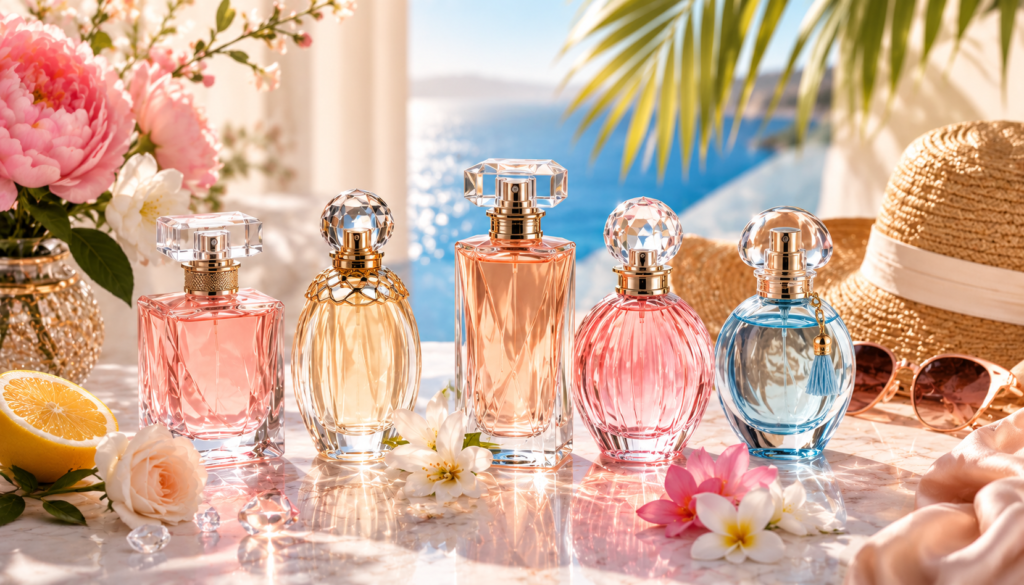
I think the biggest shift in how I approach perfume happened when I stopped thinking about owning “a signature scent” and started thinking about building a small, intentional wardrobe of fragrances for different moods, different contexts, different versions of myself that show up across a single summer. Just like I don’t wear the same outfit to a client meeting that I wear to a beach day, I don’t reach for the same bottle either, and once I gave myself permission to think this way, my whole relationship with fragrance became so much richer and more genuinely fun.
My daytime, errand-running, “I just want to smell clean and put-together” bottle is almost always something citrus-forward — light, bright, the kind of scent that feels like an extension of freshly washed hair and clean laundry rather than a statement. I’ll spritz this on after my shower most mornings, somewhere in that quiet five minutes before the day actually starts, and it becomes part of the same calming ritual I talked about in thinking through my outfit the night before. There’s something about the scent hitting your skin while it’s still slightly damp from the shower that makes it feel less like getting dressed and more like waking up properly.
My “I want to feel like the most elegant version of myself” bottle leans white floral, something with real depth and a little bit of sensuality to it, the kind of scent I reach for before dinner with someone I love, before a special event, before any moment where I want my presence in a room to feel intentional rather than incidental. This is the bottle I’m more careful with, more sparing in how I apply it, because I want it to stay associated with those specific, slightly elevated moments rather than becoming background noise to an ordinary Tuesday.
My “soft, skin-like, barely-there” bottle has become my most-reached-for option over the last year or two, genuinely reflecting that broader cultural shift toward quieter, more intimate fragrance. I wear this one on the days I want to feel comforted rather than composed — the days that call for the same energy as my soft cardigan, my “soft landing” outfit I mentioned when I wrote about dressing for stress. It’s the scent equivalent of being wrapped in something familiar, and there’s real comfort in having a fragrance that does that emotional work for you.
And then there’s my purely joyful, no-occasion-necessary fruity-floral bottle, the one I wear specifically when I want to feel a little lighter than my actual mood that day, the olfactory equivalent of putting on a bright color when you’re feeling grey inside. I don’t reach for this one as often as the others, which somehow makes it feel more special every time I do.
The Layering Ritual That Changed How I Think About Fragrance Entirely
I want to talk about layering, because I think it’s one of the most underrated tools in the entire fragrance conversation, and once I started doing it intentionally rather than accidentally, my relationship with perfume completely transformed. Layering, in the way I practice it, isn’t about literally mixing two different perfumes together and hoping for the best — that can absolutely go wrong, and I’ve had a few unfortunate, slightly chemical-smelling mornings to prove it. It’s about building scent in stages, starting with the products underneath your perfume and treating the final spritz as the finishing note rather than the whole story.
I always start with a fragranced or lightly scented body wash or oil in the shower, something that shares a family with whatever perfume I’m planning to wear that day — a citrus wash under a citrus cologne, for instance — because this creates a kind of scent foundation on the skin itself that makes the eventual perfume feel more cohesive, more like it’s coming from you rather than sitting on top of you. Then I’ll use a matching or complementary scented body lotion while my skin is still slightly damp, because lotion genuinely helps fragrance last longer; the oils in a good lotion give the perfume molecules something to hold onto, slowing that rapid summer-heat evaporation I mentioned earlier.
Only after all of that do I actually apply the perfume itself, and even then, I’ve become much more thoughtful about where. Pulse points get most of the attention for a reason — the warmth from blood vessels close to the skin’s surface at your wrists, the base of your throat, behind your ears, genuinely does help diffuse fragrance more effectively throughout the day. But I’ve also started spraying a little into my hair, which holds scent beautifully and means that every time you move, every time the breeze catches it, you get this lovely little waft that feels almost accidental, almost like someone else just noticed something about you that you didn’t have to try for.
This whole ritual takes maybe three extra minutes compared to just spraying perfume directly onto bare, dry skin and walking out the door, and the difference in how long the scent lasts, how it develops over the day, and honestly how much more luxurious the whole getting-ready process feels, is enormous. It’s become one of those small, repeatable acts of self-care that costs almost nothing in time but pays back disproportionately in how put-together and cared-for I feel walking into my day.
What Your Perfume Says Before You Say Anything At All
There’s a particular kind of confidence that comes from knowing you smell good, and I don’t think it gets discussed nearly as often as how clothing or makeup affects confidence, even though I’d argue it might matter just as much, maybe more, because scent operates on such a primal, immediate level. Smell bypasses so much of the conscious processing that vision and hearing go through; it travels almost directly to the parts of our brain responsible for memory and emotion, which is exactly why a particular fragrance can transport you instantly back to a specific summer, a specific person, a specific version of yourself, faster and more vividly than almost any photograph could.
This is part of why choosing your summer perfume thoughtfully feels like such a meaningful act of self-definition rather than a trivial beauty choice. The scent you wear this summer isn’t just something other people will notice — it’s something your own brain will eventually link permanently to this particular season of your life, these particular memories, this particular version of who you’re becoming. I have bottles in my collection that I genuinely cannot wear anymore, not because I dislike how they smell, but because they’re so completely tied to a specific chapter of my life that wearing them again feels like opening a door I’m not ready to walk back through. That’s not a small thing. That’s powerful, and it’s worth choosing your fragrances with at least a little of that weight in mind.
There’s also something to be said for how confidently you carry yourself once you know, beyond any doubt, that you smell wonderful. It’s similar to the feeling of wearing a perfectly fitted blazer or having your hair done exactly the way you wanted — a small, private certainty that settles your posture, your eye contact, the whole quiet register of how you move through a room. Nobody else necessarily knows why you feel more grounded that day. They just notice that you do.
Reading the Room: Matching Your Perfume to the Moment, Not Just the Season
While building a small fragrance wardrobe by scent family gives you the foundation, I think the real art of wearing perfume well comes down to reading the actual moment in front of you, the same intuitive sensitivity I described when I talked about dressing for the mood rather than just the meeting. A scent that feels perfect for a rooftop dinner can feel completely wrong for a quiet morning workout, even if both happen on the same humid July day.
For the mornings I’m moving fast — a workout, a chaotic school drop-off, errands stacked on top of each other — I reach for something almost aggressively fresh and citrus-forward, something that can hold up against actual physical movement and a little sweat without turning unpleasant, which heavier or sweeter scents genuinely can do once they mix with perspiration. There’s a reason gym bags and locker rooms are full of bright, clean colognes rather than rich ambers; the chemistry of heat and movement simply asks for something lighter.
For the long, slow summer evenings — the kind with string lights and a glass of something cold and conversations that wander wherever they want to go — I let myself reach for something with more depth, even within the summer-appropriate range. A white floral with a touch of warm musk underneath, something that develops and deepens as the night goes on rather than staying static, mirrors the unhurried energy of an evening that has nowhere urgent to be.
For travel days, I genuinely think a soft, skin-like musk is almost unbeatable, partly for the practical reason that strong fragrances can feel overwhelming in the recycled air of an airplane cabin, both to you and to the strangers sitting uncomfortably close beside you, and partly because the comforting, familiar quality of a good skin scent does real emotional work on a day when so much else feels unfamiliar and out of your control.
A Few Thoughts on Building This Without Spending a Fortune
I don’t think a meaningful conversation about luxury fragrance is complete without acknowledging, honestly, that some of the most beloved names in this space come with genuinely significant price tags, and that building an entire wardrobe of designer and niche perfumes isn’t realistic for most of us, myself included for long stretches of my adult life. I want to be honest about that rather than write around it the way a lot of glossy fragrance content tends to.
What I’ve found, though, is that fragrance is one of the more forgiving categories when it comes to finding genuinely beautiful options across a range of price points, partly because so much of how a scent reads on you has to do with your own skin chemistry rather than purely the prestige of the bottle. A well-made, more affordable citrus cologne, applied thoughtfully with the layering ritual I described, can genuinely outperform an expensive bottle worn carelessly straight onto dry skin with no preparation at all.
I’d also gently encourage testing before committing, especially for anything you’re considering as an investment piece. Fragrance interacts so personally with individual skin — the same bottle can smell completely different on two people standing next to each other — that a scent your favorite influencer swears by might simply not work the same way on you, and no amount of beautiful packaging changes that basic chemistry. Sample sizes, testers at the counter, even a friend letting you borrow a spritz from her own collection, are all worth far more than buying blind based on a review alone, however glowing.
And honestly, sometimes the most meaningful bottle in your collection isn’t the most expensive one at all — it’s the one tied to a specific memory, a specific gift, a specific version of summer that mattered to you. I have a drugstore-affordable spray that I will defend with my whole chest because it smells exactly like a particular beach trip years ago, and no amount of niche perfumery prestige changes how much I love it.
The Small Rituals That Make Fragrance Feel Like Self-Care Instead of an Afterthought
I think the difference between treating perfume as a forgettable final step in getting ready versus treating it as a genuine moment of care comes down almost entirely to pace. When I’m rushing — sprawling deodorant on with one hand while holding my phone with the other, spritzing perfume in the same frantic motion — the whole thing feels transactional, just one more box to check before I’m out the door. When I slow down, even by ninety seconds, the entire experience shifts into something that feels closer to a small ceremony.
I’ve started closing my eyes for the few seconds right after I spray, just to actually register the scent rather than letting it become instant background noise the way familiar smells so quickly do. I’ll often do this right by an open window if I can, letting a little natural light and air in while the fragrance settles, which somehow makes the whole moment feel more like a genuine pause than a chore squeezed into an already packed morning.
I also keep my favorite bottles somewhere visible rather than tucked away in a drawer, the same way I’ve come to believe a beautiful robe deserves to hang somewhere you’ll actually see it rather than be buried in a closet. There’s something quietly motivating about a perfume collection displayed with even a little intention — a small tray, a particular corner of a vanity — because it turns the act of choosing your scent for the day into something closer to selecting an outfit than grabbing whatever’s nearest.
What I Wish I’d Known Years Ago About Wearing Perfume Well
If I could go back and talk to the version of myself who treated perfume as an afterthought, something to spray on in the elevator on the way out the door, I think I’d tell her that fragrance deserves the same intentionality we’re learning to give everything else in our lives — our skincare, our style, the way we spend our limited free hours. It’s not a trivial category just because it’s invisible. If anything, its invisibility is exactly what makes it so powerful; nobody can point to your perfume the way they might compliment a dress, and yet it shapes how people feel in your presence in a way few other choices do.
I’d also tell her not to be afraid of having more than one bottle, more than one identity, more than one mood represented in her collection. There’s no rule that says you need to pick a single signature scent and wear it forever to be sophisticated. Some of the most genuinely elegant women I know move fluidly between several fragrances depending on the day, the season, the version of themselves the moment calls for, and that fluidity feels far more alive, far more interesting, than rigid loyalty to one single bottle out of some misplaced sense of consistency.
Summer, more than any other season, gives you permission to play. The heat practically demands lighter, brighter, more joyful scents anyway, so use that as an excuse to actually experiment — to sample things you’d normally walk past, to ask the woman at the counter what she personally wears in July, to let your fragrance collection genuinely reflect the particular, fleeting, sun-warmed mood of this specific summer rather than defaulting to whatever’s familiar simply because it’s familiar.
Bringing It All Together: How I’ll Actually Be Wearing Perfume This Summer
As I sit here writing this, genuinely looking forward to the warmer months ahead, my plan is exactly what I’ve described throughout this whole rambling, perfume-obsessed love letter: a citrus cologne for fast mornings and clean errands, a white floral for the evenings that deserve a little ceremony, a soft skin-like musk for the days I need comfort more than statement, and one purely joyful fruity-floral bottle reserved for no occasion at all beyond wanting to feel a little lighter than the day might otherwise have given me.
I’ll be layering thoughtfully rather than just spraying carelessly on my way out the door. I’ll be testing a few new bottles I haven’t tried before, because even after everything I’ve just told you about building a considered wardrobe, I still believe there’s real joy in discovery, in letting yourself be surprised by something new sitting on a counter you weren’t even planning to visit. And I’ll be paying attention, the way I try to with everything in this stretched-thin, overcommitted season of life, to how each scent actually makes me feel rather than just how it photographs or how popular it is on the very same Pinterest boards I admittedly still love scrolling through.
If you take nothing else from this entire long, indulgent read, I hope it’s this: the right summer perfume isn’t really about smelling good for anyone else, however lovely that side effect is. It’s about giving yourself one more small, sensory anchor in a season that, for so many of us, moves far too quickly to actually feel. A few seconds with a beautiful bottle, a little patience while it settles into your skin, and suddenly you’re carrying something genuinely lovely with you into whatever the rest of your day decides to demand. That’s not vanity. That’s just one more quiet, deliberate way of taking care of yourself, one warm, sun-soaked morning at a time.
Understanding the Fragrance Pyramid (Without It Feeling Like a Chemistry Lecture)
I promised at the start of this that I wouldn’t write anything that felt like a textbook, and I meant it, but I do think there’s real value in understanding the basic structure of how perfume actually develops on your skin, because it changes how you shop, how you test, and how you avoid the heartbreak of falling in love with a scent in the store only to feel completely betrayed by it three hours later.
Every fragrance, broadly speaking, unfolds in three stages, often called the top, heart, and base notes, though I tend to think of them more like the opening line, the middle of the conversation, and the lingering impression someone leaves after they’ve already left the room. The top notes are what you smell in the first few minutes — usually citrus, light fruits, sometimes a sharp green note — and they’re designed to evaporate quickly, which is exactly why they can be a little misleading. So many of us have made the mistake of smelling a perfume on a card at a counter, deciding instantly based purely on that first bright burst, and walking away with a bottle that smells nothing like that thirty minutes later once the top notes have faded and the actual heart of the fragrance takes over.
The heart notes, sometimes called the middle notes, are where the real personality of a perfume lives, and they typically emerge somewhere between fifteen minutes and an hour after application. This is where most florals live — the jasmine, the rose, the orange blossom — and it’s genuinely the stage I think deserves the most attention when you’re deciding whether a fragrance is right for you, because it represents what you’ll actually be wearing for the bulk of the day, not just the fleeting first impression.
The base notes are the ones that linger longest, sometimes for hours after the heart notes have faded, and they’re usually built from heavier, slower-evaporating ingredients like musk, woods, vanilla, or soft ambers. Even summer-appropriate fragrances almost always have some kind of base note holding everything together, because without it, a perfume would simply vanish within an hour, no matter how lovely the opening was. The trick with summer fragrance specifically is choosing base notes that are light enough not to feel heavy in heat, which is exactly why so many warm-weather perfumes lean on soft musks or pale woods rather than the deep, resinous ambers and dark woods that dominate winter fragrance.
Understanding this structure means you can actually test a perfume properly instead of making a rushed decision based on the first thirty seconds. My own rule, which I’d genuinely encourage you to steal, is to never buy a fragrance the same day I first smell it. I’ll spray it on my wrist, go about my errands, and let it develop through all three stages over the following hours before deciding whether it’s actually earned a place in my collection, rather than just having a lovely opening act and nothing else to say after that.
How to Make Your Summer Perfume Actually Last
One of the most common frustrations I hear from friends about summer fragrance is that it simply doesn’t last the way they want it to — they spray it on in the morning and by lunchtime it’s gone, leaving them feeling like they wasted both the product and the moment of care that went into applying it. Some of that is simply the nature of lighter, brighter summer-appropriate scents, which are built to evaporate faster precisely because that’s what makes them feel fresh rather than heavy. But there’s also a lot you can do to extend that lifespan without sacrificing the lightness that makes summer fragrance so appealing in the first place.
Moisturized skin holds fragrance dramatically better than dry skin, which is part of why I mentioned the layering ritual earlier, but it’s worth repeating because I think it’s the single most impactful, lowest-effort change most women could make to how long their perfume lasts. Dry skin is porous and absorbs fragrance oils quickly, essentially pulling the scent in and breaking it down faster, while well-moisturized skin creates a smoother surface that allows fragrance molecules to sit and diffuse more gradually throughout the day.
Application technique matters more than most of us realize, too. Rubbing your wrists together after spraying perfume — something so many of us do almost instinctively — actually breaks down the top notes through friction and heat, which means you lose some of that beautiful opening burst before it’s even had a chance to properly unfold. Instead, I’ve trained myself to spray and simply let the fragrance settle on its own, undisturbed, which sounds like such a small adjustment but genuinely changes how the scent develops over the following hours.
I also keep a small travel-sized version of whatever I’m wearing that week in my bag for reapplication, because summer heat means fragrance simply doesn’t last as long as it would in cooler months, and there’s no shame at all in a quick refresh sometime in the early afternoon. I tend to reapply more sparingly than my morning application, just a touch at the wrists or the base of the throat, treating it more like a gentle reminder of the morning’s scent rather than starting completely over.
Storage matters more than people think as well, and this one genuinely surprised me when I first learned it. Bathrooms, with their fluctuating heat and humidity from showers, are actually one of the worst places to store perfume, even though it’s where most of us instinctively keep our bottles for convenience. Heat, light, and humidity all degrade fragrance over time, breaking down the delicate balance between notes and sometimes shifting the entire character of a scent months before you’d expect a bottle to “go bad.” I keep my favorite bottles on a cool, dry shelf away from direct sunlight now, and I’ve genuinely noticed the difference in how consistently they smell bottle after bottle, even toward the end of a bottle’s life.
The Memory You’re Building Without Even Realizing It
I touched earlier on how powerfully scent connects to memory, but I want to sit with this idea a little longer, because I think it’s the real, quiet magic underneath everything else I’ve written here. Years from now, you won’t necessarily remember exactly what you wore on a particular summer evening, or exactly what you said during a particular conversation that mattered to you. But if you catch a stray whiff of whatever perfume you were wearing that night, years later, in a completely unrelated context — a stranger walking past you on the street, a sample card at a different counter entirely — I’d bet you anything the entire memory comes rushing back with a vividness that almost nothing else can replicate.
This is, I think, the deepest reason to choose your summer fragrance thoughtfully rather than grabbing whatever’s trending or whatever a stranger online insists is the scent of the season. You’re not just choosing something to smell nice for the next few months. You’re quietly building the scent-memory architecture of an entire chapter of your life, one you won’t fully appreciate until you’re standing somewhere completely different, years from now, and a stray trace of bergamot or jasmine pulls you straight back to exactly who you were this particular summer.
I have a small collection of bottles I’ve kept, mostly empty now, that I simply can’t bring myself to throw away, because each one represents a specific summer I lived through — the citrus cologne from the summer I moved to a new city alone and felt terrified and alive in equal measure, the white floral from the summer of a wedding that meant everything to me, the soft musk from the quieter, more recovering summer that came after a harder year. I’ll probably never finish wearing through some of these bottles again, and that’s fine. They’re not really about the liquid left inside anymore. They’re keepsakes, in the truest sense, holding entire seasons of feeling inside something as small and ordinary as a glass bottle.
Gifting Fragrance: Why It’s One of the Most Intimate Gifts You Can Give (And How to Get It Right)
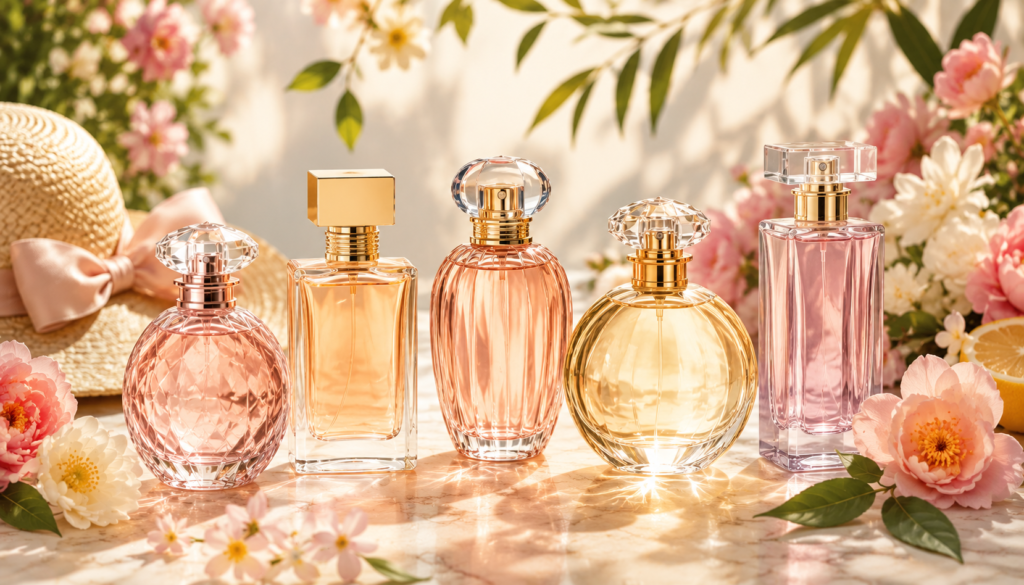
I want to take a small detour here to talk about gifting perfume, because I think it’s one of the most beautiful, underrated gestures available to us, and also one of the easiest to get slightly wrong if you’re not thinking about it the right way. Giving someone a fragrance is, in a sense, telling them how you perceive them, or how you’d love for them to feel, and that’s a genuinely tender thing to offer someone, whether it’s a close friend, a sister, a daughter stepping into her own sense of style for the first time, or a partner you want to surprise.
The mistake I see most often, and one I’ve absolutely made myself in years past, is choosing a fragrance purely based on what the giver loves rather than what actually suits the recipient’s existing taste and lifestyle. If your best friend has worn the same bright, sporty citrus scent for a decade and genuinely loves it, gifting her a deep, sultry amber because you personally find it gorgeous isn’t really a gift for her — it’s a gift for the version of her you might secretly wish she’d become, which is a very different, much less generous thing.
Instead, I try to pay attention to what someone already gravitates toward, what their existing bottles smell like, even what their clothing and overall aesthetic suggest about the energy they’re drawn to, and then look for something that expands gently on that rather than overriding it entirely. If a friend lives in soft, clean girl aesthetics — minimal makeup, quiet luxury basics, that whole effortless, dewy-skinned energy — a louder, more maximalist scent is probably not going to land the way you hope, however beautiful you personally find it.
I’d also gently suggest, for anyone nervous about gifting fragrance because skin chemistry is so personal, that smaller, more accessible price points or sample-sized gift sets can be a wonderful way to introduce someone to a new scent family without the pressure of a full-sized bottle they might end up not loving. There’s something genuinely thoughtful about giving someone the gift of discovery rather than the gift of a single, locked-in decision you’ve made on their behalf.
Perfume and Travel: Packing Light Without Sacrificing the Ritual
Since I mentioned travel days earlier in the context of choosing softer, skin-like scents, I want to go a little deeper into the actual logistics of bringing fragrance with you when you’re away from home, because I think this is a place where a lot of women either overpack unnecessarily or, more often, simply abandon the whole ritual entirely while traveling, treating it as one more thing too complicated to bother with on the road.
I’ve become a genuine evangelist for travel-sized atomizers, the small refillable spray vials you can fill from your full-sized bottle before a trip, partly for the obvious practical reason that they comply with airline liquid restrictions far more easily than a full bottle, but mostly because they completely remove the excuse not to maintain the ritual just because you’re somewhere unfamiliar. I keep two or three filled at all times in my travel bag, rotating between a citrus for daytime sightseeing and a softer musk for evenings, and the tiny weight and space they take up is nothing compared to how much more like myself I feel applying a familiar scent in an unfamiliar hotel bathroom.
There’s something genuinely grounding about this practice that I didn’t fully appreciate until a particularly disorienting work trip a few years back, the kind where I was in a different city than I’d planned to be in, dealing with circumstances I hadn’t anticipated, feeling about as far from settled as I’ve ever felt. I remember the small, almost embarrassingly simple comfort of spraying my familiar scent on before heading into yet another unfamiliar meeting room, and how much that tiny, repeated gesture helped me feel like I was still, underneath all the disruption, fundamentally myself. Fragrance travels in a way that’s lighter and easier than almost anything else in our self-care arsenal, and I think it deserves a permanent place in the travel bag rather than being left behind as an unnecessary luxury.
A Closing Thought on Choosing What Feels Like You
I’ve thrown a lot of categories, rituals, and personal stories at you over the course of this very long, very perfume-obsessed read, and if it feels like a lot to hold onto, I want to leave you with something much simpler than all of it: the only real rule that matters is choosing what genuinely feels like you, in this particular season of your life, rather than chasing whatever feels objectively “correct” by trend standards or social proof.
Trust your own nose more than you trust a stranger’s glowing review. Trust the way a scent makes your shoulders drop or your posture lift more than you trust how popular it is on whatever platform you’re scrolling through this week. The most elegant women I know don’t smell expensive because of what’s written on the label. They smell like themselves, fully and confidently, in a way that makes you want to lean in a little closer just to understand what exactly that warmth is. That’s the whole secret, really, dressed up in citrus and musk and warm summer skin instead of fabric and tailoring this time, but built from exactly the same quiet, deliberate intention all the way through.
What Actually Changes How a Perfume Smells on You
I mentioned skin chemistry briefly already, but I think it deserves its own real conversation, because understanding why a fragrance smells completely different on you than it did on the woman at the counter, or on your best friend who swears by the exact same bottle, takes so much of the frustration and self-doubt out of fragrance shopping. It’s not that you’re doing something wrong. It’s chemistry, plain and simple, and once you understand the variables at play, you stop blaming yourself for a perfume that simply wasn’t built for your particular skin.
Your skin’s natural pH plays a bigger role than most of us realize. More acidic skin tends to make fragrances develop faster and sometimes a little sharper, while more neutral or slightly alkaline skin tends to hold scent in a softer, slower, more rounded way. Neither is better or worse, but it does explain why the exact same bottle can read as bright and zesty on one person and warm and mellow on another standing right beside her.
Diet genuinely factors in too, in ways that sound almost too simple to be true but absolutely are. Heavy consumption of spicy food, garlic, or alcohol can subtly shift the way your natural skin oils smell, which in turn shifts how a fragrance interacts with that base layer underneath it. I’m not telling you to overhaul your diet for the sake of your perfume, that would be absurd, but it’s a small, interesting piece of the puzzle worth knowing about, especially if you’ve ever noticed a favorite scent smelling slightly different on you depending on the week.
Hormones are perhaps the most under-discussed variable of all, and as someone who has noticed her own relationship with certain fragrances shift across different hormonal phases, I think this deserves far more attention than it typically gets in beauty conversations. Many women report that their favorite, most reliable signature scent occasionally smells subtly different during certain points in their cycle, during pregnancy, or through other hormonal transitions, and this isn’t imagined or overly sensitive perception — it’s a genuinely documented phenomenon tied to how hormonal fluctuations affect both our sense of smell and our skin’s own scent profile. If a fragrance you’ve loved for years suddenly smells slightly off to you during a particular season of your life, it’s worth knowing that the bottle probably hasn’t changed. You have, in some small chemical way, and that’s completely normal.
Even the climate you live in factors into this conversation more than people expect. Someone living somewhere consistently hot and humid will generally experience fragrance differently, and often more intensely, than someone in a drier or more temperate climate, which is part of why a friend’s glowing recommendation from a completely different part of the world doesn’t always translate perfectly once you bring that same bottle home to your own particular air.
Letting Your Fragrance Reflect the Woman You’re Actually Becoming, Not Just the One You Used To Be
I want to close this particular thread of thought with something a little more personal, because I think it’s easy, while reading a long piece like this one, to get a little too caught up in the technical side of things — the notes, the pyramids, the layering rituals — and lose sight of the much simpler, much more emotional truth underneath all of it. Your relationship with fragrance, more than almost any other beauty category, has a way of quietly tracking your own evolution as a person, whether you’re paying attention to that or not.
I think about the fragrances I wore in my early twenties, sweeter, louder, a little more eager to be noticed, and I don’t say that with any judgment toward the woman I was then. She needed that. She was still figuring out who she wanted to be, still testing out different versions of confidence, and her perfume reflected exactly that searching, exploratory energy. The scents I reach for now are quieter, more settled, less interested in announcing themselves and more interested in simply being true to how I actually feel in my own skin on any given day. That shift didn’t happen because someone told me sophistication meant restraint. It happened gradually, almost without me noticing, as I became a genuinely calmer, more settled version of myself in other areas of my life too.
I’d gently encourage you to notice this in your own fragrance journey, both backward and forward. What did you wear five years ago, and does it still feel true to who you are now, or has some part of you quietly outgrown it without your conscious permission? And looking ahead, is there a fragrance sitting in your cart, or lingering in your memory from a counter you walked past, that feels like it belongs to a slightly more confident, more settled, more fully-arrived version of yourself than the one currently standing in front of the mirror? There’s real value in occasionally reaching for that scent slightly before you feel fully ready for it, the same way trying on a beautifully tailored blazer can sometimes make you stand a little straighter before your posture has actually caught up to the moment. Fragrance, much like elegant clothing, doesn’t just reflect who you are. Sometimes, quietly, it helps shape who you’re becoming.
This is, I think, the real reason this whole category deserves so much more thoughtful attention than most of us give it in the rush of an ordinary busy life. It’s never really just about smelling nice for the people around you, lovely as that side effect is. It’s about the quiet, private relationship between you and a particular bottle, a particular ritual, a particular handful of seconds each morning when you get to decide, deliberately, who you’re choosing to be that day.
How many sprays is actually enough? For most eau de parfum or eau de toilette concentrations, two to four sprays on pulse points is plenty for daytime wear; summer heat amplifies projection, so it’s genuinely easy to overdo it without realizing, especially indoors or in air conditioning where scent doesn’t disperse as quickly as it does outside.
Should I switch my perfume completely once summer ends, or can I keep wearing the same one year-round? There’s no rule forcing you to switch, but I’d encourage at least experimenting with seasonal rotation, simply because so many lighter summer scents genuinely do perform differently, and sometimes disappointingly, once the temperature drops and your skin’s chemistry shifts with it.
Is it true that perfume smells different on everybody? Yes, genuinely. Skin pH, diet, hormones, even the products you layer underneath all affect how a fragrance develops on you specifically, which is exactly why testing on your own skin rather than trusting a friend’s glowing recommendation alone matters so much.
What’s the difference between eau de parfum and eau de toilette, and does it matter for summer? Eau de parfum has a higher concentration of fragrance oil and typically lasts longer, while eau de toilette is lighter and fades faster. For summer specifically, I actually lean toward eau de toilette concentrations for daytime, precisely because their lighter intensity suits the season’s mood, reserving eau de parfum for evenings when I want something with a bit more staying power.
Is it bad to layer two different perfumes together? It can work beautifully when the families complement each other — a citrus cologne under a soft musk, for instance — but I’d avoid combining two strongly opinionated scents, like two different heavy florals, which tend to compete rather than harmonize. When in doubt, layer your scented body products rather than two separate finished perfumes, and let the actual fragrance be the single final note.
Whatever you end up choosing this summer, I hope it becomes one more small, sensory thread woven through everything else you’re already doing to take care of yourself this season — the outfits you choose with intention, the rituals you protect even on your busiest days, the quiet confidence of simply feeling like the truest version of yourself as you move through whatever this summer decides to bring you.