
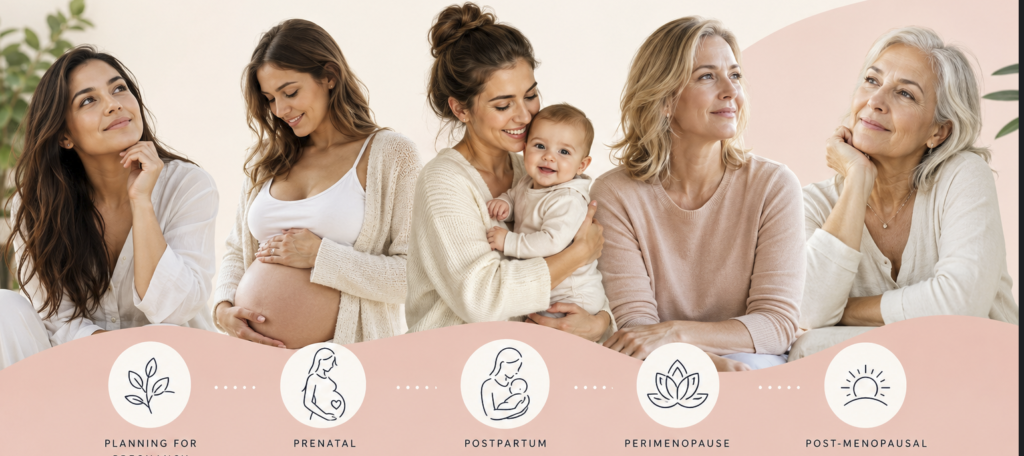
There’s something incredibly powerful about being a woman.
Not because everything comes easily to us—quite the opposite, actually. Our bodies are constantly evolving, adapting, stretching, healing, changing. Sometimes beautifully. Sometimes painfully. Often both at once.
As women, we move through life in chapters that feel almost like entirely different versions of ourselves. One year, we’re dreaming about future babies and scrolling through fertility tips at midnight. Another year, we’re navigating swollen ankles, back pain, and the surreal feeling of growing a human. Later, we may find ourselves holding a newborn while wondering why nobody prepared us for how emotional, exhausting, and deeply transformative postpartum life really is.
And then, just when we feel like we’ve learned our bodies all over again, another transition quietly arrives: hormonal changes, shifting energy levels, mood swings we can’t quite explain, and eventually the profound life stage of menopause.
No one really talks enough about how many times women have to reinvent themselves.
Not just emotionally, but physically too.
This is why I believe women need community more than ever. We need honest conversations. We need women ahead of us saying, “Yes, I’ve been there too.” We need permission to ask questions without embarrassment, fear, or guilt.
So wherever you are right now—thinking about pregnancy, expecting your first baby, surviving postpartum, or learning how to feel at home in your body again during menopause—this is for you.
Because every stage deserves care, understanding, and compassion.
Before Pregnancy: Preparing for More Than Just a Positive Test
When people talk about getting pregnant, the conversation often starts at conception.
But in reality, pregnancy preparation begins much earlier.
For many women, the journey starts with a quiet decision. Maybe you and your partner start having “the conversation.” Maybe you stop birth control and suddenly feel both excited and terrified. Maybe you’re doing it alone and making plans entirely on your own timeline.
Whatever your story looks like, planning for pregnancy is about far more than fertility.
It’s really about preparing your whole life.
Physically, this is one of the best times to become deeply familiar with your body. Not in a hypercritical way, but in a curious, supportive one.
How is your energy lately?
Are you sleeping well?
Do you feel strong?
Do you move your body regularly?
Many women don’t realize how much pregnancy asks of the body until they’re already in it. Strong hips, a stable core, healthy mobility, cardiovascular endurance, and good recovery habits all matter more than most people think.
This doesn’t mean you need to become a fitness fanatic.
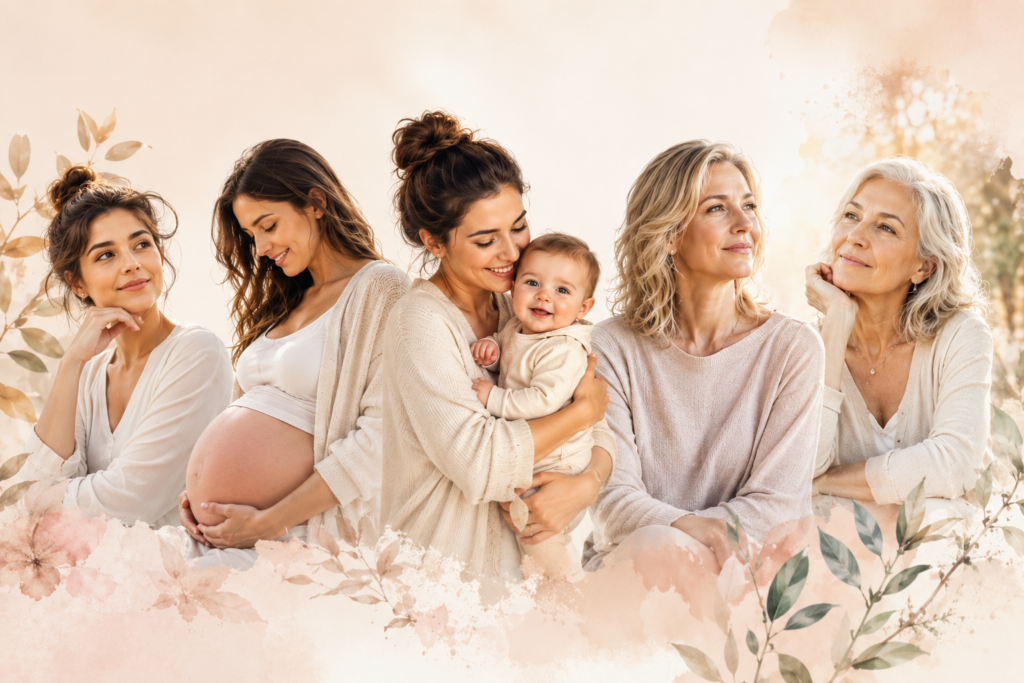
It means building sustainable habits.
Walking regularly. Strength training a few times a week. Improving posture. Supporting pelvic floor health before it becomes a problem.
Nutrition matters too, of course.
This is usually the moment folic acid enters every conversation—and for good reason. Starting prenatal vitamins early can support neural tube development long before you even know you’re pregnant.
But beyond supplements, pregnancy preparation is also a beautiful invitation to nourish yourself better overall.
More protein.
More iron-rich foods.
Hydration.
Balanced meals.
Less skipping breakfast and surviving on coffee.
And then there’s the emotional side nobody warns you about.
Trying to conceive can be surprisingly emotional—even before anything has actually happened.
There can be pressure, expectations, excitement, anxiety, and fear all tangled together.
Will it happen quickly?
Will something be wrong?
Am I ready?
Will I be a good mother?
These questions are so normal.
Pregnancy planning isn’t just about preparing a body. It’s about preparing an identity shift.
And that can feel huge.
Pregnancy: Living in a Body That Changes Daily
Pregnancy is one of the strangest, most beautiful, and most humbling experiences a woman can go through.
Nothing fully prepares you for it.
Not the apps.
Not the books.
Not even other people’s stories.
Because once it’s your body, everything feels different.
Suddenly your body is no longer operating under familiar rules.
You’re exhausted in ways you didn’t know existed.
You may feel nauseous, emotional, ravenous, bloated, glowing, miserable, empowered, and vulnerable—sometimes all before noon.
Pregnancy is full of contradictions.
You can feel deeply grateful and deeply uncomfortable at the same time.
Both are allowed.
Prenatal care becomes your new rhythm.
Appointments, scans, bloodwork, vitamins, symptom tracking—it can feel like pregnancy becomes a full-time project.
And while medical monitoring is important, I think what matters just as much is learning to stay connected to yourself during pregnancy.
Not every ache means something is wrong.
Not every emotional day is a sign you’re failing.
Your body is doing extraordinary work.
Movement during pregnancy can make a huge difference.
Not because pregnancy is a time to “stay in shape,” but because movement helps you feel better.
Walking can ease stiffness.
Prenatal yoga can improve mobility and reduce anxiety.
Strength exercises can help support your back, hips, and pelvis as your center of gravity changes.
Simple squats, upper body work, glute strengthening, and breathing exercises can become surprisingly valuable.
And let’s talk honestly about posture.
As the belly grows, everything shifts.
Your ribs flare.
Your lower back compensates.
Your pelvis tilts.
Suddenly even getting out of bed feels like a strategic maneuver.
This is where body awareness becomes so important.
Small adjustments—how you stand, lift, sit, sleep, and move—can dramatically change how you feel.
Pregnancy is also when many women begin thinking ahead.
Not just about labor, but about life after labor.
And honestly? That’s smart.
Because postpartum arrives much faster than most people expect.
Postpartum: The Chapter Nobody Fully Explains
Postpartum is often introduced as a sweet montage.
Soft baby blankets.
Tiny fingers.
Family photos.
Sleepy cuddles.
And yes, those moments exist.
But postpartum is also raw.
Messy.
Tender.
Lonely.
Overwhelming.
Physically, you are recovering from an enormous event.
Whether you had a vaginal birth, C-section, medicated birth, traumatic birth, smooth birth, or something in between—your body has been through something major.
And yet the world often shifts its full attention to the baby almost instantly.
Meanwhile, you’re bleeding, healing, leaking milk, sweating through the night, running on fragmented sleep, and trying to understand who you are now.
No one talks enough about identity loss in postpartum.
You can love your baby deeply and still grieve your old life.
That doesn’t make you a bad mother.
It makes you human.
Recovery deserves intention.
Pelvic floor rehabilitation matters.
Core healing matters.
Scar care matters.
Rest matters.
So many women rush into “bouncing back” because of cultural pressure.
But postpartum isn’t a bounce.
It’s a rebuild.
A slow one.
Walking is often enough in the beginning.
Breathing exercises can feel surprisingly profound.
Gentle reconnection with your core and pelvic floor can begin earlier than many expect—with proper guidance.
And emotionally?
This chapter can feel wildly unpredictable.
One moment you’re staring at your baby with overwhelming love.
The next, you’re crying because you haven’t showered, eaten properly, or slept in days.
Postpartum mental health deserves serious attention.
Baby blues are common.
But persistent sadness, rage, numbness, anxiety, or intrusive thoughts should never be ignored.
Support is not optional here.
It is essential.
Ask for help.
Accept meals.
Say yes when someone offers to hold the baby so you can nap.
Let people support you.
Women are often taught to be endlessly self-sufficient.
Postpartum is where many of us learn that interdependence is actually strength.
Perimenopause: When Your Body Starts Speaking a New Language
Perimenopause is one of the most misunderstood phases in a woman’s life.
Many women enter it without realizing what’s happening.
They just know something feels… off.
Sleep changes.
Mood shifts.
Periods become unpredictable.
Energy dips.
Weight redistributes.
Anxiety appears out of nowhere.
And suddenly the body that once felt familiar starts operating differently.
This can be deeply unsettling.
Especially because society doesn’t exactly prepare women for this chapter with warmth or nuance.
Perimenopause is often framed like decline.
But I don’t think that’s fair.
It’s transition.
Yes, hormones fluctuate significantly.
Estrogen and progesterone begin shifting in ways that affect nearly everything: metabolism, mood regulation, temperature control, sleep quality, libido, skin, and even joint comfort.
But this phase can also be an invitation.
A recalibration.
A new conversation with your body.
What worked in your twenties may no longer work now.
And that’s okay.
Many women find they need more recovery, more protein, more strength training, and more intentional stress management.
Cardio still matters—but strength training becomes especially important.
Muscle mass supports metabolism, bone density, insulin sensitivity, and long-term independence.
This is not the phase to fear getting “bulky.”
This is the phase to protect your future body.
Nutrition often needs adjustment too.
More fiber.
More calcium.
More vitamin D.
More protein.
Less under-eating.
Less punishing restriction.
And perhaps most importantly: more self-compassion.
Because hormonal changes can affect emotional resilience too.
Mood swings are real.
Irritability can feel intense.
Overwhelm can hit differently.
This is where many women begin prioritizing themselves in new ways.
Not selfishly.
Necessarily.
Better boundaries.
More rest.
Less tolerance for nonsense.
Honestly, there is something quietly powerful about that.
Menopause and Beyond: Becoming Yourself Again, Differently
Menopause is often spoken about as an ending.
The end of fertility.
The end of periods.
The end of a reproductive era.
And biologically, yes, it marks a significant transition.
But emotionally?
It can feel like a beginning.
For some women, menopause brings relief.
No more cycle tracking.
No more pregnancy concerns.
No more monthly hormonal rollercoasters.
For others, it can feel like grief.
A confrontation with aging, identity, femininity, and change.
Both experiences are valid.
Post-menopausal life comes with new health priorities.
Bone density becomes increasingly important.
Strength training and weight-bearing exercise are no longer optional extras—they are long-term investments.
Walking, resistance training, mobility work, and balance exercises all matter.
Heart health becomes another major focus.
Hormonal shifts can affect cardiovascular risk, so regular screenings become even more valuable.
Blood pressure.
Cholesterol.
Glucose levels.
Routine care matters.
But beyond the medical side, I think post-menopause offers something deeply beautiful:
Perspective.
There is often a quiet confidence that emerges in women during this stage.
Less people-pleasing.
Less performing.
Less apologizing.
More clarity.
More honesty.
More self-definition.
It can be an incredibly liberating chapter.
A time to reconnect with passions, hobbies, travel, friendships, movement, creativity, and pleasure in forms that have nothing to do with productivity.
Women spend so much of life caring for others.
Menopause can be a season of returning inward.
Not shrinking.
Expanding differently.
Every Stage Deserves Support
If there’s one thing I wish more women understood, it’s this:
You do not have to navigate these stages alone.
Not pregnancy planning.
Not infertility fears.
Not pregnancy discomfort.
Not postpartum tears.
Not perimenopausal confusion.
Not menopausal reinvention.
There is no medal for suffering silently.
Find your people.
Find your professionals.
Find the women who are honest.
The ones who will tell you what helped them.
The ones who will listen without judgment.
The ones who remind you that your experience is real.
Women thrive in community.
We always have.
At every age, your body will ask different things of you.
Different support.
Different care.
Different softness.
Different strength.
That isn’t failure.
That’s life.
Your body is not meant to stay the same forever.
It is meant to carry you through seasons.
And every season deserves respect.
So wherever you are right now—in anticipation, exhaustion, transition, grief, excitement, uncertainty, or renewal—I hope you remember this:
You are allowed to evolve.
Again and again and again.
And there is beauty in every version of you.