for Beginners (Flat Knit)
A free, fully written-out flat knit kids hat pattern with sizing from toddler through to older child — perfect for knitters of every level
My nephew has worn out six handknitted hats in three years. Not worn out in the ‘it got a hole’ sense — worn out in the sense that he wore them so constantly and so enthusiastically that the yarn eventually gave in. He would grab his current hat the moment we suggested going outside. He’d wear it at the breakfast table on cold mornings. He once wore one to a birthday party because, as he put it, ‘it’s the softest thing I own.’ He was four. I still think about that.
I mention this not to boast about my knitting (the hats were honestly quite simple) but because it illustrates something important about knitting for children that I don’t think gets said enough: kids actually wear the things you make them. With joy and without self-consciousness and with the particular enthusiasm that small people bring to things that feel like they belong specifically to them. A handknitted hat on a child is not a decorative object or a keepsake waiting for a shelf. It’s a piece of clothing that gets lived in, and there is no higher compliment.
If you’ve been wanting to try a kids hat knitting pattern but have felt uncertain — maybe you’re still fairly new to knitting, or you’ve tried patterns before that seemed simple and turned out not to be, or you’re not sure about sizing or whether you need circular needles or how to make a hat flat without it looking odd at the seam — I want you to know that this guide exists specifically for you. It’s written for real people with real questions and real lives, not for people who already know all the answers.
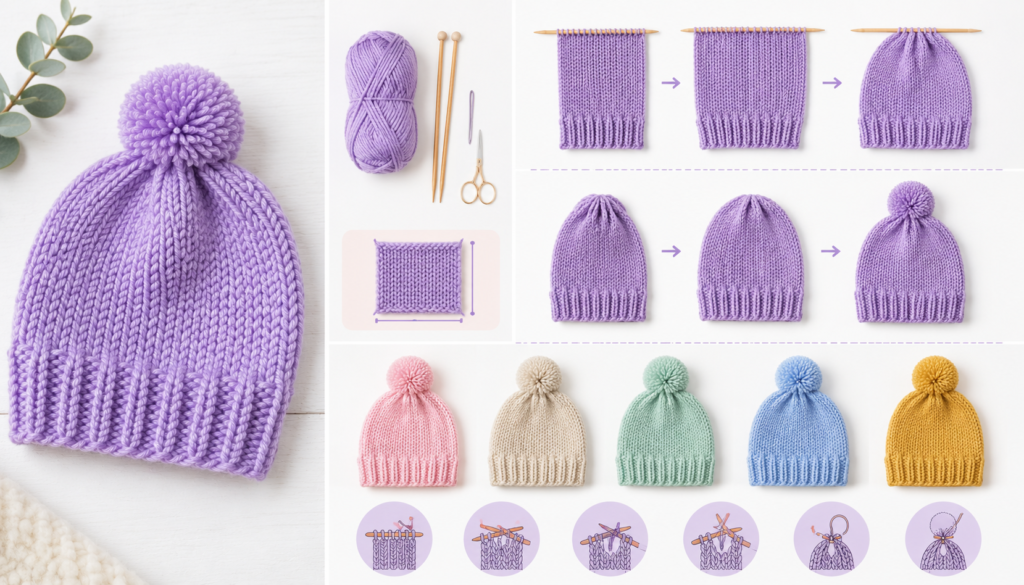
We’re going to work a flat knit hat from brim to crown. Two straight needles, one seam at the back, a complete pattern for three children’s sizes, and everything you need to know to finish it well. By the end of this article, you’ll have all the information you need to cast on with confidence. And by the end of the project, you’ll have a hat that a child will want to wear to breakfast.
Let’s begin.
Why Kids Hats Are One of the Best Projects a Knitter Can Make
There’s a category of knitting projects I think of as ‘high reward, low commitment’ — projects that are small enough to finish in a reasonable time frame, satisfying enough to feel genuinely worthwhile, and useful enough that the finished object has a real place in someone’s life. Kids hats sit at the very top of this category, and I’d argue they deserve more attention than they often get.
Most discussions of beginner knitting projects default immediately to scarves. And look, I understand the logic. A scarf is just rows of the same stitch, no shaping, no complexity. But here’s what nobody tells you about knitting your first scarf: it takes a very long time to finish, and finishing things matters enormously when you’re learning. The satisfaction of completion — of casting off, weaving in ends, and holding a finished object in your hands — is one of the most motivating experiences in knitting. It makes you want to cast on again. Immediately. A scarf can take months to deliver this feeling. A kids hat can deliver it in a weekend.
The sizing is also forgiving in ways that adult garments simply cannot be. A children’s hat that’s slightly larger than intended will fit for longer. A hat that’s slightly smaller may still work on a younger child. Children grow, hats stretch, and the flexibility of knitted fabric accommodates the small imprecisions of learning in a way that makes kids projects deeply kind to beginners.
And then there’s the joy factor. Children have not yet developed the adult self-consciousness about wearing handmade things. They don’t compare their handknitted hat to something they saw in a shop window. They just know that this hat is soft and warm and someone made it for them, and that is, to a small person, an entirely complete and sufficient reason to love it.
Knitting for children is also one of the most reliable ways to use up beautiful yarn that you might otherwise find too precious to knit into a large project. A 100g skein of something genuinely gorgeous — a hand-dyed superwash merino, say, or a beautiful tweed — can become a kids hat and still have yarn left for a coordinating project. The small scale means you can use the good stuff without the investment of a large garment.
“Children don’t compare their handknitted hat to anything. They just know someone made it for them, and that is entirely enough.”
Flat Knit vs. In the Round — Why Straight Needles Are the Smart Choice for Beginners
Almost every hat pattern you’ll encounter online is designed for circular needles — that joined loop of needle and flexible cable that allows you to knit in a continuous spiral, producing a seamless tube of fabric. Circular knitting is genuinely wonderful and I use circular needles constantly. But teaching it alongside hat construction to someone who is still getting comfortable with the basics of knitting is, in my experience, a reliable recipe for confusion and frustration.
Circular needles introduce a completely different logic to the knitting. Instead of turning your work at the end of each row and knitting back in the opposite direction, you’re always moving in the same direction, which means that what were right-side and wrong-side rows become a single uninterrupted right side. The stitches are distributed around the cable rather than sitting in a neat line you can count easily. The join point needs managing. The cable can pull uncomfortably if it’s not the right length for the number of stitches you’re working. All of this is entirely manageable with experience. Without experience, it’s a lot to hold in your head simultaneously.
Straight needles eliminate all of this complexity. Two needles, both pointing in the same direction when you’re ready to knit. Transfer stitches from one needle to the other, turn your work, repeat. The logic is simple and visible. You can see both sides of your fabric clearly. You can count your stitches from a resting position without rotating your work. And there is no cast-on edge to accidentally twist at the join, which is one of the most common and most devastating beginner circular knitting mistakes.
The flat knit hat is seamed at the back with a simple mattress stitch — a method of joining that creates an almost invisible seam on the right side of the fabric and takes about five minutes once you’ve done it a time or two. The seam then sits at the centre back of the hat, hidden by the crown, and is genuinely undetectable to anyone who doesn’t know to look for it. The finished hat looks exactly like a hat knitted in the round. The process is significantly more accessible for beginners.
I want to be honest about the one practical trade-off: when you’re knitting flat, the wrong side (the inside of the hat) faces you on every even-numbered row, and working the wrong side in stockinette means purling all stitches. Some beginners find purling less comfortable than knitting initially. If this is you, I have a straightforward solution in the pattern section: a garter stitch option that eliminates purling almost entirely and produces a beautifully textured hat that many people actually prefer.
Everything You Need — Materials for Your Kids Hat
One of the genuine pleasures of small projects is that they need very little. Here is exactly what you need for this pattern, with honest guidance on each item to help you make good choices.
Yarn — Choosing Something the Child Will Actually Want to Wear
Children’s skin varies in sensitivity, but as a general principle, the yarn that goes on a child’s head should pass what I call the inner wrist test: rub the yarn against the inside of your wrist. If it feels scratchy or irritating after a few seconds, a child will not want to wear a hat made from it. Children are considerably less polite than adults about this. They will simply take the hat off and leave it on the floor, no matter how much you love the colour.
For kids hats, I recommend superwash merino wool as the first choice. Superwash means the wool has been treated to be machine washable — an absolutely non-negotiable practical consideration for children’s wear — and merino is one of the finest, softest wool types available. The combination gives you a hat that is warm, breathable, durable, naturally odour-resistant, and soft enough that the child won’t notice they’re wearing anything on their head.
Good quality acrylic is my firm second recommendation, and I want to make this point without apology because there is sometimes an unspoken snobbery in knitting communities about acrylic yarns that is honestly not warranted when it comes to children’s wear. Premium acrylic yarns — I’m thinking of brands like Paintbox Simply DK, Scheepjes Colour Crafter, Lion Brand Pound of Love, and Drops Safran — are soft, beautifully coloured, machine washable, and affordable enough that you can knit generously without agonising over the cost. For a child who is going to stuff the hat in a school bag, lose it at a football match, and then find it six months later under a car seat, a well-made acrylic hat is often the right choice.
Wool-acrylic blends offer an excellent middle ground: enough wool content for natural warmth and breathability, enough acrylic content for durability and easy care. A 75% merino / 25% nylon blend is particularly lovely for children’s hats because the nylon adds real durability to the wear points at the brim without compromising softness. Drops Merino Extra Fine, Paintbox Simply DK, and Cascade 220 Superwash Sport are all excellent choices widely available online and in yarn shops.
Weight-wise, this pattern uses Aran weight yarn (also called worsted or 10-ply). Aran is the sweet spot for kids hats: it knits up quickly enough to finish in a few sittings, produces a warm, substantial fabric appropriate for outdoor wear in cooler weather, and works on needles large enough that the stitches are easy to see and handle without being so large that the fabric looks chunky or cheap. You’ll need between 80 and 120 grams depending on the size you’re knitting.
✨ Yarn Tip: If you’re shopping in person and you’re not sure which yarns are soft enough, take a small piece of the yarn and rub it against your inner wrist for about 10 seconds. If you feel any prickling or irritation, the child almost certainly will too. Trust this test over the label.
Needles
For Aran weight yarn, you want straight needles in US 8 (5mm) or US 9 (5.5mm). If you tend to knit tightly, use the 5.5mm. If you tend to knit loosely, the 5mm will help you achieve a firmer, warmer fabric. If you’re not sure where you land, knit a small gauge swatch (more on this shortly) and adjust accordingly.
Needle length doesn’t matter significantly for this project — 25cm or 30cm straight needles are both fine. For material, bamboo needles are my strong recommendation for beginners because they’re lightweight, warm, and have a slight grip that keeps stitches from sliding off accidentally. If you already own metal needles and are comfortable with them, those work perfectly well too.
Additional Supplies
You’ll also need: a blunt tapestry or darning needle with a large eye for seaming and weaving in ends, a small pair of sharp scissors, a tape measure or ruler, and optionally a row counter (the little clicker you can find in any craft shop, which saves significant mental energy when you’re tracking rows). Stitch markers are helpful but not essential — a small loop of contrasting yarn does exactly the same job.
Gauge — The Short Conversation You Actually Need to Have
I know, I know. Gauge. The word that makes beginners want to skip ahead to the actual pattern. But please stay with me for just a moment, because understanding gauge even loosely will make a significant difference to whether your hat comes out the right size, and I can explain it simply enough that it won’t take long.
Gauge simply means: how many stitches and rows does your knitting produce per 10 centimetres? This number is not universal. It varies between knitters based on how tightly or loosely each person holds the yarn and forms their stitches. Two people using identical yarn and needles can produce fabric of different sizes. Neither person is doing it wrong — they simply have different natural tension.
The way to find your gauge is to knit a small swatch: cast on about 20 stitches in your chosen yarn and work 20 rows in stockinette or whatever stitch the pattern uses. Lay the swatch flat without stretching it. Count how many stitches fit in 10cm across the middle, and how many rows fit in 10cm from bottom to top.
For this pattern knitted in Aran weight on 5mm needles, you’re aiming for approximately 18 stitches and 24 rows per 10cm. If you have significantly more stitches than this (your tension is tight), try going up half a needle size. If you have significantly fewer (your tension is loose), try going down. A stitch or two either way is fine and won’t cause a problem in a children’s hat. More than two stitches out, and the sizing will be affected enough to matter.
❤️ From experience: Gauge swatching feels like wasted time until the first time you knit an entire hat that doesn’t fit. Then it feels like fifteen minutes very well spent. For children’s hats especially, where the sizing window is fairly specific, a quick swatch genuinely pays off.
Sizing Guide — Getting the Fit Right for Every Child
Children’s head sizes vary considerably, and unlike adult sizing where there are fairly consistent patterns, kids can have heads that run large or small for their age. The most reliable thing to do is measure the actual child’s head if you can — a soft tape measure around the widest part of the head, just above the ears and across the forehead. If measuring is not possible, use the age guide below as a starting point and err toward the larger size if you’re between measurements.
One thing worth understanding: a properly fitted knitted hat is knitted to approximately 2–3 cm less than the actual head circumference. Knitted fabric stretches, and a hat that measures 48cm when laid flat will comfortably stretch to fit a 50–52cm head. This is intentional — the stretch keeps the hat on the head rather than sliding down.
SIZE GUIDE:
Size 1 — Toddler (12 months to 3 years):
Actual head circumference: 46–50 cm (18–19.5 in)
Knit hat to: 44 cm flat (17 in)
Size 2 — Child (3 to 6 years):
Actual head circumference: 50–54 cm (19.5–21 in)
Knit hat to: 48 cm flat (18.5 in)
Size 3 — Older Child (6 to 12 years):
Actual head circumference: 54–58 cm (21–22.5 in)
Knit hat to: 52 cm flat (20 in)
If the child you’re knitting for has a head on the larger side for their age, simply use the next size up. The hat will fit slightly more generously and the child will have room to grow into it. Children’s hats are forgiving in a way that adult hats are not, and a slightly generous fit is always preferable to a hat that’s too tight.
The Pattern — Free Kids Hat Knitting Pattern (Flat Knit, Beginner-Friendly)
Before we dive in, let me give you the abbreviations you’ll see in this pattern. Knitting uses shorthand that can look like a foreign language at first — it really is a kind of shorthand, and it makes much more sense once you’ve used it a few times.
ABBREVIATIONS:
CO = Cast On
K = Knit stitch
P = Purl stitch
K2tog = Knit 2 stitches together (a decrease — reduces stitch count by 1)
St / sts = Stitch / Stitches
RS = Right Side (the outside of the hat)
WS = Wrong Side (the inside of the hat)
Rep = Repeat
BO = Bind Off (same as Cast Off)
PM = Place Marker
[ ] = Total stitch count after completing that row
Pattern Information
MATERIALS:
– Aran weight yarn, 80–120g (superwash merino or quality acrylic)
– US 8 (5mm) or US 9 (5.5mm) straight needles
– Blunt tapestry needle for finishing
– Stitch markers (optional)
– Scissors, tape measure
GAUGE:
18 sts x 24 rows = 10 cm (4 in) in stockinette stitch on 5mm needles
Adjust needle size to achieve correct gauge
SIZES:
Size 1: Toddler (12 mo – 3 yrs)
Size 2: Child (3 – 6 yrs)
Size 3: Older Child (6 – 12 yrs)
FINISHED MEASUREMENTS (lying flat):
Size 1: approx. 22 cm wide x 20 cm tall (before crown shaping)
Size 2: approx. 24 cm wide x 22 cm tall
Size 3: approx. 26 cm wide x 24 cm tall
Step One — The Brim
The brim is where we begin, and it’s worked in a 2×2 rib — a pattern of two knit stitches alternating with two purl stitches — that creates a stretchy, neat edge that hugs the head naturally and won’t curl or roll up. This is the most important practical feature of the brim, and it’s also what gives handknitted hats that characteristic comfortable fit that children find so wearable.
If you’re completely new to the purl stitch, now is a good moment to practice it before casting on. The purl is essentially the knit stitch done in reverse: instead of inserting the needle from front to back, you insert it from back to front, with the yarn held in front of your work. YouTube has dozens of excellent slow-motion tutorials — search ‘purl stitch for absolute beginners’ and watch two or three until it clicks. Once it does click, it really does click.
CAST ON:
Size 1 (Toddler): Cast on 76 sts
Size 2 (Child): Cast on 84 sts
Size 3 (Older Child): Cast on 92 sts
I recommend the long-tail cast on for this project. It creates a neat, slightly elastic edge that sits well at the brim of a hat and is worth learning if you don’t already know it. If you’re not yet comfortable with the long-tail method, a simple knitted cast on works fine.
BRIM RIBBING:
Row 1 (RS): *K2, P2; repeat from * to end of row
Row 2 (WS): *K2, P2; repeat from * to end of row
Repeat Rows 1 and 2 until brim measures:
Size 1: 4 cm (approx. 9–10 rows)
Size 2: 5 cm (approx. 11–12 rows)
Size 3: 6 cm (approx. 14–15 rows)
A note on working the 2×2 rib: you’ll notice the instructions look the same on both Row 1 and Row 2. This is correct and intentional. In a 2×2 rib worked flat, the instruction ‘K2, P2’ produces the correct stitch pattern on both right and wrong side rows because when you turn your work, the stitches naturally align to continue the ribbing. If you ever feel uncertain about which stitch to work next, look at your knitting: knit the stitches that look like little V shapes, purl the ones that look like bumps. Your knitting will guide you.
Step Two — The Hat Body
Once your brim reaches the right depth, you’ll transition into the body of the hat worked in stockinette stitch. Stockinette is the smooth, classic fabric you’ll recognise from most knitted garments — it has V-shaped stitches on the right side and horizontal bumps on the wrong side. In flat knitting, you achieve stockinette by knitting all stitches on right-side rows and purling all stitches on wrong-side rows.
HAT BODY:
Row 1 (RS): Knit all stitches
Row 2 (WS): Purl all stitches
Repeat Rows 1 and 2 until body of hat measures from end of brim:
Size 1 (Toddler): 12 cm (approx. 28–30 rows from end of brim)
Size 2 (Child): 14 cm (approx. 33–35 rows)
Size 3 (Older Child): 16 cm (approx. 38–40 rows)
Measure the body of the hat by laying your work flat — not hanging from the needle, as gravity will stretch it — and measuring from the point where the ribbing ended to the needle. When you reach the measurement for your size, you’re ready to begin the crown.
☀️ Helpful note: If you would prefer to avoid purling entirely, you can work the whole hat body in garter stitch (knitting every row on both RS and WS) instead of stockinette. The hat will be slightly thicker and have a textured, ridged appearance rather than a smooth one, which is genuinely lovely and works beautifully in tweeds or heathered yarns. Simply replace every ‘Purl all stitches’ row with ‘Knit all stitches’ and everything else stays the same.
Step Three — The Crown Decreases
This is the part that transforms your flat rectangle of knitting into the rounded top of a hat, and it’s the section that feels most magical to me even now, after hundreds of hats. You’re going to work a series of decrease rows that gradually reduce the number of stitches, pulling the fabric in toward the centre until only a small number of stitches remain. These are then gathered together and pulled closed, creating the characteristic smooth crown of a knitted hat.
The decrease stitch we’re using throughout is K2tog — knit two stitches together. You insert your needle through two stitches at once (as if they were one stitch) and knit them together normally. The result is one stitch where two used to be. It sounds technical, but once you try it, it’s immediately intuitive.
I’m going to give you the full decrease sequence for each size separately, because I find it’s much easier to follow a clean, specific set of instructions for your size than to navigate a combined pattern with multiple sets of numbers.
Crown Decreases — Size 1 (Toddler, 76 stitches)
SIZE 1 CROWN (starting with 76 sts):
Dec Row 1 (RS): *K8, K2tog; rep from * to last 6 sts, K6 [70 sts]
Row 2 (WS): Purl all sts
Dec Row 3 (RS): *K8, K2tog; rep from * to end [63 sts]
Row 4 (WS): Purl all sts
Dec Row 5 (RS): *K7, K2tog; rep from * to end [56 sts]
Row 6 (WS): Purl all sts
Dec Row 7 (RS): *K6, K2tog; rep from * to end [49 sts]
Row 8 (WS): Purl all sts
Dec Row 9 (RS): *K5, K2tog; rep from * to end [42 sts]
Row 10 (WS): Purl all sts
Dec Row 11 (RS): *K4, K2tog; rep from * to end [35 sts]
Row 12 (WS): Purl all sts
Dec Row 13 (RS): *K3, K2tog; rep from * to end [28 sts]
Row 14 (WS): Purl all sts
Dec Row 15 (RS): *K2, K2tog; rep from * to end [21 sts]
Row 16 (WS): Purl all sts
Dec Row 17 (RS): *K1, K2tog; rep from * to end [14 sts]
Row 18 (WS): Purl all sts
Dec Row 19 (RS): *K2tog; rep from * to end [7 sts]
Cut yarn, leaving a 25cm tail.
Thread tail onto tapestry needle.
Pass through all 7 remaining sts, slipping off needle as you go.
Pull firmly to close crown. Do not cut yarn — use for seaming.
Crown Decreases — Size 2 (Child, 84 stitches)
SIZE 2 CROWN (starting with 84 sts):
Dec Row 1 (RS): *K10, K2tog; rep from * to end [77 sts]
Row 2 (WS): Purl all sts
Dec Row 3 (RS): *K9, K2tog; rep from * to last 0 sts [70 sts]
Row 4 (WS): Purl all sts
Dec Row 5 (RS): *K8, K2tog; rep from * to end [63 sts]
Row 6 (WS): Purl all sts
Dec Row 7 (RS): *K7, K2tog; rep from * to end [56 sts]
Row 8 (WS): Purl all sts
Dec Row 9 (RS): *K6, K2tog; rep from * to end [49 sts]
Row 10 (WS): Purl all sts
Dec Row 11 (RS): *K5, K2tog; rep from * to end [42 sts]
Row 12 (WS): Purl all sts
Dec Row 13 (RS): *K4, K2tog; rep from * to end [35 sts]
Row 14 (WS): Purl all sts
Dec Row 15 (RS): *K3, K2tog; rep from * to end [28 sts]
Row 16 (WS): Purl all sts
Dec Row 17 (RS): *K2, K2tog; rep from * to end [21 sts]
Row 18 (WS): Purl all sts
Dec Row 19 (RS): *K1, K2tog; rep from * to end [14 sts]
Row 20 (WS): Purl all sts
Dec Row 21 (RS): *K2tog; rep from * to end [7 sts]
Cut yarn, leaving a 25cm tail. Thread through remaining 7 sts.
Pull to close crown. Use tail for seaming.
Crown Decreases — Size 3 (Older Child, 92 stitches)
SIZE 3 CROWN (starting with 92 sts):
Dec Row 1 (RS): *K11, K2tog; rep from * to last 1 st, K1 [85 sts]
Row 2 (WS): Purl all sts
Dec Row 3 (RS): *K10, K2tog; rep from * to end [77 sts]
Row 4 (WS): Purl all sts
Dec Row 5 (RS): *K9, K2tog; rep from * to last 0 sts [70 sts]
Row 6 (WS): Purl all sts
Dec Row 7 (RS): *K8, K2tog; rep from * to end [63 sts]
Row 8 (WS): Purl all sts
Dec Row 9 (RS): *K7, K2tog; rep from * to end [56 sts]
Row 10 (WS): Purl all sts
Dec Row 11 (RS): *K6, K2tog; rep from * to end [49 sts]
Row 12 (WS): Purl all sts
Dec Row 13 (RS): *K5, K2tog; rep from * to end [42 sts]
Row 14 (WS): Purl all sts
Dec Row 15 (RS): *K4, K2tog; rep from * to end [35 sts]
Row 16 (WS): Purl all sts
Dec Row 17 (RS): *K3, K2tog; rep from * to end [28 sts]
Row 18 (WS): Purl all sts
Dec Row 19 (RS): *K2, K2tog; rep from * to end [21 sts]
Row 20 (WS): Purl all sts
Dec Row 21 (RS): *K1, K2tog; rep from * to end [14 sts]
Row 22 (WS): Purl all sts
Dec Row 23 (RS): *K2tog; rep from * to end [7 sts]
Cut yarn, leaving a 25cm tail. Thread through remaining 7 sts.
Pull to close crown. Use tail for seaming.
Step Four — Seaming the Hat
With your crown gathered and your tapestry needle still threaded with the tail from the final row, you’re going to seam the back of the hat using mattress stitch. If you’ve never done mattress stitch before, I want to reassure you: it is much simpler than it sounds, and it produces a join that is genuinely beautiful once you understand the rhythm of it.
Fold your hat piece in half lengthwise, right sides facing each other (so that the smooth stockinette side is on the inside). Thread the yarn tail on your tapestry needle if it isn’t already. Working from the top (crown end) down toward the brim, pass your tapestry needle under one horizontal bar of yarn on the left side of the seam, then one corresponding bar on the right side. Pull the yarn through gently, then repeat — left bar, right bar, pull through — working your way down to the brim.
As you pull the yarn through every few centimetres, the seam will close up and become nearly invisible. Don’t pull too tightly — you want the seam to have the same elasticity as the surrounding fabric so it doesn’t create a rigid line at the back of the hat.
When you reach the cast-on edge, fasten off securely with two small stitches into the seam fabric and weave in the end. Weave in any remaining yarn tails by threading them onto the tapestry needle and working them through the fabric in different directions for about 5cm each before trimming.
Turn the hat right side out. The seam should be nearly invisible from the outside, just a clean line at the back. And there — finished. That’s a hat.
Troubleshooting — Common Mistakes and How to Fix Them
Even experienced knitters make mistakes. The difference between a beginner and an experienced knitter is not that the experienced knitter never makes errors — it’s that they know what they’re looking at when something goes wrong, and they know how to fix it. Here are the most common issues with this type of hat and what to do about each one.
My stitch count keeps changing
This is the most universal beginner frustration and it’s almost always caused by one of a small number of things: accidentally knitting into the space between stitches rather than into the stitch itself (which creates an extra stitch), forgetting to move the yarn to the front before a purl stitch and then accidentally creating a yarn-over (which looks like an extra stitch), or dropping a stitch and not noticing (which loses a stitch). Count your stitches every 5–10 rows — it takes about thirty seconds and saves hours of confusion. If your count is off, try to identify where the problem occurred by looking at each stitch carefully. A dropped stitch will show up as a run or a gap; an accidental extra stitch will often look slightly looser or more open than its neighbours.
My hat is much smaller than expected
Almost certainly a gauge issue. If your hat is coming up noticeably smaller than the measurements suggest, your tension is probably tighter than the pattern expects. The fix: try the next needle size up. For future projects, always work a gauge swatch before committing to the full piece — 15 minutes of swatching will tell you everything you need to know about whether your tension matches the pattern.
The ribbing is twisted at the cast on
This doesn’t actually happen with flat knitting — that’s a circular needle specific problem (the cast on row twisting around the circular needle before you close the join). One of the genuine advantages of flat knitting is that twisted cast-on is impossible. If your brim looks strange, it’s more likely to be an inconsistency in tension or a mistake in the rib pattern. Check that you’re consistently working K2, P2 and not accidentally switching the order.
My purl rows look different from my knit rows
They will look different from the wrong side, and that’s completely correct — this is what creates stockinette. However, if you can see the difference between purl rows and knit rows from the right side (the smooth side), this usually indicates inconsistent tension: you’re purling at a different tension from your knitting. This is very common with beginners and smooths out naturally with practice. In the meantime, consciously try to hold the yarn with the same tension when purling as when knitting.
I dropped a stitch and watched it unravel
First: don’t panic. A dropped stitch is fixable. Stop knitting immediately and don’t put the work down anywhere it might unravel further. Find the dropped stitch — it will appear as a run, like a ladder, in the fabric. Use a crochet hook to catch the bottom of the run and work the stitch back up through the ‘rungs’ of the ladder. There are excellent video tutorials for this search ‘picking up a dropped stitch in stockinette’ — watching it demonstrated once is worth more than reading about it a dozen times.
My seam is visible from the outside
This is almost always a matter of practice rather than technique error. The first time you do mattress stitch, the result will be visible. The fifth time, it will be nearly invisible. The key is to work slowly, take one bar of yarn at a time from each side, and pull gently but consistently. If your seam is pulling the fabric, you’re pulling too tightly. If there are gaps, you may be taking more than one bar at a time. Be patient with yourself — this is a skill that genuinely improves with repetition.
Customising Your Kids Hat — Making It Uniquely Theirs
The basic hat pattern is a canvas. Once you’ve knitted it a couple of times and feel confident with the construction, there’s a whole world of customisation available to you. Here are some of my favourite ways to make a simple hat into something personal and memorable.
Pom-Poms — The Easiest and Most Effective Addition
A pom-pom on a kids hat is not just decoration — it’s a practical solution to the slightly flat gathered crown that results from the final decrease row, and it makes children absolutely delighted. Kids love pom-poms in a way that defies rational explanation. They grab them. They bounce them. They demand them on every hat from the moment they discover that hats can have them.
Making a pom-pom is extraordinarily simple. The tidiest method uses a pom-pom maker (a small plastic tool available for a pound or two at most craft shops), but you can also wind yarn around two fingers, slide it off carefully, tie it tightly in the middle with a separate piece of yarn, and snip the loops. Trim the result into a neat ball shape. Attach it to the crown by threading the tie yarn through the gathered crown stitches and tying securely on the inside.
Pom-poms in a contrast colour are particularly lovely — a warm red hat with a cream pom-pom, a navy hat with a bright yellow pom-pom, a grey hat with a multicoloured pom-pom made from several yarn scraps wound together. The contrast creates a little visual pop that makes the hat look more finished and more intentional.
Colour Stripes — Simple and Striking
Adding stripes to a flat knit hat is genuinely as simple as changing yarn at the end of a row. You work to the end of a right-side row, cut the old colour leaving a small tail to weave in, pick up the new colour (leaving a similar tail), and continue knitting. The colour change happens at the side edge of the hat, which becomes part of the seam, so there’s nothing visible on the finished hat.
Wide stripes (4 or more rows of each colour) are easier for beginners because you have fewer colour changes to manage and fewer tails to weave in. Narrow stripes (2 rows of each colour) are more visually complex but absolutely achievable. Two-colour hats — perhaps a child’s favourite colour for the body and a neutral for the brim — are a beautiful and practical choice that can become a signature personalised gift.
Ear Flaps — Adding Function and Charm
A hat with ear flaps is possibly the most practical cold-weather accessory a small child can have, and adding them to this flat knit pattern is entirely possible once you’re comfortable with the basic construction. Ear flaps are worked as two separate flat knitted pieces before the main hat — simple rectangular or slightly tapered shapes worked in the same yarn — and then incorporated into the cast-on edge of the hat. The hat is then worked as normal from that point. Adding ties (lengths of i-cord or twisted yarn that tie under the chin) completes the look and keeps the flaps in place on windy days.
Ear flap hats are enormously popular on Pinterest and make beautiful gifts for toddlers and young children who haven’t yet developed the coordination to keep a regular hat on their heads. If this sounds appealing, the ear flap technique is covered in detail in a companion post on this site.
Fair Isle-Inspired Colourwork — For When You’re Ready to Level Up
Once you’ve made the basic pattern several times and feel truly confident with the flat knit hat construction, a simple colourwork band — just a few rows of a repeating two-colour motif, like a simple geometric or a row of tiny trees or stars — transforms an everyday hat into something that looks genuinely impressive. Simple colourwork worked flat is less intimidating than it sounds, because you’re only ever working two colours at once, and many traditional small motifs repeat on a very short sequence of stitches. A hat with even a narrow band of colourwork makes a gift that people will keep for years.
Yarn Colours and Seasonal Inspiration — Choosing Something the Child Will Love
There is an art to choosing yarn for children, and it’s genuinely different from choosing yarn for adults. Children have specific, often very firm opinions about colour, and those opinions don’t always map onto what the adults in their lives would choose for them. The most successful approach, wherever possible, is to involve the child in the colour choice. Let them pick their colour from whatever options you present. The hat you knit in the colour they chose will be the hat they actually wear.
If you’re knitting as a gift and can’t consult the child, here are some general principles I’ve developed over years of knitting for children: bright, clear colours (primary reds, yellows, and blues) are more reliably loved than muted or sophisticated ones; children under five often favour primary colours over pastels; children in the 5–10 range frequently have very specific colour preferences tied to their current interests (football team colours, a favourite character’s palette); and older children often appreciate being given something that reads as ‘grown-up’ and fashionable rather than obviously babyish.
Autumn and Winter Hats
Autumn is the natural season for kids hat knitting. The first genuinely cold morning of October is a reliable call to action for many knitters — suddenly there are children in your life who need warm heads, and the season’s palette of burnt orange, deep red, forest green, and rich navy all make beautiful hat colours.
For autumn and winter hats, I lean toward superwash wool or wool-blend yarns rather than pure acrylic, because wool’s natural temperature-regulating properties make a genuine practical difference in very cold weather. A merino-acrylic blend in a deep teal or a warm rust is the kind of thing a child will wear every day from October to March, which means the hat gets the use it deserves.
Tweed yarns — those beautiful heathered, flecked yarns that read slightly differently in every light — make particularly characterful kids hats and hide any slight tension inconsistencies beautifully under their busy surface texture. If you’re still building confidence in your knitting, a tweedy yarn is a genuinely forgiving choice.
Spring Hats
Spring hats for children should be lighter and more cheerful, but children’s heads genuinely still get cold in early spring and a hat remains practical well into April in most northern climates. Cotton-merino blends are ideal for this transitional weather — warm enough to be useful, breathable enough not to overheat when the child is running around outside.
Colour-wise, the spring palette I find most satisfying is the brighter, cleaner end of the spectrum: a clear leaf green, a bright daffodil yellow, a fresh sky blue. These photograph beautifully in the outdoor light of spring, which is something to consider if you’re knitting hats to photograph and share on your knitting account or blog.
Summer and Holiday Hats
A lightweight cotton hat provides sun protection and a sweet handmade detail for summer holidays and warm-weather adventures. Cotton yarn in this weight knits at a slightly different tension than wool — it’s less elastic, which means you may need to adjust your needle size — but it washes impeccably and comes in a brilliant range of bright, summery colours.
A nautical stripe in navy and white. A cheerful tomato red for a child who loves bold colours. A soft seafoam green for a beach holiday. Cotton hats for summer are a project worth having in your repertoire, and the hat body works up even more quickly in cotton’s slightly stiffer fabric.
Gift-Giving — Sharing Your Handmade Work With the Children You Love
Knitting for children as a gift carries a particular kind of weight. I’m not sure I can fully explain why, except to say that it’s connected to the knowledge that you made something specifically for a specific small person, and that the making took real time that you chose to spend this way. Children sense this, even young ones. They may not have words for it yet, but they understand at some level that the soft hat that fits exactly their head was made for them, and that the person who made it was thinking of them while they worked.
Presenting Your Hat as a Gift
A handmade hat deserves a presentation that honours the work that went into it. I fold finished hats into a neat cylinder shape and place them in a small drawstring cotton bag or wrap them in a square of tissue paper tied with a length of the same yarn used in the hat. This small detail — using a bit of the actual yarn as ribbon — is one of my favourite finishing touches because it immediately communicates what the gift is made of and how it was made.
Always, always include a care tag. This can be as simple as a small handwritten card tucked inside the gift with the yarn fibre content and washing instructions. For machine-washable yarns, write the temperature and instructions clearly. For hand-wash-only yarns, be explicit about this. Parents of young children do enormous amounts of laundry, and a hat that can’t be machine washed without specific instructions is a hat that may accidentally be ruined in the first week. Give them the information they need to care for it properly.
Multiple Hats as a Gift Set
One of my favourite gift strategies for newborns and young babies is to knit a small set of two or three hats in different sizes — a newborn, a six-month, and a one-year size — packaged together as a ‘growing gift.’ The baby will grow into each one in sequence, which means the handmade hat remains relevant for the first year or more rather than being outgrown in a few weeks. Parents find this genuinely thoughtful and practical, and the three hats together in coordinating colours look beautiful packaged together.
For older children, a hat knitted in the same yarn as a pair of handmade mittens or a small cowl creates a matching set that photographs beautifully and makes the kind of gift that gets talked about. I’ve given hat-and-mitten sets to children of almost every age and they’ve consistently been among the most appreciated handmade gifts I’ve ever made.
Knitting for Charity — Giving Your Skills to Children Who Need Them
Beyond knitting for the children you know personally, there are beautiful opportunities to use your new skills in service of children who need warm handmade things and don’t have someone to make them. Many charities, hospitals, schools, and community organisations actively welcome donations of handknitted hats for children — from newborn NICU hats to cold-weather hats for children in countries with limited resources to hats for children in local homeless shelters.
If this resonates with you — the idea of your knitting going to a child you’ll never meet, but who will be warm because of it — I would encourage you to look into what organisations in your area accept handknitted donations. The guidelines are usually specific (certain fibres, certain sizes, no embellishments for health and safety reasons), but working within those guidelines to produce something beautiful and useful is a deeply satisfying application of a skill you’re building.
Frequently Asked Questions
How long will it take me to knit this hat as a beginner?
Honestly, plan for somewhere between four and eight hours of actual knitting time, spread over several sessions. Experienced knitters can finish this hat in an evening. Beginners working carefully through the pattern, checking instructions, counting stitches, and learning as they go will need longer. Both of these timelines are completely fine — the pace of your learning doesn’t determine the quality of the finished hat.
Can I use a different weight of yarn?
Yes, but you’ll need to adjust the stitch count. Using DK weight yarn (lighter than Aran) on smaller needles will give you more stitches per centimetre, so you’ll need more stitches in your cast-on to achieve the same circumference. Using bulky or chunky yarn on larger needles gives you fewer stitches per centimetre, so you’ll need fewer. If you want to use a different weight, knit a gauge swatch first, calculate how many stitches equal the circumference you need for your size, and cast on that number. The decrease structure will need adjustment accordingly.
Can I use circular needles for this pattern?
Absolutely. The flat knit pattern works on straight needles or on circular needles used flat (not joined into a round). Many knitters prefer circular needles even for flat knitting because the cord allows the weight of the work to rest on your lap rather than being held entirely by the needles. If you use circular needles, use them as you would straight needles — knit to the end, turn the work, and knit back. Do not join into a round.
What if the child’s head size falls between two of your sizes?
Use the larger size. Children grow fast and a hat that fits generously will have a longer useful life than a hat that’s slightly snug. If you know the child has a particularly small head for their age, adjust down. The key measurement is always the head circumference — measure if you can, and let that guide your size choice rather than age alone.
How do I know if I’m working the right-side or wrong-side row?
On the first row after your cast-on, the right side (RS) is the side where you can see the cast-on tail hanging from the right-hand end (assuming you cast on from left to right, which is standard). After that, the right side is always the smooth stockinette side — the side with the V-shaped stitches. If the V-shapes are facing you, you’re on the right side and should knit. If the bumpy side is facing you, you’re on the wrong side and should purl.
My hat looks fine but the seam area has a slightly different texture. Is that normal?
Yes, completely. The area at the very edges of your flat knitting (the selvedge) will look slightly different from the main fabric because those edge stitches are worked differently from the interior stitches — they carry the strain of turning and the beginning and end of rows. Once these edge stitches are enclosed in the mattress stitch seam, they disappear entirely. This is one of the reasons mattress stitch produces such a beautiful join — it hides all the evidence of the flat construction behind a clean, minimal seam.
Can I wash this hat in the washing machine?
It depends entirely on the yarn. Superwash merino and most acrylic yarns can be machine washed on a gentle or delicate cycle in cool water and laid flat to dry. Non-superwash wool must be hand washed in cool water and dried flat, or it will felt and shrink significantly. Always include washing instructions with your gift, and if you’re knitting specifically for young children (who generate impressive quantities of laundry), choose a machine-washable yarn as a matter of practical kindness to the parents.
A Few Things I’ve Learned From Fifteen Years of Knitting Kids Hats
I’ve been making children’s hats for a long time, and I’ve accumulated a set of small practical observations that don’t quite fit into any of the formal sections above but that I genuinely wish someone had told me earlier. So here they are, offered without any particular structure, as one knitter to another.
Soft yarn is non-negotiable. I know I said this already, but I’m saying it again because I’ve learned it the hard way. The most beautiful hat made from the wrong yarn will not be worn. Do the wrist test. Every time. Even for yarns you’ve used before, because different colourways are sometimes processed differently and the same yarn can vary slightly between batches.
Make the brim slightly longer than you think you need to. A generous brim that can be folded up once gives options: it can be worn as a taller hat, or folded to create a cozy double-thickness band that keeps ears warm. Children who resist hats often accept a hat with a generous fold-up brim because it gives them something to fiddle with and adjust themselves.
Weave in your ends very, very securely. Children’s hats go through washing machines and bags and playground adventures and the aggressive attention of siblings. An end that’s been carelessly woven in will work its way out after a few washes. Take the extra minute to weave each end through the fabric in at least two different directions, changing direction at least once. It makes a real difference to longevity.
Take a photo of every hat before you give it away. I cannot tell you how many hats I’ve made and given and have no record of. A quick photo in natural light before wrapping takes thirty seconds and means you have a reference, a record, and something to share if you want to. My phone’s camera roll is in some ways the most complete catalogue of my knitting practice, and I’m glad for every photo in it.
Give yourself permission to make the same pattern many times. There is a tendency in crafting culture to feel that you should always be doing something new, always pushing your skills, always challenging yourself. But there is also real pleasure and real skill in making the same thing repeatedly and doing it a little better each time. My nephew’s sixth hat was considerably better than his first. The same pattern, knitted many times, is how expertise is built.
Finally: the hats that get worn the most are not always the most technically accomplished. My nephew’s most beloved hat was not my most skilled work. It was a slightly irregular thing in his exact favourite colour, with a pom-pom that was perhaps slightly too large for the hat, made in an evening when I was tired but wanted to finish. He wore it until the pom-pom was a felted shadow of its former self. The love that went into it was visible in ways the technique was not. That’s the thing about making things for people: the care matters more than the craft.
Why Knitting for Children Is One of the Most Rewarding Things You Can Do With Your Needles
I want to take a moment before the end of this guide to talk about something that isn’t really about knitting technique at all — or rather, it’s about what knitting technique is in service of.
We live in an era of extraordinary abundance when it comes to children’s clothing. More choices, more colours, more instantly available options than any previous generation could have imagined. And yet. The handmade hat that a grandmother knitted, or an aunt, or a friend who doesn’t even think of herself as a ‘real knitter’ yet — that hat occupies a completely different emotional category from everything else in the child’s wardrobe. Because it carries a story. Because someone sat down and chose the colour and worked the stitches and thought of the child while they did it. That specificity of care is not available for purchase.
I think about the culture of slow making that has been quietly building for the past several years — the growing number of people who are choosing to make things rather than buy them, not out of necessity but out of a desire to reconnect with the pleasure of producing something with their own hands. Kids hat knitting is a small but real part of this culture, and there is something genuinely meaningful about choosing to spend an evening making a warm hat for a child you love instead of ordering one from a website.
The Pinterest boards full of handmade children’s things, the knitting communities where people share their makes and celebrate each other’s finished objects, the blogs where grandmothers document thirty years of knitting for grandchildren — all of this is evidence of something that matters: the human need to make things, to give things that were made, to participate in the ancient, continuous, cross-cultural tradition of women sitting with fibre and tools and creating warmth out of patience and skill and love.
You are part of that tradition. Every hat you cast on joins it. And the child who wears your hat, running through autumn leaves with a pom-pom bouncing against their small head, is the living reason for all of it.
“Every hat you cast on joins a tradition of women making warmth with their hands. The child who wears it is the reason for all of it.”
Closing Words — Your Hat is Waiting to Be Made
You now have everything you need. The pattern in three sizes. The materials guidance. The troubleshooting advice. The finishing techniques. The customisation ideas. All of it.
What I hope you also have is the confidence to begin. Because that’s really the thing that stops most people from knitting: not a lack of information but a lack of belief that they can actually do it. And I am telling you directly, from experience, that you can. The stitches are learnable. The pattern is achievable. The hat will happen if you let it.
Cast on your stitches this evening. Or this weekend. Or whenever the right moment arrives. Follow the instructions carefully and slowly, especially at the beginning. Count your stitches more often than you think you need to. Don’t rush the finish — a carefully sewn seam makes a real difference to how the finished hat looks. And when you’re done, hold it in your hands for a moment before you wrap it or wash it or give it away. Hold it and know that you made it.
That feeling doesn’t get old. Not after the tenth hat or the hundredth. The particular satisfaction of a finished handmade thing is one of the most consistent, renewable, completely reliable pleasures I know. I hope you get to experience it soon.
Happy knitting. And if you make this hat, I would genuinely love to hear about it.
Share your finished hat using #KidsHatFlatKnit or leave a comment below. Every make shared inspires someone else to begin.
— Written with warmth for knitters at every stage of the journey
A Knitting & Handmade Lifestyle Blog • 2026