
Using 2 Straight Needles
A beginner-friendly pattern with full instructions, tips, and everything you need to make your first baby hat
The first baby hat I ever knitted was a complete disaster. I’m saying this upfront because I think it’s important for you to know. It was too small, knitted in the wrong yarn weight, and one side was noticeably tighter than the other because I’d been holding the yarn differently without realising. My sister took one look at it and said, very kindly, “it would fit a doll.” She wasn’t wrong.
But here’s what I also remember about that little disaster hat: the feeling of finishing it. Of casting off those last stitches, weaving in the ends, and holding this tiny, imperfect, entirely handmade thing in my hands. Despite everything wrong with it, I had made it. My hands had turned a ball of soft yarn into something real. And something about that feeling — that specific satisfaction of making — was addictive enough that I cast on another hat the very next day.
That was fifteen years and approximately two hundred baby hats ago. I’ve given them as gifts, donated them to hospital drives, sold them at craft fairs, and kept a small collection of my favourites in a drawer that I open occasionally just to feel the softness of them. Baby hats knitted on straight needles have become one of my very favourite projects: they’re quick enough to finish in an evening, portable, forgiving of minor mistakes, and they make people genuinely happy when you give them.
If you’ve been wanting to try knitting a baby hat but you’ve felt intimidated — by circular needles, by complex patterns, by the feeling that maybe you’re not quite ready for something this small and precise — I want to tell you something important: this pattern was designed for you. Two straight needles. Simple stitches. Clear instructions. A hat that actually fits a real baby. Everything I wish I’d had for my very first attempt.
Let’s begin.
Why Baby Hats Are the Perfect First Knitting Project
I’ve taught dozens of women to knit over the years, at kitchen tables and community halls and in the corner of my local yarn shop on Thursday evenings. And the question I get most consistently from beginners is: what should I make first? Scarves, most knitting guides suggest, because they’re just rows of the same stitch going in the same direction. And scarves are fine. They work.
But my honest recommendation — the thing I actually tell people when they ask me, one knitter to another — is a baby hat. And here’s why.
First, the scale. A baby hat requires somewhere between 50 and 100 grams of yarn and maybe two hours of actual knitting time once you know what you’re doing. For a beginner, that might be spread over several evenings. But even so — you’re finishing something. You’re completing a project. That completion is enormously important when you’re learning, because completing things builds confidence in a way that endless scarf rows simply cannot. A scarf is always kind of done and kind of not done for months. A baby hat is done, definitively, in a weekend.
Second, the purpose. There is something about knitting something with an actual destination — this hat will go to this baby, or this shower, or this hospital donation box — that keeps you going when the learning is frustrating. A scarf can wait. A baby you love is arriving in six weeks and you want to have something ready. That urgency and that love are genuinely motivating in a way that abstract practice projects aren’t.
Third, the forgiveness. I know it sounds counterintuitive — surely tiny stitches on a tiny hat would be less forgiving? But baby hat recipients do not critique gauge. They don’t notice if your tension was slightly looser on Thursday than it was on Wednesday. A small imperfection in a hat made with love is not a flaw; it’s evidence of handmaking, and handmaking is the whole point.
And fourth, honestly, the joy. There is something deeply, specifically wonderful about making things for babies. The smallness of a completed baby hat in your hand — the way it fits over your fist, the way the stitches look at that scale, the softness of the yarn you chose because you thought of the baby’s skin — produces a feeling that is unlike any other craft completion I know. If you want to fall in love with knitting quickly, make a baby hat.
“There is something deeply wonderful about making things for babies — the love is built right into the stitches.”
Why Straight Needles Make Everything Easier
When most people picture knitting a hat, they picture circular needles — that connected loop of needle and cable that looks a bit like something from a bicycle repair kit. And circular needles are wonderful, genuinely. I use them constantly. But when you’re just starting out, circular needles introduce an entire extra layer of complexity: which direction are you going, which end do you hold, how does the join work, why does it keep twisting? These are all very manageable questions once you have some knitting experience. At the beginning, they’re the difference between finishing your first hat and giving up halfway through.
Straight needles are just needles. Two of them, parallel. You knit from one to the other, turn your work, and knit back. The logic is simple and visible and intuitive in a way that makes it much easier to understand what’s happening to the stitches as you work. You can see both sides of the fabric. You can count your stitches easily. You can stop mid-row and put the work down and pick it up again without any of the orientation confusion that circular needle projects can introduce.
Making a baby hat on straight needles instead of in the round simply means the hat is worked flat and then seamed at the back. That seam takes about five minutes to sew. It is not a significant compromise. The result is a beautiful hat that fits correctly and looks exactly the same from the outside as its circular-needle equivalent — but was made by someone who didn’t have to navigate circular needle technique in the middle of learning everything else simultaneously.
Straight needles are also more portable, more comfortable for many people to hold, less likely to drop stitches mid-project, and easier to borrow or find in a pinch. If you already own straight needles, you can start this hat today without any additional equipment. That matters. Sometimes the best project is the one you can begin right now.
Everything You Need — Materials for Your Baby Hat
One of the things I love most about baby hats is that they require very little. This is not a project where you need to invest in a lot of equipment before you can begin. Here’s exactly what you need, and some thoughts on each item to help you make good choices.
Yarn — The Most Important Decision You’ll Make
I want to spend a little time here because yarn choice genuinely matters for baby projects in a way it doesn’t quite matter for scarves or blankets. Baby skin is sensitive. The gorgeous rustic wool you’ve been eyeing for your own winter sweater project is probably not the right choice for something sitting against a newborn’s head for hours at a time. You want something soft — genuinely, noticeably soft when you rub it against the sensitive skin of your inner wrist, which is the test I always use.
The best fibres for baby hats are: 100% superwash merino wool, which is soft, washable, and temperature-regulating in a way that makes it ideal for babies; merino blends with a small percentage of nylon added for durability; cotton blends for summer hats or warmer climates, as cotton is breathable and hypoallergenic; and bamboo or bamboo-blend yarns, which have a beautiful softness and a slight natural sheen.
I want to be honest with you about acrylic yarn, because I know it comes up. There are very good acrylic yarns that are completely baby-safe and perfectly soft — Lion Brand Pound of Love is one example I’ve used many times, and many of the premium baby acrylics produced by brands like Paintbox and Drops are genuinely lovely. The advantage of acrylic is price, washability, and the enormous range of colours available. If you choose acrylic, look for yarns specifically marketed for baby projects and always do the wrist test before buying.
For this pattern, you want DK weight yarn (also called light worsted or 8-ply). This is the most versatile weight for baby hats — light enough to produce a thin, comfortable fabric that isn’t stiff or heavy on a tiny head, but substantial enough that the stitches are easy to see and work with as a beginner. You’ll need approximately 50–70 grams for a newborn hat, and no more than 100 grams for a slightly larger size.
Some specific yarns I love and recommend for this project: Paintbox Simply DK (affordable, wonderful colour range, very beginner-friendly), Cascade 220 Superwash (a beautiful merino in a classic range of colours), Rowan Baby Merino Silk DK (a real luxury option for a very special gift), and Drops Safran (a cotton-acrylic blend that’s perfect for warm-weather babies).
Needles
For DK weight yarn, you’ll want straight needles in a US 6 (4mm) or US 7 (4.5mm) size. If you’re new to knitting and your tension tends to run tight, go up to the 4.5mm. If you’ve been told you knit loosely, or if you’re not sure, start with the 4mm and check your gauge (more on that in a moment). Needle length doesn’t matter significantly for this project — 23cm or 25cm needles will work perfectly.
Material is a matter of personal preference. Bamboo and wooden needles are warm, light, and grippy, which makes them excellent for beginners because stitches are less likely to slip off accidentally. Metal needles are smoother and faster, which experienced knitters often prefer but can be slippery for beginners. If you don’t yet have a preference, start with bamboo.
Additional Supplies
Beyond yarn and needles, you’ll want: a tapestry or darning needle for seaming and weaving in ends (blunt tip, large eye), a stitch marker or two (a small rubber band or a piece of contrasting yarn works perfectly well), a pair of scissors, and a tape measure. Optionally: a row counter, which you can find as a small plastic clicker at any craft store and which saves a tremendous amount of ‘wait, how many rows have I done?’ mental energy when you’re learning.
☀️ Quick Tip: If you’re shopping at a craft store and feel overwhelmed by the yarn choices, look for the label. Any yarn labelled ‘baby’ or ‘soft’ in DK weight is worth picking up and doing the wrist test with. Trust your instincts — if it feels too scratchy against your inner wrist, it will feel too scratchy against a baby’s head.
Understanding Gauge — Why It Matters More Than You Think
I almost didn’t include this section, because I know that gauge talk can make beginners’ eyes glaze over. But I’m including it anyway, because the reason my first baby hat ended up doll-sized was entirely gauge-related, and I want to spare you that specific disappointment.
Gauge simply means: how many stitches and rows does your knitting produce per inch (or 10cm)? This number varies from knitter to knitter based on how tightly or loosely each individual holds the yarn and how firmly they form their stitches. Two people using identical yarn and needles will not necessarily produce the same size fabric. This is completely normal and not something you’re doing wrong — it’s just how knitting works.
To check your gauge: cast on about 20 stitches and knit 20 rows in the stitch you’ll be using for the pattern. Lay the swatch flat without stretching it. Measure how many stitches fit in 10cm across, and how many rows fit in 10cm from bottom to top. For this pattern using DK weight on 4mm needles, you’re aiming for approximately 22 stitches and 28–30 rows per 10cm.
If you have more stitches than that per 10cm, your tension is tight and your hat will be small — try going up a needle size. If you have fewer stitches, your tension is loose and your hat may be large — try going down a needle size. You don’t have to hit the gauge exactly perfectly; within a stitch or two is fine. But knowing where you land helps you understand whether any adjustments are needed before you invest an evening in a hat that won’t fit.
❤️ From experience: I know gauge swatching feels like extra work when you just want to start knitting. But for baby items specifically — where the sizing is so precise — a fifteen-minute gauge swatch will tell you enormously useful information. Make it while watching your favourite show and you won’t even notice you’re doing it.
The Baby Hat Sizes — Which Size Should You Knit?
Baby heads grow remarkably fast. A hat that fits a newborn may not make it past the first month. This is why, if you’re knitting for a baby who hasn’t arrived yet, I always encourage going slightly larger rather than smaller. A hat that’s a little big will fit for longer. A hat that’s a little small may never fit at all.
Here are the sizes this pattern covers, based on standard head circumference measurements:
SIZE GUIDE:
Premature / Tiny Newborn: head circumference approx. 25–28 cm (10–11 in)
Newborn (0–3 months): head circumference approx. 33–35 cm (13–14 in)
Small Baby (3–6 months): head circumference approx. 38–40 cm (15–16 in)
Baby (6–12 months): head circumference approx. 43–45 cm (17–18 in)
In each case, you’re knitting the hat to roughly 2–3 cm less than the actual head circumference, because knitted fabric stretches. A hat that measures 31cm when flat on a table will comfortably stretch to fit a 33–35cm head, which is exactly right. This is one of those knitting principles that sounds confusing until you experience it, and then suddenly makes complete sense.
For most gifting situations — a baby shower, a new baby visit, a donation — I knit the 0–3 month newborn size as my default. It fits the widest range of newborns, looks adorable on babies from about 2kg upward, and remains wearable for the first several months of life. For a premature or very small baby, use the tiny newborn size. For a baby who’s already arrived and you know their age, move up accordingly.
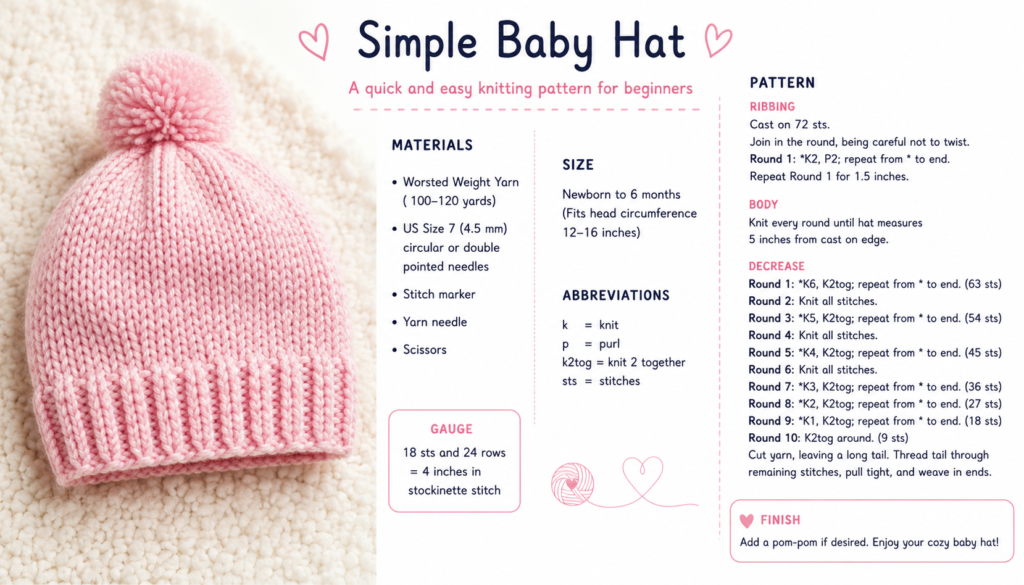
The Pattern — Simple Baby Hat on 2 Straight Needles
Before we begin, a quick note on abbreviations. Knitting patterns use shorthand that looks intimidating at first but becomes completely intuitive very quickly. Here’s what you’ll see in this pattern:
ABBREVIATIONS:
CO = Cast On
K = Knit
P = Purl
K2tog = Knit Two Together (a decrease — reduces your stitch count by 1)
St/sts = Stitch/Stitches
RS = Right Side (the outside of the hat, facing you)
WS = Wrong Side (the inside of the hat, facing you)
Rep = Repeat
PM = Place Marker
BO = Bind Off (also called Cast Off)
If you’re brand new to knitting and the knit and purl stitches are still new friends, don’t worry. I’ll walk you through everything. The knit stitch is the one that looks like a V from the right side; the purl stitch creates a little bump. Together they’re the building blocks of everything in this pattern.
Pattern Notes and Information
MATERIALS:
– 50–70g DK weight yarn (soft, baby-safe fibre)
– US 6 (4mm) or US 7 (4.5mm) straight needles
– Tapestry needle for seaming
– Stitch markers (optional but helpful)
– Scissors
GAUGE:
22 sts x 28 rows = 10cm (4 in) in stockinette stitch on 4mm needles
Adjust needle size as needed to achieve gauge
STITCH PATTERN:
Ribbing: alternating K2, P2 (creates the stretchy brim)
Body: stockinette stitch (K on RS, P on WS)
The Brim — Casting On and Starting the Ribbing
The brim of a baby hat serves two purposes: it looks sweet and finished, and it stretches to accommodate different head sizes. We’ll work the brim in a 2×2 rib, which simply means alternating two knit stitches with two purl stitches across every row.
If you’ve never cast on before, the long-tail cast on is my strong recommendation for this project — it creates a neat, slightly elastic edge that is perfect for the brim of a hat. There are excellent video tutorials for this on YouTube if you search ‘long tail cast on for beginners’ and seeing it demonstrated is much easier than reading about it.
CAST ON:
Premature size: Cast on 52 sts
Newborn (0-3 months): Cast on 60 sts
Small Baby (3-6 mos): Cast on 68 sts
Baby (6-12 months): Cast on 80 sts
BRIM RIBBING (all sizes):
Row 1 (RS): *K2, P2; rep from * to end of row
Row 2 (WS): *K2, P2; rep from * to end of row
Repeat Rows 1 and 2 until brim measures:
Premature / Newborn: 3 cm (approx. 8–10 rows)
Small Baby / Baby (6-12 mos): 4 cm (approx. 10–12 rows)
A note on the ribbing: you’ll notice that working the WS row of a 2×2 rib looks exactly the same as the RS row. This is one of those wonderful properties of the stitch pattern — it’s the same instructions on both sides, which makes it much easier to remember than some other rib variations. Just look at your work: knit the stitches that look like Vs, purl the stitches that look like bumps, and you’ll always be working the rib correctly.
The Body — Stockinette Stitch Section
Once your brim is the right depth, it’s time to move into the main body of the hat. We’ll switch to stockinette stitch here, which is the smooth, classic fabric you’ll recognise from most knitted garments. In flat knitting (which is what we’re doing), stockinette is worked by knitting all stitches on right-side rows and purling all stitches on wrong-side rows.
HAT BODY:
Row 1 (RS): Knit all stitches across
Row 2 (WS): Purl all stitches across
Repeat Rows 1 and 2 until body measures from end of brim:
Premature size: 6 cm (approx. 16–18 rows)
Newborn (0-3 months): 8 cm (approx. 22–24 rows)
Small Baby (3-6 mos): 10 cm (approx. 28–30 rows)
Baby (6-12 months): 12 cm (approx. 32–34 rows)
Measure your work by laying it flat and using a tape measure or ruler held parallel to the rows. Measure from the point where the ribbing ended (not from the cast on edge) to your current needle. When you’ve reached the measurement for your size, you’re ready for the crown decreases.
✨ Helpful reminder: As you work the body, the purl side (wrong side) faces you on every even-numbered row and can look a bit bumpy and strange. Don’t worry — that’s completely normal. The smooth stockinette fabric forms on the right side, and your hat will look beautiful from the outside.
The Crown — Working the Decreases
The crown is where the magic happens. This is where your flat rectangle of knitting transforms into the rounded top of a hat, through a series of decreases that gradually pull the stitches in toward the centre. It sounds more complex than it is — I promise. The decrease we’re using, K2tog (knit two stitches together), is one of the most beginner-friendly decreases in knitting: you simply insert your needle through two stitches at once instead of one, and knit them as if they were a single stitch.
I’ll give you the decrease rows for the most common size here (Newborn, 60 stitches). For other sizes, the principle is the same: you’re dividing your stitch count into even sections and working a decrease at the end of each section, then repeating this every other row until you have a small number of stitches remaining.
CROWN DECREASES — NEWBORN SIZE (60 stitches):
Decrease Row 1 (RS): *K8, K2tog; rep from * to end [54 sts]
Row 2 (WS): Purl all sts
Decrease Row 3 (RS): *K7, K2tog; rep from * to end [48 sts]
Row 4 (WS): Purl all sts
Decrease Row 5 (RS): *K6, K2tog; rep from * to end [42 sts]
Row 6 (WS): Purl all sts
Decrease Row 7 (RS): *K5, K2tog; rep from * to end [36 sts]
Row 8 (WS): Purl all sts
Decrease Row 9 (RS): *K4, K2tog; rep from * to end [30 sts]
Row 10 (WS): Purl all sts
Decrease Row 11(RS): *K3, K2tog; rep from * to end [24 sts]
Row 12 (WS): Purl all sts
Decrease Row 13(RS): *K2, K2tog; rep from * to end [18 sts]
Row 14 (WS): Purl all sts
Decrease Row 15(RS): *K1, K2tog; rep from * to end [12 sts]
Row 16 (WS): Purl all sts
Decrease Row 17(RS): *K2tog; rep from * to end [6 sts]
You now have 6 stitches on your needles. Cut your yarn, leaving a tail of about 20cm (8 inches). Thread this tail onto your tapestry needle, then pass the tapestry needle through all 6 remaining stitches on the knitting needle, slipping them off as you go. Pull the yarn tail firmly through to gather the top of the hat closed. This creates the smooth, gathered crown that gives a baby hat its characteristic little rounded top.
Do not cut the yarn yet — you’ll use this tail to seam the hat.
Crown Decreases for Other Sizes
PREMATURE SIZE (52 stitches):
Dec Row 1: *K11, K2tog; rep from * to last 0 sts [48 sts]
Dec Row 3: *K6, K2tog; rep from * to end [42 sts]
Dec Row 5: *K5, K2tog; rep from * to end [36 sts]
Dec Row 7: *K4, K2tog; rep from * to end [30 sts]
Dec Row 9: *K3, K2tog; rep from * to end [24 sts]
Dec Row 11: *K2, K2tog; rep from * to end [18 sts]
Dec Row 13: *K1, K2tog; rep from * to end [12 sts]
Dec Row 15: *K2tog; rep from * to end [6 sts]
Cut yarn, thread through remaining sts, pull closed.
SMALL BABY SIZE (68 stitches):
Dec Row 1: *K8, K2tog; rep from * to last 8 sts, K8 [62 sts]
(Continue decreasing as for newborn size from 60 sts, adjusting for 62 sts)
Dec Row 3: *K8, K2tog; rep from * to end [56 sts]
Dec Row 5: *K6, K2tog; rep from * to end [49 sts — approx]
Continue decreasing, knitting 1 fewer st between decreases each RS row
until 7 sts remain, then K2tog across to 4 sts, cut & thread through.
Don’t worry if the maths doesn’t divide perfectly evenly for sizes other than the newborn — a stitch or two either way in the decrease section makes essentially no visible difference in the finished hat. Knitting is flexible in a way that sewing isn’t, and the final gathering of remaining stitches at the crown covers a multitude of small mathematical imprecisions.
Seaming the Hat — Finishing Your Work
With the crown gathered and your tapestry needle still threaded, you’re going to seam the back of the hat using mattress stitch. Mattress stitch is a side seam technique that creates an almost invisible join on the right side of the fabric — once you learn it, you’ll use it for decades.
Fold your hat piece in half lengthwise so that the two side edges are together. Thread your tapestry needle through the edge stitches on one side, then the corresponding edge stitches on the other side, working in a zigzag pattern up the seam. Pull gently but firmly as you go. The seam will close up neatly. Work from the top (crown) down to the brim.
Once the seam is complete, weave in any remaining yarn ends by threading them onto your tapestry needle and working them into the fabric for about 5cm in different directions. Trim the excess. Turn the hat right side out. You’re done.
Now please hold it in your hands for a moment and feel what you’ve just made. Go on. I’ll wait.
Common Beginner Mistakes and How to Fix Them
I have made every single one of these mistakes. Multiple times. So please accept this section as it’s intended: not as a list of things not to do, but as a kindly forewarning from someone who has been there and survived every single one of them.
Accidentally Adding or Losing Stitches
This is the most common beginner problem by a significant margin, and it’s almost always caused by one of three things: accidentally knitting into the space between stitches rather than into the stitch itself (which creates an extra stitch), knitting into both loops of the same stitch (same result), or dropping a stitch off the needle and not catching it before it unravels (which loses a stitch). The fix is to count your stitches regularly — every 5–10 rows — and compare to the number you should have. Catching a mistake two rows back is manageable. Catching it twenty rows back is considerably less fun.
Uneven Tension
Some rows tighter, some looser. One sleeve of a tension that seems to fluctuate like your mood during a long project. This is completely normal in the beginning and smooths out naturally as you knit more. The best thing you can do is try to keep your yarn-holding hand consistent and not grip too tightly when things feel uncertain. If you knit a row in a rush or while tense, it’ll show. Give yourself permission to knit slowly when you’re learning.
Twisting Stitches
Twisted stitches happen when you insert the needle into the back of the stitch instead of the front, creating a stitch that is crossed at its base. On the right side, these look slightly tighter and different from their neighbors. The fix is simply to always insert your needle from front to back, going through the front leg of the stitch. Videos, again, are enormously helpful for seeing this correctly.
The Brim Curling Up
If you’ve ever knitted a flat piece in stockinette and noticed the edges curling relentlessly toward the purl side — yes, that’s a property of the stitch itself. This is exactly why baby hats have a ribbed brim rather than a stockinette one: the ribbing lies flat naturally and creates a stable edge. If your brim is still curling, make sure you’re actually working the rib (K2, P2) and not accidentally working all knit stitches.
Losing Track of Where You Are in the Pattern
This happens to everyone. You step away mid-row to answer the door, come back, and stare at your work trying to remember which direction you’re going. The solution is: always leave your work at the end of a row, never mid-row, and use a row counter or a piece of paper to mark which row you’re on. For the decrease section especially, put a small sticky note with the current row number on your pattern so you always know exactly where you are.
Yarn Colour and Seasonal Ideas — Making Each Hat Special
The practical pattern is only part of what makes a baby hat meaningful. The choices you make around colour, texture, and detail are where your own personality and love come through — where the hat becomes specifically and unmistakably yours.
Colour Palettes Worth Considering
The classic baby colours — pale yellow, mint green, soft white, blush pink — are classics for good reason. They read as soft and gentle in a way that feels right for a new baby, they photograph beautifully in the golden light of nursery windows, and they tend to be available in every yarn brand’s core range. There is nothing wrong with choosing a beautiful pale lemon yellow for a spring baby or a soft heather lavender for a winter one.
But if you’re drawn to something bolder — a rich rust orange, a deep teal, a gorgeous tomato red — please don’t let convention talk you out of it. Some of the most beautiful baby hats I’ve ever made have been in strong, saturated colours that look extraordinary against newborn skin. A tiny hat in forest green with a little rolled brim. A deep burgundy hat for a winter baby. A bright, warm coral for a summer arrival. Trust your instincts.
For striped versions, the beauty of this flat-knit pattern is that you can change colours at the end of any row simply by cutting the old colour, attaching the new one, and continuing. Even two or three rows of a contrast colour at the brim creates something that looks far more intentional and detailed than the effort required.
Seasonal Yarn Suggestions
For winter babies: look for yarns with a small percentage of cashmere or alpaca blended in — they have a warmth and softness that is genuinely unmatched. Avoid pure alpaca for very young babies, as it can shed, but a cashmere-merino blend in a deep winter colour (midnight blue, forest green, rich plum) is a genuinely heirloom-quality choice. The hat will be treasured.
For spring and autumn babies: the standard DK merino or cotton-merino blend is perfect. Light, breathable, and available in all the beautiful muted dusty shades that photograph so beautifully in natural light. Sage green, dusty rose, warm cream, pale terracotta — these are the colours of a Pinterest board in the best possible way.
For summer babies: pure cotton or bamboo-cotton blends in bright, cheerful colours. These breathe beautifully, won’t overheat a baby in warm weather, and wash impeccably. A bright sunflower yellow or a clear aqua in a summer cotton yarn is one of the most cheerful things you can make.
Adding a Little Something Extra
Once you’ve made the basic pattern a few times and feel confident, there are beautiful small additions that elevate a simple baby hat into something truly special. A handmade pom-pom in a contrasting colour, attached to the gathered crown. A tiny crocheted flower or a simple bow knitted separately and sewn on. An embroidered initial in the corner of the brim. A small button detail. None of these requires advanced skill — they just require a willingness to add one extra step to the finishing process.
Pom-poms are my personal favourite addition, and they’re so easy to make. You can buy a pom-pom maker for a few pounds at any craft store, or simply wind yarn around two fingers, tie it in the middle, and snip the loops. A fluffy pom-pom in a contrast yarn colour transforms a simple hat into something that looks like it came from a boutique.
Gift-Giving Inspiration — Sharing Your Handmade Work
There is a specific kind of bravery required to give someone a handmade gift. I say bravery because the handmade gift is more personal than a purchased one in a way that feels vulnerable — you’re not just giving an object; you’re giving your time, your attention, your care, your skill. That feels exposed in a way that buying something at a shop does not.
But I want to tell you something that fifteen years of giving handmade baby hats has taught me: people treasure them. The parents of newborns are surrounded by new-baby gifts, many of them beautiful and expensive, and what they often remember years later is not the fancy pram or the designer blanket but the hat that someone’s grandmother knitted, or the one a friend made during the long quiet evenings of her own maternity leave with a message tucked inside. Handmade things carry stories in a way that purchased things simply cannot.
Presenting Your Hat Beautifully
The presentation of a handmade gift matters more than people often acknowledge. Not because the packaging is the point, but because beautiful presentation communicates that you thought about the whole experience of receiving it, not just the making of it.
I like to fold finished hats gently and place them in a small muslin bag or wrap them in tissue paper in a colour that complements the yarn. A simple handwritten tag with the yarn details (fibre content and washing instructions — very important for a baby item) adds a professional, thoughtful touch. Sometimes I include a second skein of the yarn in case the parents want to knit something matching, which is a detail that knitting parents particularly appreciate.
If you’re making a hat as a baby shower gift, consider knitting two or three in different sizes — a newborn, a three-to-six-month, and a six-to-twelve-month. Package them together tied with a ribbon. This is one of the most practical gifts a new parent can receive, because it means the baby always has a handmade hat that fits, regardless of how quickly they grow.
Baby Shower Bundles and Sets
A single beautiful baby hat is a wonderful gift. But if you have time and inclination, a coordinated knitted set — hat and matching booties, or hat and a pair of tiny mittens — is the kind of gift that gets photographed and shared and remembered for years. The booties and mittens patterns that pair with this hat style are equally beginner-friendly; once you’ve finished your first hat, you’ll be surprised how quickly the other pieces come together.
Knitting for hospital donation is another beautiful option, and many hospitals and neonatal wards actively welcome donations of hand-knitted baby hats, particularly in very small premature sizes. If you’re looking for a way to make your new craft meaningful beyond your immediate circle, this is one of the most genuinely impactful things you can do with your needles.
Styling Ideas — The Many Moods of a Baby Hat
You might not think of a knitted baby hat as something that can be styled, in the same way you think about an outfit or a room. But the aesthetic choices you make in knitting one — the yarn colour, any additions, the finishing details — create a mood that is worth thinking about intentionally, especially if you’re making for a specific nursery aesthetic or a particular aesthetic-minded parent.
The Classic and Timeless Look
White, cream, or pale yellow hat in a smooth merino DK, with a slightly longer 2×2 rib brim. No additions. Beautifully finished seam. This hat reads as heirloom — something that could have been knitted by a grandmother in any decade and would always look right. It photographs beautifully in natural light and pairs with almost any nursery aesthetic.
The Modern and Colourful Look
A bright, confident colour in a clean DK yarn — a clear teal, a warm rust, a bold mustard — with a contrasting colour stripe at the brim and a pom-pom at the crown. This reads as contemporary and playful, the kind of hat you see in those beautiful new-baby announcement photos against a white linen background. Great for parents who are confident in their colour choices and don’t default to the traditional pale palette.
The Cottagecore and Cozy Look
A soft, slightly textured yarn in a muted natural tone — oatmeal, soft sage, dusty rose, warm biscuit — worked in a slightly longer body with a generous brim. Add a small fabric bow in a complementary floral print or a crocheted flower at the brim. This reads as dreamy and handmade in the most intentional way, perfect for a nursery that leans toward the soft and natural, and one of the most save-worthy looks on Pinterest.
The Luxury and Quiet Elegance Look
A cashmere-merino blend in a deep, sophisticated colour — navy, forest green, a rich camel — worked in a simple, unadorned silhouette with a precise seam and impeccable finishing. No embellishments. Just extraordinary yarn in a beautiful, considered colour. This is the baby hat for the parent who appreciates quality over flash, and it is a gift that genuinely communicates how much you care.
Frequently Asked Questions
How long does it take to knit a baby hat as a beginner?
Honestly? Anywhere from one long evening to a week of weeknight knitting sessions. An experienced knitter can finish this hat in about two hours. A beginner working through the pattern carefully, stopping to check the instructions and count stitches, will probably need four to eight hours spread over several sessions. Both of these are completely fine. The pace is part of the pleasure when you’re learning.
Can I use a thicker or thinner yarn than DK?
Yes, but you’ll need to adjust the pattern. If you use a lighter fingering or sport weight yarn with smaller needles, you’ll need more stitches to achieve the same circumference. If you use a heavier worsted or bulky yarn, you’ll need fewer stitches but the hat will be thicker and potentially less comfortable on a baby. I’d recommend sticking to DK for your first hat and experimenting with other weights once you understand how the construction works.
What if my hat comes out too small or too big?
If it’s too small, check your gauge — you’re likely knitting tighter than the pattern expects. Try going up a needle size. If it’s too big, you may have looser tension than the pattern expects — try going down a needle size. You can also simply adjust the stitch count: add 4–8 stitches to the cast on for a larger hat, or reduce by 4–8 for a smaller one.
Can I knit this hat without the ribbed brim?
You can, but the brim serves an important practical purpose — the ribbing stretches to fit different head sizes and stays in place on a baby’s head better than a non-ribbed edge. If you prefer the look of a folded stockinette brim (which you fold up to reveal the reverse), you can work the entire hat in stockinette and simply fold the first few inches up. It’s a different aesthetic and works beautifully if you prefer it.
My seam is visible from the outside. What did I do wrong?
Probably nothing. Seaming takes practice, and the first few times you do it, the seam will be visible. As you get a sense for the mattress stitch and develop a consistent tension in your seaming, it will become much neater. For now, simply make sure the seam is at the centre back of the hat rather than somewhere it will be visible — most people never look at the back of a baby’s hat closely enough to notice anyway.
How do I wash a knitted baby hat?
This entirely depends on the yarn fibre. Superwash merino and most acrylic yarns can be machine washed on a gentle, cool cycle and laid flat to dry. Non-superwash wool (untreated natural wool) must be hand-washed carefully in cool water and dried flat — machine washing will cause felting and shrinkage. Cotton and bamboo yarns are generally machine washable. Always include a care tag with your gift that specifies the yarn content and washing instructions.
Can I sell hats made from this pattern?
This pattern is designed for personal use, charity donations, and gift-giving. If you’d like to sell hats made from the pattern, please credit the source and check any specific terms that accompany the pattern as published on the website. Many pattern designers actively encourage selling finished items from their designs, as long as credit is given.
Personal Reflections — Why Knitting Baby Hats Matters
I want to end with something that isn’t really about knitting at all. Or rather, it’s about what knitting is really about — which is not yarn and needles and gauge swatches, but the very human impulse to make something with your hands and give it to someone you love.
In a world where almost anything can be bought in two clicks and delivered before you’ve finished your morning coffee, there is something quietly radical about deciding to make something instead. To sit down with needles and yarn and commit your time — real, irreplaceable time — to creating something that exists because your specific hands made it. That cannot be replicated or mass-produced. That carries, in every stitch, the evidence of your care.
Baby hats feel like the purest expression of this impulse. No one needs you to knit a baby hat — you can buy a hat in any shop. You choose to knit one because the making is an act of love. Because sitting with your needles in the evening, thinking about the baby who will wear this hat and the parents who will put it on their baby’s head for the first time, and choosing the colour specifically and working the stitches carefully — all of that is a form of care that has no purchased equivalent.
And the things you make with love have a tendency to be kept. I’ve heard from so many parents who still have, tucked away in a memory box, the knitted hat their baby wore home from the hospital. Not the fancy purchased items — the handmade one. The one someone sat and made for them. That permanence, that being-kept, is the highest compliment a handmade object can receive.
So if you’re sitting at the beginning of your knitting journey, feeling uncertain and a little overwhelmed by needles and pattern abbreviations and gauge calculations — I want to tell you: all of that resolves itself with practice. What doesn’t need practice is the love that motivated you to try. That part you already have. Cast on. The rest will follow.
“Every stitch is a small act of love, made tangible.”
A Few Final Knitting Tips — From My Knitting Bag to Yours
I’ve been collecting these over the years — the small things that make a real difference and that you don’t always find in official knitting guides because they’re too practical to be interesting, or too specific to be universal. But they’ve helped me, and I hope some of them help you.
Never start a new skein of yarn in the middle of a row. Always finish the row first and join at the edge. This makes weaving in ends dramatically easier and keeps your seam area clean.
When you’re not sure if a stitch looks right, look at the stitches around it. Knitting is repetitive, and a mistake usually looks clearly different from the established pattern of the surrounding stitches. Trust your eye.
Keep a small dedicated knitting bag — even just a zippered pouch — for your in-progress project. Having everything in one place (needles, yarn, scissors, tapestry needle, pattern) means you can pick it up and put it down without losing anything, which makes knitting fit much more easily into a busy life.
If you drop a stitch and watch it unravel down several rows, don’t panic and don’t try to fix it without a crochet hook. A small crochet hook and a YouTube video for ‘how to pick up a dropped stitch’ will save the situation in about five minutes. Dropped stitches are fixable; they’re not the catastrophe they feel like in the moment.
Take photos of your finished objects. I know this sounds like social media advice and it partially is — if you share your makes, photos are how you document and share them. But even if you never post anything anywhere, having a photo record of things you’ve made is genuinely wonderful. I have photos of my first baby hat, disaster that it was, and looking at it now makes me think of exactly who I was when I made it and how much I’ve learned since.
Finally: don’t compare your learning curve to anyone else’s. Some people pick up knitting in an afternoon. Some people struggle for months before everything clicks. Both of these paths lead to the same place: a person who can knit, who has something to show for their practice, who is building a skill that will give them enormous pleasure for the rest of their life. The pace of the journey doesn’t determine the quality of the destination.
You Made Something Wonderful — A Closing Note
Whether you’ve finished your first baby hat or you’re sitting here at the beginning of this journey with needles in hand and yarn wound and ready — I hope this guide has given you what you needed. A clear pattern you can trust. An honest conversation about the bits that are tricky. The encouragement to try even if you’re not sure you’re ready.
You are ready. The hat is small. The pattern is achievable. The stitches are learnable. And the feeling of finishing — of holding something tiny and soft and entirely handmade in your hands — is worth every moment of uncertainty along the way.
Cast on. One stitch at a time. The hat, and the habit, will follow.
Happy knitting.
Share your finished hat! Tag your makes with #SimpleKnittedBabyHat or leave a comment below — I love seeing what everyone creates.
— Written with love for knitters everywhere
A Knitting & Handmade Lifestyle Blog • 2026