
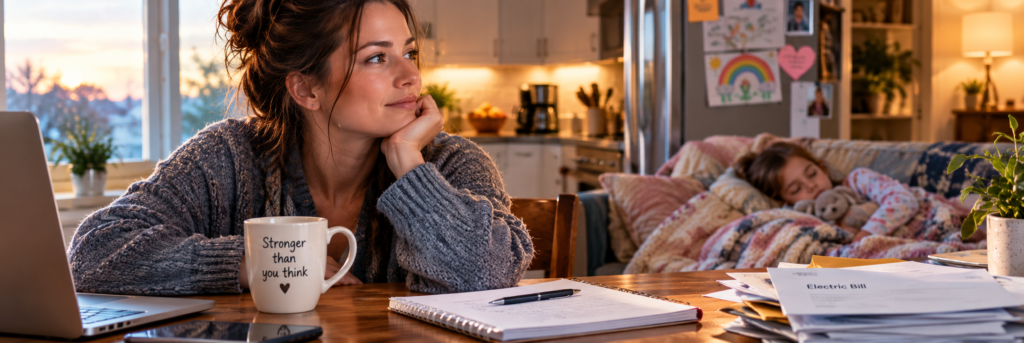

I am thirty-seven years old. I have a seven-year-old daughter, a job at the front desk of a veterinary clinic, a car with a noise I am pretending not to hear, and a mortgage-sized quantity of love that has nowhere to put itself down.
I am writing this because for a long time I did not think anyone wanted the real version of this story. The real version has no villain and no triumph in it. Nobody storms out in the rain. Nobody gets a dramatic rescue at the end. It is mostly Tuesdays. It is mostly an ordinary woman making ordinary decisions at an ordinary kitchen table, usually alone, usually tired, and usually, somehow, okay.
But it is also the most important thing I have ever done, and I would like it to be seen, even if only by one other woman standing at her own counter at 5:40 in the morning, holding her own coffee, listening to her own house hum.
If that is you: hello. Come in. I have saved you a seat.
How We Got Here
People like a beginning. They want to know what happened, who left, who was to blame. I understand the instinct. I used to want that too, a clean explanation I could hand over so that nobody would have to wonder.
The truth is that Daniel and I ended the way a slow leak ends a tire. There was no blowout. For about two years there had been a gradual loss of pressure that we both noticed and neither of us named. We were polite. We were tired. We passed the baby back and forth in the evenings like a relay baton and said things like “Did you take the trash out?” and “She’s finally down.” Somewhere in there we stopped being two people who liked each other and became two people running the same small business.
He told me on a Sunday afternoon, in the kitchen, while Josie napped. I remember that the dishwasher was running. I remember thinking that I would have to wait for it to finish before I could say anything, which is a ridiculous thing to think, and I have never forgotten it.
“I don’t think I can keep doing this,” he said.
“Doing what?” I asked, though I knew.
“All of it.” He rubbed his face with both hands. “I’m not saying it’s your fault. I’m saying I’m not who you need.”
I wanted to be angry. I waited for the anger the way you wait for a sneeze, and it did not come. What came instead was a kind of flat, clear sadness, and underneath it, shamefully, something that felt a little like relief. Not because I wanted him gone. Because someone had finally said the thing out loud, and the air in the room could move again.
He moved to Colorado that spring, for a job and, I think, for a version of himself he thought he could still become. He is not a monster. I want to be clear about that, because the story that people prefer has a monster in it. He sends a card on Josie’s birthday, usually a few days late. He calls on some Sundays and not on others. Last year he sent money four months out of twelve. When she was four she asked me, in the bathtub, with great seriousness, “Is my dad a real dad or a pretend dad?” and I said, “He’s a real dad who lives far away,” and she nodded and went back to arranging her plastic ducks by size.
I have since learned that there is a particular kind of grief in a person who is still alive and simply not here. You cannot hold a funeral for it. You cannot receive casseroles. You just wake up one day and understand that you are the only parent in the house, and that this is not a phase, and that you had better learn to do it well.
So I did what a person does. I learned the things I did not know. I learned how to read the escrow statement. I learned how to bleed a radiator, from a video, at midnight, on my knees, with a towel. I learned that the sound of a smoke detector with a dying battery is designed by someone who hates mothers. I learned that I could do nearly everything, and that doing nearly everything was a different thing than wanting to.
The Arithmetic of Ordinary Days
On the first of every month I sit at the kitchen table with a pencil, a calculator that was my father’s, and a stack of envelopes I do not really need anymore, since most of my bills are online. I keep the envelopes anyway. There is something about writing a number on a physical thing and putting it in a physical pile that makes me feel as though I am in charge of something.
The numbers are not dramatic. That is the part I find hard to explain to people who have never done this. I am not in a crisis. I have a job, and a roof, and a refrigerator that is mostly full. But there is no slack in the line. Every dollar is already spoken for, and if one thing goes sideways, such as a vet bill for the clinic’s cat that I somehow ended up paying for, a flat tire, or a school fee I had not planned on, the whole thing shifts and I spend a week doing math in my head in the shower.
After-school care costs more than I would like to say aloud. The car insurance went up for no reason that was explained to me. The good peanut butter is two dollars more than the other peanut butter, and I stand in the aisle in front of the shelf, doing a calculation that would embarrass me if anyone could see it, and I buy the other one.
“Mom, can we get the cereal with the marshmallows?” Josie asked last Saturday, holding the box up like a trophy.
“Not this week,” I said.
She looked at the box and then at me. I watched her decide not to ask why. She is seven, and she has already learned to read my face the way a sailor reads weather. She put the box back on the shelf, carefully, front label out, the way I taught her to leave things. Then she took my hand and said, “That’s okay. The regular kind is good, too.”
I wanted to buy her every box of cereal in the store. I wanted to buy her a small, sunny house with a lemon tree in the yard. Instead I squeezed her hand and said, “You’re right. It’s good.” And then in the car I sat for a moment before I started the engine, because my throat had closed up over a thing as small as cereal.
Here is what nobody tells you about being careful with money. It is not only about the money. It is about the hundred small moments in which you decide not to want something, and then decide not to let your child see you decide. It is about being the keeper of the line between enough and not quite, and standing on it all day long with a smile.
In September I filled out the form for reduced-price school lunches. I sat with it for three days. I do not know why it felt like a confession. I have a good job. I work hard. But the numbers are the numbers, and the form was clear, and my daughter’s lunch is a small, real thing I can take off the list. When the approval came in the mail, I felt two things at once, and by now you will not be surprised by that. I felt relief so sharp it made my knees soft. And I felt a small, stubborn shame that I knew was unearned, and that I carried around for a week anyway like a stone in a pocket.
I keep a jar on top of the refrigerator. It is an old pickle jar with the label soaked off. Into it goes whatever is left over, a few dollars here, the change from the grocery store, a ten I find in a coat. It is not much. But it is ours, and it has no job. It exists to be spent on something unnecessary. In June it bought us two ice cream cones and a ride on the carousel at the park, and my daughter, sitting on a painted horse with her braids flying, looked at me and shouted, “Mom! Mom! Look at me!” And I looked. I looked as hard as I have ever looked at anything. And I thought, there it is, that is what the money is for.

Deciding Alone
The fever came at 11:40 on a Thursday night.
I knew before I touched her forehead. A mother knows the weight of a hot child, the way her whole body lies against you like a small furnace. The thermometer said 103.2. Josie’s cheeks were bright and her eyes were glassy, and when I asked her what hurt, she said, in a small, blurred voice, “Everything, a little.”
Here is the thing about decisions in the middle of the night. They are the same decisions anyone would make, with one difference: I was the only one making them. There was no one on the other side of the bed to say, “Let’s give it an hour,” or “No, I think we should go.” There was no second opinion, no steady hand. There was me and a thermometer and the bright red numbers.
I gave her the medicine. I got a cool washcloth. I called the nurse line on my insurance card and sat on hold listening to a recording of soothing piano, doing the arithmetic. The emergency room copay. The urgent care, closed until morning. The shift I could not afford to miss tomorrow. The possibility, small but present, that I was being foolish and she was fine. The possibility, smaller but heavier, that I was being foolish and she was not.
“Is she drinking fluids?” the nurse asked, when she finally came on. Her voice was kind and unhurried, and I could have wept at it.
“A little. She’s sleepy.”
“Is she responding when you talk to her?”
“Yes. She’s, yes. She’s just hot, and tired.”
“Any stiff neck, rash, trouble breathing?”
“No.”
“Okay. Here is what I’d suggest.” And she walked me through it, the signs to watch, the numbers that would change the plan, the timing of the next dose. “You’re doing the right things, Mom. Call us back if anything changes.”
You’re doing the right things, Mom. I held that sentence like a lit match. It was the first time anyone had said it to me all day, and she was a stranger on a phone line, paid to say it, and it did not matter. I wrote it on the back of an envelope so I would not forget.
I sat on the bathroom floor with the door open so I could hear her, with my back against the tub, watching the little line of light under her bedroom door. Every twenty minutes I got up and checked. At 2:15 her fever broke into a damp, sweaty sleep. At 2:30 I let out a breath I did not know I had been holding. At 3:00 I was still awake, and the wave of fear that had been holding me upright drained away, and in its place came a different feeling that I had no name for. It was not fear. It was something like the echo of fear: the knowledge that I had been alone with it.
I picked up my phone. I scrolled through my contacts, past my sister, who was asleep two time zones away, past my mother, who would worry for a week, past friends whose lives were full of their own midnight emergencies. I did not call anyone. I put the phone face down on the bath mat and sat there, in the quiet, and I let myself feel how heavy it was to be the person who decides.
The big decisions are like that, too. Last spring I was offered a job at a larger clinic across town: better pay, better benefits, a longer commute, and a schedule that would have meant missing most of Josie’s afternoons. I made lists. I made lists of the lists. I asked friends what they would do, and every one of them said, “Whatever you think is best,” which is the kindest thing and also, in the moment, the most useless. In the end I stayed where I was. I took the smaller salary and the shorter drive, and I kept the afternoons, and I have not been entirely sure I was right in the months since. Some nights I run the numbers again.
That is what no one warns you about. It is not the size of the decisions. It is that you make them without anyone to tell you, afterward, that you chose well. You live inside the choice, and the choice has no witness.
When the morning came Josie woke up cool and cranky and hungry. She ate two pieces of toast, looked around the kitchen as if returning from a long voyage, and said, “Why are you so tired, Mom?”
“I stayed up with you,” I said.
She considered this. “Did I do something bad?”
“No, baby. You just got sick. It’s my job to stay up.”
“Okay,” she said, and patted my hand twice, a little gesture she had absorbed from somewhere, perhaps from me. “You can sleep now.”
I could not, of course. There was a school to call and a clinic to call and a pile of laundry the size of a small dog. But the offer lodged somewhere warm in my chest, and stayed there all day.
Lonely in a Crowded Room
There is a kind of loneliness that has nothing to do with being alone, and it took me years to understand that the two are different.
I am almost never alone. I am surrounded. I am surrounded at the clinic by colleagues who bring in banana bread and ask about my weekend. I am surrounded at school pickup, in the cluster of parents on the sidewalk, trading small talk about the weather and the bake sale. I am surrounded by Josie, who talks to me from the moment she wakes up until the moment she falls asleep, in a continuous, delightful, exhausting stream. I could not tell you the last time I was physically by myself for an hour.
And yet.
Last month there was a birthday party for a boy in Josie’s class, held at a trampoline park that smelled of rubber and feet. I stood against the wall with a paper cup of lukewarm coffee, watching our kids launch themselves into foam pits, and I listened to the couples around me. They had a whole language I did not speak. “Did you remember the gift?” “It’s in the car, babe.” “I told you, we’re doing Maine this summer, I already looked at flights.” It was not that I envied them, exactly. They were just talking. But every sentence assumed a we, and I stood on the edge of it like someone watching a game of catch she was not invited to join.
A mother I like, Renata, came and stood beside me. She is warm and funny and has three children and a husband who coaches soccer on Saturdays. “I honestly don’t know how you do it,” she said, shaking her head. “I’d lose my mind. You’re amazing.”
“Oh, you’d do it,” I said. “You do what you have to do.”
“No, really,” she said, and touched my arm. “I couldn’t.”
I smiled. I said thank you. And I felt the small, quiet click of a door closing, the way it always does when someone calls me amazing. It is a compliment, and I know she means it. But what it also means is you are on the far side of something from me. It means that I am a person to be admired from a distance, and not a person who is invited to the dinner party, because who would watch Josie, and also, what would we talk about?
I am not saying this to be bitter. Renata is a good friend. I am saying it because the loneliness of single motherhood is not a dramatic loneliness. No one is rude to you. People are kind. They send texts that say thinking of you! They tell you that you can call anytime. And you know they mean it, and you do not call, because you can see how full their lives are, and because what you would want to say is too large and too strange to fit in a phone call. I am so tired. I am so tired and no one has touched me in eight months. I miss the sound of someone else’s key in the door.
At Thanksgiving I drove six hours to my sister’s house, with Josie asleep in the back and the radio turned low. The house was full of people. There were cousins and aunts and a dog and the loud, warm tangle of a family that loves each other. My sister hugged me at the door. My mother pressed a plate into my hands. Someone put a baby on my lap. At one point I looked around the crowded table, at the faces lit by candles and the steam rising from the dishes, and I thought, I am surrounded by people who love me, and I have never felt so far from anyone.
It was not their fault. It was not even about them. It was that I had spent so long being the only grown-up in my own house that I had forgotten how to be a guest in anyone else’s life. I did not know how to put the plate down. I did not know how to be looked after. When my brother-in-law said, “Sit, sit, we’ve got the dishes,” I did not know where to put my hands.
Later, in the guest room, with my daughter’s small body curled against my side, I cried silently into the pillow, the way you learn to when there is a sleeping child within arm’s reach. I was not sad, exactly. It was more like pressure leaving a tire. I just needed, for a few minutes, to be nobody’s mother.
In the morning my sister brought me a cup of coffee in bed. She did not say anything. She just set it on the nightstand, and squeezed my foot through the blanket, and left. It was the kindest thing anyone did for me that whole year.
The Hours After Bedtime
At 8:15 Josie is in bed. At 8:40, after two more glasses of water, one more song, a question about whether worms have feelings, and a last-minute announcement that she needs a poster board for tomorrow, she is asleep. And the house exhales.
Those are the hours I have to myself, and they are not what you might imagine. They are not a spa. They are dishes. They are the lunch to be packed, the email to be answered, the form that says emergency contact with a second line I never know what to put on. There is a sink full of bowls and a counter that has to be wiped, and somewhere in there I stop moving and stand in the middle of the kitchen and realize it is very quiet.
The quiet is its own thing. It is not peaceful, always. Sometimes it is a held breath. Sometimes it is the echo of a conversation I want to be having and cannot.
What I miss, most days, is not romance. I want to be honest about that, because I think it is a thing people assume. What I miss is the ordinary company of another grown-up. I miss someone to say, “You will not believe what the dog at the clinic did today,” and to hear the other person laugh in the right place. I miss someone to ask, “Did you eat?” and mean it. I miss the small, domestic, wordless acknowledgments of a shared life: a hand on the small of my back as someone passes behind me in the kitchen, the sight of two coffee mugs in the sink instead of one.
I miss being known in the tiny ways. Not the headline things. The small things. Someone who would notice that I had stopped humming.
I have tried to fill the space. I listen to podcasts while I clean, two women who talk about books and bad dates and their mothers, and sometimes I laugh out loud in my empty kitchen, and then feel a little ridiculous. I text my friend Priya at ten o’clock at night, and she texts back a string of exclamation points and a photo of her cat, and for a moment I feel held. I take baths that are too short, with the door cracked open. I read the same three pages of a novel on the couch until my eyes close.
Once, a man who came into the clinic with his elderly retriever stayed a few minutes longer than he needed to at the desk. He asked how long I had worked there. He said I had a good laugh. I went home that night and stood in the bathroom looking at my face in the mirror, a face that had not been looked at as a woman’s face in a long time, and I felt something that was half hope and half grief. I never saw him again. It does not matter. What matters is that I noticed how hungry I was to be noticed, and that I did not know what to do with the discovery.
Here is the honest shape of it. I do not feel incomplete without a partner. I want to say this clearly, because I am so tired of the idea that a woman and her child are only half of something. We are whole. We are a whole, loud, tender, complicated family of two. But being whole is not the same as being unlonely. I can be a full person and still wish, on a Wednesday night with the dishes done and the house humming, for another voice in it.
Sometimes I say that out loud to the empty kitchen. “I wish someone were here.” And the house just listens. And that, strangely, helps.
What I Don’t Say
There are things I do not say to anyone. They live in the hours between two and four in the morning, when fear has the run of the house.
What if something happens to me?
It is the one that comes first and most often. If I am the only parent, then I am the only safety net. If I get hit by a car on the way to work, who is Josie’s mother? One winter I sat at the kitchen table with a legal pad and wrote out what I would want. I made a list of names: my sister, then my best friend. I worked out guardians and accounts and a little letter to be read later. I filled three pages. Then I went to the bathroom and was quietly sick, and came back, and finished.
I have a will now. It is in a folder in the closet, behind the winter hats. I have told my sister where it is. It is a perfectly responsible thing to have done, and it took more out of me than almost anything I have ever signed.
What if I am doing this wrong?
This one is quieter, and it never leaves. I think about the morning in October when I could not find my keys and Josie could not find her library book, and I raised my voice, a sharp, ugly edge of a voice, and she went still and small, the way a bird goes still. I saw it happen. I saw her shoulders come up around her ears. And I was standing in the entryway with my heart pounding, thinking: there is no one here to catch me when I am like this. There is no one to say, “Hey, you’ve got this, take a breath.” There is only a seven-year-old with huge eyes, waiting to see what kind of mother I am going to be in the next ten seconds.
I knelt down. I said, “I’m sorry. I yelled, and that wasn’t fair. I’m stressed about being late, but it’s not your fault.”
She looked at me for a moment. “It’s okay,” she said. “You’re allowed to be grumpy.”
“I’m allowed to be grumpy,” I said. “But I’m not allowed to be mean.”
“You weren’t mean. You were just loud,” she said generously, and then she hugged me around the neck, and we found the keys in the refrigerator, and we were nine minutes late, and we survived.
I hold on to that. Not the yelling. The repair. I have to believe the repair counts for more.
What if she grows up thinking love means doing it all alone?
What if she thinks she is the reason he left?
That last one surfaced a few months ago, in the car, at a red light. “Mom,” she said from the back seat, in the casual tone of a child asking about the weather, “why doesn’t Dad come to my stuff?”
I watched the light. It was a long red light.
“I think,” I said slowly, choosing each word, “that your dad has some things he’s figuring out. And I think it’s hard for him. But it has nothing to do with you, Josie. Nothing. You are the best thing that ever happened to him, and he just isn’t very good at showing it.”
She was quiet. The light turned green. Behind us, someone honked. “Okay,” she said. Then, a moment later: “Can we get fries?”
We got fries. We sat in the parking lot of the burger place and ate them out of the paper bag, and she told me a long, complicated story about a girl named Maeve who had a pet rabbit that could do a trick, and I listened with my whole body, and I thought: This is it. This is what I have. This is how I show her she is loved: I stay. I stay in the car. I stay at the table. I stay in the room.
I do not know what she will remember. I do not know if I am giving her enough. I know only that I am here, every single day, and that presence is the one thing in my power that I will never run out of.
The fears are real. I have stopped trying to argue them away. Instead I let them sit in the room, like uninvited guests, and I make them a cup of tea, and I say, I see you. But I am not leaving.
The Small Things That Hold Everything Up
If I told only the hard parts, I would be lying. I would be giving you half a truth, and the other half is the reason I would do every bit of it again.
It is Saturday morning, and the kitchen smells like butter. Josie stands on a chair beside the stove in her pajama pants and one of my old T-shirts, which reaches her knees, holding the whisk like a scepter. She is in charge of the batter. I am in charge of the heat. We have a system. She cracks the egg, and we fish out the shell together, and she says, with enormous gravity, “This is how you know it’s a real pancake. There has to be a little bit of shell.”
“That’s not how it works,” I say.
“It’s how we do it,” she says.
And she is right. That is exactly how we do it. We have a hundred of these, tiny private customs that belong to no one else. The song we sing when we brush teeth, which is the same four words to the tune of a song that does not exist. The way she reaches for my hand in the parking lot, without looking, the way you reach for a railing. The handshake we invented in the car, which has seven steps and ends with a head bump. The pasta she still calls “pasghetti,” which I have never once corrected, because I know there will come a day when she says it right, and I will miss the wrong version terribly.
Sometimes I think about how much of a childhood is made of things too small to photograph. No one will ever take a picture of the way she tucks her feet under her when she reads, or the sound she makes when she is trying not to laugh. But I carry them. I am the archive. I am the only living record of these ten thousand tiny moments, and that is a heavy honor, and a sweet one.
On a rainy afternoon in March, we skipped the errands and walked to the corner in our boots. She jumped in every puddle. Every single one. She ran ahead and turned around, soaked to the knees, her face wet and radiant, and shouted, “Mom! Come on! Rain doesn’t hurt you!” And I looked at the dull gray sky and the dripping trees and the list of things I was supposed to be doing, and I thought, she’s right. I stepped in a puddle. It was cold and it was ridiculous and I laughed so hard I had to hold on to a lamppost.
There is a note I leave in her lunch every day. Nothing profound: Have a good day. You are brave. Eat your carrots. One afternoon, coming home from work, I found a note on my pillow, written in pencil in her big, uneven letters: Dear Mom. You are the best mom. I will help you with the money. Love Josie. There was a drawing underneath of two stick figures holding hands beside a small, round dog. We do not have a dog. She has been campaigning for a dog for two years.
I sat on the edge of the bed and read it three times. I will help you with the money. I wondered, for a second, how much she knows. I wondered if I had let her see too much. But then I looked at the dog, with its round, hopeful face, and I understood that what she had written was not a burden. It was love. It was a seven-year-old’s way of saying: I see you. We’re in this together.
I put the note in the drawer of my nightstand, where I keep the things I cannot lose.
Here is what I have learned about joy. It does not arrive in the places you expect. It does not wait for you to have enough money or enough sleep or enough time. It is stubborn and small, and it grows in the cracks, the way moss grows in the seams of a sidewalk. A warm bath. A song on the radio. A child’s hand slipped into yours without a word. It does not erase the hard parts, and it does not need to. It simply sits beside them, and some nights it is enough.
Letting Someone In
The car died on a Wednesday in November, in the parking lot of the grocery store, with a gallon of milk and a bag of apples in the trunk and Josie in the back seat in her good coat.
I turned the key. Nothing. I turned it again. The dashboard flickered and gave up. I sat with my hands on the wheel, and I could feel the old, familiar panic rise in me, the arithmetic starting up in my head, the cost of a tow, the cost of a repair, the cost of missing work, all of it stacking, stacking.
“Mom?” Josie said, in the careful small voice she uses when she can tell something is wrong.
“It’s okay, baby. The car is just taking a rest.”
I stood in the cold with the hood up, looking at an engine I did not understand, and a man in the next row, a neighbor from two doors down whose name I had never quite learned, walked over. “Trouble?” he said.
I almost said, No, I’m fine, I’ve got it. The words were right there. It is the reflex of a woman who has spent years convincing everyone, herself included, that she needs nothing.
Instead I heard myself say, “Actually, yes. I think the battery is dead. I don’t know what to do.”
He nodded, as though I had said something perfectly reasonable. “Got cables in my truck. Give me a minute.”
His name was Mr. Alvarez. It took him four minutes to get the car started and ten more to tell me about his late wife’s Buick, which had also died in parking lots, and his daughter in Phoenix who never called enough. Josie stood next to him, solemnly handing him things he did not need. When it was over, he said, “You tell me if you need anything. I’m right there. I’m home most days. I mean it.”
I said thank you. And then, because I had been practicing, I said, “I might take you up on that.”
I did, in January, when the sitter canceled and I was desperate. He came over with a deck of cards and a bag of butterscotch candies and sat with Josie at the kitchen table for two hours. I came home to the sight of them playing a ferocious game of Go Fish, my daughter gleefully shouting, “Got any sevens?” and an old man with reading glasses pretending to be outraged. I stood in the doorway with my coat still on, and I felt something loosen inside me that I had been holding tight for years.
I had thought that asking for help meant admitting I was failing. I had it exactly backwards. Each time I let someone in, the weight shifted, and I could breathe a little deeper.
Since then, I have said yes more often. I said yes when Renata invited us to Sunday dinner, and sat at a loud, crowded table where I was handed a baby and a glass of wine and told to relax. I said yes to Priya’s offer to sit on the phone with me while I filled out the forms. I said yes to my sister, who has started sending a little money each month with a note that says for fun, not bills. It is not a rescue. It is a web, thin strands, one at a time, and I am learning to lean on it.
What I Know Now
I am not the same woman who stood in that kitchen on a Sunday afternoon while a dishwasher ran. I do not think I could have predicted who I would become. I used to think that strength was something you had or did not have, like height. I understand now that it is something you practice, in small, unglamorous increments, until one day you look up and find that you have built a house out of it.
I know that I can do hard things. Not because I am special, but because I have no choice, and in the absence of choice a person discovers what she is made of. I know that I can sit with fear without being ruled by it. I know that a repair is more powerful than a perfect record. I know that I can be lonely and loved at the same time, tired and grateful at the same time, uncertain and still moving forward.
I know that I am enough for my daughter. Not a perfect mother, not a rich one, not a rested one. But a present one, a real one, a woman who stays. I know that she will not remember the cereal I did not buy. She will remember the pancakes. She will remember the puddles and the notes in her lunch box and the sound of her name said with love.
I have also come to know that I am allowed to want things for myself. I am allowed to want rest, and company, and a future that has room in it for me. Last month I signed up for a pottery class on Thursday evenings, with Mr. Alvarez staying with Josie. I am terrible at it. My bowls come out lopsided. But for two hours I sit with my hands in cool, wet clay, and nobody needs anything from me, and when I come home, my daughter is asleep with a playing card in her fist, and I feel like a person again.
I do not know what the next ten years hold. I do not know if there will be a partner, or a bigger house, or an easier season. I have stopped needing to know. What I have instead is a quiet, steady faith, not that everything will turn out the way I hope, but that I will be able to meet whatever comes. That is the thing that single motherhood has taught me. I am more capable than I ever imagined, and I am worthy of gentleness, too.
5:40 a.m., Again
The alarm goes off at 5:40, and I am already awake.
The house is dark and humming. The radiator ticks. Down the hall my daughter is asleep with one arm flung above her head, hailing her dream taxi. On the counter there is a lunch half packed, a note waiting to be written, and the permission slip, signed this time, with a coffee ring in the corner.
I make the coffee. I stand at the window. The street is the color of dishwater, and then, slowly, as I watch, it is not. A line of pale gold crosses the rooftops. A porch light clicks off. The garbage truck groans its way toward us, and I smile at it, the way you smile at an old friend.
I do not know what today will bring. There will be a spilled juice and a missed call and a moment when I want to sit down on the floor and not get up. There will also be a small voice in the hallway, saying, “Mom?” and a face with its hair flattened on one side, and a hand that finds mine without looking.
I finish my coffee. I wash the cup. I walk down the hall, and I open her door, and the light falls across her sleeping face.
“Good morning, my love,” I whisper. “It’s time to wake up.”
And she does, and the day begins, and I am ready.
Almost always, I am ready.