
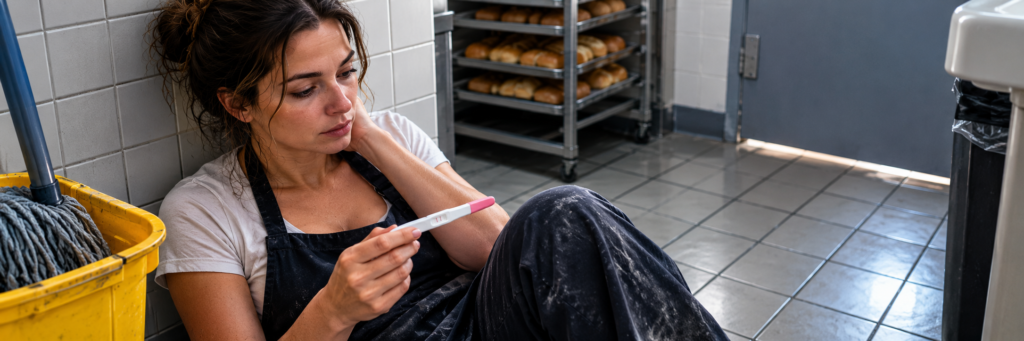

I sat there for a long time. Out in the kitchen I could hear the proofing ovens ticking and my coworker Dolores singing along to the oldies station, off-key and utterly content. Life was going on, ordinary and loud, on the other side of the door. And I was sitting in the middle of the floor, with my whole future rearranging itself around me, while a mop bucket dripped quietly into its own gray water.
I wasn’t afraid yet. That came later. What I felt first, strangely, was a kind of stillness, as if someone had gently turned down the volume on the entire world so that I could hear one small, clear thing. You are not alone in there anymore.
Then there was a knock. “Tess? You okay? The rye needs scoring.”
“Be right out,” I said, and washed my face, and went back to work. I scored forty loaves of rye that morning with a razor blade, and my hands did not shake once. I have thought about that often since. How the most important moments of your life can arrive in the middle of a shift, and you have to finish the shift.
I am telling you this story because I have never told it all the way through to anyone. Not my mother. Not my friends. Not even my son, who is eleven now and asks the kind of questions that make me put down whatever I am holding. I am telling it because I think there are women who need to hear that it is possible to start in a bathroom with a mop bucket and arrive, years later, somewhere with a little light in it.
I am not going to tell you it was easy. I am going to tell you it was real.
The Months Before He Came
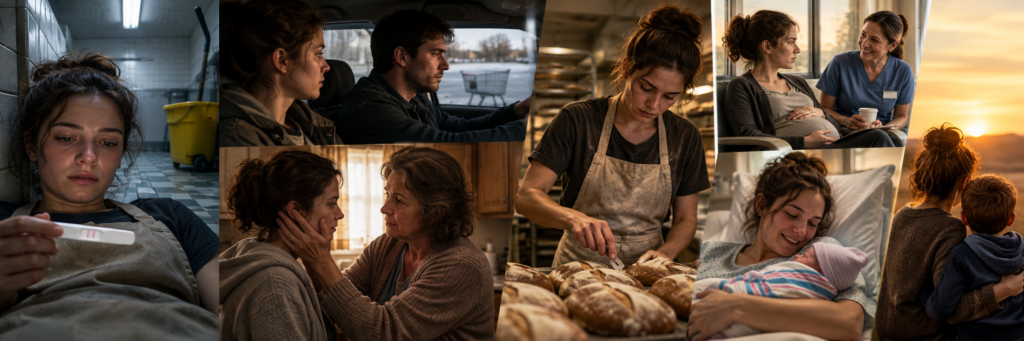
I told Rick on a Friday, in his car, in the parking lot behind the grocery store, because I did not trust myself to say it anywhere I could not leave.
We had been together almost two years. He was funny and kind in the easy ways, the way a person is kind when nothing is being asked of him. He remembered my coffee order. He sang in the shower. When I said the words, I’m pregnant, he did not say anything at all. He looked straight ahead through the windshield at a shopping cart someone had abandoned in a parking space, and he gripped the steering wheel with both hands as though the car were moving.
“Okay,” he said finally. “Okay. Wow.”
“I’m keeping it,” I said. I had not known I would say that until I said it.
“No, yeah. Of course. I just, I need to think.”
“Take your time.”
He took six weeks. In that time he called less, and then texted less, and then the texts grew polite and short, the way you write to someone you are already saying goodbye to. At the end he said it over the phone, in a voice that sounded like it was reading from a card. He said he was not ready. He said he did not want to do it halfway. He said he thought it was better for everyone if he stepped back, and I remember thinking, with a clarity that astonished me, better for everyone is a phrase people use when they mean better for me.
I did not scream. I did not cry, not then. I said, “Okay, Rick. Take care of yourself,” and I hung up, and I put the phone down on the counter very gently, as though it might break, and then I stood in my tiny kitchen with my hands flat on the Formica and listened to my own breathing.
Telling my mother was harder.
She lived forty minutes away in the house I grew up in, a narrow, creaking place with a porch swing and a pecan tree that dropped its nuts all over the lawn each October. She had raised me mostly alone after my father died, and I knew she had hoped for a different road for me. She stood in her kitchen with a dish towel in her hands while I told her. She was quiet a long time.
“Is that what you want?” she asked. “To have it?”
“Yes.”
“Then that’s what we’ll do,” she said. She put the towel down. She crossed the kitchen and held my face in her two cold hands, the way she did when I was small and had a fever. “It’s going to be hard, Tessie. I won’t lie to you. But you are not doing it by yourself.”
I wish I could tell you that this was true all the way through. My mother loved me, and she helped in every way she could. But she worked double shifts at the nursing home, and her knees were failing, and forty minutes is a long way when you are bleeding and exhausted and it is two in the morning. The truth, which I learned slowly, is that there is the help people can give, and then there is the part that only you can do. Most of the time I was alone in the second category.
I went to my prenatal appointments by myself. I got used to the other women in the waiting room with their husbands and their phones and their muttered conversations about car seats. The nurse who took my blood pressure was named Joanne, and she noticed, the way good nurses do, and after the third visit she started saving me a seat by the window and a cup of ginger ale. “You’re doing great, hon,” she would say, and it was all I could do not to cry on her scrubs.
Mateo was born on a rainy Tuesday in March, at 3:14 in the morning, after nineteen hours of labor that I will not describe, except to say that my mother held my left hand and Dolores, who had driven in from the bakery in her flour-dusted sneakers, held my right. When they put him on my chest, wet and furious and impossibly small, with a shock of black hair and a face scrunched up like an old man who has just been told something he disagrees with, I looked down at him, and something in me cracked open and rearranged itself permanently.
“Hi,” I whispered. “Hi. It’s me. I’m your mom.”
He stopped crying. He opened his eyes, dark and unfocused and enormous, and looked at nothing, and I have never in my life felt so completely seen.
Night Shifts and Tiny Fingers
No one prepares you for the sheer, grinding physical fact of it.
The books say that newborns sleep sixteen hours a day. This is technically true. What they do not mention is that those sixteen hours are delivered in forty-minute installments, like a cruel subscription service. For the first month I slept in fragments, hunched over the couch cushion with a baby on my chest, in a fog so thick that I once put the milk in the cupboard and the coffee mugs in the refrigerator and did not notice until the next day.
I went back to work at eight weeks. I did not want to. But the bakery was holding my position as a favor, and I could not afford the favor to expire, and so I wrapped my son in a blanket at 9:30 each night, handed him to Mrs. Pham from across the hall, and walked down the stairs to my shift.
Mrs. Pham is eighty if she is a day, five feet tall, with a voice like gravel and a laugh like a bell. She had raised four children of her own and buried a husband, and she took one look at me in the hallway, the first week, and said, “You look like death. Give me the baby.” She charged me forty dollars a week. I know now that it was a fraction of what her time was worth. I know she never raised the price, not once, in all the years.
“Go,” she would say, waving me out the door with a wooden spoon. “He is fine. I have done this before. You go work and you come home and you sleep.”
But sleep was a country I had trouble getting back to. I would finish at 6:30, walk home in the pale blue morning, collect my son, feed him, bathe him, put him down, and then lie in my bed with the curtains drawn, staring at the ceiling with my eyes burning, listening to the sounds of the world getting up. The garbage trucks. The school buses. The neighbors’ televisions. It is hard to sleep when the whole day is shouting.
I remember one night in particular, in the fourth month. I had been awake for nearly thirty hours. I was standing at the long steel table in the bakery, shaping rolls, and I felt the strangest sensation, as though the floor were tilting very slowly to the left. I put my hand on the table to steady myself. The rolls in front of me began to blur.
“Tess.” Dolores was at my elbow, her voice low. “Honey. Sit down.”
“I’m fine.”
“You are not fine. You are gray. Sit.”
She pulled a flour sack stool out from under the table and pressed me down onto it, and she stood in front of me with her hands on her hips, a short, round, formidable woman in a hairnet. “You can’t keep doing this.”
“I don’t have another option.”
“There is always another option. It just might not be a good one.” She sighed. “I’m not telling you what to do. I’m telling you that you almost fell over, and you have a baby at home, and he needs you in one piece.”
I sat on the stool and cried, quietly, with flour on my hands, and Dolores pretended not to notice, and finished my rolls for me. That night I made a decision, the first of many I would make alone. I asked my manager to move me to the early morning shift, which paid less but let me sleep when the baby slept. I took the pay cut. I did the math on the back of an envelope, and it came out thin, and I did it anyway.
Here is the thing I want you to understand about exhaustion. It is not only physical. It dissolves your judgment, your patience, your sense of who you are. I was not myself in those first months. I snapped at my mother. I cried at diaper commercials. I looked at my son’s perfect, sleeping face and felt a love so enormous that I could hardly breathe, and in the same minute I felt a flash of something terrible, a small cold voice that whispered, I cannot do this. I was ashamed of that voice. I did not tell a single person about it for years.
But I have come to believe that voice is not the truth about us. It is simply what happens when a human being has been pushed past her limit and is still standing. It is the sound of a person who is carrying something heavy and has not been allowed to put it down.
And then there were the mornings. Oh, the mornings. At some point in the fifth month, Mateo learned to smile, a real smile, a toothless explosion of delight that took over his whole face. He would wake, and see me, and grin as though I were the greatest wonder he had ever encountered. And I would lift him out of the crib, and he would grab a fistful of my hair with his tiny, surprisingly strong fingers, and every single fragment of the night before would fall away.
That is the bargain, I think. The nights take everything. The mornings give it back.
The Year the Rent Went Up
The envelope came in October, the week Mateo turned three and a half.
I knew what it was before I opened it. Landlords have a particular kind of envelope, thin and white and official, with a window in the front that makes your stomach drop. Inside was a letter, politely worded, informing me that due to market adjustments, my rent would be increasing by one hundred and forty dollars a month, effective in sixty days.
I read it standing in the hallway with my coat still on. Then I read it again. Then I sat down on the stairs, because my legs had made the decision for me.
One hundred and forty dollars a month is not a lot of money to some people. To me, it was the difference between a thin month and an impossible one. I had already trimmed everything I could trim. I knew, to the dime, what was in my account, and I knew that there was no room in the numbers for a hundred and forty extra dollars. I would have to find the money from somewhere, or find a new place to live.
“Mama?” Mateo appeared at the top of the stairs in his dinosaur pajamas, rubbing his eyes. “Why are you sitting on the stairs?”
“I’m just thinking, bug.”
“About what?”
“About where we’re going to live.”
He considered this seriously. He came down three steps and sat next to me, his small shoulder pressed against my arm. “We can live here,” he said. “It’s good here.”
“It is good,” I said. “I like it here too.”
“Then we should stay.”
I put my arm around him and did not say anything. What do you say to a child who believes that wanting something hard enough is the same as being able to afford it?
I spent two weeks looking at apartments. I drove to places on my lunch break, wearing my work clothes, to stand in empty rooms that smelled of fresh paint and other people’s lives. They were all either too far from my job, or too expensive, or too frightening. I found one that was cheap enough, on the far side of town, a basement unit with a single small window at ground level. The landlord, a man with a toothpick in his mouth, said, “It’s quiet. Kids’ school is right down the street.” I looked at the narrow window and the stains on the ceiling, and I thought of Mateo’s bright, round face, and I walked out.
In the end I did two things. First, I called my mother and asked, in the smallest voice I have ever used, whether she could spare any money. She sent two hundred dollars, folded inside a card with a cartoon cat on it, and I knew without being told that she had skipped something to do it. Second, I took my grandmother’s ring to a pawn shop.
It was a small ring, a thin gold band with a single chip of garnet. My grandmother had worn it for fifty years, and my mother had given it to me when I turned eighteen. I did not own much of value, but I owned that. I turned it over and over in my fingers in the car outside the shop for a full twenty minutes, remembering my grandmother’s hands, her flour-white knuckles, her voice saying, You hold on to what matters, Tessie.
But what matters, I told myself, is a roof for my son. The ring is a thing. He is a person.
The man behind the counter turned it under a little lamp, squinting. He offered me three hundred and ten dollars. I took it. I walked out into the cold sunshine with a slip of paper in my hand and my ring finger bare, and I sat on a bench and cried for ten minutes, and then I went to work.
I have never told my mother. I think about it sometimes, in the quiet hours. Not because I regret it, because I do not. I would do it again tomorrow. But because it taught me a lesson I did not want to learn: that love, in a life like mine, is often measured in what you are willing to give up. That a mother is someone who looks at the things she holds dear and quietly makes room.
We stayed in the apartment. I picked up two extra weekend shifts. I clipped coupons with a determination bordering on religion. I learned which grocery store marked down the day-old bread on Thursdays, and which pantry at the church on Elm Street gave out boxes on the first Saturday of the month. I went to that pantry once, in December, in a hat pulled low over my eyes, convinced that everyone in line could see how ashamed I was. The woman at the table, a retired schoolteacher with half-moon glasses, simply handed me a box and said, “We’re glad you came.”
I carried the box to the car with my face burning. And when I got home and unpacked it on the counter, a can of peaches, a box of macaroni, a bag of rice, a jar of peanut butter, Mateo clapped his hands and shouted, “Peaches! It’s like a party!” And I laughed, with tears running down my face, because he was right. It was a party. It was a party because he had decided that it was.
Choices I Made Alone
There is a story people tell about difficult decisions: that they come with a moment of clarity, a trumpet blast, a sign. In my experience they come with a legal pad, a cold cup of tea, and a sleeping child in the next room, and you sit there at the kitchen table at eleven at night, and you simply have to choose.
The biggest one came when Mateo was six.
I had been at the bakery for six years. I was good at it. I had been promoted to lead baker, which meant an extra two dollars an hour and the right to boss around the new hires. I could shape a baguette with my eyes closed. But the work was killing my back, and the pay had not moved in any meaningful way, and I had begun to notice that every time I looked ahead at the next ten years, I saw the same long, flour-dusted shift, the same careful arithmetic, the same ceiling.
Dolores, who had become something like an aunt to both of us, said it plainly one morning over coffee. “You’re too smart to be here forever, Tess.”
“There’s nothing wrong with the bakery.”
“No. There’s nothing wrong with it. It’s just not enough for what you’ve got.” She stirred her coffee. “You used to say you wanted to be a nurse.”
I had said that, once, at nineteen, before life rearranged the furniture. I had taken a single anatomy class at the community college and loved it, the logic of the body, the quiet drama of it. And then I had gotten pregnant and shelved it, the way you shelve a book you plan to come back to.
“That ship sailed,” I said.
“Ships come back,” said Dolores. “Sometimes you have to row out and meet them.”
I went home and did the math. A nursing program, even part-time at night, would take years. It would cost money I did not have. It would eat my evenings, which meant I would see Mateo less. It would mean childcare I could not afford, and exhaustion on top of exhaustion, and no guarantee at the end. I might fail a class. I might run out of money. I might get halfway and have to quit, and then I would have spent years of my son’s childhood chasing something I could not finish.
On the other side of the scale was the possibility, small and bright and frightening, of a different life. A real salary. A way out of the arithmetic.
I wrote it all out on the legal pad. I wrote pros and cons in two columns, and then I tore the page up, because I realized it was not a list problem. It was a faith problem. I did not need more information. I needed to decide whether I believed in myself enough to be tired in a new way.
That night I sat on the edge of Mateo’s bed while he slept, one small arm flung over his head, his breath slow and even. I watched the rise and fall of his chest. And I thought, what do I want him to know about his mother? I did not want him to know a woman who played it safe. I wanted him to know a woman who tried.
I enrolled in the fall.
It was brutal. For five years I worked mornings at the bakery, picked Mateo up from school, made dinner, did the homework, got him to bed, and then sat at the kitchen table with a textbook and a highlighter until my eyes wouldn’t focus. On the nights I had classes, Mrs. Pham or my mother took him. There were weeks when I saw my son for forty minutes a day. I remember one evening, rushing out the door with my backpack over my shoulder, and Mateo, age seven, standing in the hallway in his socks.
“Are you going to class again?”
“I am, bug. I’ll be back before you wake up.”
“You’re always going somewhere.”
It was not an accusation. It was just an observation, delivered in the flat, honest way of a child. But it landed in my chest like a stone. I knelt in front of him, my backpack sliding off my shoulder.
“I know it feels that way. I’m doing it because I want us to have a better life. But I’m going to be home on Saturday, and we’re going to make pancakes, and I won’t open a single book. Deal?”
He thought about it. “Can I have chocolate chips?”
“Chocolate chips.”
“Deal,” he said, and put out his hand, and we shook, solemnly, like two businesspeople.
I walked to the bus stop that night with tears freezing on my cheeks, thinking, Am I robbing him of something to give him something else? I still do not know the answer to that. It is the kind of question that does not have one. But I held on to Saturday. Saturday was mine, and his, and I never broke the promise.
The Question About His Father
When Mateo was eight, he asked about Rick.
We were in the car. It is always the car. There is something about being side by side, facing forward, with nowhere to look but the road, that makes children brave.
“Mama, who’s my dad?”
I had rehearsed this a hundred times. I had planned it, drafted it, delivered it to the bathroom mirror. And none of it came. “His name is Rick,” I said, after a moment. “He lives in a different state.”
“Why?”
“Because when I found out I was having you, he wasn’t ready to be a dad. That was about him, bug. It was never about you.”
“Does he know about me?”
“He knows you exist.” I swallowed. “I sent him a picture when you were born. He didn’t write back.”
Mateo was silent. I watched him in the rearview mirror, his small face turned to the window, the passing streetlights flickering across his cheeks.
“Do you think he thinks about me?”
I have been asked a few hard questions in my life. This was the hardest. I did not want to lie to him, and I did not want to hurt him, and for one wild moment I could not find a path between the two.
“I don’t know,” I said finally. “I honestly don’t. But I know this. If he knew you, if he really knew you, he would think you were amazing. Because you are.”
“Okay,” Mateo said. After a minute he added, in a small, careful voice, “I’m glad you stayed.”
I pulled over, in front of a dry cleaner’s, with my hazard lights on, and I turned around in my seat and reached back, and he put his hand in mine. We sat like that, not saying anything, the engine ticking, for a long time.
The Quiet Hours
At the end of every night there is a quiet, and I have learned to be careful with it.
When the dishes are done and the homework checked and Mateo is asleep, with a book open on his chest and his glasses crooked on his nose, I stand in the hallway for a moment and just look at him. It is a ritual. I cannot help it. I look at his face, so much like mine and yet so entirely his own, and I let the day fall off me like a heavy coat.
And then the apartment gets quiet. The refrigerator hums. The pipes knock. A television murmurs through the wall. And the loneliness arrives. It does not come with a bang. It comes quietly, like a cat, and sits beside me on the couch.
People assume that the loneliness of single motherhood is about romance, and sometimes it is. But more often, it is about being known. It is about having no one who remembers, as you do, that today was the day Mateo lost his first tooth, or said his first full sentence, or stood on the diving board and did not jump. When I think of the things I have seen, the first steps, the missing teeth, the grins, and I think of how few people witnessed them, it makes my chest ache. There is no one to turn to and say, did you see that? No one to share the astonishment.
Sometimes I text Dolores. Sometimes I call my mother and listen to her complain about her knees. Sometimes I simply sit with a cup of tea and let the quiet be quiet. I have learned that I cannot fill every silence. Some of them just need to be lived in.
The fear comes in these hours, too. It is a familiar visitor. What if I get sick? What if I fall behind? What if the money runs out? What if I am not enough for him, not patient enough, not present enough, not whole enough? What if the thing I am doing to build his future is costing him the present? There are no answers at eleven at night. There are only the questions, circling like moths around a lamp.
One night, in the middle of nursing school, I came home from a clinical shift and found Mateo awake on the couch, curled under a blanket, with a cup of juice. It was past midnight. Mrs. Pham was asleep in the armchair, snoring softly, her glasses slipping down her nose.
“Why are you up?” I whispered.
“I couldn’t sleep. I wanted to wait for you.”
“Baby, it’s so late.”
“I know.” He leaned his head against my arm. “I like it when you’re home.”
I sat down beside him and he fell asleep within minutes, his head heavy against my shoulder, his hair smelling of shampoo and warm blankets. I stayed there for an hour. I did not move. I did not wake Mrs. Pham. I just sat in the dark living room, with my son’s weight against me, and felt every doubt I had been carrying quiet down and go still.
I had spent so many nights asking whether I was enough. What I came to understand, slowly, on that couch, is that it was never a question of enough. It was a question of presence. I was there. I was here. I had come home. And that, for a nine-year-old on a quiet night, was the whole world.
The Small Joys That Hold Everything Up
If I told you only the hard parts, you would think we were miserable, and we were not. That is the part that people never expect. We laughed. We laughed all the time.
Mateo is a funny kid. He has a sense of humor that I can only describe as dry, delivered deadpan, from a child who is mostly knees and elbows. When he was seven he decided that our upstairs neighbor’s cat was a retired spy. For months he kept a notebook of evidence. Tuesday: The cat was seen near the mailbox. Suspicious. Wednesday: The cat did not look at me. He knows that I know. I read that notebook out loud to Dolores once, and she laughed so hard that she had to sit down on a flour sack.
On Saturdays, the pancake rule still stands. It has become a ceremony. He cracks the eggs, because he insists on it, and I measure the flour, and we play music from the old radio on top of the refrigerator, and there is always, always flour on the counter, on the floor, and on at least one of us. He has a particular way of flipping a pancake, with a flourish and a small, triumphant “Ha!” And sometimes it lands in the pan and sometimes it lands on the stovetop, and either way we eat it.
“Mama,” he said last week, with his mouth full, “you know what’s the best thing about our house?”
“What?”
“It smells like pancakes.”
“That’s because we make pancakes.”
“No. It smells like pancakes even when we don’t. It’s just the smell of us.”
I could not answer. I had to turn to the stove and pretend the batter needed attention.
There are a thousand moments like this, small and unrecorded and priceless. His laugh, which cracks in the middle now that his voice is changing. The way he leaves his shoes at the door in a heap and then lines them up, one by one, when he sees me looking. The way he pats the couch cushion beside him when he wants me to sit. The soccer games on cold Saturday mornings when I stand on the sideline in my coat, clutching a paper cup of terrible coffee and screaming like a lunatic. “That’s my son!” I yell, to no one in particular. “That’s my son out there!”
He pretends to be mortified. But I see him looking, between plays, searching the sideline for my face. And when he finds me, he grins.
I used to think joy was something you earned after the hard part was over. I know now that joy lives inside the hard part, in the cracks, in the margins, in a boy’s laugh and a plate of slightly burned pancakes. It does not wait for a better time. It is already here, if you are quiet enough to hear it.
The Spring Everything Slipped
In the spring of my fourth year of school, Fenwick’s Bakery closed.
No one saw it coming, though everyone should have. The owner, a gentle man named Mr. Fenwick, had been fighting rising costs and a new chain store down the road for two years. One Friday he gathered us in the kitchen, took off his cap, and said, in a voice that broke on every other word, that Monday would be our last day. Dolores cried. I did not. I stood very still, with my hands in my apron pockets, and felt the floor go out from under me for the second time in my life.
I had twelve hundred dollars in savings, a semester of nursing school left, and a son who needed new shoes. I applied everywhere. I waited tables for six weeks at a diner where the manager called me “sweetheart” in a way that made my skin crawl. I did not have a choice, so I smiled, and I took the tips, and I went home with my feet throbbing and my pride in a small, tight knot.
There was a night in May when it all collided: a failed exam, a leaking faucet, and a call from the school about a missing form. I sat on the bathroom floor, the same cool tile that had once told me I was going to be a mother, and I put my face in my hands. I can’t do this anymore, I thought. I am so tired of being strong.
A small knock at the door. “Mama?”
I wiped my face. “One minute, bug.”
“Are you sad?”
I almost lied. Then I opened the door, and there he was, ten years old, with a worried crease between his brows, holding out a crumpled piece of paper. It was a drawing: a woman in scrubs, with a stethoscope, and a boy beside her, both of them smiling, both of them enormous against a tiny yellow house.
“That’s you,” he said. “When you’re a nurse. I made it so you remember.”
I sat down on the hallway floor and pulled him into my lap, although he was almost too big for it, and I held on to him for a long time. “I’m sad,” I admitted. “I’m tired and I’m scared. But I’m not giving up.”
“You don’t have to not be sad,” he said, with the grave wisdom of a child who has heard a lot of adult conversations. “You just can’t quit.”
That summer, my mother sold a few things from her house and, against my protests, sent me a check. Dolores found me a position at a clinic that needed part-time front desk help. Mrs. Pham brought soup. I accepted all of it. Some of it I accepted with tears, and some with gratitude, and some with both. It took me a long time to learn that receiving is not the opposite of being strong. It is a kind of strength, too.
Hope Has a Sound
Hope, I have discovered, has a sound. It is not a trumpet or a cheer. It is quieter than that. It is the small click of a pen being picked up again. It is the hum of a kettle at five in the morning. It is a boy’s footsteps in the hallway.
The night I graduated, the auditorium was warm and crowded and smelled of floor polish and carnations. I wore a white dress under my cap and gown, because my mother had insisted, and I sat in a row of strangers who had become friends, my hands damp, my heart doing something erratic in my chest. When they called my name, Teresa Marie Alvarez, I stood up on legs that did not feel like my own and walked across the stage.
And from the third row, a voice rang out, high and clear and mortifyingly loud:
“THAT’S MY MOM!”
The whole room laughed. I looked down, and there he was, standing on his seat, in a clip-on tie, with his glasses crooked, waving both arms over his head. Beside him my mother was crying, and Mrs. Pham was clapping like a woman at a prizefight, and Dolores was holding up her phone, and every single person I loved was looking at me.
I have never been so happy in my life, and I have never been so tired. I suspect those two things are related.
Afterward, outside, under a sky going violet at the edges, Mateo ran to me and threw his arms around my waist. He was eleven years old and nearly as tall as my shoulder. “You did it,” he said into my gown.
“We did it,” I said.
“Can we get pancakes?”
“It’s nine o’clock at night.”
“Pancakes don’t have a time,” he said, and he was right.
We sat in a diner at ten p.m., the three of us and my mother, eating pancakes in our good clothes. Mateo told the waitress that I was a nurse now. She congratulated me, and gave us free pie, and I thought of the girl on the bathroom floor, twenty-three, scared, with a mop bucket by her knee, and I wanted to reach back through time and put a hand on her shoulder. I wanted to say: You have no idea. You have no idea what you are going to do.
For the Mother Reading This
I work now on the pediatric floor of a small hospital. I wear soft shoes, and I carry a pocketful of stickers, and I have held the hands of more frightened children and exhausted mothers than I can count. I know, in a way I never would have otherwise, what it looks like when a woman is running on nothing but love. I see it in the parents who sleep in plastic chairs. I see it in the ones who ask, in a whisper, if they can have a blanket. I always bring the blanket.
The money is better. We are not rich. We still count, and I still keep a jar on top of the refrigerator for ice cream. But the rent is paid, and the shoes fit, and Mateo has a bedroom with a window that looks out on a maple tree. When he was little, I used to tell myself that the hard part would end. It did not, exactly. It just changed shape. I think that is what a life is.
If you are where I was, sitting on a bathroom floor, or at a kitchen table with a calculator, or in a parked car with your forehead against the steering wheel, here is what I would tell you.
You are doing better than you think. The fact that you are worried about doing it right is proof that you are. Every night you show up, every pancake, every Saturday, every promise you keep, is being recorded somewhere in the deep, quiet memory of your child. They will not remember the cereal you couldn’t buy. They will remember that you stayed.
Ask for help. Take the soup. Accept the check. Let someone hold the baby for an hour while you sleep. It does not make you weak. It makes you a person, which is all any of us are.
And please, be gentle with yourself. You are carrying more than anyone can see. You are allowed to be tired, and afraid, and also full of love, all at once. Those things do not cancel each other out. They are the whole of it.
Tonight, after I finish writing this, I will walk down the hallway and stand outside my son’s door and listen to him breathe. The house will be quiet. The refrigerator will hum. And I will think about the long road between a bathroom floor and this hallway, and I will feel something I did not have a word for until recently.
It is not pride, exactly. It is not relief. It is closer to gratitude, to the astonished knowledge that I got to be his mother. That whatever else is true, I got to be this boy’s mother, all the way through, on the hard days and the soft ones.
That is my story. It is not dramatic. It is not finished. But it is mine, and it is true in all the ways that matter.
I hope that yours gets a little easier, and I hope you know that you are not alone.
With love,
Tess