
By a woman who finally stopped treating her body like a project and started treating it like a home.
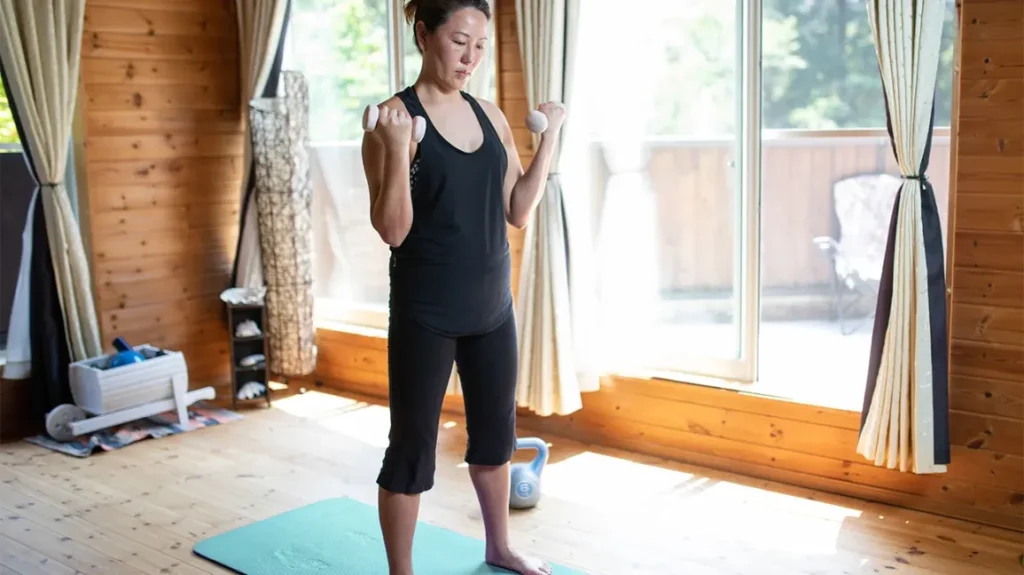
There’s a particular kind of Tuesday morning I want to tell you about. It’s early — not aggressively early, but early enough that the light coming through your window is still that soft, golden kind that makes everything feel cinematic. You’re in your kitchen, matcha steaming, dressed in a set that somehow manages to look both effortless and considered — maybe a clay-toned ribbed two-piece or a creamy white long-sleeve paired with seamless shorts that fit like they were made specifically for your body. There’s a small speaker playing something low and ambient. Your yoga mat is already rolled out in the living room, and you haven’t checked your phone yet.
That image? That’s not a Pinterest board. That’s a lifestyle — and it’s one more women are consciously building for themselves in 2026.
Home fitness has had one of the most meaningful glow-ups of the decade. What used to feel like a consolation prize — oh, you can’t afford a gym membership, so here’s a YouTube video — has become the intentional, aesthetically-driven, deeply personal wellness ritual that women are genuinely choosing over crowded, fluorescent-lit gyms. And I’m not just talking about doing a few squats in your bedroom while your coffee brews. I mean a full, well-considered approach to moving your body at home in a way that feels luxurious, sustainable, and completely yours.
This post is my attempt to lay out the home fitness habits that have genuinely changed how I feel in my body — not just physically, but emotionally, energetically, and even stylistically. Because if you’ve been in the wellness space for any amount of time, you already know that how you feel about your workouts is just as important as what you’re actually doing in them.
Let’s get into it.
Why Home Fitness Has Become the Most Elegant Choice
I want to start here, because I think a lot of women still feel a vague guilt about not going to the gym — like skipping that commute to a crowded weight room is somehow a failure of ambition or discipline. It’s not. Let’s be completely honest about this.
The gym, for all its merits, is also loud, competitive, and often designed around a very specific (and very male-coded) idea of what fitness should look like. There’s a reason the “gym selfie” became its own social phenomenon — because so much of gym culture is performative. You go, you’re seen going, you post that you went. The actual movement becomes secondary to the optics of it.
Home fitness is the opposite of that. It’s intimate. It’s yours. It exists in a space you control, in a rhythm that matches your life, wearing clothes you actually love, listening to whatever you want, pausing when you need to, going harder when you feel it.
The clean girl aesthetic that has dominated wellness-adjacent social media for the past few years isn’t just about drinking your green juice and having perfect skin. It’s about a whole approach to daily life that prioritizes ritual over routine, intention over obligation. Home fitness fits perfectly into that world. Your mat, your light, your pace, your music. No one watching, no one comparing, no one crunching loudly beside you.
And from a purely practical standpoint? The math is undeniable. No travel time, no waiting for machines, no monthly membership fees that make you feel guilty every time you skip a week. You can work out for twenty minutes at 6 a.m. and be showered and at your desk by 7. Or you can do a slow, restorative evening stretch session after dinner in your pajamas and call it a night. That flexibility isn’t laziness — it’s intelligence.
Building Your Home Fitness Aesthetic (Yes, This Matters)
I know some people roll their eyes at the idea of curating the look of your workout space, as if caring about aesthetics is somehow shallow or frivolous. But here’s what I’ve learned: environment is everything when it comes to building habits. Your surroundings are not neutral. They either invite you toward a behavior or they create friction against it.
When your workout corner is beautiful — even in the smallest, most budget-friendly way — you actually want to go to it. It’s that simple.
So let’s talk about what that looks like in practice.
The mat matters more than you think. I spent years rolling out whatever cheap foam thing I’d bought in a clearance bin, and every single time I got onto it, some small part of my brain registered it as low-effort and low-priority. When I finally invested in a quality mat — thick, non-slip, in a color that genuinely made me happy to look at — my relationship with morning movement changed almost immediately. It wasn’t the mat doing anything magical. It was the signal I sent myself by choosing it.
In 2026, the most aesthetically resonant workout spaces I’ve seen on social media tend to lean into what I’d call quiet luxury fitness — clean lines, neutral tones, nothing cluttered or chaotic. A sage green or ivory mat against light wood floors. A single candle or diffuser nearby. Maybe a small shelf with your resistance bands, a water bottle you love, and a plant or two. That’s it. You don’t need a home gym. You need a corner of your home that feels like it belongs to you and your body.
Lighting is underrated. If your living room or bedroom looks cold and harsh in the morning, your nervous system will register that and resist. Warm-toned bulbs, or even just working near a window during the day, change the entire energy of a workout. I’ve done the same yoga flow in different lighting conditions and it genuinely feels like a different experience. Soft and warm makes you feel held. Bright and fluorescent makes you feel like you’re being evaluated. Choose accordingly.
Your workout wardrobe is part of the ritual. This is the part where elegant streetwear becomes genuinely relevant — not as a fashion flex, but as a functional tool for motivation and confidence. There is a documented psychological phenomenon sometimes called enclothed cognition, which is essentially the idea that what you wear affects how you think, feel, and perform. When you put on something that makes you feel beautiful and capable, you move differently.
The 2026 fitness aesthetic for women who care about style has moved well past the neon leggings-and-crop-top era. What I’m seeing — and loving — is a shift toward elevated basics: matching sets in organic cotton or bamboo fabrics, muted earth tones and dusty pastels, structured sports bras that work as tops on their own, oversized hoodies that double as loungewear. There’s a softness to it all, a femininity that doesn’t feel like it’s trying too hard.
Brands operating in the elevated activewear space have caught on to this. The soft glam movement that’s been reshaping beauty standards is bleeding into fitness fashion too — you don’t have to choose between looking polished and moving your body freely. The two things are finally in conversation with each other.
The Morning Movement Ritual: Why You Should Start Small and Sensory
If I had to point to one single habit that has had the most profound impact on my physical and mental health, it would be this: I move my body within the first hour of waking up, every single morning, without exception — but I do the bare minimum rather than the most.
I know that sounds counterintuitive in a culture that worships the 5 a.m. cold-plunge-and-HIIT-before-sunrise crowd. But that level of intensity, for most women, most mornings, is simply not sustainable. And unsustainable habits don’t build anything.
What I’ve found works is starting so small it feels almost laughable. Five minutes of gentle stretching in bed before I even stand up. A slow walk from one room to another. Lifting my arms above my head and taking three deep breaths. That’s it. That’s the entry point.
What that tiny morning ritual does — neurologically, physically, emotionally — is enormous. It tells your body that today is a day when you honor it. It starts a chain of small, positive decisions that tend to compound over the course of the day. It connects you to your breath and your physical presence before your phone, your inbox, or your responsibilities have a chance to claim your attention.
From that small start, you can expand as your energy allows. Some mornings that five-minute stretch becomes a twenty-minute yoga flow. Some mornings it stays at five minutes and that’s genuinely fine. The non-negotiable is the initiation, not the duration.
I’ve also started thinking about morning movement as sensory rather than purely physical. Which sounds a little abstract, so let me explain. When I unroll my mat, I do it slowly and with attention. I notice the texture under my hands, the temperature of the room, the quality of light. I put on music that matches my mood — sometimes something languid and slow, sometimes something that makes me want to move with more intention. I take a sip of whatever I’m drinking — usually warm lemon water or matcha — before I begin. I create the conditions for the ritual before I begin performing it.
This is not woo or mysticism. It’s just attention. And attention is what transforms a chore into a practice.
Strength Training at Home: The Habit That Will Change Everything
If you’ve been doing exclusively cardio-based workouts — whether it’s running, dance cardio, long walks, or step aerobics — and you’re not where you want to be physically, I gently want to suggest that strength training might be the missing piece.
And I want to address the fear first, because I know it’s there: the fear of bulking up, of looking “too muscular,” of losing softness or femininity. This fear is so widespread among women and it is so thoroughly unfounded. Building visible muscle as a woman requires years of very heavy, very specific training combined with a significant caloric surplus. The kind of strength training I’m going to talk about — bodyweight work and light to moderate resistance — will make you look leaner, feel more capable, improve your posture dramatically, and give you an energy that reads as confident before you’ve even said a word.
Strong is the new aesthetic, and I mean that in the most genuinely feminine sense. There’s something about a woman who carries herself with physical ease — who picks up heavy things without wincing, who stands tall without effort, whose arms have shape and whose legs are steady — that is profoundly attractive. Not because anyone is watching, but because she knows it. That knowing lives in the body.
So. Home strength training. Here’s how to build the habit.
Start with bodyweight fundamentals. Before you buy anything, before you look at a single resistance band or dumbbell, learn to move your own body well. Squats, lunges, push-ups, glute bridges, planks, dead bugs, bird dogs — these exercises, done with attention to form and genuine effort, are more than enough to build significant strength. They require zero equipment and zero space beyond what you already have.
The key is progressive overload, which is just a gym-bro term for gradually making things harder over time. You do ten push-ups, and then next week you do twelve, and then you do them slower, and then you add a pause at the bottom, and then you elevate your feet. The exercise is the same. The difficulty increases. Your body adapts. Strength builds.
Invest in a small, beautiful resistance toolkit. Once you’re ready to add some equipment, you don’t need much. A set of fabric resistance bands in a few different resistance levels, a pair of medium-weight dumbbells (something between 5 and 15 pounds depending on your current strength), and a set of ankle weights if you love glute work (and you should love glute work, because the benefits extend well beyond aesthetics). That’s it. You can store all of it in a single drawer or a small basket. You can travel with the bands. You can leave the dumbbells somewhere you’ll see them and be reminded to pick them up.
Three sessions a week is genuinely enough. I want to push back against the all-or-nothing mentality that pervades fitness culture. You do not need to strength train every day. You do not need hour-long sessions. Three thirty-minute sessions per week, done consistently over months, will produce results that will genuinely surprise you. Consistency is the variable that matters most. It beats intensity every single time.
The Pilates Obsession Is Justified — Here’s Why
If you’ve spent any time in wellness-adjacent social media in the past two or three years, you’ve noticed that Pilates has become the movement practice of the moment. And unlike a lot of trends, this one has earned its cultural moment.
Pilates — particularly reformer-style movements adapted for the mat — is uniquely suited to the aesthetic and functional goals of most women. It builds deep core strength that supports your spine and improves posture in a way that almost nothing else does. It lengthens and tones without bulk. It teaches you to be precise and present with your body, which is genuinely meditative. And the results, when practiced consistently, are the kind that people notice even if they can’t name what changed — you just seem longer, more settled in your body, more graceful.
The good news is that a significant portion of the Pilates method can be done at home, on a mat, with no equipment. The online space for Pilates content has exploded, and there are genuinely excellent instructors offering free and affordable guided classes at every level.
What I love about Pilates as a home practice specifically is that it doesn’t require a high-intensity, high-energy day to be effective. You can do a thirty-minute Pilates session on a day when you’re tired, when you’re a little stressed, when your motivation is low — and come out the other side feeling genuinely better. It meets you where you are in a way that, say, HIIT simply doesn’t.
For women building a home fitness routine in 2026, I’d suggest weaving Pilates into your week the same way you’d plan outfits — not every day needs to be the same, and you can dress up or dress down the intensity based on how you feel. A twenty-minute core-focused session on Tuesday, a longer full-body flow on Saturday morning, a quick ten-minute stretch and roll-down before bed on Thursday. The variety keeps it interesting. The consistency builds the results.
Walking: The Most Underrated Habit in Your Entire Wellness Arsenal
Can we talk about walking? Because I feel like it has a slight image problem — it’s perceived as what you do when you’re not doing a “real” workout, a consolation prize for people who can’t be bothered to run. And this is completely wrong, and the science increasingly backs that up.
Walking — specifically, regular daily walking at a brisk-ish pace — does things for your body and mind that almost no other form of exercise replicates. It regulates cortisol (your stress hormone) more effectively than high-intensity exercise. It supports cardiovascular health without stressing your joints. It actively engages your creativity and problem-solving capacity (there’s a reason so many writers, artists, and thinkers are devoted walkers). It improves sleep quality, supports digestion, maintains a healthy weight, and — perhaps most importantly — it’s something most people can do every single day for the rest of their lives.
The 10,000 steps benchmark that became such a social media fixture is a reasonable goal, but it’s not magic. What matters more is regularity and intention. A daily walk — even thirty minutes — done every day, rain or shine, high-energy or low, is one of the most powerful health habits you can build.
I’ve started thinking about my daily walks as part of my aesthetic practice, which sounds ridiculous until you understand what I mean. I have a walking outfit that I love — usually a matching set in a breathable fabric, a pair of clean white trainers that I keep actually clean, sunglasses, sometimes a light jacket. I take a route I find beautiful. I listen to something that engages my mind — an audiobook, a podcast, sometimes just music. I try to notice things: the light, the trees, other people’s gardens, the smell of the air.
This is the clean girl aesthetic applied to movement. You’re not just exercising. You’re inhabiting your life. You’re being a person who moves through the world with intention and presence. That shift in framing — from workout to ritual — is not trivial. It’s the difference between something you do and something you are.
The Yoga Habit: Flexibility, Groundedness, and That Indefinable Something
I came to yoga late and with significant skepticism. I thought it was slow, I thought it was easy, I thought it was for people who didn’t want to work hard. I was wrong on all three counts and I am comfortable enough in my wrongness to say so plainly.
Yoga, done with genuine attention and progressed over time, is hard. Not hard in a gritting-your-teeth, lungs-burning way — hard in the way that requires you to be completely present with what your body is doing, to hold positions that challenge your stability and strength and flexibility simultaneously, to breathe through discomfort rather than brace against it.
But the reason yoga has survived as a practice for thousands of years and continues to draw people from every corner of the world isn’t primarily because it’s an effective physical workout. It’s because of what it does to your relationship with your own body and mind.
Regular yoga practice — I mean regular, not three times and you quit — builds a quality of attention that transfers to everything else in your life. You start to notice when you’re holding tension you don’t need to hold. You start to breathe differently under stress. You start to feel at home in your body in a way that’s difficult to articulate but impossible to miss once you have it.
For home fitness, yoga is ideal. All you need is a mat and enough space to lie down with your arms extended. The YouTube and app landscape for yoga instruction is vast, excellent, and largely free. You can find ten-minute flows and ninety-minute practices. You can find styles ranging from slow and deeply restorative to physically demanding vinyasa sequences that will absolutely work you.
What I’d suggest, especially if you’re new, is starting with yin yoga or restorative yoga — the slow, long-hold practices where you stay in a pose for several minutes. These look the least impressive on paper. They will humble you faster than almost anything else in your fitness life, and they will also make you feel better than almost anything else in your fitness life.
Nutrition as a Fitness Habit: What You Eat Is Part of the Practice
I want to step sideways from movement for a moment, because any honest conversation about fitness habits has to include what you eat — not as a diet prescription, not as a list of rules, but as a genuine practice of attention.
Here’s the thing I’ve come to believe after years of trying different approaches to eating: the most elegant relationship with food is not restriction, not tracking macros obsessively, not eliminating entire food groups in the name of optimization. It’s curiosity. It’s paying attention to how different foods make you feel, not just while you’re eating them, but an hour later, a day later, in your body during movement and at rest.
The women I admire most in the wellness space — the ones who actually seem to have figured something out — eat with pleasure and without guilt. They choose whole, real, beautiful food most of the time, not because they’re following a protocol but because they’ve noticed that it makes them feel better. They don’t moralize about a dessert. They also don’t pretend that everything is equally nourishing. They just pay attention.
Protein has become a genuine cultural moment in 2026 — and unlike a lot of nutrition trends, this one is grounded in solid science. Adequate protein intake supports muscle maintenance and growth, keeps you full and satisfied in a way that prevents the mindless snacking that disrupts so many eating patterns, supports skin and hair health, and becomes increasingly important as women age. If you’re doing any kind of strength training at home, protein is not optional — it’s what your body uses to rebuild the muscle fibers you’re challenging.
But I don’t want to get clinical about it, because the moment eating becomes a numbers game, you lose the joy, and joy is non-negotiable. Think instead about adding rather than restricting. Add an egg to your breakfast. Add some Greek yogurt to your snack. Add some lentils or chickpeas to your salad. Add a handful of nuts. These additions nudge your nutrition in the right direction without requiring you to become a spreadsheet.
Hydration is also a fitness habit — probably the most underrated one. Your muscles don’t perform well when you’re dehydrated. Your skin doesn’t look the way you want it to look. Your energy is flatter. Your cravings are louder. A simple practice of keeping a beautiful water bottle within reach at all times, and refilling it before it’s empty, does more for your daily wellness than most supplements and many workouts.
Recovery Is a Fitness Habit (And the One Most Women Skip)
This is the part of the fitness conversation that gets skipped most often, and I think it’s because we’ve inherited a cultural narrative that says rest is laziness and that if you’re not pushing, you’re not progressing. This narrative is not only wrong — it’s actively counterproductive.
Your body does not get stronger during exercise. It gets stronger during recovery from exercise. The workout creates the stimulus — tiny micro-tears in muscle fibers, cardiovascular stress, neural challenge. Sleep and rest are when your body responds to that stimulus by rebuilding stronger than before. Skip the recovery and you don’t just plateau — you actually regress. You accumulate fatigue, your performance declines, your injury risk rises, and you start to dread the thing you were once excited about.
Recovery as a fitness habit looks like several specific practices.
Sleep is the foundation. Not seven hours minimum as a goal — seven to nine hours as a real, genuine, non-negotiable priority. The women who look the most vibrant, who have the most energy, who seem to have cracked some code about aging gracefully — they sleep. They are unapologetic about protecting their sleep. They don’t sacrifice it for late-night scrolling or early-morning hustle culture signaling. This isn’t passive. Sleep is when growth hormone is released, when cortisol resets, when muscle is repaired, when memory consolidates. It is the most powerful beauty treatment and the most effective performance enhancer available to you, and it costs nothing.
Active recovery is different from rest days. Rest days don’t mean lying still. They mean doing something gentle and deliberate in place of your regular training — a slow walk, a restorative yoga session, some light stretching, swimming if you have access to it. This keeps blood flowing to muscles that need repair without adding further stress.
Foam rolling and self-massage. I know — it sounds very devoted-gym-person, and once upon a time it was. But a simple foam roller is one of the best forty-dollar investments you can make for your home fitness practice. Rolling out your quads, your glutes, your thoracic spine, your calves — it breaks up adhesions in the fascia (the connective tissue around your muscles), improves circulation, reduces soreness, and honestly feels incredibly satisfying in a slightly painful way that you’ll quickly come to crave.
Epsom salt baths. I’m putting this in the recovery section rather than the self-care section because it genuinely belongs here. Magnesium absorption through the skin, whether or not it’s as significant as the wellness world claims, is secondary to the undeniable fact that a warm bath relaxes muscles, calms the nervous system, and supports the parasympathetic state your body needs to recover effectively. Make it beautiful — candles, a good book or podcast, a face mask — and it’s also your most glamorous wellness habit.
The Mental Fitness Habit: Why Mindset Is the Whole Game
I’ve been building toward this section since the beginning, because everything else I’ve talked about — the movement, the nutrition, the recovery — all of it is built on a foundation that is fundamentally mental. Your mindset about your body, your fitness, your capability, and your worth determines whether you will show up consistently or fall off the wagon every few weeks.
Most women have been taught — through fashion magazines, through social media, through a thousand subtle cultural messages — to relate to their bodies as problems to be solved. Your body is something to be managed, controlled, improved, minimized, sculpted. Your fitness practice is the vehicle for making your body more acceptable. Exercise is a punishment for eating. Rest is a reward for exercising.
This framework is not just demoralizing — it’s functionally broken. It cannot produce lasting results because it roots your motivation in shame, and shame is not a sustainable fuel. It burns hot and short and leaves you exhausted and worse about yourself than when you started.
The mental habit I’m advocating for is the opposite: curiosity about your body, rather than criticism of it. What can it do? What does it feel like when it moves? What makes it feel strong? What makes it feel nourished? What brings it genuine pleasure? These questions are more motivating than any aesthetic goal, because they point toward experience rather than appearance. And here’s the quietly radical thing about that: when you exercise for experience — for the way it makes you feel rather than the way it makes you look — you actually stick with it. And when you actually stick with it, the physical results show up anyway.
The journaling habit that so many wellness practitioners recommend isn’t just for processing feelings. It’s a powerful tool for this kind of body-mind awareness. Five minutes in the morning or evening, writing what you notice about your body — its energy, its tension, its needs — builds a relationship of attention and care that transforms how you move through the world.
Meditation, even in its simplest form — ten minutes of sitting quietly, watching your breath — is also a fitness habit in the most literal sense. It reduces cortisol, which directly affects how your body stores fat, particularly around the midsection. It improves sleep quality. It increases pain tolerance. It builds the capacity to sit with discomfort without reacting, which is exactly what you need to sustain a challenging workout.
Tracking Progress Without Losing Your Mind: The Elegant Approach
Progress tracking in fitness is a subject that can get very dark, very fast. If your only metric is the number on a scale, you will be disappointed routinely, because weight fluctuates constantly in response to hydration, hormonal cycles, sodium intake, time of day, and dozens of other variables that have nothing to do with fat loss or muscle gain.
But tracking nothing means you lose the feedback that helps you stay motivated and make smart adjustments. So what’s the elegant middle path?
A few metrics I’ve found genuinely useful and non-destabilizing:
Strength progression. Can you do more reps than last month? Can you hold a plank thirty seconds longer? Can you do a push-up from your toes where you couldn’t before? These numbers go up. They go up consistently with good training. And they feel wonderful to notice because they tell you something real about what your body is building, independent of how it looks.
Energy levels. This is the most underused metric in fitness, and it’s one you can track simply by paying attention. Do you feel more energetic mid-afternoon than you did three months ago? Are you waking up more rested? Do you have more capacity in your day? Energy is the output of good nutrition, good movement, and good recovery in combination — and improvements in energy are often the first signs that your habits are working, well before any physical changes are visible.
How your clothes fit. Not as a measure of worth, but as practical feedback. A pair of trousers that fit differently than they did ninety days ago is giving you information. So is a sports bra that you need to size up because your back has gotten stronger. Clothes don’t lie, and they’re a gentler metric than the scale.
How you feel during workouts. A workout that felt difficult three months ago now feels manageable. The hill that used to wind you now doesn’t. These are real gains. They’re worth noting.
Building a Weekly Rhythm That You’ll Actually Keep
The biggest reason home fitness habits fail isn’t lack of motivation or lack of knowledge. It’s lack of structure. Without the external scaffold of a gym schedule or a class time, it’s easy for workouts to become perpetually deferred — always planned for tomorrow, always bumped by something more urgent.
The solution is to be intentional and specific about your weekly rhythm before the week begins — and to protect that rhythm like you protect other appointments.
Here’s a structure I’ve found sustainable and varied enough to stay interesting:
Monday — A thirty-minute strength-focused session. Bodyweight or light weights. Set the tone for the week with something that makes you feel capable and in your body.
Tuesday — A walk. That’s it. An intentional, no-phone walk of at least thirty minutes. Let yourself breathe, think, decompress from the Monday re-entry.
Wednesday — Pilates or yoga flow, somewhere between twenty and forty-five minutes depending on your energy. Mid-week is when I tend to need movement that is nourishing rather than depleting.
Thursday — Another strength session, or a short HIIT if you’re feeling it. Keep it under forty minutes. The goal is to maintain momentum without burning out before the weekend.
Friday — Something joyful. Dance cardio in your kitchen, a long walk with a podcast you’ve been saving, a gentle stretch and skincare evening. Friday movement should feel like a reward, not a chore.
Saturday — Your longer session if you want one. This is the day for a forty-five-minute yoga flow, a longer Pilates practice, a beautiful outdoor walk or hike. You have time; use it.
Sunday — Rest. Or light stretching. The Sabbath model — one complete rest day per week — is genuinely important for physical recovery and mental sustainability.
This rhythm is not a prescription. It’s a template. Some weeks you’ll do less. Some weeks you’ll do more. Some weeks everything will fall apart and you’ll do one walk and call it good. And that’s fine. The goal is a baseline that you return to without drama, week after week, year after year.
Your Home Fitness Wardrobe: Style as Self-Care
I want to come back to this, because I think it deserves a dedicated section. The intersection of fitness and fashion is a real and meaningful one, especially for women who care about how they present themselves in the world — and that includes how they present themselves to themselves.
The elegant streetwear aesthetic that has been gaining ground in women’s fashion is particularly well-suited to home fitness. This is not about dressing to impress anyone else — it’s about the way certain clothes make you feel, and how that feeling translates into how you move.
Elevated streetwear for fitness combines the comfort and functionality of activewear with the refinement and aesthetic intention of high fashion. Think: a perfectly fitted ribbed sports bra in a neutral or muted tone, worn with high-waisted wide-leg joggers in a matching fabric. A cropped hoodie in heavyweight cotton with clean seaming. Seamless sets in the kind of colors that feel almost luxurious — deep mocha, dusty rose, slate grey, warm ivory.
The fabrics matter here. There’s a world of difference between cheap synthetic activewear that pills and bags and an organic cotton or bamboo-blend set that moves with you and holds its shape. The investment is worth making, not just for durability but for the daily experience of putting it on. When your workout clothes feel beautiful, getting dressed for movement becomes part of the ritual rather than a practical afterthought.
Footwear is part of this conversation too. For home workouts, you often don’t need shoes at all — going barefoot or in socks is actually recommended for yoga and Pilates specifically, because it increases proprioception (your body’s sense of where it is in space). But for walking and outdoor movement, your footwear is a style statement. The clean, minimal trainer — white leather, or neutral mesh, no excessive branding — has become a cornerstone of the clean girl and quiet luxury aesthetics. It’s functional and elegant simultaneously, which is the whole goal.
Accessories aren’t frivolous either. A silk scrunchie to keep your hair out of your face. A delicate ring or two you can wear through your workout. A good-looking water bottle in a material that doesn’t leach chemicals into your water and that you genuinely enjoy using. These details are not pretentious. They’re thoughtful.
The Social Dimension: Accountability Without the Pressure
Home fitness can feel isolating, and that’s worth naming. The gym, for all its irritations, is a social space. There’s energy in the room. There are people nodding at you in recognition. There’s a subtle mutual accountability that comes from showing up to the same place as other people who are also showing up.
At home, none of that exists by default — which means you have to create it intentionally.
The most effective form of social accountability I’ve found for home fitness is a small, specific commitment to one other person. Not a formal accountability group, not a paid coach (though both of those can work) — just one friend who is also trying to build home fitness habits, who you text when you’ve done your workout and who texts you back when they’ve done theirs. The exchange takes less than thirty seconds and it creates a powerful feedback loop.
Social media can also play a positive role here, when used thoughtfully. Following accounts that inspire movement without triggering comparison is an art worth developing. The Pinterest and Instagram landscape for women’s home fitness in 2026 is rich with beautiful, body-positive content — women sharing their morning rituals, their mat setups, their post-workout skincare routines, their favorite flows. Curating your feed to include this kind of content, and unfollowing anything that makes you feel worse about yourself, is not passive. It’s intentional curation of your mental environment, and it matters.
Creating your own small documentation practice can also be motivating. Not for followers or for performance, but for your own record. A simple note in your phone each day — “moved my body for twenty minutes” — builds a visual streak that has surprising motivating power. Or a monthly check-in photo, not for comparison with anyone else but for your own relationship with your own progress. The point is to witness yourself with the same care and attention you’d offer a friend.
Seasonal Rhythms and Listening to Your Body
Your fitness practice does not exist outside of your life. It exists within it — and your life has seasons, rhythms, demands, and energies that change constantly. A truly sustainable home fitness habit is one that accommodates this variability rather than demanding that you override it.
In winter, the cold and the reduced light affect your energy and motivation in ways that are biological, not moral. Moving your workouts earlier in the day (before the afternoon energy dip that seems worse in winter) helps. Making your workout space extra warm and inviting helps. Choosing movement that feels more restorative — yoga, slow Pilates, gentle walks — rather than trying to maintain summer-level intensity helps most of all.
In spring, energy tends to return. This is when you naturally want to push a little more, explore new movement practices, perhaps add more outdoor activity to the mix. Let that instinct guide you. Your body knows what it needs from each season.
The hormonal cycle also creates a monthly rhythm that significantly affects your energy, your strength, and your recovery capacity. Women who track their cycle and adapt their fitness to it — training harder in the follicular and ovulatory phases when estrogen is higher and energy is abundant, and shifting to gentler, more restorative movement in the luteal and menstrual phases — report feeling dramatically better in their bodies and getting better results from their training. This approach, sometimes called cycle-syncing, is not pseudoscience. It’s basic physiology applied intelligently.
The point is not to give yourself permission to skip workouts every time you don’t feel like it (because you won’t feel like it regularly, and that’s not a reason to stop). The point is to develop genuine discernment between the days when pushing through is growth and the days when pushing through is harm. That discernment is one of the most sophisticated things you can develop in your relationship with your body.
The Long Game: Why This Is a Lifestyle, Not a Program
Every January, fitness apps and programs and challenges see a massive spike in signups. Every February, most of those signups have fallen off. Not because the people who signed up were weak or unmotivated — but because programs are finite, and the body doesn’t work on a finite timeline.
You will not get fit in thirty days. You will not transform your body in six weeks. Those timelines are marketing, not physiology. What you can do in thirty days is establish new habits. You can in six weeks begin to feel stronger, more energetic, more at home in your body. These are real and significant results — but they’re the beginning, not the end.
The women I’ve seen genuinely transform their relationship with their bodies have something in common that has nothing to do with discipline or willpower. They stopped thinking about fitness as a destination and started thinking about it as a dimension of their life. Movement is not something they do to earn or maintain their bodies. It’s something they do because they are alive and their bodies are capable and moving feels good.
This shift doesn’t happen overnight. It happens through accumulation — through months of small consistent actions that gradually rewrite your self-concept from someone who is trying to get fit to someone who moves and cares for their body as a matter of course. The identity shift is the result, not the prerequisite.
What home fitness habits give you, more than anything else, is ownership. When you don’t need a gym membership, a class schedule, or external validation to move your body — when the habit lives entirely within you and your space and your routine — you have something that cannot be disrupted by a closed gym, a cancelled class, a travel schedule, or a change in circumstance. You have a relationship with your own body that belongs entirely to you.
That’s what we’re building here. Not a program. A practice. Not a transformation before-and-after. A life.
The Post-Workout Ritual: Where Fitness Meets the Beauty Routine
One of the things I’ve come to genuinely treasure about a home fitness practice is what comes after the movement — the unhurried, deeply personal ritual of taking care of your skin and body in the aftermath of a workout. At a gym, this is rushed and somewhat impersonal: shared showers, hurried skincare in a communal mirror, the vague pressure to clear out and make room for the next person. At home, the post-workout ritual is entirely yours to design.
And design it you should, because it’s one of the most pleasurable and effective intersections of fitness and beauty in your entire routine.
Your skin is in a uniquely receptive state immediately after exercise. The increased circulation from movement brings blood to the surface, which is why you have that enviable post-workout flush. Your pores are open and warm. Your skin is primed to absorb whatever you give it. This is not the moment for heavy makeup or ten-step complexity — it’s the moment for the simplest, most effective skincare you own.
The non-negotiable is cleansing. Sweat sitting on your skin is not harmful in the immediate short term, but sweat mixed with any trace of makeup or SPF, left on the skin for an extended period, will eventually contribute to congestion and breakouts. A gentle, non-stripping cleanser used post-workout — even a micellar water on a cotton pad if you’re in a rush — clears the canvas.
What comes next is where your post-workout skincare can become genuinely luxurious. A lightweight but nutrient-rich serum applied to warm, clean skin absorbs beautifully. If you’re using anything with vitamin C or niacinamide or hyaluronic acid, the post-workout window is one of the best times to apply it. Your skin will thank you in the long-term way that good skincare pays off — not dramatically, but cumulatively, in a quality of radiance and resilience that people attribute to genetics but is actually just consistent, attentive care.
The body gets attention too. Post-workout is the ideal time to apply a body oil or lotion — your skin is warm, your circulation is up, and absorption is excellent. The ritual of taking a few minutes to massage a good-quality oil into your arms and legs and wherever else your body appreciates it is not indulgent. It is a practice of embodied self-care that reinforces the message you’ve already sent your body through movement: I am paying attention to you. I value how you feel.
The clean girl aesthetic that has shaped so much of the beauty conversation in the 2020s is particularly compatible with this post-workout approach. Glass skin, glowy and hydrated and natural — it starts with movement, which improves circulation and lymphatic drainage. It’s maintained with consistent, simple skincare. It’s not achievable through makeup alone, no matter how sophisticated the coverage. It requires actually taking care of yourself.
There’s also something to be said for the ritual of changing out of your workout clothes and into something considered afterward. Even if you’re working from home all day, the act of putting on a real outfit after your morning movement creates a psychological transition from workout mode to work mode. A well-chosen pair of wide-leg trousers and a soft knit, or even a beautiful dress and your favorite sneakers if that’s your aesthetic — the change signals to your brain that this phase of your day is complete and the next one is beginning. Rituals are not just physical. They are psychological punctuation.
A Final Word: On Beauty, Strength, and Being at Home in Your Body
I want to end with something I think about a lot, in the intersection between fitness and femininity and the particular moment we’re living in culturally.
There’s a kind of beauty that comes from the inside of a woman who has learned to inhabit her body with care and attention. It’s not the beauty of any particular shape or size. It’s the beauty of presence — of someone who moves with ease and confidence, who knows what her body can do, who treats it with the same investment she’d give her skin or her wardrobe or her home.
This is what I want for every woman who reads this. Not a six-pack (though if that’s your goal, go get it). Not a particular number on the scale. Not a transformation that earns you compliments. Just the quiet, private, deeply satisfying knowledge that you are taking care of yourself. That you are showing up for your body the way you’d show up for someone you love. That you have built a life in which movement, nourishment, and rest are not luxuries or aspirations — they’re just how you live.
Home fitness, at its best, is an act of self-respect. Every time you unroll your mat, lace up your trainers, choose the salad that actually sounds good to you, or go to bed at a reasonable hour — you are voting for the version of yourself who feels strong and well and at home in her skin.
Start today. Start small. Start with something you actually enjoy. Come back tomorrow. Come back the day after that.
The woman you want to be isn’t waiting somewhere in the future on the other side of a transformation. She’s the one who shows up today, in the ordinary Tuesday morning light, in the workout set she loves, with her matcha and her mat and her music, ready to begin.
She’s already you.