

There’s a moment many women recognize, even if we don’t talk about it often enough. It’s not dramatic. It’s not loud. It’s not obvious. It’s quiet. A morning when you get up, move in a familiar way, and suddenly realize: your body has changed.
Not worse. Not weaker. Just… different.
The postpartum period isn’t about “getting your body back.” It’s about beginning a new relationship with it. One where the question is no longer how fast you can progress, but how well you can listen.
And that might be the hardest part.
When the World Moves Fast, but Your Body Needs Stillness
Everything around us moves quickly. We’re constantly exposed to “before and after” photos, transformations, comeback stories. Narratives that suggest that within a few weeks, you can return to where you once were.
But your body is not a project.
It’s not something with a deadline.
Your body is a system that spent nine months adapting, building, holding, and then went through an intense physical event. Whether you gave birth vaginally or via cesarean section, recovery is not optional — it’s essential.
In the early weeks, the most important “exercise” isn’t exercise at all.
It’s rest.
Presence.
And giving yourself permission not to rush.
The First Connection: Learning to Breathe Again
It may sound strange.
After all, you’ve always been breathing.
But after birth, your breathing changes. The diaphragm, abdominal wall, and pelvic floor work together, and that coordination is often disrupted during pregnancy and delivery.
That’s why one of the most important starting points isn’t a workout — it’s a sensation:
how you breathe.
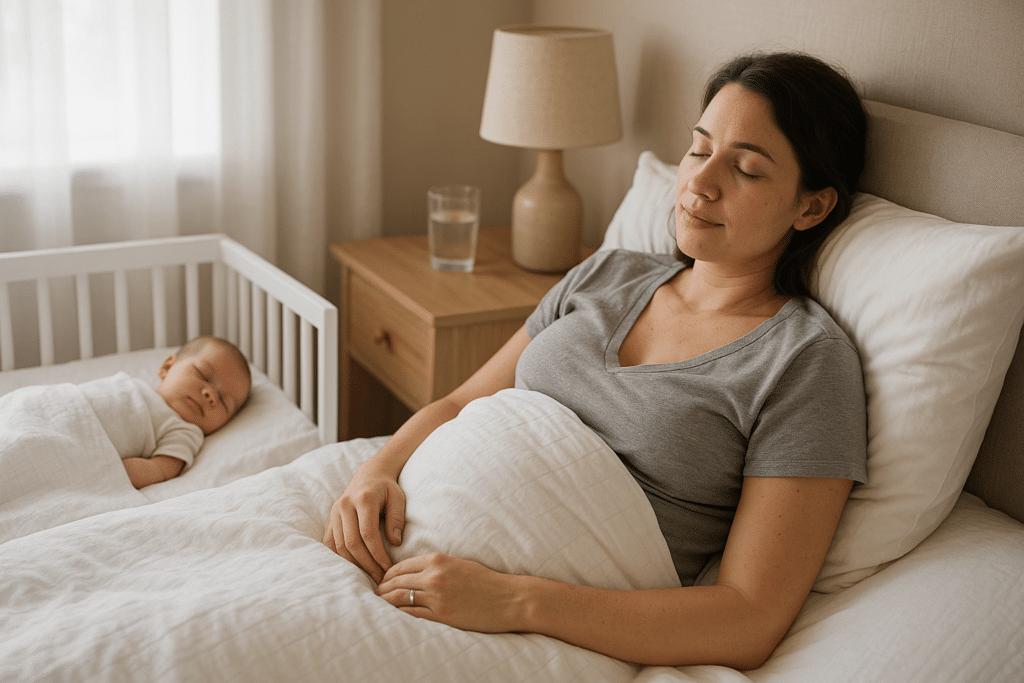
When you lie on your back, place a hand on your belly, and take a slow breath in, it might feel unfamiliar at first. But as you pay attention, as you give yourself time, something slowly begins to return.
A rhythm.
And with it, a sense of safety.
The Invisible Muscle That Changes Everything
It’s rarely talked about, yet it plays a crucial role: the pelvic floor.
This group of muscles supports your internal organs, stabilizes your core, and directly affects your everyday comfort. During childbirth, however, it undergoes significant strain and often needs time to recover.
Activating the pelvic floor is not about force.
Not about squeezing.
It’s a subtle, internal lift. As if you were gently lifting something from within — invisibly.
For many women, this is the first moment they feel reconnected to their body.
It’s not dramatic.
But it’s deeply transformative.
When Movement Takes on a New Meaning
As days turn into weeks, a new feeling begins to appear:
you want to move.
Not because you have to.
But because it feels good.
And this is where the real return begins.
Not with structured training plans.
But with small, intentional movements.
A gentle stretch in the morning.
A short walk in fresh air.
A slow spinal movement that leaves you thinking: “that felt good.”
Pelvic tilts, controlled movements, cat-cow stretches — these don’t just activate muscles. They help you feel safe in your body again.
And that matters more than any intense workout.
Your Core Is Not the Enemy
For many women, the abdominal area feels the most unfamiliar after birth.
Softer.
More sensitive.
Different.
And often, this is where the strongest urge appears: “I need to fix this.”
But your body doesn’t need fixing.
It needs support.
Rebuilding your core doesn’t start with crunches. In fact, those can often do more harm than good in the early stages.
Real strength lives deeper.
In slow, controlled movement.
In the way you observe your breath, your muscle engagement, and your presence during each exercise.
It’s not a fast path.
But it’s a stable one.
Your Body Speaks — It’s Worth Listening
There’s one thing you can’t bypass in this process:
your body is constantly giving feedback.
Sometimes gently.
Sometimes more clearly.
A pulling sensation.
A deeper-than-usual fatigue.
A subtle discomfort that whispers: this might be enough for now.
These are not obstacles.
They are guidance.
When you learn to listen, recovery becomes not only safer, but more intentional.
And this is where one of the biggest shifts happens:
you stop controlling your body from the outside,
and start working with it.
Returning — But Not to the Same Place
Many people think of this period as a “return.”
As if there’s a specific point you need to get back to.
But the truth is, you’re not returning to the same place.
You’re moving forward.
Toward a new version of yourself.
Toward a body that now knows something it didn’t before.
Toward a kind of strength that isn’t only physical.
And perhaps toward a relationship with yourself that is deeper, more patient, and more honest than ever before.
Closing Thoughts
Postpartum recovery is not linear.
There will be days when you feel strong and energized.
And others when even the simplest movement feels like a challenge.
Both are normal.
What matters is not how fast you move forward.
But how connected you remain to yourself along the way.
Because in the end, it’s not just your body that’s rebuilding.
It’s you.