
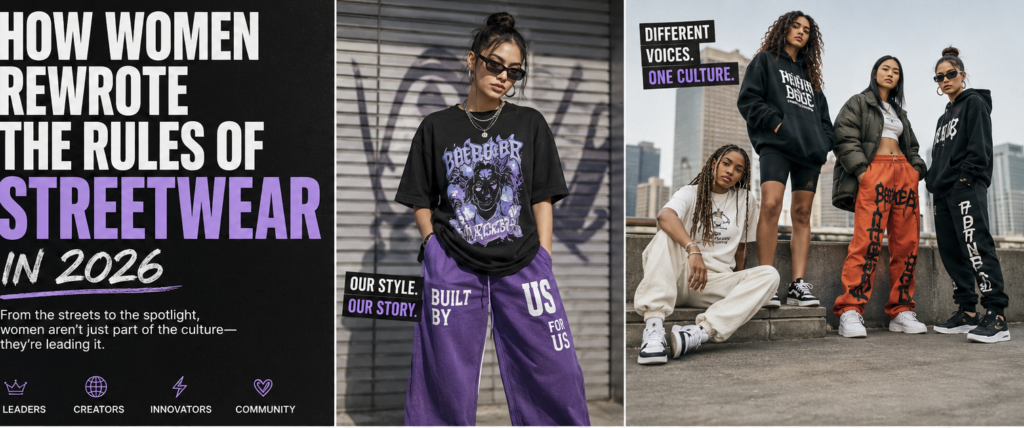
It started with an oversized blazer and a pair of Jordans. Now it’s a whole movement — and the women leading it have never looked more intentional, more powerful, or more themselves.
There’s a particular kind of confidence that happens when you walk into a room wearing something nobody expected. Not provocative, not performative — just deeply, quietly sure of yourself. I noticed it for the first time on a Tuesday morning in late March, outside a coffee shop in East London. A woman in her mid-thirties stood waiting for her order, wearing wide-leg cargo trousers in a soft dove grey, a pristine white oversized hoodie tucked at the waistband, and the kind of minimal gold jewellery that catches light without demanding attention. She had on low-top New Balance 550s — the cream colourway, obviously — and a structured micro-bag slung at her hip. No one around her was wearing anything particularly remarkable. And yet she was somehow the whole scene.
That’s what women’s streetwear does in 2026. It doesn’t shout. It doesn’t need to. After years of the fashion world insisting that streetwear was a male domain — a gritty subculture built on skate parks, hip-hop, and limited Supreme drops — women have not just entered that space. They’ve quietly renovated it from the inside out, bringing with them an instinct for elegance, a deeply personal relationship with comfort, and an aesthetic sensibility that has made the whole genre richer, stranger, and infinitely more interesting.
This is the story of that transformation. But more than that, it’s the story of what it means — right now, in this moment — to dress like you belong everywhere, to no one, and entirely to yourself.
Where It Began: The Long History Nobody Talks About
Here’s the thing about the “women didn’t wear streetwear” narrative: it was never actually true. It was just the narrative that got written, because for a very long time, the people doing the writing weren’t paying attention to the right women.
Go back to the late eighties and nineties and you’ll find women in TLC music videos wearing oversized denim and bold prints. You’ll find Salt-N-Pepa in leather and logo everything. You’ll find Black women in New York and LA who were building entire visual languages — layering sports jerseys over turtlenecks, wearing bucket hats and Air Force 1s — before any of this was being covered in Vogue or recognized as “fashion.” The runway was elsewhere. The culture was here. And women were already a central part of it.
What changed wasn’t women’s participation. What changed was who started paying attention.

By the early 2020s, the conversation had shifted enough that major houses — Balenciaga, Off-White, Sacai — were explicitly courting the female streetwear customer. Collaborations multiplied. Women’s sizing was no longer an afterthought on drops. And then, somewhere around 2023 to 2024, something subtler started happening: women stopped waiting for the culture to make room for them, and started building their own version of it entirely.
In 2026, that version is fully formed. And it’s far more interesting than anything that came before it.
The Aesthetic Landscape Right Now
If you’ve spent any time on Pinterest or the fashion side of Instagram lately, you’ll have noticed that the visual vocabulary of women’s streetwear in 2026 is almost impossible to pin to a single mood. That’s not a flaw — it’s the whole point. The movement has fractured into a dozen distinct sub-aesthetics, each with its own logic, its own icons, its own relationship to luxury and comfort and self-expression.
But there are a few currents running through all of them, threads you can trace even when the surface looks completely different.
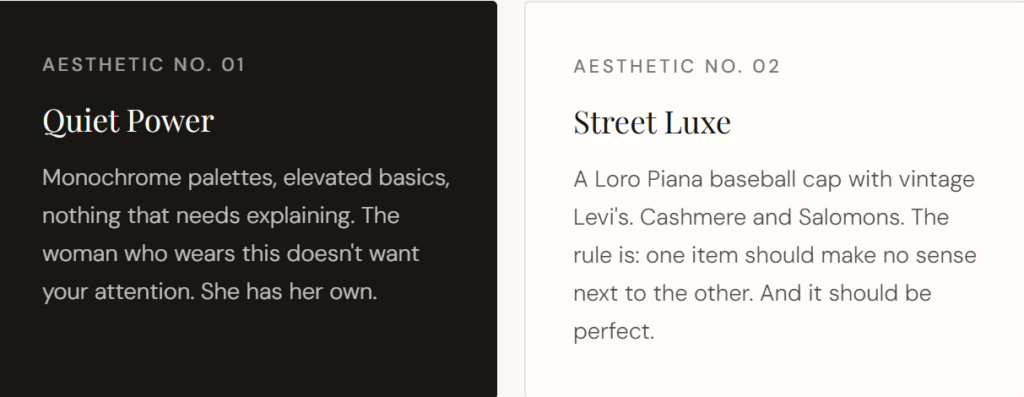
The first is what I’ve been calling Quiet Power dressing. This is the woman who has fully absorbed the lessons of quiet luxury — the Loro Piana-era obsession with understatement — and applied them to a streetwear context. Her palette runs to oatmeal, slate, warm ivory. Her sneakers are always clean. Her jewellery, if she wears any, is architectural and deliberate. She is communicating exactly one thing: that she doesn’t need to communicate anything at all.
The second current is what happens when you cross genuine luxury heritage with streetwear irreverence, and the result is something I find genuinely exciting to look at. Think: a perfectly worn-in vintage leather jacket worn over a Brunello Cucinelli rib-knit, paired with straight-leg denim and a pair of New Balance 1906Rs in a colourway so specific and considered it had to have been searched for deliberately. This is dressing with both historical awareness and a sharp, slightly amused eye — it says “I know what things cost, and I find it interesting that none of that information is visible right now.”
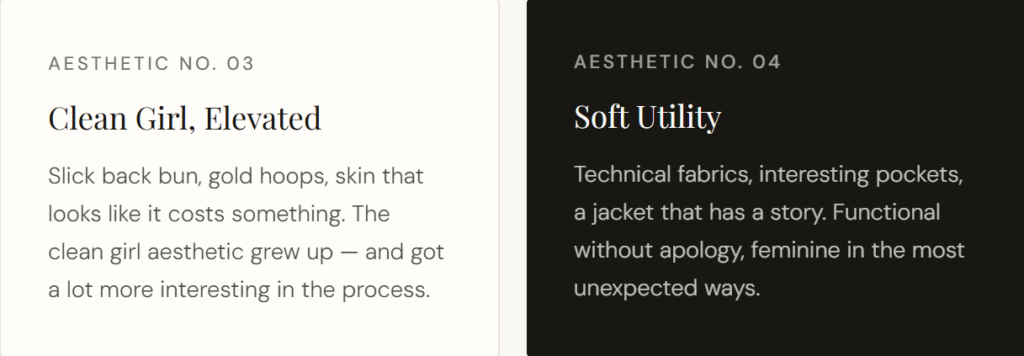
The third is the evolution of the clean girl aesthetic, which has been transformed by time and collective boredom into something far more textured. The base remains: excellent skin, minimal makeup, gold jewellery, hair that looks effortless because someone spent twenty minutes making it so. But in 2026, the clean girl wears a vintage college crewneck. She layers a technical gilet over a silk slip top. She’s got Samba Adidas on her feet but a fine-gauge cashmere cardigan on her shoulders, and the whole thing is somehow both entirely casual and oddly precise.
The fourth current — soft utility — might be my personal favourite. This is the woman who genuinely needs her clothes to work hard, who finds beauty in function, who has fallen completely in love with the technical outerwear movement and is now wearing Arc’teryx to dinner because she’s decided the distinction is irrelevant. Her clothes have pockets. Real ones. And they’re always in the right colour.
The Sneaker Question
Let’s talk about sneakers for a moment, because they remain the heartbeat of the whole thing — the element that ties every aesthetic together, the one purchase that signals, more than any other, that a woman understands what this world is actually about.
In 2026, the sneaker conversation for women is genuinely complex. It’s no longer enough to know the silhouettes — everyone knows the silhouettes now. What matters is how you know them, and more specifically, what you do with that knowledge.

The New Balance 990 series remains a totemic choice — the 990v6, specifically, in the grey/silver colourway that looks like it was designed specifically for rainy Sunday mornings and oak-panelled coffee shops. There’s something about that shoe that communicates a particular kind of fashion literacy: it’s saying “I know what the hype looks like, and I prefer the thing that will still be beautiful in fifteen years.”
The Adidas Samba, which went through its cultural moment and came out the other side somehow still relevant, has evolved in 2026 into a kind of blank canvas — a shoe so established in the cultural imagination that what you wear with it speaks louder than the shoe itself. A Samba worn with wide-leg tailored trousers and a belted mac is a completely different statement from a Samba worn with a micro-skirt and a football jersey, even though it’s literally the same shoe.
And then there’s the continuing rise of women’s-specific footwear from brands that didn’t traditionally make shoes with a female eye — Salomon, Merrell, On Running — which has opened up an entirely new vocabulary of technical-meets-beautiful that I find genuinely thrilling. The Salomon XT-6 in a dusty rose colourway, worn with wide-leg technical trousers and an oversized structured bomber? That’s a look that simply did not exist five years ago. It was invented by women, for women, through a combination of Pinterest mood boarding, collective aesthetic experimentation, and the simple refusal to wear something uncomfortable just because it was the only option.
The Icons: Women Who Built the Visual Language
Every movement has its people who aren’t quite celebrities in the traditional sense, who exist in a space between creative professional and cultural figure, and who carry the aesthetic forward through the accumulation of small, specific choices made publicly over time.
I don’t mean the musicians who get dressed by stylists for magazine covers — though some of them are doing extraordinary work. I mean the women who wake up every day and decide what they believe in, sartorially, and then go out into the world and demonstrate it.
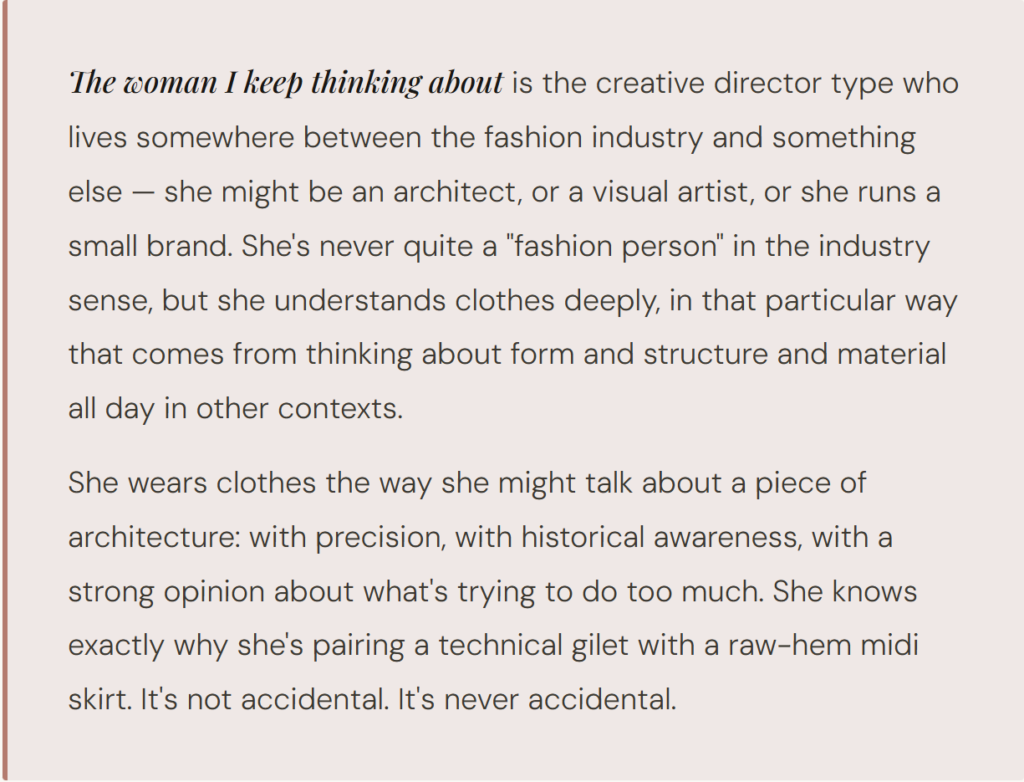
There are also the athletes who have crossed over into genuine style territory — not through brand deals, but through a kind of physicality in the way they wear things that is entirely their own. A former professional basketball player who has moved into coaching and wears the most incredible combinations of oversized vintage sports jerseys and tailored wide-leg trousers and barely-there jewellery. A professional tennis player who off-court wears nothing but the most considered, restrained monochrome looks and makes it seem like the most natural thing in the world.
And then there are the women I find on Pinterest who have no names attached to their images and whose styles I can only describe in fragments: the grey cashmere oversized crew, the perfectly broken-in Gazelles, the Uniqlo wide-leg trousers that somehow look expensive, the one vintage band tee that anchors the whole look in something real and earned.
These women are the ones actually building the aesthetic, collectively, without anyone coordinating the project. Which is, if you think about it, exactly how culture has always worked.
The Intersection of Activism, Identity, and What You Wear
I want to be careful here, because there’s a version of this conversation that flattens something genuinely complex into a neat, digestible narrative. Not every woman who wears streetwear is making a political statement. Not every choice carries the weight of resistance. Sometimes a hoodie is just a hoodie, and pretending otherwise is its own kind of erasure.
But there is also something true and important in the observation that clothing — particularly clothing that exists at the intersection of subculture, race, class, and gender — has never been politically neutral. The history of streetwear is a history of marginalized communities creating beauty and meaning on their own terms, and of mainstream culture subsequently appropriating that beauty while discarding or actively harming the communities that made it.

Women who participate in streetwear culture in 2026 are navigating all of that history, whether consciously or not. And many of them are navigating it very consciously indeed. There’s a significant current within women’s streetwear right now that is explicitly about reclamation — of space, of style, of the visual language of a culture that was built in part by women whose contribution was minimized or unacknowledged.
This shows up in the way certain women dress with an ostentatious disregard for who the original audience was “supposed” to be. It shows up in the choices to buy vintage rather than from the current market, to create the look from unexpected sources, to refuse the perfectly curated “women’s streetwear” section that many brands now offer as a kind of appeasement. It shows up in the way some women wear sports jerseys from teams or eras that carry personal meaning — a father’s favourite team, a city they came from, a period of time they want to carry with them.
Clothing as language. As testimony. As a way of saying: I was here, this mattered, this is mine.
There’s also the quieter activism of simply existing with confidence in spaces that were not designed for you. The boardroom in the oversized blazer and Jordans. The black-tie event in the beautifully tailored wide-leg suit and pristine court shoes. The fashion week street style moment where you’re not dressed for anyone’s camera, just for yourself, and the camera happens to be there.
These aren’t grand gestures. But they accumulate. And they change what’s considered possible.
How to Actually Build the Wardrobe
This is the part where I’m supposed to tell you exactly what to buy, and I’ll resist that impulse slightly, because the whole point of what we’ve been talking about is that the wardrobe is built from specificity and personal history, not from a shopping list. But I can tell you the principles I keep coming back to, the things I look for when I’m building looks that feel genuinely like mine rather than a mood board someone else assembled.
1
One Foundational Silhouette, Worn to Death
Pick one bottom — wide-leg trousers, a straight-leg jean, a midi skirt — that you know works with your body and your life, and then buy it in every fabric weight and colourway that makes sense. This is your anchor. Everything else orbits it.
2
At Least One Thing That Shouldn’t Work
The combination that makes you second-guess yourself before you leave the house, and then turns out to be the thing people stop you to ask about. This is where personality lives. Don’t skip it.
3
Something Earned, Not Just Bought
A vintage find, an inherited piece, something that has a story. The best streetwear looks I’ve ever seen had one element that wasn’t available for sale anywhere. It was just someone’s actual life, worn in.
4
Your Sneaker, Singular
Not the sneaker that’s trending. Not the one everyone has. The one that, when you put it next to the rest of your wardrobe, makes total sense in a way that you can’t quite explain to anyone who doesn’t already see it.
5
The Outerwear Piece That Changes Everything
A great coat, bomber, or technical jacket can make a T-shirt and jeans look like an intentional statement. It’s the thing that says you thought about this — even when you didn’t, really.
6
Gold, Just a Little
I’m a committed believer in the single gold chain over every streetwear look, from the most technical to the most elevated. It’s the detail that says feminine without announcing it.
The Social Media Effect: Pinterest Boards, Instagram Aesthetics, and What They’re Actually Doing to Our Style
I have a complicated relationship with what social media has done to the way women dress, and I think it’s worth being honest about both sides of it.
On one hand: Pinterest has genuinely democratized aesthetic inspiration in a way that has been transformative. The ability to find and save images of women dressed in ways that resonate with you — across cultures, across decades, across the specific geography of the places fashion actually exists — has made it possible for women to develop genuinely personal visual vocabularies that weren’t available to previous generations without tremendous resources or luck. I’ve discovered entire aesthetic frameworks through Pinterest that I had no language for before I saw them collected together on someone else’s board.
On the other hand: the trend cycle on social media has never moved faster, and the speed at which an aesthetic goes from genuinely interesting to completely saturated to slightly embarrassing in retrospect has compressed to somewhere around eighteen months, if that. The clean girl aesthetic that felt fresh and specific in 2022 was a content category with 47 million posts by 2024. The mob wife aesthetic peaked and was archived within what felt like weeks. The coastal grandmother had barely arrived before it started feeling like a costume.
The women who are navigating this most elegantly, I’ve noticed, are the ones who use social media purely as an input — a source of reference images, of unexpected combinations, of proof that the thing they’re imagining actually exists in the world — and then log off and do their own thing. They’re not building looks for documentation. They’re building looks for themselves, and occasionally those looks get documented, which is a very different relationship with the medium.
This shows up in the way the most compelling women’s streetwear imagery tends to be candid rather than posed, found rather than staged. The best content — the stuff that actually inspires rather than just performs inspiration — looks like someone caught in the process of living their actual life. Which is, again, the whole point of what streetwear has always been: clothing designed for use, not display.
The Luxury Dimension: When Streetwear Meets High Fashion
Something happened in the luxury market over the past several years that has had significant consequences for women’s streetwear, and I think it’s worth examining directly.
The major houses — not all of them, but the ones paying closest attention to cultural movement — realized that the streetwear-influenced woman was one of the most interesting and underserved customers in luxury. She had money. She had aesthetic intelligence. She was not interested in the traditional signifiers of luxury femininity (the handbag as status object, the heel as aspiration, the ladylike silhouette). She wanted something that could move with her — literally and culturally — and that didn’t require her to perform a version of femininity she found retrograde.
The results of this realization have been genuinely mixed. On one end, you have houses that have responded thoughtfully — reimagining their technical expertise in fabrics and construction in the context of garments that can actually be worn in the way the streetwear customer wears things: all day, in motion, in weather, in real life. Loro Piana’s technical outerwear has been doing this for years. More recently, you can feel it in the way certain Bottega pieces exist in a space between street and ultra-refined that feels newly coherent. Loewe’s relationship with craft and the handmade has always had a streetwear-adjacent quality — a slightly rough-at-the-edges honesty that makes their most elevated pieces feel like something found rather than purchased.
On the other end, there are the cynical plays — the luxury house logo on the hoodie, the branded sneaker collaboration that isn’t really in conversation with streetwear culture, just dressed up in its visual vocabulary. These are always visible, always slightly desperate-feeling, and the streetwear-literate woman generally ignores them with a kind of quiet efficiency that I find deeply admirable.
The most interesting luxury streetwear in 2026, in my observation, isn’t coming from the major houses at all. It’s coming from the small labels — many of them women-founded, most of them operating at a smaller scale than “luxury brand” typically implies — that are building something genuinely new from the materials of both worlds. Elevated fabrics, streetwear construction. Handcraft methods, utilitarian silhouettes. Couture-level attention to detail in a bomber jacket that you can actually wear to the airport. These are the brands to find and follow, because they’re doing the most interesting work, and they won’t be small for very much longer.
Beauty and the Streetwear Woman: A Specific Kind of Skin
We can’t talk about this aesthetic without talking about beauty, because the two have always been intertwined in streetwear culture, and in 2026 the relationship has evolved into something particularly specific.
The beauty aesthetic that pairs best with women’s streetwear right now is one I’d describe as conspicuously unbothered. Which is not the same as unmade — it’s the opposite of that, actually. It requires significant effort to look this precisely, intentionally low-key.
It starts with skin. The clean girl movement, for all that I’ve complicated it above, left behind one genuinely lasting truth: good skin is the foundation, and it’s always been a more potent style statement than any amount of makeup. The skincare practices that have filtered through into general consciousness over the past several years — the SPF discipline, the barrier-repair focus, the hydration-first approach that has largely replaced the oil-stripping, pore-minimizing routines of previous decades — have produced a generation of women whose faces simply look different. Healthier. Softer. More themselves.
The makeup palette that accompanies the most compelling streetwear looks in 2026 tends toward the skin-forward: a good tinted moisturizer or a very light, luminous foundation. Soft blush placed high on the cheekbone. A mascara that separates and lengthens without dramatizing. A lip that’s either completely bare or a very precise, very personal shade of rose or terracotta that’s been chosen with the same care as a sneaker colourway.
The eyebrow, notably, has relaxed. The sharp, filled, structured brow that dominated for over a decade has given way to something more natural, slightly brushed-up, present without being architectural. It’s a small change with a significant effect: it makes the whole face look like it belongs to an actual person, living an actual life.
Hair in the streetwear aesthetic is similarly precise in its apparent casualness. The slicked bun remains a constant — it’s one of the great style shortcuts of our time, the thing you do when you want your clothes to read and your face to read without your hair complicating either of those readings. But there’s also a growing current of very natural texture, worn with the kind of confidence that comes from actually understanding and caring for your particular hair rather than trying to make it look like someone else’s.
Braids — protective and beautiful and culturally rooted — remain both a practical choice and a powerful aesthetic element in this space. Box braids with a bucket hat and an oversized vintage crewneck is one of the most complete looks of this era, in my opinion. It requires nothing else. It’s already the whole argument.
The Future: Where Women’s Streetwear Goes From Here
If I had to identify the single most interesting direction in women’s streetwear right now — the current that I think will define what this whole movement looks like five years from now — it would be this: the growing integration of craft and technical skill into the aesthetic, in a way that moves beyond both the heritage-luxury axis and the mass-market drop culture that has dominated for so long.
I mean the women who are thinking about where their clothes come from, how they’re made, what they’re made of — and finding that those questions lead them toward small producers, sustainable materials, garments that are made to last rather than to be replaced next season. This is a different kind of investment in clothing: not the investment of the collector, hunting for resale value and scarcity, but the investment of someone who wants to build a wardrobe that will still be exactly right in twenty years.
The streetwear woman of 2026 is increasingly buying fewer things, chosen with more precision, from sources she’s thought harder about. Her relationship with vintage has deepened — not because it’s fashionable, but because it’s increasingly the best way to find the exact thing she wants at the exact quality she expects. She understands that the most interesting piece in any look is usually the one with the longest history, and she’s developed the eye and the patience to find those pieces.
She’s also, increasingly, making things herself. Not in a mass-market DIY-trend way — the customized denim and bleached T-shirts of a few years ago — but in a more serious, skills-based sense. She’s learning to sew. She’s altering things. She’s understanding structure and fit in a way that gives her a completely different relationship with clothes in general: she’s not just wearing them, she’s reading them. She can see how they were made. She can imagine how they could be different. This changes everything.
And then there’s sustainability — a word that has been deployed so cynically by so many brands that it’s almost lost its meaning, but which remains genuinely important when you strip away the greenwashing and look at what the most thoughtful women in this space are actually doing. They’re buying less. They’re repairing more. They’re thinking about end-of-life when they make purchase decisions. They’re choosing materials they can understand and trust. None of this is glamorous in the traditional fashion-content sense, which might be exactly why I believe in it.
A Final Thought: On Dressing Like Yourself
I’ve spent a lot of this piece talking about aesthetics and movements and cultural forces, and I want to end with something simpler, because I think it’s the thing that matters most.
The women who are doing the most interesting things in streetwear right now are the women who have stopped performing a version of style and started simply dressing like themselves. This sounds obvious. It is not obvious. It takes years, usually, and a willingness to look slightly wrong for a while as you figure out what actually belongs to you and what you’ve been wearing because you thought you were supposed to.
The woman I described at the beginning of this piece — the one outside the coffee shop in East London, in her grey cargos and cream NB550s — had that quality. Not just style. Something more specific: a relationship with her own image that had clearly been worked out over a long time, through a lot of looking and trying and discarding, until what remained was exactly right. Nothing extra. Nothing missing.
That’s the goal, isn’t it? Not the perfect outfit, or the most aspirational aesthetic, or the look that photographs best. Just the accumulation of knowledge about yourself — your proportions, your colour palette, the silhouettes that make sense given the body and the life and the specific series of choices you’ve made — until getting dressed becomes, not effortless exactly, but honest. A direct expression of who you actually are, rather than who you think you should be.
Streetwear, at its best, has always been about that. It started in communities where you wore what you had, what you could find, what meant something to you — and the beauty emerged from that authenticity, not from adherence to a prescribed aesthetic. Women have taken that founding principle and made it entirely their own. And in doing so, they’ve made streetwear more interesting, more complex, and more genuinely connected to what clothes have always actually been for: telling the truth about who you are to the world, one day at a time.