
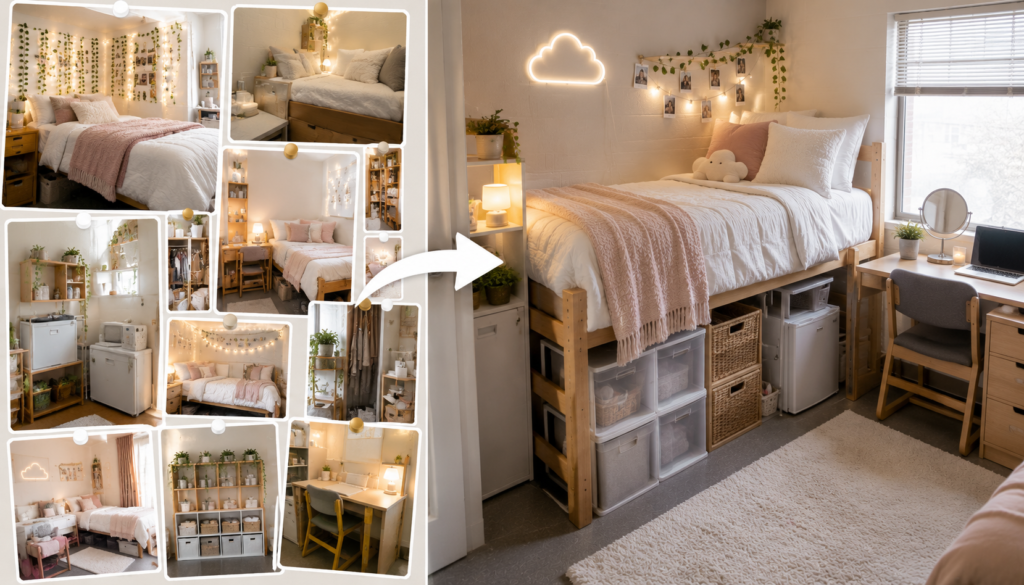
I still remember the exact moment my freshman year dorm bed went from “sad twin XL mattress with a Target sheet set” to something I actually wanted to photograph. It wasn’t a big moment. It was 11 p.m. on a Tuesday, I had a chemistry lab report due in nine hours that I hadn’t started, and instead I was standing on a desk chair trying to figure out how to hang a canopy from a cinder block ceiling with Command hooks that had already failed me twice that semester. My roommate walked in, looked at me, looked at the sad little swoop of tulle I’d managed to attach, and said, “It looks like a ghost gave up halfway through haunting this bed.”
She wasn’t wrong. But three weeks later, after some trial and error, a return trip to Target, and an embarrassing number of hours scrolling Pinterest boards titled things like “dorm room aesthetic” and “cozy dorm ideas,” that bed became the reason people stopped by our room. It became the background of every photo I took that year. It became, genuinely, my favorite place in the entire building — more than the lounge with the good couches, more than the study room with the whiteboard walls, more than the kitchen with the questionable microwave.
That’s the thing nobody really tells you about dorm decorating: your bed isn’t just furniture. In a room that’s roughly the size of a generous walk-in closet, your bed is basically your entire personality on display. It’s your living room, your reading nook, your Zoom call backdrop, your crying-after-a-bad-exam spot, and your Friday night hangout all rolled into one 80-inch-long rectangle. So when Pinterest shows you these unbelievably lush, layered, magazine-worthy dorm beds — the kind piled with twelve pillows and draped in gauzy canopies and somehow looking like a boutique hotel despite being bolted to a cinder block wall — it makes sense that we all want that. We’re not just chasing an aesthetic. We’re chasing the feeling that our tiny slice of a shared room can still feel like ours.
This is the article I wish someone had handed me before I started that whole process. Not a sterile list of “10 dorm room must-haves,” but an actual walk-through of what it takes to get your bed from a screenshot to something that survives real dorm life — roommates, RA inspections, community bathrooms, fire code restrictions, laundry day, and all.
Why the Dorm Bed Became the Main Character of Room Decor
Something shifted in the last few years. Dorm decorating used to mean a string of fairy lights and a poster from Ikea. Now it’s an entire genre of content. Search “dorm room” on Pinterest and you’ll fall into a rabbit hole that could eat your entire evening — coastal grandmother dorms with linen duvets and wicker baskets, dark academia setups with brass reading lamps and burgundy velvet, “clean girl” rooms in oatmeal and cream that look like they belong in a Copenhagen apartment, maximalist collage walls paired with beds buried under a dozen mismatched pillows that somehow still look intentional.
And at the center of almost every single one of these photos? The bed.
There’s a practical reason for this. In most dorm rooms, the bed physically dominates the space. It’s the biggest object in a room that might only be 12 by 16 feet, sometimes shared with another person’s entire life crammed into the same footprint. Your desk is functional. Your closet is functional. Your mini fridge is, unfortunately, extremely functional. But your bed is the one surface where you actually get to make design choices that aren’t dictated by “will this fit” or “does the school allow this.” It’s soft. It’s textural. It photographs beautifully. And unlike a wall you can’t paint or a floor you can’t refinish, it’s completely, 100% yours to transform.
There’s also an emotional layer to this that I think gets glossed over in a lot of “how to decorate your dorm” content. College is disorienting. You’ve just left a home that, however imperfect, was yours — your room, your walls, maybe even your own bathroom — and you’ve traded it for a shared box with someone you might have met over a two-paragraph email exchange in August. Your bed becomes this small, controllable pocket of comfort in an environment where almost nothing else feels familiar. Making it beautiful isn’t shallow. It’s a coping mechanism disguised as an aesthetic choice, and honestly? I think that’s kind of beautiful in itself.
That emotional pull is exactly why these Pinterest dorm bed trends go viral in the first place. They’re not just showing you a pretty layout. They’re selling you a feeling — the feeling of walking into your dorm room after a brutal day and sinking into something that actually feels like sanctuary instead of just “the place I sleep because I have to.”
So let’s talk about how to actually get there.
The Anatomy of a Pinterest-Worthy Dorm Bed
Before we get into specific aesthetics — coastal, dark academia, clean girl, and so on — I want to break down the actual structural formula that makes these beds work. Because here’s something I learned the hard way: you can buy every single item from a viral TikTok “dorm haul” video and still end up with a bed that looks flat, cluttered, or somehow both. The trend itself isn’t magic. The layering is.
Every genuinely stunning Pinterest dorm bed, regardless of style, follows roughly the same underlying structure. Think of it in layers, from the mattress up.
Layer One: The Foundation You Never See
This is the part nobody posts about, and it’s the part that matters most for your actual sleep quality and the part that makes everything above it look plush instead of lumpy. Dorm mattresses are, without exception, terrible. They’re thin, they’re firm in all the wrong ways, and after a year of use they develop a very specific dip in the middle that feels like sleeping in a canoe.
A quality mattress topper is non-negotiable if you want that thick, cloud-like silhouette you see in photos. I’m talking about a topper with real loft — at least two to three inches of memory foam or a plush featherbed-style topper — not the thin quilted pad that comes in a lot of “dorm bedding bundle” sets. This is genuinely the single most impactful purchase for both comfort and appearance. It changes the entire proportion of your bed. Without it, your fitted sheet sits flat against a thin mattress and everything above it looks deflated, no matter how many pillows you pile on. With it, your whole bed gets this soft, rounded, inviting height that makes the rest of the styling actually read the way it’s supposed to.
If your budget allows for exactly one splurge in this whole process, put it here. It’s invisible in most photos, but it’s the reason the visible parts look right.
Layer Two: Sheets That Actually Hold Their Shape
I used to think sheet quality was one of those things people exaggerated about, the way people exaggerate about the difference between a $12 bottle of wine and a $40 one. Then I switched from a cheap microfiber set to a mid-range cotton percale, and I genuinely could not believe the difference. Cheap sheets wrinkle in a way that reads as “unmade” even five minutes after you’ve made the bed. Better sheets — percale for a crisp, hotel-like look, or a soft brushed cotton for a more relaxed, lived-in feel — hold their shape and drape properly, which matters enormously in photos and honestly in real life too.
You don’t need to spend a fortune here. What you need is to avoid the very cheapest tier of bedding, which tends to be thin, static-clingy, and pill after a few washes. Mid-range is genuinely enough. This is not a category where the most expensive option is dramatically better than the second-cheapest good option.
Layer Three: The Duvet or Comforter — Your Color Foundation
This is where your aesthetic really starts to take shape, because your duvet or comforter sets the tone color-wise for everything that follows. This is the layer where you decide: am I doing warm neutrals? Cool tones? A bold statement color with neutral accents? A pattern-forward moment?
One thing I notice in almost every successful Pinterest dorm bed is that the duvet itself tends to be relatively simple — solid, or a subtle texture like waffle knit or a soft ribbed weave — while the pattern and personality get introduced through the pillows and throws layered on top. This is a really useful principle to steal. A busy patterned duvet under busy patterned pillows starts to feel chaotic fast, whereas a simple base gives your eye somewhere to rest.
Layer Four: The Pillow Situation (This Is Where the Magic Happens)
Okay, this is the layer everyone actually cares about, and it’s the one that separates a bed that looks “fine” from a bed that looks like it belongs in a design magazine. The pillow arrangement is doing so much visual work in these photos, and there’s an actual formula behind it, even if it looks effortless.
Here’s the general structure that shows up again and again in viral dorm setups:
-
Euro shams in the back (roughly 26×26 inches) — these are the big, structural pillows that lean against the wall or headboard and create height and volume. Two of these is the sweet spot for a twin XL.
-
Standard or king pillows in the middle — your actual sleeping pillows, usually in coordinating pillowcases, sometimes with a decorative flange or piping detail.
-
A few accent pillows in front — smaller, often a different shape (lumbar, round bolster, or a small square), in a contrasting texture or a pop of pattern. This is where you get to have fun. A chunky knit pillow, a velvet bolster, a scalloped-edge cushion.
The trick that makes this look styled rather than random is varying the texture while keeping the color palette fairly tight. You want a bouclé pillow next to a linen one next to a velvet one — different materials catching light differently — but staying within roughly the same two or three shades. This is the exact same principle interior designers use in full-scale living rooms, just shrunk down to fit a twin XL mattress.
And a small but genuinely important tip: fluff and prop your pillows so they’re leaning slightly forward and angled, not stacked flat like a pillow fort wall. Pull the front pillows slightly toward the foot of the bed and let the back ones lean at a slight angle. That subtle asymmetry is what reads as “styled” instead of “just placed there.”
Layer Five: The Throw Blanket Moment
A throw blanket, draped — never folded flat — across the foot of the bed or cascading off one corner, is doing more compositional work than people realize. It breaks up the horizontal lines of a made bed, adds texture, and gives you a built-in excuse to introduce a secondary color or pattern without committing to it as your main palette.
The trick with throws is the draping technique. A throw that’s just laid flat and smoothed looks stiff. What you want is what stylists sometimes call the “lazy fold” — drape it so it falls naturally, maybe with one corner trailing slightly off the edge of the bed, with some soft folds rather than crisp lines. It should look like you tossed it there after using it, not like you ironed it into place. (Even though, let’s be honest, you probably did spend several minutes adjusting it to look accidentally perfect. No judgment. We’ve all been there.)
Layer Six: The Frame Around the Bed
This is the layer that turns “nice bedding” into “an actual moment” — the canopy, the curtains, the string lights, the headboard situation, the wall behind the bed. We’ll get into the specifics of how to do this within actual dorm restrictions in a bit, but structurally, this is the layer that provides visual context. It’s the difference between a nicely made bed sitting in an empty room and a bed that feels like it’s the anchor of an entire designed space.
Breaking Down the Viral Dorm Bed Aesthetics
Now that we’ve got the underlying formula, let’s talk about the specific looks that keep showing up on Pinterest and TikTok, why each one works, and how to actually pull it off without spending your entire semester’s book budget.
The Cloud Bed
This is probably the single most recognizable dorm bed trend of the last few years, and there’s a reason it refuses to go out of style. The cloud bed is exactly what it sounds like: an enormous, soft, all-white or cream mound of pillows and layered textures that looks like you could disappear into it. Think five or six pillows in varying sizes, a plush white duvet, maybe a faux fur or sherpa throw, everything in shades of white, cream, and the palest possible gray.
Why it works: monochromatic color schemes trick the eye into perceiving more volume and softness than actually exists, because there’s no color contrast breaking up the shapes. Everything blends into one big, soft mass. It also photographs incredibly well because white and cream reflect light beautifully, which is part of why this aesthetic dominates so much of Pinterest — it’s inherently photogenic.
The honest reality check: an all-white bed in a shared dorm room, in a building with community laundry and roommates and the general chaos of eighteen-year-olds living independently for the first time, requires more maintenance than the photos suggest. I loved my white-and-cream setup, and I also washed my duvet cover roughly every ten days because dorm rooms get dusty fast and white shows everything. If you’re going this route, buy a duvet with a removable, washable cover rather than a comforter you can’t easily launder, and consider a cream or oatmeal tone instead of pure white — it hides the reality of daily life slightly better while keeping that same soft, airy feeling.
Coastal Grandmother Dorm
This trend borrowed its name from the broader “coastal grandmother” aesthetic that took over social media a couple of years back — think Nancy Meyers movie interiors, linen everything, a sort of unhurried, sun-faded elegance. Translated to a dorm bed, this means natural linen or linen-blend bedding in soft blues, warm whites, and sandy neutrals, often with a striped or gingham accent pillow, maybe a woven rattan or seagrass basket nearby, and a general sense of relaxed, breezy comfort rather than crisp perfection.
Why it works: linen has this incredible quality of looking intentionally rumpled rather than messy. Where a wrinkled cotton sheet reads as “unmade,” a wrinkled linen sheet reads as “effortlessly lived-in.” This is genuinely useful information for a dorm setting, because your bed is going to get rumpled — you sit on it, you nap on it, you host your friends on it during a study break — and linen forgives all of that in a way crisp cotton simply doesn’t.
The honest reality check: real linen bedding sits at a higher price point than most other options, and it wrinkles by design, which some people find charming and others find genuinely annoying to look at every day. If you love the aesthetic but not the price tag or the wrinkle factor, a linen-blend or a “washed cotton” sheet set gives you 80% of the visual softness at a fraction of the cost and with fewer wrinkles to manage.
Dark Academia Canopy Bed
This one leans dramatic — deep jewel tones like burgundy, forest green, and navy, heavier fabrics like velvet, brass or dark wood accents, and often an actual canopy or curtain structure around the bed that creates a sense of enclosure and drama. Think old library energy, candlelight (battery-operated, obviously, given fire codes), leather-bound books stacked on the nightstand, a vintage-style desk lamp.
Why it works: darker colors and heavier textures create a sense of coziness and intimacy that’s genuinely appealing in a small space, especially for people who find all-white minimalism a little cold or sterile. There’s also something inherently dramatic and romantic about a canopy — it transforms a standard dorm bed frame into something that feels like a four-poster from a completely different era.
The honest reality check: darker fabrics show lint, dust, and pet hair (if you have a resident stuffed animal collection, no judgment) more visibly than lighter tones do, especially navy and burgundy velvet. And canopy setups require real thought about hanging hardware, because most dorms prohibit anything that involves drilling into walls or ceilings. We’ll cover the workaround for this in the practical section below, but it’s worth knowing upfront that this look takes a bit more engineering than the others.
Clean Girl / Quiet Luxury Neutral Bed
If cloud beds are about maximum volume and coastal grandmother is about relaxed texture, this trend is about restraint. Think oatmeal, taupe, warm gray, and soft camel tones. Minimal pattern. A focus on quality over quantity — two or three really good pillows instead of eight mediocre ones. Often paired with a wood or rattan bed tray, a single ceramic vase, maybe one carefully chosen piece of art rather than a full gallery wall.
Why it works: this aesthetic essentially imports the “quiet luxury” and “elevated everyday” principles that have been dominating home design more broadly into the dorm room context. It reads as mature, intentional, and calm in a way that stands out precisely because it’s the opposite of the maximalist, everything-everywhere approach a lot of dorm rooms default to. In a space with limited square footage, restraint can actually read as more luxurious than abundance, because it signals that every object was chosen deliberately rather than accumulated.
The honest reality check: this is, somewhat ironically, one of the harder looks to execute on a true student budget, because the entire aesthetic depends on the quality of a small number of items being genuinely good — a nice linen throw, a well-made pillow, sheets with a real weight to them. You can’t fake quiet luxury with quantity or with the cheapest version of everything, because the whole point is that everything reads as considered. If you’re drawn to this look, it’s worth saving up for fewer, better pieces rather than buying a large bedding “haul” of budget items.
The Maximalist, Eclectic, Everything-Everywhere Bed
This is the joyful opposite of the quiet luxury approach — mismatched patterns, bold colors, a mix of vintage and new, pillows in six different prints that somehow work together, maybe a patchwork quilt, definitely too many stuffed animals if you ask your roommate, but exactly the right amount if you ask you.
Why it works: when done well, maximalism isn’t actually chaos — it’s controlled abundance. The trick that separates a maximalist bed that looks curated from one that looks like a garage sale explosion is usually a unifying color thread running through the mismatched patterns. You might have five different prints, but if they all pull from the same three or four colors, your eye reads them as a cohesive collection rather than a random pile.
The honest reality check: this look genuinely requires the most editing, which sounds counterintuitive for a style built on “more.” But every maximalist space that actually photographs well has an editor behind it, someone who tried six pillows together, decided two of them clashed, and swapped them out. If you’re going maximalist, buy a few extra options and actually test combinations before committing, rather than assuming more is automatically better.
Y2K and Butterfly Revival
This one swings younger and more playful — pastel or bubblegum color palettes, butterfly and heart motifs, fuzzy or fur-textured pillows, string lights with colored bulbs instead of warm white, maybe a disco ball or two. It’s nostalgic, a little kitschy on purpose, and unapologetically fun in a way that pushes back against the more “adult,” muted aesthetics dominating a lot of home decor content right now.
Why it works: not every eighteen-year-old wants their dorm room to look like a boutique hotel. Some people want their space to feel genuinely playful and young, and this trend gives permission for that. It also tends to be more budget-friendly than some of the other looks, because a lot of the key pieces — colored string lights, novelty pillows, fuzzy textures — are inexpensive and easy to find.
The honest reality check: because this trend leans so heavily on specific, recognizable motifs, it can start to feel dated faster than a more neutral palette would. That’s not necessarily a problem — plenty of people are fine refreshing their look each year or even each semester — but if you’re hoping your bedding investment lasts all four years without feeling stale, this might be a trend you lean into with a few key accent pieces rather than committing your entire palette to it.
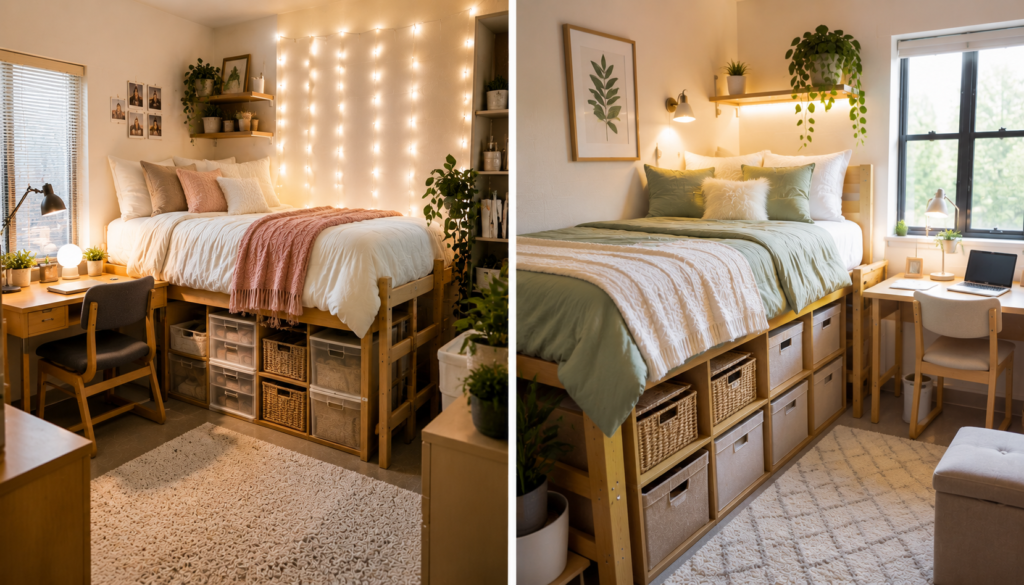
Getting the Proportions Right: The Part Pinterest Doesn’t Show You
Here’s something that took me embarrassingly long to figure out: a huge percentage of what makes a Pinterest photo look so effortlessly perfect isn’t actually the products. It’s the camera angle. Most of those photos are shot from slightly above and at a flattering distance, in good natural light, with the rest of a cluttered, lived-in dorm room carefully cropped out of frame.
When you’re standing in your actual room, at your actual eye level, surrounded by your actual desk clutter and your roommate’s actual side of the room, the same bedding can look completely different. This isn’t a failure on your part. It’s just the gap between a curated photograph and lived reality, and understanding that gap early saves you a lot of unnecessary disappointment.
A few things that genuinely do translate from photo to real life, though, if you get the proportions right:
Pillow-to-bed-width ratio matters more than pillow count. A twin XL mattress is 39 inches wide. If you cram eight pillows onto that width, they end up squished, overlapping awkwardly, and losing their individual shape. Four to six well-chosen pillows, properly fluffed and given room to breathe, will look fuller and more luxurious than eight crammed-together ones. This was probably my single biggest early mistake — I thought more pillows automatically meant more “that Pinterest bed,” and instead I just had a lumpy, overcrowded mess that took up half my desk chair when I wanted to actually sleep.
Height creates the “plush hotel bed” illusion. This goes back to the mattress topper point, but it’s worth repeating because it’s the detail people skip most often when trying to save money. Without real loft underneath your sheets, no amount of pillow styling on top will create that sink-in, cloud-like silhouette. If you can only afford one “extra” item beyond the basics, this is genuinely it.
Negative space is not your enemy. One thing I notice in a lot of failed dorm-bed attempts is a kind of horror-vacui approach — filling every possible inch with something, because more feels like more effort, more personality, more value for money spent. But some of the most striking Pinterest beds actually use restraint deliberately. A single, perfectly draped throw with room around it can look more elevated than a bed piled with unrelated objects.
The Practical Side: Making It Work Within Actual Dorm Rules
This is the section I really wish had existed when I was planning my own room, because so much dorm decor content just assumes you can drill into walls, hang heavy canopies from the ceiling, and generally treat the room like your own private apartment. Almost every college has fairly strict fire and safety codes that limit what you can actually do, and figuring this out before you buy things saves you money and frustration.
The Canopy Question
Canopy beds are one of the most requested looks, and also one of the most commonly misunderstood in terms of what’s actually achievable. Most dorms prohibit:
-
Drilling or screwing anything into walls or ceilings
-
Draping fabric directly over light fixtures or smoke detectors (this one is a genuine fire hazard, not just a rule for the sake of rules)
-
Hanging anything heavy from ceiling tiles, which usually aren’t structurally rated to support real weight
What actually works instead is a freestanding canopy frame that attaches to the bed itself rather than the room. These are typically a lightweight metal frame that either clamps onto your bed frame or sits as its own four-poster structure around the mattress, with fabric draped over the top. Because the whole thing is self-supporting, it doesn’t require touching the walls or ceiling at all, which means it’s almost universally allowed even in stricter dorms. This is honestly the move for anyone chasing that dark academia or romantic canopy look — it gives you the visual effect without fighting your housing contract.
If your bed happens to be lofted (more on that below), you sometimes get a built-in version of this for free, because you can drape fabric from the loft’s support bars.
The Lofted Bed Reality
A huge number of dorm beds are either pre-lofted or loftable, meaning they sit up higher off the ground with space underneath for a desk, dresser, or seating area. This changes your styling approach in a few important ways.
First, a lofted bed is more visible from below and from across the room, which means the underside of your bed — the frame, any hanging storage, string lights along the frame — becomes part of the overall look, not just the top surface. Some of the most striking dorm room photos I’ve seen use the underside of a lofted bed as a kind of built-in canopy structure, hanging sheer curtains from the frame’s edges to create a partially enclosed nook underneath, almost like a reading tent.
Second, getting on and off a lofted bed multiple times a day changes how practical certain pillow arrangements are. If you’re constantly climbing a ladder, an elaborate twelve-pillow arrangement you have to carefully reconstruct every morning gets old fast. A lot of people with lofted beds settle into a slightly simpler, more low-maintenance version of their dream aesthetic once they’ve lived with the climbing reality for a few weeks — which is worth knowing upfront so you don’t over-invest in a setup you’ll find yourself simplifying anyway.
Working With Cinder Block and Painted Brick Walls
If your dorm has the classic cinder block walls, you already know that “just hang it on the wall” is a lot harder than it sounds. Regular nails and screws don’t work well in cinder block, and most schools prohibit them anyway. Command strips rated for the surface (there are specific cinder-block-rated hooks, which behave differently than the standard drywall version) are your best bet for lightweight items like string lights or a small tapestry, but they genuinely do fail more often on textured or painted block than on smooth drywall, especially with humidity or temperature swings.
For anything with real weight — a canopy frame, a large tapestry, string lights with a lot of length and therefore weight — over-the-door hooks, tension rods that wedge between the wall and any adjacent surface, or furniture-mounted solutions (attaching to your bed frame or desk rather than the wall) tend to hold up far better over a full semester than adhesive strips do. I learned this the hard way after my tapestry fell directly onto my sleeping roommate at 2 a.m., which remains one of the more memorable apologies I’ve had to give in my life.
The Fire Code Layer Nobody Loves Talking About
I know this isn’t the fun part of the article, but it’s genuinely important: most dorms restrict real candles (obviously), certain types of string lights (some require LED-only, some prohibit incandescent bulbs specifically), and fabric draped in ways that could create a fire hazard near outlets or heat sources. Before you buy your canopy fabric or your string lights, it’s worth an actual five-minute read of your school’s housing handbook, because getting written up during a room inspection — or worse, having your RA make you take everything down the week before parents’ weekend — is a genuinely deflating experience after you’ve put real effort into your space.
The good news is that battery-operated or USB-powered LED string lights have gotten so good in the last few years that you genuinely don’t lose much of the visual warmth by going this route. Look for warm white (around 2700K, if the packaging lists color temperature) rather than cool white, which tends to read as harsh and clinical rather than cozy.
Budgeting for Your Bed: What’s Worth the Splurge and What Isn’t
Let’s talk money, because Pinterest boards very conveniently never mention prices, and a lot of “get the look” content quietly links to items that add up to several hundred dollars once you actually total the cart. Here’s how I’d allocate a realistic dorm bedding budget based on what actually moves the needle visually and comfort-wise, versus what you can save on without anyone noticing the difference.
Worth Splurging On
The mattress topper. I’ve said this already but it bears repeating one more time because it’s genuinely the highest-impact purchase you’ll make. A good topper transforms both how your bed looks and, frankly, whether you’ll actually sleep well for the next nine months. This is not the place to go with the cheapest option.
At least one or two “hero” pillows. You don’t need every pillow to be expensive, but having one or two genuinely nice ones — a bouclé Euro sham, a good chunky knit pillow — gives the whole arrangement a sense of quality that elevates the cheaper pieces around it. This is a trick stylists use constantly: one elevated item makes everything nearby read as more elevated too.
Your actual sleeping pillow. Not the decorative ones — the one you put your head on every night. Dorm life is exhausting enough without waking up with a stiff neck. This is health infrastructure disguised as decor, and it’s worth the investment.
Where You Can Genuinely Save
Your duvet cover, if you’re comfortable with basic options. A simple, solid-color duvet cover from a budget retailer does the exact same visual job as an expensive one, especially since it’s mostly going to be layered under pillows and a throw anyway. Save the splurge budget for the layers people actually see and touch.
Decorative accent pillows in cheaper prints. These are the pieces most likely to get switched out seasonally, damaged by dorm life, or simply fall out of favor as your taste shifts over the year. Don’t sink serious money into items with a genuinely short expected lifespan.
String lights and small decor accents. Unless you’re going for a specific premium look (like brass fixtures for dark academia), budget string lights and small decorative objects genuinely look almost identical to pricier versions in a small dorm room, especially once they’re part of a fuller styled composition rather than standing alone.
The Secondhand and Thrifted Angle
One thing that doesn’t get talked about enough in dorm decor content is how much of the “collected, not decorated” look — especially for maximalist or vintage-inspired aesthetics — genuinely benefits from thrifted pieces rather than everything-matching-new sets. A vintage quilt from a thrift store, an odd little ceramic vase, a slightly mismatched vintage pillowcase repurposed as a cushion cover — these add a layer of authenticity and visual interest that brand-new, matching bedding sets can’t replicate, and they usually cost a fraction of the price. If your campus has any kind of secondhand shop, estate sale circuit, or even a well-stocked thrift store nearby, it’s genuinely worth an afternoon before you commit to buying everything new.
Three Budget Tiers, Broken Down
Because “just spend more on quality pieces” is easy advice to give and considerably harder advice to follow when you’re working with actual student money, I want to walk through what a realistic bed transformation looks like at three different price points. These aren’t rigid rules, just a sense of what tends to be achievable at each level, based on watching my own dorm bed evolve (and helping a handful of friends shop for theirs) over the years.
The Lean Budget Approach
At the tightest end, the move is to concentrate your entire budget on the mattress topper and one genuinely nice pillow, and let everything else be simple, solid-colored, and inexpensive. A plain duvet cover in a good neutral, two standard pillows in coordinating cases, and a single throw blanket can still look intentional if the colors are chosen carefully and the topper underneath is doing its job. Skip the canopy entirely at this tier, or improvise one with a simple curtain rod-and-sheer-panel setup rather than a dedicated frame. The trick at this budget level is restraint — five well-chosen, well-coordinated items will always look better than ten mismatched cheap ones, so resist the urge to fill every gap just because something is inexpensive.
The Mid-Range Sweet Spot
This is where most of the Pinterest looks in this article become genuinely achievable without requiring a part-time job specifically to fund your bedding. At this tier, you’re looking at a proper mattress topper, a mid-range cotton sheet set, a simple duvet in a nice color, and a full pillow arrangement mixing two or three textures — maybe a bouclé Euro sham, a couple of standard pillows, and a small accent pillow in a contrasting texture. A freestanding canopy frame becomes realistic here too, along with battery-powered warm LED string lights and a genuinely nice throw blanket. This tier is honestly where I’d encourage most people to aim, because the visual jump from “lean budget” to “mid-range” is dramatic, while the jump from “mid-range” to “splurge” is comparatively subtle and mostly shows up in fabric quality rather than overall visual impact.
The Splurge Setup
At the higher end, you’re able to invest in genuinely premium materials throughout — real linen sheets, a higher-fill mattress topper, designer or boutique-brand pillows, possibly a custom or higher-end canopy setup with proper drapery-weight fabric rather than lightweight sheer panels. This tier also opens up room for more considered accent pieces: a ceramic reading lamp instead of a plastic one, a wood bed tray instead of a folding one, higher-quality baskets for underbed storage that double as decor rather than purely functional bins. The visual difference between this and the mid-range tier, to be honest, is more about longevity and tactile quality than dramatic photographic impact — but if you can afford it, the extra comfort and durability across a full nine months of daily use is a genuinely worthwhile investment, not just an aesthetic flex.
Mistakes I Made (So You Don’t Have To)
I promised at the start of this that I’d be honest about the actual process, not just the highlight reel, so here’s my personal list of dorm bed mistakes, offered with the specific hope that you’ll skip at least one of them.
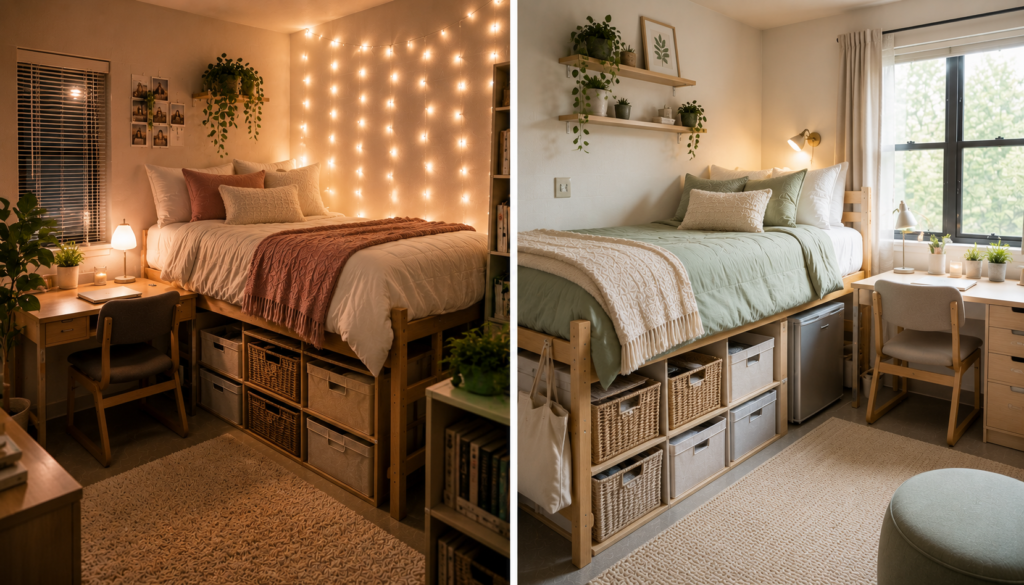
I bought bedding before I saw my actual room. I ordered a full set based on a photo I loved, and then arrived to discover my dorm room had a strange yellow undertone to the overhead lighting that made my carefully chosen sage green look muddy and off. Lesson learned: if you can, wait until move-in day, or at minimum look up photos of your specific building’s lighting, before locking in a color palette you can’t easily return.
I underestimated laundry logistics completely. A duvet cover you can take off and wash is infinitely more practical than a single-piece comforter, especially with community laundry machines that are often small, in demand, and occasionally out of order for a week at a time during finals season (of course). Anything you choose should be realistically washable given your actual laundry situation, not just theoretically washable in an ideal world with your own machine at home.
I went too matchy-matchy at first. My initial bedding was a single bundled “set” — sheets, pillowcases, and duvet all from the same exact pattern line. It looked flat and a little juvenile, honestly, like something out of a catalog rather than a space someone had actually put thought into. Mixing pieces from different sources, even within a coordinated palette, almost always looks more intentional and more “you” than an all-matching bundle.
I didn’t account for how often I’d actually be sitting on my bed. Because dorm rooms are so small, your bed ends up doubling as your couch for most of the day — you sit on it to eat, to do homework, to hang out with friends when your desk chair runs out of room. A styling approach that looks perfect but collapses the second someone sits down isn’t actually functional for dorm life. I eventually shifted toward a slightly more relaxed arrangement that could survive being sat on repeatedly throughout the day and still look intentional afterward, rather than something that needed a full ten-minute reconstruction every single time.
I forgot to think about my roommate’s side of the room. This one is less about the bed itself and more about the whole room, but it’s worth mentioning: a stunning, heavily styled bed can look strange or even a little isolating if it’s dramatically mismatched with the rest of the room’s energy. Not that you need to coordinate outfits with your roommate, but a quick conversation about general color direction — even just “should we both lean warm or both lean cool” — tends to make the whole room feel more cohesive rather than like two completely separate universes taped together at the middle. My sophomore year roommate and I never explicitly planned this out, but we both happened to gravitate toward warm neutrals with the occasional green accent, and the room ended up feeling like one continuous, considered space rather than a visible dividing line down the middle of the floor. I’ve heard the opposite story plenty of times too, from friends whose rooms ended up split almost comically down the center — one side moody and dark academia, the other side bright Y2K pastels — which isn’t a disaster by any means, but it does mean the room as a whole reads more like two separate dorm rooms sharing a door than a single space, which is worth knowing going in if a cohesive overall look matters to you.**
I underestimated how much natural light changes everything. The exact same sage green duvet that looked slightly muddy under our north-facing window’s dim afternoon light looked completely different — brighter, greener, more like the photo I’d originally fallen in love with — in a friend’s south-facing room down the hall. If you have any flexibility in choosing your room or at least advance knowledge of which direction your window faces, it’s worth factoring into your color decisions, since the same exact bedding can read as two entirely different colors depending on how much and what kind of natural light actually reaches your bed throughout the day.
Seasonal Refreshing: Making One Bed Work All Year
Here’s something the initial Pinterest-to-reality transformation content rarely addresses: your dorm bed has to survive an entire academic year, through very different seasons, moods, and levels of energy you have available for maintaining it. What looks perfect and cozy in October, when you’re eagerly nesting into the new semester, might feel completely wrong by March, when everyone (let’s be honest) is running on fumes.
A smart approach is building your base layer — mattress topper, fitted sheet, main duvet — in a genuinely neutral, versatile palette that can flex across seasons, and then treating your throw blanket and one or two accent pillows as your “seasonal refresh” items. Swapping a lightweight linen throw for a chunky knit one as the weather turns, or introducing a warmer accent color in winter and a fresher, lighter one in spring, lets you feel like you’re refreshing your space without a full re-buy every few months. It’s the same principle interior stylists use with full-size living rooms — change the accessories, keep the investment pieces constant — just scaled down for dorm life.
This also solves a very real practical problem: exam season and moving-out chaos both tend to leave your bed looking considerably less pristine than move-in day. Having a system where you can quickly swap in fresh pillowcases and a clean throw, rather than needing to rebuild your entire aesthetic from scratch, makes it much more likely you’ll actually maintain the look through finals week instead of giving up on it entirely by November (no judgment if you have, we’ve all been there).
2026 Dorm Bed Trends Worth Knowing About
Design trends move fast, and dorm aesthetics in particular tend to cycle even quicker than home decor more broadly, since a huge chunk of the audience turns over every single year as new students arrive with fresh Pinterest boards. A few directions I’m seeing gain real momentum heading into this year:
Tactile, hand-touched textures over flat perfection. There’s a growing shift away from the ultra-glossy, everything-matches, catalog-perfect look toward textures that feel handmade or at least hand-selected — chunky crochet throws, hand-knotted pillow covers, slightly imperfect ceramic accents. This connects to a broader “soft living” and intentional design movement happening across home decor generally, where the emphasis is shifting from showroom-perfect to genuinely lived-in and personal.
Warmer, richer neutrals replacing the all-white cloud bed. While the cloud bed aesthetic isn’t disappearing, I’m seeing a real shift toward warmer variations of it — think caramel, warm taupe, and soft terracotta accents mixed into what used to be a purely white-and-gray palette. This tracks with the broader quiet luxury and timeless elegance trends dominating home design right now, where warmth is being prioritized over the starker, colder minimalism that was popular a few years back.
A return to genuine personality over pure trend-chasing. After a few years of very identifiable, easily-labeled aesthetics (clean girl, dark academia, cottagecore, and so on), there’s a noticeable pushback toward beds and rooms that feel more like an authentic mix of a specific person’s actual interests, rather than a single Pinterest category executed perfectly. This is genuinely good news for anyone who’s felt pressure to pick exactly one aesthetic and commit fully — the current direction favors curated eclecticism over rigid categorization.
Multi-functional styling that accounts for actual use. As dorm rooms continue to double as study spaces, hangout spots, and occasionally impromptu dining rooms, there’s more attention being paid to beds that can transition between “styled for photos” and “functional for actually living” without a complete reset each time. Think bolster pillows that double as back support while working from bed, or a bed tray that serves as both a decorative object and an actual desk substitute during a particularly packed week.
Sustainability-conscious choices. More students are actively seeking out organic cotton, recycled-fiber, or secondhand bedding options, both for environmental reasons and because these materials often have a more interesting, less mass-produced texture and drape than fully synthetic alternatives. This fits into the broader “intentional design” conversation happening in home decor spaces generally — buying fewer, better things rather than accumulating a large volume of disposable ones.
Frequently Asked Questions About Dorm Bed Styling
How many pillows should I actually put on a twin XL dorm bed?
Somewhere between four and six is the sweet spot for most people. This usually breaks down as two Euro shams in back, your actual sleeping pillow or pillows in the middle, and one or two smaller accent pillows in front. Beyond six, you start running into real proportion problems on a mattress that’s only 39 inches wide, and you also start creating a genuine practical problem every single night when you have to relocate an entire pillow army just to go to sleep.
Do I need a bed skirt for a dorm bed?
It depends entirely on your bed frame and storage situation. If your school provides bed risers or you’re storing bins underneath your bed, a bed skirt hides that storage and creates a cleaner, more finished line at the base of the bed, which does genuinely elevate the overall look. If your bed frame itself is attractive (some newer dorm furniture has a nicer wood or metal finish) or if you’re not storing anything visible underneath, you can skip it without losing much visual impact.
What size canopy or curtains do I need for a dorm bed?
For a freestanding canopy frame designed specifically for a twin or twin XL bed, you’ll generally want curtain panels in the 84-inch length range, though this varies by the specific frame’s height. If you’re draping fabric from a lofted bed frame instead of a standalone canopy, measure the actual height from your loft’s support bar to the floor before buying anything, since lofted bed heights vary quite a bit between schools and even between individual dorm buildings.
How do I keep my bedding smelling fresh between washes?
A fabric refresher spray helps between full washes, but the bigger factor is actually airing things out regularly — pulling your duvet back and letting your mattress topper breathe for even twenty minutes with a window open, if you have one, makes a genuinely noticeable difference in a small, often poorly ventilated dorm room. Cedar sachets tucked near your bedding also help with general freshness without needing to run a full wash cycle every week, which, given community laundry room reality, is honestly not always feasible anyway.
Is it worth buying a bed frame riser for extra storage?
If your dorm allows it and your bed isn’t already lofted, risers genuinely transform your available storage, giving you room for bins, a mini fridge, or extra luggage underneath. The tradeoff is that a raised bed changes your proportions and can make climbing in and out slightly less convenient, especially if you’re not used to a taller bed. Most people find the storage tradeoff well worth it, particularly in smaller dorm rooms where floor and closet space is at an absolute premium.
How do I make my bed look good in photos without professional lighting?
Natural light is your best friend here — if your room has a window, style and photograph your bed during the day rather than relying on overhead dorm lighting, which tends to be harsh, yellow-toned, or a strange fluorescent blue-white depending on your building. Shooting from a slightly elevated angle, rather than straight-on at eye level, also tends to flatter the pillow arrangement and make the bed look fuller, closer to how those Pinterest photos are typically composed.
What’s the single best first purchase if I’m starting from scratch?
The mattress topper. I know I’ve said it several times throughout this piece, but if you take away exactly one piece of advice, let it be this one. Everything else you layer on top will look and feel better once that foundation is right, and it’s the one purchase that impacts both the aesthetic and your actual sleep quality every single night for the entire year.
Making It Actually Feel Like Home
Here’s what I keep coming back to, months and years removed from that first chaotic attempt at a canopy with failing Command hooks: the goal was never really to perfectly recreate a Pinterest photo. The goal was to walk into a room that, on paper, belonged equally to me and a near-stranger, and feel something like relief instead of just… tolerance. The styling, the pillow arrangement, the careful color palette — all of that was really just a means to an end, which was creating a small physical space that felt like an extension of who I actually was, in a period of my life defined by figuring that out in real time.
If you’re standing at the beginning of this process right now, scrolling through screenshots and feeling slightly overwhelmed by how far away your actual dorm room looks from the version in your head, I’d tell you what I wish someone had told me: it’s going to take longer than one shopping trip, it’s going to involve at least one item you have to return, and it’s genuinely not going to look exactly like the photo, because your room has its own lighting, its own quirks, its own weird yellow-tinted overhead fixture that no amount of styling fully overcomes. And none of that means you’re doing it wrong.
The dorm beds that actually end up feeling special by the end of the year aren’t the ones that most precisely replicated a single Pinterest board. They’re the ones that evolved a little — that got a new throw blanket in November because the first one wasn’t quite warm enough, that gained a stray pillow gifted by a friend for your birthday that technically clashes but you’d never remove it, that started out as one aesthetic and drifted, gradually and honestly, into something a little more specifically, unmistakably yours.
That’s really the whole point. Not the perfect photo. The place that, after a long day of classes and everything else college throws at you, actually feels like somewhere you want to come back to.