
There’s a version of pregnancy that lives online—the glowing skin, the tiny baby clothes folded in perfect nursery drawers, the soft bump photos taken in golden-hour light. And while those moments absolutely exist, there’s another side that doesn’t always make it into the picture.
The uncomfortable side.
The very real, very unglamorous side where getting out of bed feels like a full-body strategy session, rolling over in the middle of the night becomes a five-step operation, and your lower back suddenly feels like it has aged twenty years overnight.
For me, the third trimester was where pregnancy truly became physical in a way I hadn’t fully anticipated.
Until then, I had been managing fairly well. The first trimester was mostly exhaustion and food aversions. The second trimester felt like a small reward—more energy, a visible bump, that sweet phase where strangers smile at you instead of wondering whether you just had a large lunch.
Then the third trimester arrived like a plot twist.
Suddenly, my body felt heavier in ways that weren’t just about weight gain. My center of gravity had completely changed. My belly was leading every movement like it had developed its own personality. My hips felt wider, my pelvis felt unfamiliar, and my lower back started complaining almost constantly.
Not sharp pain at first—just an ache.
A deep, dull, lingering ache that settled somewhere between my lower spine and hips and followed me through the day like an annoying background soundtrack.
At first, I ignored it.
I assumed back pain was simply part of the package. Pregnancy equals back pain, right? Everyone talks about it casually, like swollen ankles or cravings.
But as the weeks passed, it became harder to dismiss.
Standing while cooking dinner made my lower back throb. Sitting too long made me stiff. Walking helped for a while, until suddenly it didn’t. Even simple things like brushing my teeth or loading the dishwasher became strangely uncomfortable because leaning forward felt like my back was filing a formal complaint.
And nighttime? That was its own adventure.
No one warned me how hard sleeping becomes when you’re pregnant.
Not because you’re just “a little uncomfortable,” but because your body suddenly has very specific opinions about every sleeping position.
Back sleeping? Not ideal.
Stomach sleeping? Obviously impossible.
Left side? Recommended, but after several hours even that starts to feel like your hips are protesting.
I became deeply emotionally attached to pillows.
Not in a cute way. In a survival way.
One between the knees, one behind my back, one under my belly, sometimes another under my feet depending on the day. My bed started looking less like a place for sleep and more like an architectural project.
And still, I’d wake up sore.
That’s when I started understanding why pregnancy back pain is so common—and why it can feel much more intense in the third trimester.
As your baby grows, your body has to adapt constantly.
Your uterus expands, your abdominal muscles stretch, and your posture naturally shifts forward as your center of gravity changes. This places extra pressure on the lower back, particularly the lumbar spine.
At the same time, pregnancy hormones are quietly doing their own thing.
One hormone in particular deserves a mention: relaxin.
It sounds lovely. Relaxing. Peaceful. Spa-like.
It is none of those things.
Relaxin helps loosen ligaments and joints in preparation for childbirth, especially around the pelvis. This increased flexibility is biologically useful—but it can also create instability.
Your joints become looser.
Your pelvis shifts.
Your body is literally becoming more mobile to make room for birth, which is incredible from a biological perspective and deeply inconvenient from a comfort perspective.
This looseness can make your back muscles work harder to stabilize everything.
So even if you aren’t doing anything particularly strenuous, your body is already performing an all-day balancing act.
Add weight gain, posture changes, and fatigue, and suddenly your back is carrying a workload it did not sign up for.
For some women, the discomfort stays mostly in the lower back.
For others, it turns into sciatica.
And unfortunately, I got to experience that too.
The first time it happened, I was standing in my kitchen when I felt a sharp pain shoot from my lower back through one side of my butt and down my leg.
It was fast, surprising, and deeply rude.
Not dramatic enough to send me collapsing onto the floor, but enough to make me freeze mid-movement and think, “What was THAT?”

Sciatica during pregnancy happens when the sciatic nerve becomes irritated or compressed.
The sciatic nerve is the largest nerve in the body, running from the lower back through the hips, buttocks, and down each leg. During pregnancy, changes in posture, pelvic alignment, muscle tension, or pressure from the growing uterus can irritate this nerve.
The result?
Burning pain, tingling, numbness, or shooting discomfort that can travel down one leg.
It can feel weirdly specific and deeply annoying.
Mine wasn’t constant, but when it flared, it made walking feel awkward and sitting feel unpredictable.
At this point, I had two choices:
Do absolutely nothing and continue complaining dramatically.
Or actually figure out what helped.
Turns out, movement mattered far more than rest alone.
This surprised me.
My instinct was to sit down constantly and “protect” my back. And while rest absolutely has its place, too much inactivity actually made me feel stiffer and worse.
Gentle movement helped more.
Not intense workouts. Not heroic fitness routines.
Just intentional, supportive movement.
Walking became one of the simplest things that consistently helped me feel better. Even a short walk around the block often reduced stiffness and relieved some pressure.
There’s something about movement that reminds your body it still knows how to function, even while carrying what feels like a watermelon attached to your torso.
Stretching also became non-negotiable.
Not in an influencer way where I suddenly transformed into a graceful prenatal yoga goddess.
More realistically: I stretched because my body was staging a rebellion.
One of the most helpful stretches for me was the seated figure-four stretch.
Sitting in a sturdy chair, I crossed one ankle over the opposite knee and leaned forward slightly with a straight back.
Nothing dramatic.
Just enough to feel a stretch deep in the glutes and hips.
This helped especially on days when sciatica symptoms were flaring.
Hip opening stretches were surprisingly helpful too.
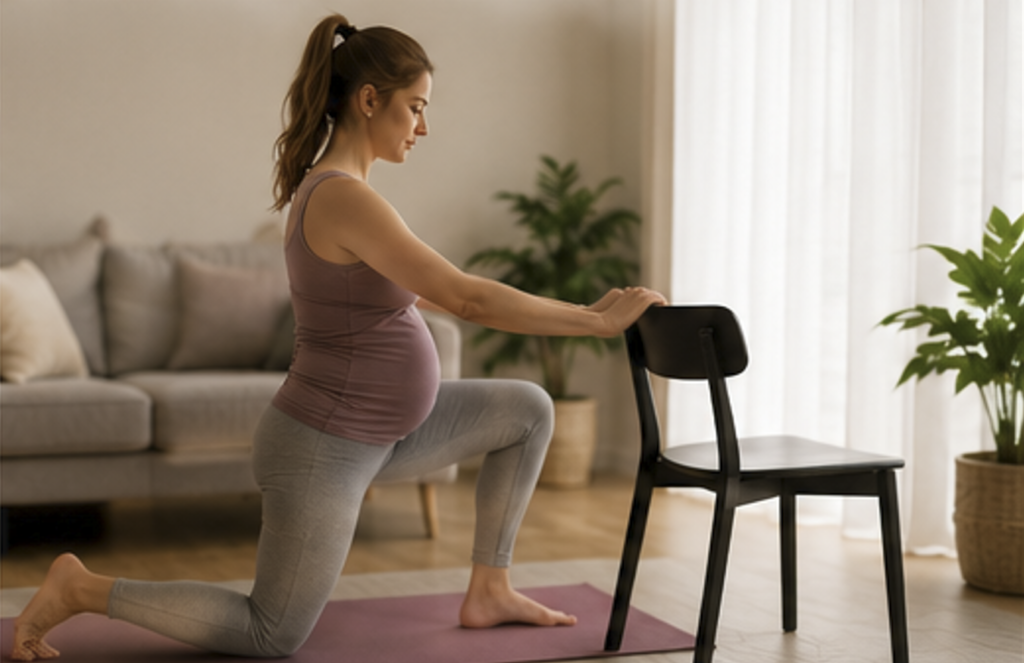
A gentle kneeling lunge helped release tight hip flexors, which had apparently become tighter than my patience.
Pregnancy shifts posture so dramatically that muscles in the front of the hips can shorten and tighten from compensation.
Stretching them helped my pelvis feel less locked up.
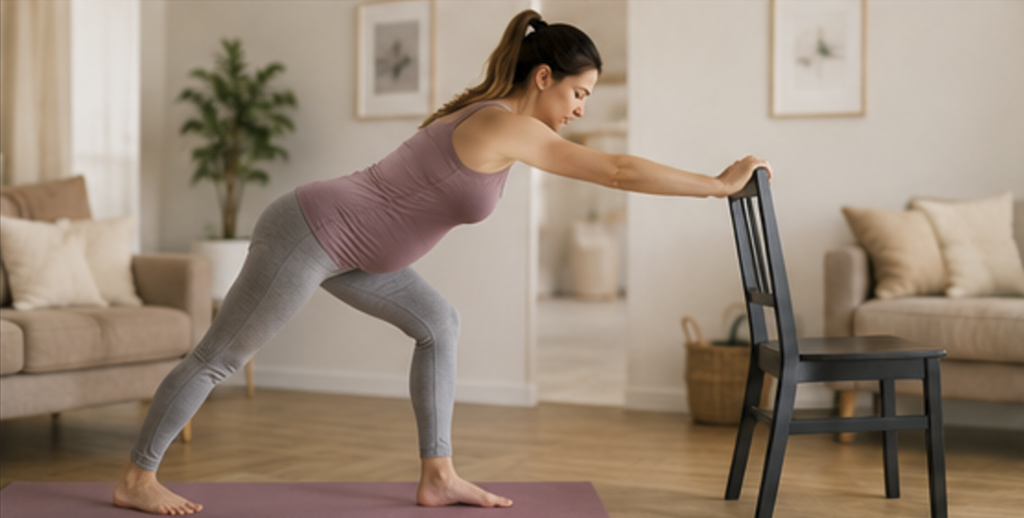
Another favorite was a supported forward stretch using a chair or countertop.
Hands placed on the surface, feet slightly wider than hips, slowly hinging back until I felt length through my spine.
It sounds simple because it is simple.
And simple was exactly what my third trimester body could tolerate.
Heat also became one of my best friends.
A warm compress on my lower back at the end of the day felt genuinely restorative.
Not too hot, just warm enough to relax tight muscles.
Sometimes relief doesn’t need to be revolutionary.
Sometimes it’s warmth, stretching, hydration, and surrendering to the fact that your body currently has very different needs.
Supportive sleep positioning mattered too.
That pillow between the knees? Essential.
It helps keep the pelvis aligned and reduces strain on hips and lower back.
A pillow under the belly can also reduce that pulling sensation some women feel while side sleeping.
Tiny adjustments can make a surprisingly big difference.
I also had to relearn posture.
Not because I was dramatically slouching, but because pregnancy posture sneaks up on you.
Your belly pulls forward, your shoulders compensate, your ribcage shifts, and before you know it, you’re standing like a question mark.
Being mindful about stacking my posture helped.
Shoulders relaxed.
Chest gently lifted.
Pelvis neutral.
Soft knees.
Nothing rigid—just awareness.
And honestly? Accepting help mattered too.
There’s a strange pressure many women put on themselves during pregnancy to continue functioning normally despite obvious physical changes.
To keep carrying groceries.
To keep cleaning.
To keep bending, lifting, reaching, organizing, nesting, doing everything.
At some point, I had to admit that my body was doing enough already.
Growing a human is not a side project.
It is full-time biological labor.
Let someone else carry the laundry basket.
Ask for help lifting things.
Sit down while folding baby clothes if you need to.
Pregnancy is not a productivity competition.
Of course, there are times when back pain deserves medical attention.
While general soreness and muscular discomfort are common, severe or sudden pain, rhythmic cramping, fever, numbness, or pain paired with other concerning symptoms should absolutely be discussed with a healthcare provider.
Trust your instincts.
There’s a difference between “pregnancy uncomfortable” and “something feels wrong.”
Over time, I stopped seeing third trimester back pain as a personal failure or something I needed to just tolerate silently.
It was information.
My body was communicating constantly.
Slow down.
Adjust.
Stretch.
Rest.
Support me differently.
That mindset shift helped emotionally as much as physically.
Because pregnancy discomfort can become mentally exhausting too.
There’s something uniquely draining about being physically uncomfortable every day while still expected to function, prepare for birth, work, organize baby items, attend appointments, answer messages, and somehow also “enjoy every moment.”
Not every moment is enjoyable.
Some moments are beautiful.
Some are deeply uncomfortable.
Both can be true.
And honestly, that felt like one of the biggest lessons of late pregnancy.
You can be grateful and uncomfortable.
Excited and exhausted.
Happy and physically over it.
By the final weeks, I learned to measure success differently.
Not by productivity.
Not by perfect routines.
But by comfort, care, and getting through the day with a little more ease.
Did I completely eliminate back pain?
No.
Third trimester is still third trimester.
Gravity remains undefeated.
But I did find ways to manage it better.
And more importantly, I stopped feeling blindsided by it.
Pregnancy back pain isn’t just “part of being pregnant” in a dismissive way.
It’s a real physical response to extraordinary body changes.
Your body is shifting bones, muscles, ligaments, posture, circulation, and organ placement while growing another human being.
Of course your back has thoughts about this.
If you’re in your third trimester right now and your lower back feels like it’s filing complaints daily, you are not alone.
Stretch gently.
Move when you can.
Rest without guilt.
Use the ridiculous number of pillows.
Ask for help.
And remember: this season is temporary, even when one night of hip pain makes it feel eternal.
Your body is doing remarkable work.
Even when it feels uncomfortable, awkward, heavy, and nothing like the polished version of pregnancy social media likes to sell.
Sometimes the most honest version of pregnancy is simply this:
One hand on your belly, one hand on your lower back, slowly standing up from the couch like you’re ninety years old.
And somehow still feeling deeply in awe of what your body is capable of.