
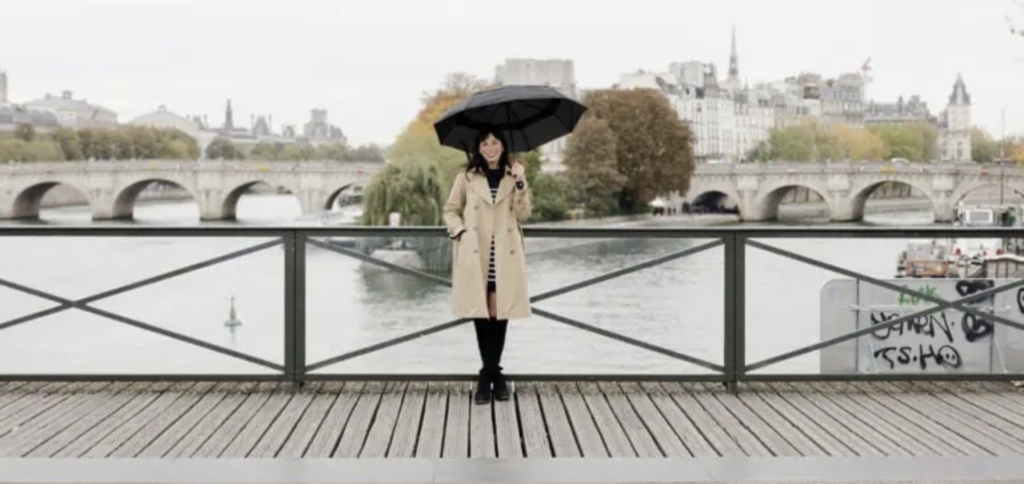
There’s a certain kind of magic that only reveals itself when the sky turns that particular shade of pewter over the Seine. Most tourists groan when the forecast says rain. But the woman who truly knows Paris? She smiles, reaches for her trench, and steps out the door anyway.
I have visited Paris more times than I can count on both hands, and I will tell you something that took me an embarrassingly long time to learn: the rainy days are often the best days.
Not because I have some poetic, contrarian personality that loves discomfort — but because rain in Paris transforms the city into something that feels lifted directly from a French New Wave film. The cobblestones glisten like brushed silver. The café windows fog up gently at the edges. Umbrellas dot the boulevards like watercolor blooms. Everyone slows down just a little, leans in a little closer, orders another café crème and doesn’t apologize for it.
There is something deeply, almost unjustly beautiful about Paris in the rain. And once you stop fighting it and start dressing for it — really dressing for it, in that quiet-luxury, effortlessly-put-together way that Parisian women have made into an art form — you realize you wouldn’t trade these grey afternoons for anything.
So. You’ve opened your weather app, seen the little rain cloud parked over the 6th arrondissement for the next three days, and felt your heart sink slightly. I’m here to fix that. This is your complete, personal, deeply lived-in guide to everything worth doing in Paris when it rains — from the covered passages to the coziest hotel bars, from the museums where you’ll genuinely lose track of time to the chocolate so thick you could stand a spoon in it.
Let’s begin.
First: The Wardrobe Conversation We Need to Have
Before we talk about where to go and what to do, we need to talk about what you’re going to wear. Because there is nothing — nothing — that will ruin a rainy Paris day faster than being underprepared, cold, and damp in shoes that were never meant to see a puddle.
The good news is that dressing for Paris rain is one of the most enjoyable styling challenges you’ll encounter. It’s the perfect context for what the fashion world has been obsessing over in 2025 and into 2026: quiet luxury meets practical elegance. The kind of dressing that looks completely unstudied but is, in fact, deeply considered.
The Trench Coat Is Not Optional
I know you know this. I know you’ve heard it before. But I will say it again, with feeling: a trench coat is the single most important piece of clothing you can pack for Paris, rain or shine. And in the rain, it becomes genuinely indispensable.
The trench coat has had one of the most remarkable quiet-luxury renaissance moments of the past few years. It moved from “classic staple” to “the piece everyone is pinning on their Paris aesthetic boards” — and for good reason. A well-cut trench in a warm camel, pale sand, or classic khaki will photograph beautifully against wet Haussmann stone, will keep the chill off your shoulders on a grey afternoon, and will make you look like you’ve been dressing like this your entire life.
Go for a mid-length or longline silhouette if you want something that feels current. The oversized, slightly boxy trench is having a major moment — draped over the shoulders with the belt loosely knotted rather than tied, worn over a chunky knit or a silk blouse. It’s the kind of piece you’ll wear in Paris and then want to wear everywhere for the rest of your life.
Waterproof Boots That Are Actually Beautiful
The Chelsea boot has been one of Paris’s signature shoe sightings for a few years now, and in the rain, it makes absolute sense: the low profile, the clean silhouette, the way it works with everything from wide-leg trousers to midi skirts. If you invest in a quality pair in genuine leather with good waterproofing, you will not regret it. Wear them with slightly cropped trousers to show off the ankle, or with thick ribbed socks peeking above the cuff for that very Parisian, very effortless look.
If you’re a heel person — and I respect that deeply — look for block-heeled ankle boots with some weather resistance. Nothing that requires picking your way through puddles on your tiptoes. Paris pavements are beautiful and absolutely ruthless to impractical footwear.
Layers, Scarves, and the Art of Looking Warm Without Looking Bundled
The Parisian approach to cold, rainy weather is not to pile on every warm thing you own. It’s to choose each layer intentionally. A lightweight cashmere turtleneck under a blazer under the trench. A silk scarf at the neck — not for warmth necessarily, but because it pulls everything together with that finishing-touch quality that separates an outfit from a look.
Scarves are, in my experience, the most underestimated accessory in most women’s wardrobes. In Paris, they are practically a love language. Knot it loosely at the collar of your trench. Drape it over one shoulder. Tie it in your hair on a slightly lighter rain day. However you wear it, it signals something — intention, care, style — that resonates in a city that considers personal aesthetic a form of self-expression.
The Umbrella Question
Please, I beg you: pack a compact, beautiful umbrella and not as an afterthought. You can find gorgeous options in muted tones — navy, burgundy, forest green, black — that will actually look good in photographs instead of clashing with everything you’re wearing. Carry it even when rain isn’t forecast, because Paris weather is famously unpredictable and you will be caught out if you don’t.
The Covered Passages: Paris’s Most Romantic Secret
If you’ve never walked the covered passages of Paris on a rainy day, you are missing one of the city’s most extraordinary experiences — and one that most tourists completely overlook in favor of queuing for the Eiffel Tower in the drizzle.
The passages couverts are 19th-century glass-roofed arcades, built during the heyday of Parisian commerce as elegant, sheltered spaces for shopping and promenading. There were once over 150 of them; today, only a handful remain, and they are absolute time-capsule treasure chests of architecture, atmosphere, and quirky independent shops.
Walking them in the rain is the stuff of Pinterest dreams. The light that filters through the old glass ceiling is soft and diffuse — the kind of natural light that makes everything look like it’s been run through the most flattering filter imaginable. The sound of rain on the glass above you, while you’re completely dry below, wandering past antiquarian booksellers and stamp collectors and tiny bistros, is one of those small perfect things.
Galerie Vivienne is the one most visitors discover first, and it earns its reputation entirely. The mosaic floors, the ornate ironwork, the neo-classical details — it is almost absurdly beautiful. Stop into Jean-Paul Gaultier’s boutique (his atelier has long called this passage home) or browse the vintage books and wine at the shop toward the far end. Allow yourself to walk slowly. This is not a place to rush.
Galerie Véro-Dodat is darker, moodier, more mysterious — painted columns, mahogany shopfronts, gas-style lanterns. It feels like stepping into a different century entirely. I always feel a slightly Gothic romance here that I find completely irresistible on a rain-grey afternoon.
Passage des Panoramas is the oldest of the surviving passages, dating to 1800, and it has a wonderful mix of stamp dealers, vintage poster shops, and excellent little restaurants. It connects to the Passage Jouffroy, which in turn connects to the Passage Verdeau — so on a seriously rainy day, you can spend a remarkable amount of time wandering from one to the next without ever getting wet.
Allow a full afternoon for the passages. Bring some cash for small purchases — a vintage postcard, a beautiful old print, a glass of wine at one of the little bars. These are the kinds of afternoons that become your favourite Paris memories.
Afternoon Tea in Paris: The Ritual You Deserve
There is something specifically, indulgently right about settling into an afternoon tea in Paris when it’s raining. The ritual of it — the tiered stand, the finger sandwiches, the petit fours, the careful choice of tea — feels like the most civilized possible response to grey weather.
Paris has elevated its afternoon tea scene considerably over the past few years, moving far beyond the classic English high tea format into something distinctly French: lighter, more architectural in the pastry department, with that particular Parisian obsession with beautiful presentation.
Angelina on the Rue de Rivoli is an institution, and I say this as someone who is naturally suspicious of places that have become institutions: it absolutely deserves its legendary status. The hot chocolate here — and we’ll get back to this point later in detail, because it warrants its own section — is the best in Paris, arguably the best in the world, and the Mont-Blanc pastry (chestnut cream, meringue, whipped cream) is the kind of thing you’ll still be thinking about three weeks after you’ve left. The room itself is beautiful in that gilded, Belle Époque way that feels like eating inside a jewel box. Go on a weekday if you can to avoid the longest queues, or book ahead.
Ladurée needs little introduction — its macaron towers have been dominating Pinterest boards and travel feeds for years, and the tea salons (particularly the original on the Rue Royale) are genuinely lovely spaces. The afternoon tea sets are beautifully assembled, and sitting at one of the small marble tables with the rain against the windows outside is an experience that is worth every centime.
For something slightly more contemporary and fashion-forward — the kind of space that would do well on a modern woman’s social media, that has that quiet-luxury, editorial aesthetic — seek out the tea service at some of Paris’s grand hotel lobbies. The Hôtel de Crillon and Le Bristol both offer exceptional afternoon tea experiences that feel like private, inner-sanctum Paris: not touristy, deeply elegant, the sort of thing that makes you feel like you live here rather than visit.
Dress for these. It matters. Not in a pretentious way, but in the way that dressing beautifully for a beautiful space is a form of respect and also, frankly, makes the whole experience feel more like the fantasy it should be. Your trench coat, a good cashmere knit, your Chelsea boots. You’ll feel perfectly placed.
The Paris Museums You Could Happily Get Lost In
A rainy day is, of course, the classic invitation to spend time in a museum. But I want to be specific here, because “go to a museum” is unhelpfully vague advice in a city that contains some of the greatest cultural institutions in the world. The question is not whether to go to a museum — it’s which one, and how to approach it so that you actually come away moved rather than mildly exhausted and hungry.
The Musée d’Orsay is, in my opinion, the perfect rainy-day museum in Paris. The building alone — a converted 19th-century railway station, all glass and iron and extraordinary light — is worth the entry price. The Impressionist and Post-Impressionist collection housed inside is among the most beautiful in the world. You will find Monet, Renoir, Degas, Cézanne, Van Gogh, Klimt. You will find yourself standing in front of canvases that you’ve seen reproduced a thousand times and understanding, finally, why they matter.
The light in the Orsay on a rainy day is something photographers dream about. The grey sky filtering through that great glass ceiling creates the kind of even, soft luminosity that the Impressionists themselves would have recognized. There is something almost cosmically right about looking at paintings of rain and mist and winter light inside a building filled with rain-light. Go slowly. Sit down sometimes. Let the paintings breathe.
The Musée de l’Orangerie is smaller and more focused — it houses Monet’s famous Water Lilies murals in two oval rooms specifically designed for the purpose, plus an excellent collection of works by Cézanne, Matisse, Picasso, and others. The Water Lilies rooms are, without exaggeration, one of the most immersive artistic experiences available to the human being. The paintings surround you completely. On a quiet morning, with the soft light coming through the overhead windows, you can stand in the centre of the room and feel genuinely transported.
Book tickets for both of these in advance, particularly for the Orsay. Paris’s major museums fill up quickly, and the last thing you want is to arrive in the rain and discover a two-hour queue.
The Palais Galliera — Paris’s dedicated fashion museum — is, for obvious reasons, of particular interest to us here. It’s housed in a beautiful 19th-century mansion in the 16th arrondissement and hosts rotating exhibitions dedicated to fashion history, costume, and contemporary design. If you have any love for clothing as cultural artifact, as art form, as record of the way women have moved through history, this museum will stop you in your tracks. Check what exhibition is running before your trip; it changes regularly, and some are genuinely unmissable.
The Musée Jacquemart-André is one of Paris’s most exquisite smaller museums — a private 19th-century mansion turned public, with a collection of Flemish masters, Italian Renaissance works, and decorative arts assembled by a remarkably cultivated married couple in the latter half of the 1800s. It’s the kind of place that feels like you’ve been invited into someone’s extraordinarily beautiful home. There’s also a tea room in the former dining room — frescoed ceiling, marble floors, afternoon light — that is one of the most beautiful café spaces in Paris. Have the cake. Stay a while.
Hot Chocolate in Paris: A Serious Matter
I am not going to downplay this. Hot chocolate in Paris is not a casual affair. It is not what you get from a packet. It is thick, dark, intensely flavored, often barely sweet, sometimes barely pourable — it is liquid chocolate, essentially, and it will ruin you for every other version you encounter for the rest of your life.
Angelina is the beginning and end of many people’s Paris hot chocolate journey, and honestly, I understand why. The chocolat chaud at Angelina is legendary for a reason: it’s made with a blend of African cocoas, it’s rich to the point of almost being indulgent to contemplate, and it arrives with a little pot of whipped cream on the side that you can add (or not) as the spirit moves you. Sit in the gilded dining room and take your time.
Café de Flore and Les Deux Magots on the Boulevard Saint-Germain — the famous literary cafés where Sartre and de Beauvoir once held court — both serve perfectly good hot chocolate in an atmosphere that is irreplaceable. The Deux Magots in particular has a wonderful old-world gravity that makes a rainy afternoon sitting in the red banquettes with a chocolat chaud feel like something you’ve read about in a novel. It’s slightly touristy? Yes. Is the chocolate still good and the atmosphere still extraordinary? Also yes.
For something more contemporary, several of Paris’s artisan chocolate makers — Jacques Genin, Patrick Roger, La Maison du Chocolat — offer hot chocolate services in their boutiques that are of exceptional quality. These tend to be slightly less sweet, more intensely cocoa-forward, the kind of thing that chocolate people describe with the same vocabulary as wine: notes of this, finish of that. I find it slightly amusing and also completely relatable, because good chocolate does have a whole world of flavor inside it.
Order your hot chocolate. Wrap your hands around the cup. Watch the rain. This is the correct way to spend a Paris afternoon.
Cinema in Paris: The Most French Thing You Can Do
Paris has an extraordinary relationship with cinema — it is, after all, the city where the medium was effectively born, where the Cinémathèque Française has been preserving and celebrating film for decades, where independent and arthouse cinema never went out of fashion because it was never really in fashion so much as simply part of the culture.
Going to a film in Paris on a rainy afternoon feels entirely natural, like something you should do, like the city expects it of you. And the cinemas themselves are often worth visiting for their interiors alone.
Le Grand Rex on the Boulevard Poissonnière is an Art Deco masterpiece — the largest cinema in Europe at its time of construction, with an extraordinary interior that mimics an outdoor Andalusian village under a painted night sky. Even if you don’t catch a film, it runs tours of the building. But catching a film here — ideally something properly cinematic, something that deserves a big screen — is an experience you won’t forget.
La Pagode in the 7th arrondissement is a Japanese pagoda that was converted into a cinema in the early 20th century and has been restored in recent years. The original tea room is gorgeous. The cinema screens arthouse and international films, and seeing something here has an unmistakable atmosphere of occasion.
French cinema is playing everywhere, and even if your French is limited, there is something immensely romantic about watching a French film in a Paris cinema in the rain. The language washes over you. The light changes. You eat your overpriced popcorn and feel, not for the first time and not for the last, slightly like you live inside a film yourself.
The Covered Terrace: Rain-Watching as a Form of Meditation
Paris cafés have elevated the art of the covered terrace — the terrasse couverte — to a genuine science. You’ll find them throughout the city: outdoor seating areas with retractable awnings or heated glass enclosures that allow you to be simultaneously inside and outside, protected from the rain but still part of the street, the noise, the passing umbrellas.
This is, in my opinion, one of the great pleasures available to the human being: sitting on a Parisian covered terrace, rain falling just beyond your feet, a glass of Burgundy or a cup of something hot in your hands, watching the world go by in its wet grey glory.
There is a quality of observation that these spaces invite that you can’t quite replicate anywhere else. You see the woman walking quickly in her camel coat, her scarf pulled up against the wind. You see the couple arguing and then laughing. You see the old man walking his dog without an umbrella, utterly indifferent to the rain. You see Paris being Paris, which is one of the most entertaining things you can do with an afternoon.
Café de la Paix near the Opéra Garnier has a magnificent terrace and an interior that is genuinely, spectacularly beautiful — all gilded Second Empire grandeur. Slightly grand prix in terms of pricing, but for one glass of champagne on a rainy afternoon, it’s worth it for the photographs alone and also for the simple fact of having done it.
Seek out the smaller neighbourhood cafés too, in whichever arrondissement you’re based. The covered terrace at a small local café — nothing famous, just the one around the corner — with a vin chaud or a kir, watching the locals hurry past, is equally wonderful and a fraction of the price. These are the authentic moments that don’t make it into travel magazines but live in your memory forever.
Wine Tasting in Paris: A Rainy Afternoon Education
Paris has a growing and genuinely exciting wine bar scene that is particularly well-suited to rainy day exploration. The natural wine movement, which has its spiritual home in Paris’s caves à vin and bistrots à vins, has made wine drinking in the city an adventurous, constantly evolving experience.
O Chateau in the 1st arrondissement is Paris’s most famous English-language wine school and wine bar, offering tastings from introductory to deeply specialist across a range of formats. Their tasting sessions are genuinely educational and also, importantly, extremely enjoyable — you learn what you’re drinking, why you’re drinking it, what makes it distinct, and you drink well while doing so. For a rainy afternoon, few activities are more warmly recommended.
The wine bar scene itself — particularly in the 11th arrondissement and around the Canal Saint-Martin — offers a kind of drop-in tasting education just by ordering thoughtfully and asking questions. Parisian sommeliers and cave operators tend to be passionate about their subject and delighted to share that passion. Order a glass of something you’ve never tried, ask about it, and see where the conversation goes.
Pair this with a charcuterie board, some good cheese, bread. Look out at the rain from inside a warm, dimly lit wine bar lined with bottles. This is, I would argue, one of the finest possible ways to spend a wet Paris afternoon, and it has the additional benefit of being something you can do repeatedly and differently every single time.
A Cooking Class in Paris: Learning the Language of French Food
Taking a cooking class in Paris feels like cheating at life in the best possible way — you spend a few hours in a beautiful kitchen, a proper Parisian chef teaches you something you’ll carry forever, you eat everything you make, and you leave feeling not just satisfied but genuinely accomplished.
La Cuisine Paris, situated near the Hôtel de Ville, is one of the most highly regarded cooking schools for visitors, offering classes across a wide range of French cooking styles and disciplines — croissants and pastries, classic French sauces, market-to-table cooking, macarons. The market classes are particularly wonderful: you go first to the market with the chef, learn to shop the French way (touching, smelling, asking), and then return to cook what you’ve chosen. Rain adds a quality of adventure to the market portion that is actually rather fun.
For the macaron class in particular: yes, everyone does it, and there’s a reason. Making macarons — properly, with the right technique, understanding why each step matters — is a kind of culinary meditation that also produces something beautiful. You’ll bring home shells and buttercream packed in a little box and feel absurdly pleased with yourself on the flight home.
Baking and pastry classes feel especially right on a rainy day — something about the warmth of the kitchen, the smell of butter and sugar, the concentration required, the reward at the end. It’s cozy in the most satisfying, productive sense of the word.
Shopping in Paris on a Rainy Day: Where to Go and What to Look For
There is a specific kind of shopping that belongs to rainy Paris days: unhurried, exploratory, more about the experience of being in beautiful spaces than about crossing items off a list.
The covered passages we discussed earlier offer some of this — the vintage bookshops, the old print dealers, the antiquities. But there is also the matter of Paris’s extraordinary department stores.
Le Bon Marché on the Rive Gauche is the most beautiful department store in Paris and one of the most beautiful in the world. It feels less like a department store and more like a very well-curated, very elegant cultural institution that happens to sell things. The beauty hall is extraordinary. The clothing department has a genuine editorial point of view that you won’t find replicated elsewhere. The Grande Épicerie next door — the food hall — is a destination in itself, one of those places where you find yourself standing in front of shelves of beautiful preserves and specialty products for far longer than is strictly rational.
On a rainy day, Le Bon Marché has a wonderful atmosphere: warm, busy but not chaotic, full of Parisians actually doing their shopping rather than tourists photographing the ceiling (though the ceiling is photograph-worthy). Allow two hours minimum and follow your instincts.
Merci on the Boulevard Beaumarchais is a concept store that manages to be genuinely good despite the concept-store trappings — carefully chosen homewares, fashion, books, accessories, beautiful objects, all in a former wallpaper factory with exposed brick and wooden floors. There’s a café downstairs with a used bookshop attached, and spending an hour here on a rainy afternoon browsing the shelves and drinking a coffee is one of those small pleasures that costs almost nothing and gives a great deal.
The Marais in general is excellent for rainy-day shopping: it’s dense with small boutiques, galleries, vintage shops, bookstores, and café breaks, and its covered passages and connected streets mean you can move from space to space without too much outdoor exposure.
The Hotel Bar: Paris’s Most Underrated Afternoon Destination
I want to make a case — a serious, considered, passionate case — for the Paris hotel bar as an afternoon destination in its own right, not just a place to wait before dinner.
The great Parisian palace hotels maintain bars of extraordinary quality: in their atmosphere, in their cocktail programs, in the caliber of the people you find yourself sitting next to. A rainy afternoon at one of these bars is a kind of luxury that is, frankly, more accessible than you might think — a single well-made cocktail is not significantly more expensive than two mediocre ones at a tourist café, and the experience is not comparable.
Bar Hemingway at the Ritz is obligatory, not because it’s trendy but because it is genuinely one of the finest bars in the world and happens to be in Paris. The walls are covered with Hemingway memorabilia, the bartenders are performers and craftsmen, and the martinis are — the martinis are. Just go.
Le Bar du Bristol at the Hôtel Le Bristol in the 8th has a warm, library-like quality that makes it feel like a private club you’ve been admitted to by accident. The service is impeccable without being stiff. The cocktails are excellent. The people-watching — a quiet, refined kind of people-watching, not gawping but observing — is its own entertainment.
The Bar at the Crillon was reimagined during the hotel’s renovation a few years ago and is now a study in architectural drama: high ceilings, incredible light, a sense of theatrical occasion that stops you when you walk in. Order the house signature cocktail. Sit by the window if you can and watch the rain on the Place de la Concorde.
Dress for these too. A blazer, your best earrings, something with intention. It changes the quality of the experience.
The Best Cafés in Paris to Wait Out the Rain
And finally, because the café is ultimately the heart of Paris and the most natural shelter from rain, a few specific recommendations beyond the grande dames already mentioned.
Café Procope in the 6th — the oldest café in Paris, dating to 1686 — is not exactly a place to hide from rain on a budget (it’s now a restaurant), but walking past its lantern-lit façade on a wet evening and feeling the weight of three-plus centuries of Paris literary and philosophical history is a free and worthwhile experience.
Café de la Mairie on the Place Saint-Sulpice is a perfect neighbourhood café — good coffee, simple food, a terrace that catches the light when the sun is there and is sheltered when it isn’t, a clientele of local regulars and occasional writers who come for the view of the church square and stay for the atmosphere.
Ten Belles near the Canal Saint-Martin is one of Paris’s pioneering specialty coffee spots, and the small, warm space is exactly what you want on a grey morning: a genuinely excellent coffee, good music, people who are focused on their laptops or their conversations, the rain on the canal windows.
For something deeply Parisian in the old-fashioned sense: find yourself a brasserie — a proper one, all dark wood and leather banquettes and zinc bar and excellent French onion soup — and simply stay there. Order the soup. Then order a carafe of wine. Then maybe a dessert. Watch the afternoon pass. There is no more honest Paris rainy day pleasure than this.
The Philosophical Bit: Why the Rain Is the Point
I know this reads like the kind of thing someone says who has never actually been caught in a torrential Paris downpour in shoes that turned out to be wildly non-waterproof. I have been that person. I have stood in a doorway on the Rue de Rivoli wringing out my hair while a kindly French woman next to me looked simultaneously sympathetic and baffled that I had no umbrella.
But even that was, in retrospect, a good Paris story. And the best Paris stories almost always involve some small disaster, some beautiful inconvenience, some moment where the plan fell apart and something better happened instead.
Rain is Paris’s great equalizer. It slows everyone down. It pushes you into spaces — a bookshop, a café, a covered passage — you might not have entered on a bright blue day. It creates the conditions for the kind of unhurried, accidental, genuinely memorable afternoon that you can’t engineer with a perfect itinerary.
The Parisian woman doesn’t rage against the rain. She puts on her trench, pulls her scarf a little higher, and steps out with the quiet confidence of someone who knows that the city is beautiful in every weather and that she will find something worth her time no matter what the sky decides.
That’s the energy. That’s what we’re going for. Pack your umbrella, your Chelsea boots, your most beautiful cashmere knit. Step out into the grey and the glisten. Let Paris do what Paris does.
You’ll be glad you did.
Quick Reference: Your Paris Rainy Day Checklist
To Pack: Compact umbrella in a beautiful colour — Trench coat (longline or oversized silhouette) — Waterproof Chelsea or ankle boots — Chunky knit or cashmere turtleneck — Silk scarf — A tote bag that can handle damp — Your most beautiful earrings (always)
Activities by Mood: Contemplative: Musée d’Orsay, Musée de l’Orangerie, a solo afternoon at a café with a notebook Indulgent: Afternoon tea at Angelina or Ladurée, hot chocolate, a hotel bar at dusk Educational: Cooking class, wine tasting at O Chateau, Palais Galliera fashion exhibition Exploratory: Covered passages, Marais boutique-hopping, Merci concept store Cinematic: Le Grand Rex, La Pagode, any arthouse cinema in Saint-Germain
Booking in Advance: Musée d’Orsay — Musée de l’Orangerie — Cooking classes — Afternoon tea at the palace hotels — Bar Hemingway at the Ritz (walk-ins are often possible but a reservation secures your spot)