
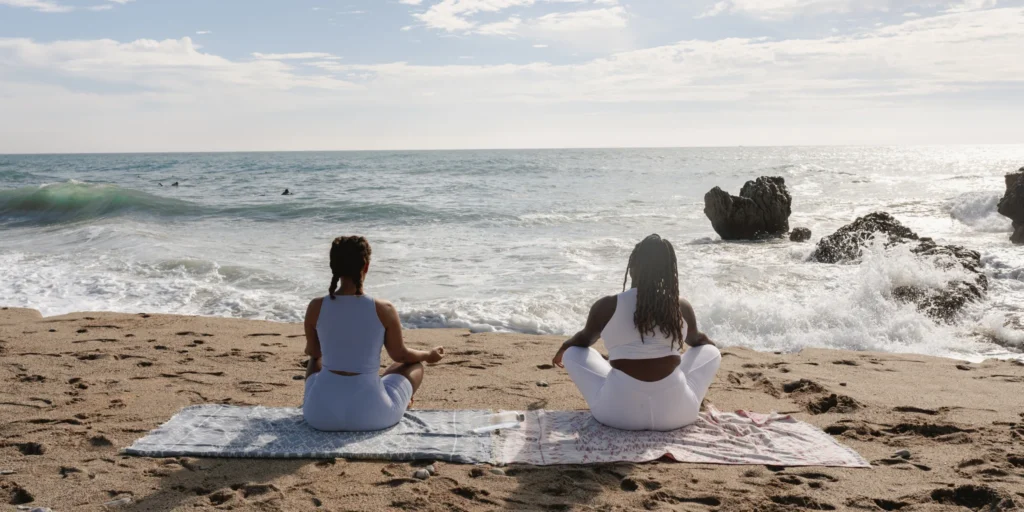
For the woman who wants to move beautifully, eat intentionally, and feel like the best version of herself — all without leaving the life she loves.
There is a version of summer wellness that has always made me slightly exhausted just reading about it. You know the one. It involves a five a.m. alarm, a punishing HIIT session before the rest of the world has had coffee, a green juice with seventeen ingredients including things you can only find in specialty stores, and some elaborate meal-prep situation that requires three hours on Sunday and a kitchen the size of a small restaurant. It is wellness as performance. Wellness as suffering. Wellness as a full-time job you didn’t apply for.
That version is not what this is.
What I want to offer instead is something that has taken me a few summers to build and refine — a genuine, liveable, beautiful approach to wellness in the warm months that supports the active, feminine, intentional life I actually want to live. One that integrates healthy cooking and purposeful movement without commandeering your entire existence. One that feels good in the doing, not just in the theoretical achievement. One where the meals are genuinely beautiful to look at and genuinely delicious to eat, and the workouts happen in your own space at your own pace and leave you feeling capable and energised rather than wrecked.
Summer is the best possible season to build this kind of wellness practice, and I don’t think that’s an accident. The light is generous. The produce is extraordinary. The warmth itself is a kind of invitation to be more physical, more alive in your body, more present in the sensory world. When everything outside is golden and ripe and full of energy, it’s almost impossible not to feel pulled toward a version of your own life that matches it.
This is the summer wellness plan I wish someone had handed me. It is comprehensive without being overwhelming, and beautiful without being impractical. Let’s build it together.
The Philosophy: Wellness as a Way of Living, Not a Thing You Do
Before any meal plan or workout schedule, I want to spend some time on the underlying philosophy, because I’ve found that the approach you bring to wellness matters more than the specific protocol you follow. The same exercise and the same food can produce wildly different relationships with your body depending on why you’re doing them and what story you’re telling yourself about it all.
The philosophy that has worked best for me is one I’d describe as wellness as a dimension of living rather than wellness as a project. A project has a start date and an end date and a goal that is reached or missed. A dimension of living is just part of how you move through the world, adjusting and evolving naturally, requiring no dramatic beginning and no frightening maintenance phase.
This matters practically because it changes what consistency looks like. When wellness is a project, missing a workout or eating something that wasn’t in the plan is a failure that threatens the whole structure. When wellness is a dimension of living, those things are just Tuesday — notable perhaps, but not catastrophic, because the overall rhythm absorbs them and continues.
The clean girl aesthetic that has genuinely shaped how many women think about their lives in 2026 is, at its best expression, a visual and philosophical representation of this approach. It is not about perfection. It is about attention — about choosing things that are real and good and considered, and arranging your life with the same care you’d bring to a beautiful room. The dewy skin, the matching set, the matcha, the quality produce — these are expressions of a sensibility, not a checklist. And the sensibility is: I take care of myself because I’m worth taking care of.
Quiet luxury, which has evolved from a fashion trend into something closer to a life philosophy for a significant number of women, adds another dimension to this. It is the understanding that the most genuinely good things are often not the loudest or most performative. The meal that is made from excellent ingredients and prepared with care is more nourishing than the elaborate Instagram-worthy recipe that required three hours and left the kitchen in chaos. The workout that fits naturally into your morning and leaves you feeling good is more valuable than the one that impresses followers but that you can only sustain for two weeks.
These are the values that underpin what follows. Not optimization. Not extremism. Just genuine, considered, pleasurable wellness — in the kitchen and in your body, throughout the beautiful months of summer.
Part One: The Summer Kitchen — Eating for Energy, Beauty, and Pleasure
Why Summer Eating Is Different — and How to Work With It
Summer fundamentally changes how most women want to eat, and I think this is worth acknowledging explicitly rather than ignoring in favour of a year-round meal plan that pretends the seasons don’t exist. When temperatures rise, the desire for heavy, rich, cooked meals diminishes. The body itself seems to prefer lighter, cooler, more hydrating food — which is not a deprivation but a gift, because the produce available in summer is extraordinary enough that eating lightly and seasonally is also eating at its most delicious.
The nutritional needs of an active woman in summer are also specific. Heat increases fluid and electrolyte requirements. Increased physical activity — more walking, more outdoor time, more movement of all kinds — raises protein requirements for muscle maintenance and recovery. The combination of heat and activity means that digestion works differently: large, heavy meals can feel genuinely uncomfortable in a way they don’t in cooler months, which is your body telling you something useful about what it needs.
The framework I’ve built for summer eating starts from these realities and works with them rather than against them. It prioritises hydrating foods, quality protein in forms that are light and digestible, the extraordinary produce of the season, and meals that are beautiful enough to feel like a genuine pleasure rather than a nutritional obligation.
The Morning Ritual: Starting the Day With Intention
Mornings in summer have a particular quality — the light comes early and golden, the air is fresh before the heat arrives, and there is a brief window of the day that belongs entirely to you before it opens out into everything else. Building a morning ritual that honours this window is one of the most impactful things you can do for your overall summer wellness.
The morning meal, for an active woman, has two jobs: to replenish the overnight fast and to fuel whatever movement is planned for the morning hours. The specific form this takes depends on your schedule and your appetite, but the principle holds across all variations — you need protein, you need hydration, and you need something that feels genuinely good to eat rather than something you force down for nutritional compliance.
The overnight oat bowl has become a staple of the clean girl morning aesthetic for good reason — when made properly, it is genuinely excellent. The version I’ve refined over the past couple of summers is built on a ratio of one part oats to one part liquid (a combination of full-fat coconut milk and Greek yogurt), a tablespoon of chia seeds, a small amount of honey, and whatever seasonal fruit is at peak ripeness. In summer, that means mango, peach, cherry, raspberry, or fig depending on the month. The toppings — added in the morning, never the night before — are where the bowl becomes beautiful: a scattering of pistachios for green colour and good fat, a small amount of granola for crunch, a thin drizzle of honey over everything.
The visual quality of this bowl is not incidental. It is genuinely part of the morning ritual — the act of assembling something beautiful before you eat it is a small act of care that sets the tone for how you treat yourself through the rest of the day. I noticed this pattern in myself some time ago and have since become entirely unapologetic about it: eating beautiful food slowly and with attention in the morning is the best possible start.
For mornings when appetite is lower or time is tighter, a well-constructed smoothie does the same work. The composition matters enormously — the smoothie that sustains you through a morning workout and keeps you satisfied until lunch is not the same as the smoothie that spikes your blood sugar and leaves you ravenous by ten. The key is the macro balance: a generous amount of protein (Greek yogurt or quality protein powder), a source of slow-release fat (half an avocado, a tablespoon of almond butter, or coconut cream), and moderate fruit for sweetness and flavour. My current summer favourite is frozen mango with spinach that vanishes into the yellow, Greek yogurt, a scoop of vanilla protein powder, coconut water, ginger, and lime. It tastes like tropical sunshine and keeps me going for hours.
The Art of the Assembled Lunch
The assembled lunch — food that is put together rather than cooked, built from components that are already prepared or require minimal intervention — is summer’s most elegant meal solution and one of the most undervalued approaches in the wellness cooking conversation.
The assembled lunch respects both your time and the quality of your ingredients. In summer, when a perfect tomato or a ripe peach needs nothing done to it to be extraordinary, the minimal approach is also the most delicious. A beautiful plate of heirloom tomatoes with good olive oil, flaky sea salt, torn basil, and a piece of burrata is genuinely one of the best things you can eat in August, and it takes less time to assemble than it took me to write this sentence.
The grain bowl is the assembled lunch in its most structured form, and it has earned its central place in the wellness eating landscape because it works — nutritionally, aesthetically, and practically. The components are: a cooked grain base (farro, quinoa, or brown rice prepared in a batch earlier in the week and stored in the refrigerator), a generous portion of vegetables (raw, roasted, or both), quality protein, and a dressing that ties everything together. When these components are ready and available, the actual assembly takes five minutes.
The dressing is the element most worth investing thought in, because it is the single ingredient that determines whether a grain bowl tastes like something or tastes like health food in the neutral, slightly sad sense. A dressing with good fat, acid, and flavour transforms adequate ingredients into something genuinely delicious. My most-used summer dressing is a combination of tahini, lemon juice, minced garlic, honey, good olive oil, and enough cold water to make it pourable. It works on everything — bowls, salads, roasted vegetables, grilled protein — and takes three minutes to make in a jar.
The protein in a summer assembled lunch is worth choosing with some care for both nutritional and aesthetic reasons. Grilled chicken thighs (marinated in lemon, garlic, and herbs before cooking) are reliable and beautiful over a grain bowl. Seared salmon provides omega-3 fatty acids whose skin benefits are genuinely visible over a summer of consistent consumption. A soft-boiled or poached egg adds both richness and protein in the most photogenic possible form — the yolk breaks and becomes a sauce. High-quality canned tuna in olive oil is the fastest protein and, when the tuna is actually good, entirely delicious. Chickpeas roasted with olive oil, cumin, and smoked paprika until crispy are the plant-based option that satisfies in a way that boiled chickpeas never do.
Dinner: The Summer Evening Ritual
Summer dinners hold a particular emotional weight that other seasons don’t quite replicate. There is something about eating in the long light of a summer evening — windows open, the day beginning to cool, the quality of time feeling slower and more generous — that makes dinner in summer feel like an occasion even when it is an ordinary Tuesday.
For an active lifestyle, dinner serves the recovery function — it is when the body replenishes what the day’s movement has used, when protein supports overnight muscle repair, and when carbohydrates and fats together provide the sustained fuel for the next day’s activities. This is the meal where I am least interested in restriction and most interested in satisfaction, because a genuinely satisfying dinner prevents the evening snacking that disrupts both nutritional intentions and sleep quality.
The sheet-pan dinner is the summer weeknight workhorse that deserves more credit than it gets in the elevated wellness cooking conversation. A sheet pan loaded with quality protein — a side of salmon, bone-in chicken thighs, large prawns, or lamb chops — surrounded by summer’s best vegetables (cherry tomatoes, zucchini, asparagus, red onion, corn cut from the cob) and dressed generously with olive oil, salt, fresh herbs, and whatever aromatics smell best — this is a complete, beautiful, nutritionally excellent dinner that takes fifteen minutes of preparation and about the same of actual time in the kitchen. The oven does the rest.
What elevates the sheet-pan dinner from weeknight convenience to genuine summer ritual is the attention to quality. The olive oil should be the kind that tastes like olives. The salt should be flaky and applied generously. The fresh herbs should be used lavishly — not as garnish but as a genuine flavouring ingredient. The lemon squeezed over everything at the end of cooking should be real and fresh. These are small things. Their cumulative effect on flavour is enormous.
The pasta dinner that belongs in summer is a different animal from the year-round version — lighter, fresher, built on the extraordinary tomatoes of August rather than the cooked-down, long-simmered sauces of winter. A fast tomato sauce made from halved cherry tomatoes cooked in good olive oil with garlic and a pinch of red chilli for fifteen minutes, tossed with al dente rigatoni and a great deal of fresh basil and good parmesan, is one of the most perfect summer dinners. It is fast, it tastes of genuine summer, and it provides exactly the kind of carbohydrate and protein combination that an active body needs at the end of an active day.
The Snacking Principle
Snacking for an active woman in summer is less about restraint and more about intentionality — about the difference between eating something because it is available and eating something because your body needs fuel and you have chosen well. The active lifestyle creates legitimate mid-day hunger that should be met with something genuinely nourishing rather than the nearest convenient option.
The post-workout snack window — the thirty to sixty minutes after exercise when muscle protein synthesis is elevated — is the one snacking moment that is genuinely functional rather than merely pleasurable. This window calls for protein and carbohydrate together: Greek yogurt with honey and fruit, a piece of good bread with almond butter and banana, cottage cheese with berries, a small smoothie built on protein powder. These are not complicated. They are simply intentional.
The afternoon snack, which exists because there are several hours between a reasonable lunch and a reasonable summer dinner, works best when it provides something the body actually needs rather than simply occupying the mouth. A beautiful grazing plate — hummus with summer crudités, a small amount of good cheese with some fruit, a handful of quality nuts alongside something sweet — satisfies in a way that individual packaged snacks almost never do, because the combination of protein, fat, and fibre creates genuine satiety rather than the brief satisfaction followed by continued hunger.
Hydration as a Wellness Practice
Water is so fundamental to everything else in this plan — to energy, to skin quality, to physical performance, to digestion — that it deserves explicit attention rather than a brief mention. An active woman in summer heat needs considerably more fluid than she might naturally consume if relying on thirst as her signal, and the effects of even mild chronic dehydration are measurable: lower energy, reduced physical capacity, poorer cognitive function, and visible skin dullness.
The hydration practice I’ve built around is consistent, sensory, and pleasurable — which is what makes it sustainable. A beautiful glass or water bottle, always visible, always refilled before it reaches empty. A morning glass of room temperature water with lemon before any coffee. A habit of noticing the colour of urine, which is the most reliable practical indicator of hydration status. And the small luxury of infused water — sliced cucumber with mint, or peach with thyme, or watermelon with basil — that makes drinking enough feel like something you want to do rather than something you’re supposed to do.
Electrolyte replacement is genuinely important for women who exercise in summer heat — not the sugar-heavy sports drinks of the commercial market, but the simpler and more effective approach of adding a pinch of quality sea salt to water, drinking coconut water after significant exercise, and prioritising potassium-rich foods (avocado, banana, cooked sweet potato) in the daily eating pattern.
Part Two: The Summer Home Workout Plan — Moving With Intention and Grace
The Case for Home Workouts in Summer — Again, Because It Bears Repeating
I have already made this argument in other contexts and I find I want to make it again here, because the summer specifically is a time when the home workout advantage is most pronounced. Outdoor temperature affects gym experience in ways that are rarely acknowledged — the commute in summer heat, the gym itself, the commute home. Summer scheduling is more variable and more social than other seasons, which means the fixed external schedule of a gym class is more frequently disrupted. And the particular quality of summer mornings — that golden early light, the cool before the heat — is something you can experience from your own home in a way you cannot from a car on the way to a fitness centre.
The home workout, in summer, is not a compromise. It is the aesthetic choice. It fits the clean girl morning ritual — the mat rolled out in the light, the speaker playing something ambient, the post-workout skincare and the slow cup of something warm — in a way that a fluorescent-lit gym simply does not.
The elegant streetwear aesthetic that frames this community’s relationship with fitness reinforces this. The matching set in clay-toned ribbed cotton, the grip socks, the silk scrunchie, the water bottle that matches the colour palette of the room — these are details that belong in a home setting, in a space that is yours, where no one is watching and the movement is entirely for you.
Building Your Summer Workout Framework
The summer workout plan is built around a six-day-a-week framework with one complete rest day, structured to provide variety, progression, and enough recovery to sustain the practice across the full season without burnout or injury.
Before the framework itself, the foundational principle: the consistency of the practice matters more than the intensity of any single session. Three months of four moderate workouts per week produces results that six weeks of daily extreme sessions does not, because the adaptation to exercise is a cumulative process and the recovery is part of the mechanism. You are not optimising a single workout. You are building a body and a habit over a full summer.
The framework distributes different types of movement across the week to prevent overuse, maintain engagement, and train different physical systems in ways that collectively produce the kind of body most active women are working toward — strong, mobile, energetic, and comfortable in its own movement.
Monday begins the week with strength — a thirty to forty-five minute session focused on the fundamental movement patterns (squat, hinge, push, pull, core bracing) using bodyweight progressions and resistance bands. The Monday session sets the physical and psychological tone for the week, and beginning with something that makes you feel strong and capable is intentional.
Tuesday is a walk day — an intentional, technology-free walk of at least forty-five minutes. Not a consolation-prize rest day, but a genuine active recovery session that supports cardiovascular health, regulates cortisol, and provides the kind of unhurried outdoor time that summer is specifically good for. The walk is part of the plan. It counts.
Wednesday is Pilates — a twenty to forty-five minute session depending on energy and schedule. Pilates occupies a specific and important place in the summer wellness plan because it works differently from strength training: it builds the deep core stability that supports posture and spinal health, lengthens and tones in the specific way that summer clothing makes visible, and has a meditative quality that midweek particularly benefits from.
Thursday returns to strength — a second session, which might be heavier or more focused than Monday’s depending on how the week has gone. This is also the day where, if energy permits, something slightly more cardiovascular is incorporated — some jump rope intervals, a dance cardio sequence, a set of stair climbs. The variation prevents the routine from becoming mechanical.
Friday is yoga — slow, intentional, mobility-focused yoga that serves both the physical function of maintaining flexibility and joint health and the emotional function of ending the working week with something that is entirely about being present in your body. A forty-five minute yoga flow on a Friday afternoon or evening is one of the most effective transitions from week to weekend available.
Saturday is your long day — the session where you have more time and can go deeper. This might be a longer yoga practice, a significant outdoor walk or hike, a swim, or a more extended strength session with the kind of careful attention to form and progression that a longer session allows. Saturday movement in summer is also where the beautiful, sensory quality of the practice is most available — time to notice the light, to appreciate the physical capability you’re building, to move without any urgency.
Sunday is complete rest, or gentle stretching and foam rolling — restorative rather than active, designed to support the recovery that makes the following week’s training effective.
The Strength Session: What It Actually Looks Like
I want to walk through a complete summer strength session in some detail, because abstract descriptions of workout frameworks are considerably less useful than concrete examples of what to actually do.
The session begins with a five-minute warm-up: slow bodyweight squats to open the hips, cat-cow movements to mobilise the spine, arm circles and shoulder rolls, leg swings, and a few hip 90/90 stretches that address the tightness most women carry in the hip flexors from prolonged sitting. This is not optional — it is the mechanism that prevents injury and prepares the neuromuscular system for the work that follows.
The main session, which runs between twenty and thirty-five minutes depending on how many sets you complete, is built around a push-pull-legs structure that ensures the session is full-body rather than isolated:
Push movement: push-up progressions (incline for beginners, flat for intermediate, decline or archer push-ups for advanced), three sets of eight to twelve repetitions, focusing on maintaining a straight line from head to heel and lowering slowly on a three-second count. The slow lowering is where the strength is actually built — not in the pushing up.
Pull movement: resistance band rows, performed seated or standing, three sets of twelve to fifteen repetitions. The band is anchored at a point in front of you (a door handle, a heavy piece of furniture, a specific anchor attachment) and you pull your elbows back, squeezing the shoulder blades together at the end of each rep. This trains the back and biceps in a way that nothing else in bodyweight training replicates as well.
Hinge movement: Romanian deadlifts or hip thrusts, three sets of ten to fifteen repetitions. If you have dumbbells, hold them in front of your thighs and hinge from the hips, keeping the spine neutral, until you feel the hamstrings engaging, then drive the hips forward to return to standing. If you don’t have dumbbells, the hip thrust — shoulders on the edge of a couch or bed, feet flat on the floor, driving the hips to the ceiling and squeezing the glutes at the top — provides a similarly effective posterior chain stimulus.
Squat movement: Bulgarian split squats or single-leg variations, two to three sets of eight to ten reps per leg. These are the most difficult movement in the session for most women and the one with the most significant payoff — the split squat trains the quadriceps and glutes unilaterally, which addresses the imbalances that bilateral squatting can mask and produces the kind of shape in the legs that bilateral work alone doesn’t achieve.
Core: two to three core exercises chosen from a set that trains different functions — a plank or plank variation for anti-extension, a dead bug or bird dog for rotational stability, and a hollow body hold for the deep core flexion that supports posture and spinal health.
The session ends with a five to ten minute cool-down: slower, longer holds in the muscles that worked hardest, followed by spinal mobility (seated forward fold, reclined twist, child’s pose), and three slow, deep breaths in a comfortable position before returning to the rest of the day.
The Pilates Practice: Why It Belongs at the Centre of Your Summer Wellness
Pilates has occupied such a dominant position in the wellness and fitness aesthetics of the past few years that it risks being dismissed as simply trendy — another thing the wellness internet got collectively excited about. I want to make the case that its prominence is entirely deserved, particularly for the specific goals and aesthetic sensibilities of the women this plan is written for.
The physical outcomes of consistent Pilates practice are distinct from those of strength training or cardio. The deep core work — the engagement of the transversus abdominis, the pelvic floor, the multifidus — produces a quality of postural support and physical presence that no amount of surface-level core exercises replicates. Women who practise Pilates consistently carry themselves differently. They sit differently, stand differently, move with a quality of control and grace that is visible and that is not achieved by any other practice in quite the same way.
The spine mobility component of Pilates — the rolling through the spine, the thoracic extension, the articulation of each vertebra in sequence — addresses the chronic stiffness and compression that modern life creates in most people’s backs. The relief of this stiffness is immediate and visceral, and its long-term maintenance produces the kind of back health that ages beautifully.
For summer specifically, Pilates produces the lengthened, toned appearance that photographs beautifully in the minimalist swimwear and matching sets of the season, and does it without the bulk that some women fear from heavier strength training. This is not the primary reason to practise it, but it is a genuine and pleasant side effect that’s worth acknowledging.
A home Pilates practice in 2026 has better support than ever — the range of online instructors offering free and affordable mat Pilates classes is extraordinary, and the quality at the top end of that range is genuinely excellent. A twenty to thirty minute session three times a week, added to the strength and yoga practice in this plan, provides a complete and beautifully varied movement life.
The Yoga Practice: Flexibility, Presence, and the Art of Slowing Down
Yoga in the summer wellness plan serves two functions that I want to be clear about, because conflating them produces a practice that serves neither well.
The first function is physical: maintaining and building flexibility, joint mobility, and the kind of body awareness that prevents injury and supports performance in every other physical practice. The hip opening sequences that undo the damage of prolonged sitting. The thoracic spine rotations that restore the range of motion lost to forward flexion at screens. The shoulder and chest opening that counteracts the chronic tightness that accumulates in the anterior body over months and years of modern posture. These are physical interventions with physical outcomes, and they matter for the function of the body even if the experience of them feels gentle.
The second function is psychological: the practice of slowing down, of paying sustained attention to a single physical experience, of breathing through discomfort without reacting to it. This is not mysticism — it is the documented, research-supported effect of mindful movement on the nervous system, and it is particularly valuable in summer when social and professional life tends to accelerate and the capacity to be genuinely still becomes more precious.
The yoga practice in this plan lands on Fridays, which is intentional. The end of the work week is when the nervous system most needs to downshift, when the physical tension of the week has accumulated most fully, and when the deliberate slowness of yoga is most appreciated. A forty-five minute yoga flow — beginning with breath work, moving through a sequence that addresses the week’s physical demands, and ending in a long savasana — is one of the most effective transitions between week and weekend available to a woman who cares about how she feels.
The Walk: Elevation Disguised as Simplicity
I keep returning to the walk because I think it remains one of the most undervalued elements of any wellness plan, and in summer specifically it achieves things that no other practice replicates.
The combination of moderate cardiovascular effort, outdoor light exposure, and the meditative quality of rhythmic movement produces a neurochemical state — elevated serotonin, regulated cortisol, increased BDNF which supports cognitive function and mood — that is genuinely difficult to achieve through any other single activity. Walking outdoors in summer sunlight is one of the most effective natural antidepressants and cognitive enhancers available, and it costs nothing.
For the elegant woman who cares about her aesthetic life, the summer walk is also the practice with the most beautiful context. The specific wardrobe consideration: a well-chosen walking outfit — a matching set in breathable fabric, clean minimal trainers that are actually clean, sunglasses that work with the face rather than against it, a lightweight jacket tied at the waist for the early morning cool — is part of the ritual. Not performance, but the same care and attention you bring to any aspect of your appearance, applied to how you show up for this particular practice.
Recovery: The Part of the Plan That Actually Creates the Results
Everything I’ve described in terms of movement produces results only if recovery is built into the structure with the same seriousness as the training itself. This is the element most frequently sacrificed when schedules tighten and willpower is high and the temptation to do more is strong, and it is the sacrifice with the most significant cost.
Sleep is the foundation of everything. Seven to nine hours, protected with the same intentionality as any important appointment. The summer-specific sleep consideration: the long evenings create a natural tendency to stay up later, which is pleasant on weekends and genuinely costly across a full week of nights. Managing bedroom temperature (a cool room sleeps dramatically better than a warm one), using blackout curtains to address the early summer light, and maintaining a consistent sleep time even when the evening is still golden and inviting — these are the specific summer sleep practices that preserve the recovery that makes everything else work.
Foam rolling and stretching, done in the evenings on training days and more extensively on the Saturday long session and the Sunday rest day, maintains the tissue quality that prevents the accumulative tightness that builds over a season of consistent training. This does not need to be elaborate — ten to fifteen minutes of targeting the areas that worked hardest, rolling slowly until the tension releases, is genuinely sufficient.
Cold and contrast therapy, which has moved from fringe wellness practice to mainstream conversation, has legitimate application for summer recovery. Not aggressive cold plunges necessarily — but the habit of finishing a shower with thirty to sixty seconds of cold water, which reduces inflammation, speeds recovery, and produces the kind of alertness that a morning coffee aspires to. In summer, this is also simply refreshing.
Part Three: Where Cooking and Movement Meet — The Integrated Summer Wellness Practice
The Post-Workout Meal as an Act of Self-Care
The meal you eat after a workout is not just nutritional strategy — it is the completion of a ritual that began when you rolled out the mat or laced up the trainers. It is the body receiving the care it asked for when it moved and worked, and treating it as such changes the relationship between movement and eating in a way that is profoundly supportive.
The post-workout meal for summer has some specific nutritional requirements — protein for muscle repair, carbohydrates for glycogen replenishment, fluid and electrolytes for rehydration — and it has the aesthetic requirement of being genuinely beautiful, because you have just done something good for yourself and the meal that follows should honour that.
The smoothie bowl is the post-workout summer meal in its most beautiful form. A base of blended frozen banana, Greek yogurt, and protein powder in a thick consistency — almost the texture of soft-serve — topped with sliced fresh fruit, granola, seeds, and a drizzle of nut butter or honey. The visual quality of the smoothie bowl, with its layers of colour and texture, is genuinely one of the most beautiful things you can put in a bowl, and it provides exactly the macro balance that a post-workout body needs.
The savoury option, which I find more satisfying after strength training than sweet options, is a grain bowl assembled from refrigerator prep: farro or quinoa with roasted vegetables, a soft-boiled egg, avocado, some sort of pickle element for digestive support, and the tahini dressing that makes everything taste complete. This takes five minutes if the prep has been done and is as nourishing and beautiful as any post-workout meal I know.
Meal Prepping as a Wellness Ritual
The relationship between meal preparation and the overall quality of your summer wellness practice is direct and mechanical: when good food is readily available, you eat good food. When the refrigerator contains nothing but bare ingredients that require significant cooking before they become a meal, you are far more likely to reach for something easier and less nourishing when you are hungry and tired after a workout or a long day.
Summer meal prep, done intentionally and kept simple, is one of the most effective wellness investments you can make. And I want to be specific about what “kept simple” means in practice, because the meal prep content on social media often makes this look far more elaborate than it needs to be.
The weekly prep that makes the most difference, requiring approximately one hour on a Sunday afternoon: a large batch of cooked grain (farro or quinoa are my current first choices, but brown rice and freekeh both work beautifully), seasoned while still warm so that it absorbs the flavour rather than wearing it. A full sheet pan of roasted vegetables — whatever is seasonal and beautiful at the market — dressed in olive oil and herbs and roasted until caramelised and slightly charred. A batch of hard-boiled eggs, which keep in the refrigerator for a week and are the fastest protein addition to any meal. A jar of dressing. Optionally, a batch of hummus if you like making it (it takes twenty minutes in a food processor and tastes completely different from the bought version) or some marinated chickpeas.
With these components in the refrigerator, every assembled lunch and quick dinner of the week is five minutes away. The prep is the investment. The week’s eating is the dividend.
The Beauty Connection: Eating for Skin, Hair, and the Summer Glow
One of the most genuinely motivating aspects of summer nutrition — particularly for women who care about their appearance alongside their health — is the direct and relatively fast-acting connection between what you eat and how you look. This is not beauty mythology. It is biology, and understanding it concretely changes the meaning of food choices in a way that is more sustainable than any external motivation.
The particular glow that appears in summer on women who are eating and moving well — the luminous, dewy skin of the clean girl aesthetic — is substantially a nutritional outcome. Adequate hydration is the most visible factor: well-hydrated skin is plump, reflective, and radiant in a way that no skincare product can fully replicate. The omega-3 fatty acids in salmon, walnuts, and flaxseeds maintain the skin’s lipid barrier — the mechanism that determines whether skin holds moisture or loses it — which is what produces the glassy quality that appears on screens and in life. The antioxidants in summer’s bright produce — tomatoes, berries, watermelon, bell peppers — protect the skin from oxidative stress from UV exposure, which is the primary cause of the dull, uneven quality that appears in skin that is not being adequately supported nutritionally.
Hair health has an equally direct nutritional connection. The shine and strength of hair reflects the availability of protein, zinc, iron, and healthy fat in the diet. A summer of adequate protein (which means genuinely adequate — not the modest amounts that characterise many women’s diets — but something closer to 1.6 to 2 grams per kilogram of bodyweight for active women), good fat, and micronutrient-rich produce produces a visible improvement in hair quality over a twelve-week period that is noticeable first to you and then to everyone else.
The clean girl aesthetic beauty stack — SPF, tinted moisturiser, cream blush, tinted lip oil — is the topical expression of skin that is already in good condition from the inside. The glow that looks effortless is only achievable effortlessly when the nutritional foundation is in place. Without it, the same products produce a different result. This is the argument for treating summer nutrition as a beauty practice as much as a health practice.
Part Four: The Lifestyle Architecture — Making It All Work Together
The Morning That Sets Everything Else Up
The morning ritual is the structural foundation of the summer wellness plan — the sequence of small, intentional choices that establishes the tone for the entire day before the day has had a chance to assert its own demands.
The morning I’ve built, and that I’ve seen work consistently for the women who have adopted versions of it, begins with thirty to sixty seconds of conscious gratitude before anything else — lying in bed, noting three specific things that are good in your current life, before reaching for a phone. This is not spiritual performance; it is a neurological warm-up that shifts the brain from the threat-scanning mode of sleep into a more open and receptive state.
Then: water. A full glass of room temperature water, before coffee or anything else. The overnight fast leaves most people mildly dehydrated, and rehydrating before caffeine prevents the cortisol spike that coffee on an empty, dehydrated stomach produces.
Then: movement. Whatever form the day’s movement takes — the strength session, the Pilates flow, the walk, the yoga practice — it happens before the day’s responsibilities have accumulated. This is not about being a morning person, which is a genuine biological variation that not everyone shares. It is about protecting the thing that gets sacrificed first when the day gets busy.
Then: the beautiful breakfast, eaten slowly and without a screen, with enough attention that the meal is actually tasted and registered by the brain as satisfying. This is the moment of the morning that is most frequently skipped or rushed, and it is the one that most directly affects how you eat for the rest of the day. A slow, satisfying, beautiful breakfast is the single best tool for managing appetite and making good choices through the afternoon and evening.
Building Aesthetic Consistency: The Summer Wellness Wardrobe
I want to spend some time here on something that sits at the intersection of fashion and wellness, because for women in this community the two are genuinely inseparable — and the summer wellness wardrobe is one of the most pleasurable aspects of building this practice.
The workout wardrobe in 2026 has completed a journey from purely functional to genuinely aesthetic — from clothes you wear to exercise in to clothes that express your sensibility while you exercise in them. The elegant streetwear approach to activewear, which this community embodies, is about the same principles that make any great outfit work: impeccable fit, quality fabric, considered colour, and pieces that communicate something about who you are without requiring you to explain it.
For the summer home workout practice specifically, the wardrobe conversation centres on matching sets in natural fabrics — organic cotton, bamboo, or quality Tencel — in the muted, sophisticated palettes that define the quiet luxury aesthetic in every other category of dressing. Warm ivory and clay, soft sage and muted olive, deep mocha and dusty rose. Ribbed textures that hold their shape and photograph beautifully. High-waisted leggings or biker shorts that create the long line that both mirrors and flatters the body you’re building.
The transition wardrobe — pieces that move from workout to errand, from morning movement to the rest of the day — is particularly relevant in summer, when the heat means that getting fully dressed twice before eleven in the morning is a genuine inconvenience. A matching set that can be worn with sandals and a linen blazer for a coffee errand after a morning workout is the practical expression of the elegant streetwear sensibility: dressed, always, but dressed without fuss.
The Evening Wind-Down: Completing the Daily Cycle
The evening is where the summer wellness plan closes the daily loop, and how you spend the last hours of the day has a disproportionate effect on the quality of everything that follows the following morning.
The evening wind-down ritual that supports the morning practice has several consistent elements. Dinner eaten at a table, without a screen, ideally with other people but also with full attention when alone — this is where the day’s nutrition is completed and the social and sensory pleasure of good food is most available. Movement in the evening, which for most evenings in this plan means only stretching or a short walk rather than a full session, but which provides the physiological transition from the alertness of the working day into the parasympathetic state that sleep requires.
The skincare ritual, which many women already practise in the evening, takes on additional significance within a wellness framework — it is the nightly act of care for the external body that mirrors the care for the internal body that the rest of the plan is building. Double-cleansing properly after a day that likely included SPF and some makeup, applying actives and hydrating layers and an oil or rich cream — this is not vanity, it is maintenance of the largest organ of your body.
Then: away from screens, genuinely. Not as a punishment, but because the evening light of a phone or laptop actively interferes with the melatonin production that initiates sleep, and melatonin production is one of the factors most easily disrupted and most consequential for how you feel the following day. A book, or a podcast, or a conversation, or simply lying in the cooling evening with the window open and the sounds of summer coming through — these are the summer evening pleasures that screens are actively preventing.
Tracking Without Obsessing: The Elegant Approach to Measuring Progress
Progress tracking in a summer wellness plan requires some delicacy, because the wrong approach to measurement produces exactly the kind of anxiety and self-scrutiny that the wellness practice is designed to counteract.
The metrics I’ve found genuinely useful and genuinely non-destructive: energy levels, tracked as a simple subjective rating each morning, which provide the most integrated feedback on how well the sleep, nutrition, and movement are working together. Strength benchmarks, which move consistently upward over a summer of good training and provide a particularly satisfying form of evidence that the practice is working. How clothing fits, which reflects body composition changes more accurately than the scale and without the daily noise that makes scale-tracking so emotionally volatile.
What I’d actively discourage: daily weigh-ins, calorie counting beyond what is necessary for a specific clinical purpose, and any form of tracking that turns eating or movement into a numbers-management exercise rather than a practice of care and pleasure. The relationship with your body that this summer wellness plan is building is one of curiosity and appreciation. The tracking should serve that relationship, not subvert it.
The Summer Wellness Plan in Practice: A Week in the Life
The most useful thing I can offer at the close of this plan is a concrete week — not as a rigid prescription but as a demonstration of how all these elements flow together in the course of ordinary summer life.
Monday begins with the morning ritual: the glass of water, then a thirty-five-minute strength session in the living room while the flat is still quiet, followed by a smoothie bowl assembled with the care and colour of something beautiful, eaten at the kitchen table with actual attention. The rest of the day unfolds from a body that has moved and been nourished.
Tuesday is the walk — forty-five minutes in the morning golden hour, wearing the good shoes and the outfit that makes you feel like yourself moving through the world. The assembled grain bowl for lunch uses the components from Sunday’s prep. Dinner is the sheet-pan situation, with whatever protein and summer vegetables are most compelling at the shops.
Wednesday is Pilates — twenty-five minutes of deliberate, precise movement in the early afternoon, which leaves the rest of the day feeling more spacious and more physically comfortable than it began. The smoothie post-workout. Dinner is pasta with the fast summer tomato sauce and an enormous amount of fresh basil.
Thursday brings the second strength session, longer and slightly more demanding than Monday’s, with a particular focus on the pulling movements that develop back strength and the postural quality that good training produces over time. The assembled lunch. An evening walk to close the work day.
Friday is yoga — the full forty-five minutes, slow and deliberate, beginning with breath and ending in the long quiet of savasana. Dinner is something beautiful and slightly celebratory — grilled fish with roasted vegetables and good bread, eaten with the windows open as the long summer evening begins to cool.
Saturday is the long day: a walk in the morning that extends into something closer to a hike, the satisfaction of having moved substantially through the world on foot, lunch assembled from a café or a market rather than the kitchen for the pleasure of it, and the afternoon spent in whatever way the summer weekend invites.
Sunday is rest: the gentle stretching, the foam roller, the long breakfast, the prep for the week that takes an hour and makes everything else possible.
This is not an exceptional week. It is an ordinary one, and that is entirely the point.
A Last Word: Summer as the Practice Ground
I want to end with something I believe about summer specifically, which is that its particular quality of aliveness — the light, the warmth, the abundance of beautiful produce, the lengthened days, the invitation to be more physical and more present — makes it the best possible season to build the kind of wellness practice that lasts beyond summer.
The habits built in three warm, generous, beautifully lit months have a way of becoming structural in a life. The morning ritual that felt natural and pleasurable in July is still there in October, because it became yours rather than a seasonal experiment. The body that is stronger and more capable in September than it was in June carries that capacity forward as a baseline rather than a summer achievement. The relationship with food as pleasure and nourishment rather than as guilt or strategy sustains through the autumn and winter because it was built on pleasure and nourishment, not restriction.
Summer gives you the conditions. This plan gives you the structure. What it becomes over the months and years ahead is entirely yours.
Begin this Monday. Begin with the water and the mat and the beautiful bowl. Begin small enough that there is nothing to fail at, and let it grow from there into something genuinely yours.
You are worth every bit of it.
This article is part of the Elegant Women Streetwear wellness and lifestyle series — where looking beautiful and living well are understood as two expressions of the same intention. Share it with the woman in your life who is building her own summer wellness practice. And then go make something beautiful for dinner.
ELEGANT WOMEN STREETWEAR · WELLNESS & LIFESTYLE SERIES