
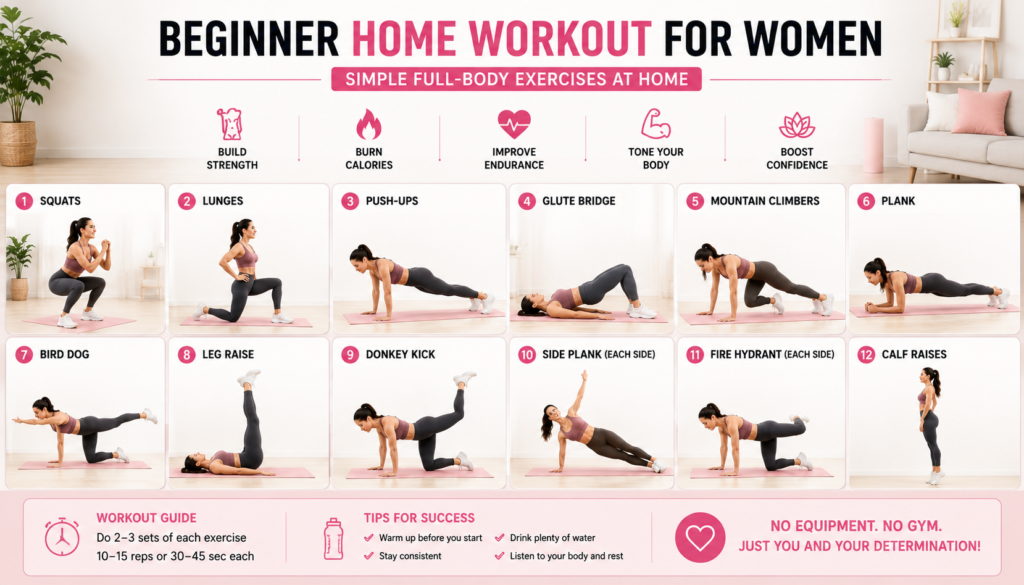
Because strong is the new chic — and you can build it right in your living room.
There is a particular kind of morning I have come to love. The kind where the apartment is still quiet, the light is soft and golden through the curtains, a playlist of something low and French is drifting from the speaker on the kitchen shelf, and I am on my yoga mat in the middle of my living room, doing absolutely nothing that requires a gym membership. No commute. No mirror-lined room packed with strangers. Just me, my body, and a workout I actually designed around my real life — which, like most women I know, is full, layered, beautiful, and incredibly busy.
I started working out at home three years ago when a shoulder injury made the gym feel more stressful than healing. What I thought would be a temporary arrangement became, honestly, one of the most transformative shifts in my wellness routine. I fell back in love with movement. I stopped associating exercise with performance or punishment, and I started seeing it for what it genuinely is — a form of self-care that happens to sculpt your body as a beautiful side effect.
This post is for the woman who has been curious about starting — or restarting — a home workout routine but doesn’t quite know where to begin. Maybe you’ve scrolled through Pinterest boards of aesthetic home gyms and felt inspired but overwhelmed. Maybe you’ve watched enough “clean girl morning routine” content on TikTok to feel motivated but unsure how to translate that energy into actual movement. Maybe you’re simply someone who wants to feel stronger, more grounded in her body, and more energised going into her day — without it becoming another thing on the to-do list that drains you.
Whatever brought you here, I want you to feel at home (quite literally). This guide is warm, honest, deeply practical, and written by someone who truly believes that a full-body workout done in your living room, in your favourite set, can be just as powerful — and far more sustainable — than anything happening in a fluorescent-lit gym. Let’s begin.
Why Home Workouts Have Become the Quiet Luxury of Wellness
There is a reason that “home gym aesthetic” is one of the most-saved categories on Pinterest right now, right alongside quiet luxury interiors and soft girl skincare shelfies. Working out at home has moved from being a budget compromise to being, in many circles, the aspirational choice. And I think that shift says something interesting about where women’s relationship with wellness is going.
We are collectively moving away from the culture of loud, performance-driven fitness — the boot camps, the high-intensity group classes designed to exhaust you into submission, the gym selfie as social currency. In its place, something quieter, more intentional, and honestly more elegant has emerged. The idea that your wellness practice should feel like yours. Curated to your space, your energy, your aesthetic. A morning stretch that happens in your favourite matching set beside a diffuser. A 30-minute full-body routine done before the rest of the household wakes up. Movement as ritual rather than obligation.
Home workouts fit this energy perfectly. They remove every barrier that typically derails beginners — the travel time, the cost, the intimidation of a crowded weights room, the anxiety of not knowing what you’re doing in public. They put you in control. And for women especially, that sense of ownership over your own wellness space is genuinely life-changing.
I also think there is something to be said for the aesthetic pleasure of it. When your workout space is beautiful — even if it’s just a corner of your bedroom with a mat, a candle, and some natural light — you actually want to go there. The clean girl aesthetic and its emphasis on calm, curated environments has made so many women realise that their wellness routine doesn’t have to happen in a chaotic, mirror-lined box. It can happen in a space that feels like you. And that matters more than people give it credit for.
Setting Up Your Home Workout Space: Small But Intentional
Before we get into the actual exercises, I want to talk about space — because one of the most common misconceptions about home workouts is that you need a lot of it. You really, truly do not. I have done full-body routines in a space roughly the size of a yoga mat. The key is intention, not square footage.
Start with a mat. This is genuinely the only piece of equipment that I would call non-negotiable for a beginner. A good quality yoga or exercise mat gives you grip, cushioning for floor work, and a psychological boundary that signals to your brain: this is the movement zone. There is something almost ritualistic about rolling out your mat that I find helps me transition from regular morning me into workout mode. I use a muted sage green one that I found in a small Etsy wellness shop, and it genuinely makes me happy every time I see it.
Beyond the mat, think about what will make the space feel good. A small speaker for your playlist. A diffuser if you’re into it — eucalyptus or peppermint works wonders for focus. Good lighting, ideally natural. I turn off my overhead light and use a warm lamp instead, which sounds unnecessarily specific but honestly makes such a difference in how the whole session feels. Some women love a full-length mirror for form checks. Others find it distracting. Know yourself on this one.
Equipment-wise, as a beginner, you can go a long time on bodyweight alone. When you’re ready to progress, a set of light-to-medium resistance bands and one or two pairs of dumbbells (I’d suggest a 3kg and a 5kg pair to start) will take you incredibly far. Store them somewhere visible and accessible — because out of sight really does mean out of mind when it comes to workout gear.
The goal is to create a space you are actually drawn to, not one you have to psyche yourself up to enter. Think of it as your personal wellness corner. A small, beautiful, functional space that exists just for you and your body. That alone changes the relationship with the routine.
What to Wear: Because Your Workout Aesthetic Actually Matters
I am going to be completely unapologetic about this section because I genuinely believe that what you wear to work out — even at home — affects how you move through the session. This isn’t vanity (or at least, it isn’t only vanity). There is real psychology behind the idea of “enclothed cognition” — the concept that what we wear affects how we think and feel about ourselves. And when you pull on a set that makes you feel put-together, elevated, and like yourself, you tend to show up to the session differently.
The activewear world in 2026 has reached genuinely beautiful places. The clean girl aesthetic has filtered all the way into gym wear, and the result is a market full of elevated, neutral-toned, beautifully constructed pieces that feel as good to wear for an afternoon coffee as they do for a squat session. Think: buttery-soft leggings in chocolate brown or soft sage, matching sports bras with delicate rib detailing, oversized crop hoodies in oatmeal or dove grey, seamless sets in dusty rose or slate blue.
The brands doing this best right now are leaning into what I’d call “quiet luxury activewear” — pieces without loud logos, made from fabrics that move and breathe beautifully, in colourways that photograph like a dream and feel even better in person. Lululemon remains a reference point for quality, but there are smaller brands — Gymshark’s softer lines, Alo Yoga’s new earthy ranges, AYBL’s neutral collections — that deliver beautifully without the price tag.
For a home workout specifically, I lean into softness. I want pieces that don’t restrict movement, that feel lovely against my skin, and that I feel genuinely good wearing. A matching set does something to the mood of a morning workout that a ratty oversized t-shirt simply doesn’t. And look — some days the ratty t-shirt is exactly right. But on the days when you’re trying to build a habit, dressing for it genuinely helps.
A few practical notes: high-waisted leggings are your best friend for floor work and squats — they stay put and they’re flattering in a way that doesn’t feel performative. A medium-support sports bra is usually sufficient for the kinds of workouts we’re building here (bodyweight and low-to-moderate intensity). And always, always wear grip socks or go barefoot. Socks on hardwood floors during lunges is a slide injury waiting to happen.
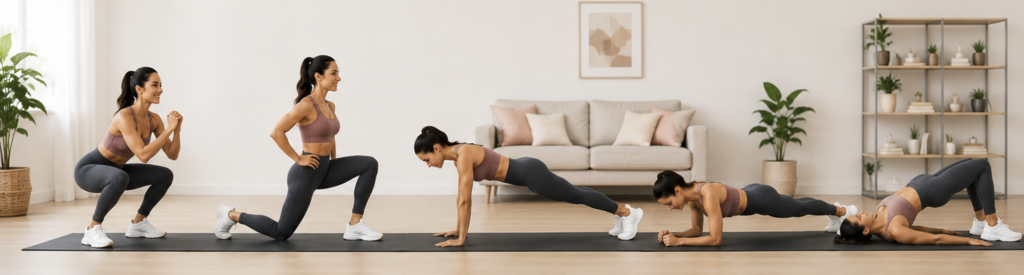
Understanding Full-Body Workouts: What They Are and Why They Work So Well for Beginners
Before I walk you through the actual exercises, I want to make sure you understand the philosophy behind a full-body workout structure — because it’s particularly well suited to beginners and to women building a sustainable routine for the first time.
A full-body workout is exactly what it sounds like: a session where you work multiple muscle groups across your entire body rather than splitting it into isolated “leg day” or “arm day” sessions. For beginners especially, this approach is gold. Here’s why.
First, it’s efficient. When time is the resource most of us are managing most carefully, a 30–40 minute full-body session delivers more return than an hour of isolated work. You’re moving more muscle mass, burning more energy, and stimulating more growth signals — all in one go.
Second, it’s sustainable. The “split training” approach that bodybuilders use requires you to work out four to six times a week to cover all muscle groups. A full-body routine works beautifully at three sessions a week, with rest and recovery built naturally into the schedule. That frequency is genuinely achievable for most women without it taking over their lives.
Third, it teaches your body to move as a system. Rather than training muscles in isolation, you’re building functional strength — the kind that helps you carry groceries, maintain posture, move with grace through your day. Full-body training emphasises compound movements (exercises that work multiple muscles at once), which are more natural, more elegant in their mechanics, and more transferable to real life.
As a beginner, the goal is not to achieve exhaustion. It’s to learn movement patterns, build consistency, and gradually increase your capacity over time. So please — and I say this with genuine warmth — leave your ego outside the door. Start lighter than you think you need to. Focus on how movements feel rather than how they look. Progress, in this context, is a quiet, patient, deeply rewarding process.
The Beginner Full-Body Home Workout: Your Complete Guide
What follows is a full-body routine designed specifically for beginners working at home. It requires no equipment (though I’ll note where you can add resistance when you’re ready to progress), can be done in around 35–40 minutes, and is built around movement patterns that are both effective and safe for someone starting out.
I’ve structured it in a way that I find flows beautifully — beginning with a warm-up that prepares your joints and nervous system, moving through a sequence of exercises that balance push and pull movements, leg work, and core, then closing with a cooldown that you’ll actually want to stay in. I’ve included notes on form because form is everything — more than weight, more than reps, more important than any other variable. Beautiful movement begins with understanding what the body is actually meant to be doing.
The Warm-Up: Never Skip This, Please
A warm-up is not wasted time. It is the difference between a session that feels fluid and one that feels stiff and achy. It prepares your joints with synovial fluid, gradually elevates your heart rate, wakes up your nervous system, and mentally transitions you into movement mode. Five to eight minutes. That’s all it takes. And I promise your body will thank you.
March in place for sixty seconds — bigger than you think, with high knees and arms swinging. Then move into arm circles, twenty in each direction, gradually widening the range. Hip circles, ten in each direction, standing with feet hip-width apart, hands on hips. Shoulder rolls, ten forward and ten back. Ankle rolls, ten each side. Bodyweight squats with a pause at the bottom, ten reps, no weight, just exploring the range. Hip flexor stretches, thirty seconds each side, kneeling on the mat. Finish with a brief cat-cow sequence — five to eight breath cycles on all fours, arching and rounding through the spine. You should feel warm, mobile, and alive by the end of this. That is exactly the point.
Exercise 1: Bodyweight Squat — The Foundation of Everything
If I could only give a beginner one exercise, it would be the squat. Not because it’s glamorous — although there is something genuinely satisfying about a well-executed squat — but because it is the most fundamental human movement pattern. We are literally built to squat. The hips hinge, the knees track, the spine stays long, and the glutes and quads work in beautiful coordination to lower and raise the body. Learning to do this correctly is one of the most valuable things you can do for your body.
Stand with your feet hip to shoulder-width apart, toes pointing slightly outward. Think of your feet as the root of the movement — they are your foundation, and everything begins with them being grounded and stable. Inhale and begin to lower your hips back and down, as though you’re about to sit into a chair that is just slightly behind you. Keep your chest lifted, your gaze forward, your weight distributed evenly across your entire foot. Your knees should track in line with your second toe — not caving inward, not flaring excessively outward. Lower until your thighs are roughly parallel with the floor, or as deep as your mobility currently allows without your lower back rounding.
Exhale and press through the entire foot — especially the heel — to rise back to standing. Squeeze your glutes at the top, gently, and take a breath before the next repetition. Aim for three sets of ten to fifteen repetitions, resting sixty to ninety seconds between sets. When this starts to feel comfortable, try adding a resistance band just above the knees to increase glute activation, or hold a light dumbbell at your chest (goblet squat position) to add resistance.
Exercise 2: Glute Bridge — The Gift Your Posterior Chain Has Been Waiting For
The glute bridge is one of those exercises that looks deceptively simple but, when done correctly, is remarkably effective at targeting the glutes, hamstrings, and lower back. It’s also an exercise I love recommending to women who spend a lot of time seated — at desks, in cars, commuting — because it actively counteracts the hip flexor shortening and glute inhibition that prolonged sitting creates.
Lie on your back with your knees bent, feet flat on the floor, hip-width apart. Your feet should be close enough that your fingertips can just brush your heels when your arms are stretched alongside your body. This is your starting position. Press your lower back gently into the mat. Exhale and press through both feet to lift your hips toward the ceiling, squeezing your glutes at the top with genuine intention — not just going through the motion, but actually contracting the muscle. Hold for a beat at the top, then lower slowly on an inhale, controlling the descent rather than dropping.
Three sets of fifteen repetitions. The progression here is beautiful and gradual: once you’re comfortable with both feet down, try a single-leg glute bridge (one leg extended, one foot planted). When you’re ready to add load, place a dumbbell or a resistance band across your hips. Eventually, you’ll work your way toward a weighted hip thrust. But that’s future you. For now, the bodyweight bridge, done slowly and intentionally, is exactly right.
Exercise 3: Reverse Lunge — Elegant, Effective, and Kinder to Your Knees
I prefer the reverse lunge over the forward lunge for beginners because it places less shear force on the knee joint and feels more controlled. You’re stepping back rather than forward, which allows you to maintain better balance and gives you more natural control over the depth and speed of the movement.
Stand with feet together or hip-width apart. Step one foot back — a large, confident stride — and lower your back knee toward the floor. Your front shin should be as close to vertical as possible, front knee stacked over your ankle. Your torso stays upright, chest lifted, core lightly engaged. Lower until your back knee is hovering just above the mat, then drive through the front foot to step back to standing. That is one repetition. Do ten on each leg for three sets.
The most common mistake I see is letting the torso lean forward excessively. Think tall spine, proud chest, long neck. You should feel the work primarily in the front glute and quad. If your knee is diving inward, slow down and think about pushing it outward gently — that’s a sign of hip weakness that will resolve itself as you build strength. To progress: hold light dumbbells at your sides, or try a walking lunge across your living room.
Exercise 4: Incline Push-Up — Building Upper Body Strength Without the Frustration
Full push-ups on the floor are an aspirational goal, not a starting point — and I want to say that with genuine care, not as a consolation. An incline push-up is mechanically identical to a floor push-up; it simply reduces the percentage of your bodyweight that you’re lifting by changing the angle. It is not a “modified” or “easier” version. It is a smarter entry point that lets you build the strength, muscle engagement pattern, and joint stability needed for floor push-ups without compromising form.
Find a surface between knee and waist height: your couch, a sturdy ottoman, your bed frame, a kitchen counter. Place your hands slightly wider than shoulder-width on the surface, arms straight. Step your feet back so your body forms a long, straight diagonal line from heel to crown. This is your push-up position. Engage your core — think about bracing as though someone is about to gently poke your stomach. Inhale and lower your chest toward the surface, elbows at roughly a 45-degree angle from your body (not flared wide to the sides, not tucked tightly against your ribs — somewhere in between). Exhale and push back up to straight arms. Three sets of eight to twelve repetitions.
The key elements: straight body line throughout (no hips sagging or piking up), chest actually reaching the surface (or close to it), elbows not flaring. When this starts to feel manageable, lower the surface height — from the couch armrest to a coffee table to the floor. That progression, taken at your own pace, is how push-up strength is built elegantly and sustainably.
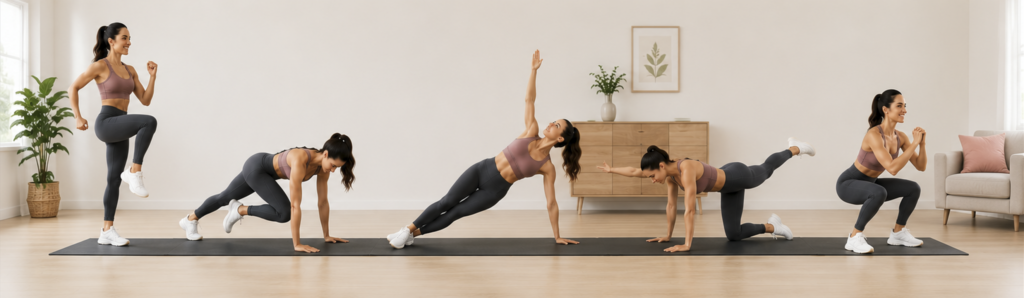
Exercise 5: Bent-Over Dumbbell Row — Because Your Back Deserves Attention Too
We spend so much time focusing on the muscles we can see in the mirror — abs, quads, biceps — and not nearly enough time on the muscles we can’t. The back is one of the most important and most neglected areas for women, and training it regularly improves posture, reduces the risk of shoulder injury, and creates that long, elegant line through the upper body that nothing else quite replicates.
For this exercise you’ll need a dumbbell, a chair, or your couch. Hinge forward from your hips — back flat, not rounded, chest roughly parallel to the floor, knees softly bent. Hold your dumbbell in one hand, arm hanging straight toward the floor, shoulder relaxed. Brace your core gently. Exhale and pull the dumbbell up toward your lower rib cage, leading with your elbow. Think: elbow to the ceiling, rather than hand to the chest. You should feel the muscles along the side and back of your shoulder blade contracting. Lower slowly on the inhale. Three sets of ten to twelve repetitions on each arm.
The most important element here is keeping your back flat throughout. If your lower back is rounding, either the weight is too heavy or your hip flexors are too tight to maintain the hinge. Use a lighter weight and take your time. Quality of movement over quantity of load, always and especially at the beginning.
Exercise 6: Dead Bug — The Core Exercise That Actually Works (And Doesn’t Hurt Your Neck)
I have a complicated relationship with traditional crunches, and I think many women who have tried and abandoned core work feel the same. The crunch, done poorly — which is most of the time, at least to start — creates neck strain, reinforces a flexed spine position, and doesn’t actually train the deep stabilising muscles of the core the way it promises to. The dead bug does.
Lie on your back and bring your arms straight up toward the ceiling, directly above your shoulders. Lift your legs so your hips and knees are both at 90 degrees — this is your starting position. Press your lower back into the mat and hold it there; this is the most important cue of the entire exercise. Keeping your lower back pressed down, slowly lower your right arm toward the floor overhead while simultaneously extending your left leg toward the floor. They move together, slowly, with full control, going only as far as you can without your lower back lifting off the mat. Return to start. Switch sides. That is one repetition.
Three sets of eight to ten repetitions on each side. The progression here is simply slowing down: the slower you go, the harder the core has to work to stabilise. This exercise trains what is called “anti-extension” core strength — the ability of the core to resist being pulled out of neutral. That is the kind of core strength that protects your spine, improves your posture, and transfers directly into every other exercise and daily movement you make.
Exercise 7: Lateral Raise — Sculpting Those Shoulder Lines
For this one you’ll want your lightest dumbbells — genuinely, lighter than you think. The lateral deltoid (the outer part of the shoulder that creates the rounded, defined shoulder line so many women want) is a small muscle that fatigues quickly and is very easy to cheat on. Using a heavy weight means the trapezius and upper back take over, and the delt gets sidelined.
Stand with feet hip-width apart, a dumbbell in each hand, arms hanging at your sides with a slight, soft bend in the elbow. Think of your arm as a lever hinged at the shoulder. Exhale and lift both arms simultaneously out to the sides, leading with your elbows rather than your wrists, until your arms are roughly parallel with the floor — no higher than shoulder height, and ideally with your pinky side slightly higher than your thumb side (imagine you’re pouring from a jug). Inhale and lower slowly, resisting gravity on the way down as much as on the way up. Three sets of twelve to fifteen repetitions.
The slow, controlled descent is where half the work happens. Don’t drop the weights — lower them with intention over three to four seconds. Your shoulders will be on fire in the most satisfying way. As you progress, you can increase the weight very gradually or add a brief hold at the top of each rep.
Exercise 8: Sumo Squat — Inner Thigh and Glute Love
The sumo squat is a variation of the standard squat with a wider stance and toes turned out more significantly — usually 45 degrees or more. This position shifts the emphasis toward the inner thighs (adductors) and the glutes while still working the quads and hamstrings, making it an excellent complement to the regular squat.
Step your feet wider than shoulder-width apart, toes pointing outward. Inhale and lower your hips straight down — not back, but down, keeping your torso more upright than in a traditional squat. Your knees track over your toes (which are already turned out, so this is natural). Lower until your thighs are parallel or below, then exhale and drive through both feet to rise. At the top, squeeze the inner thighs and glutes together deliberately. Three sets of twelve to fifteen repetitions.
To add resistance, hold a single dumbbell vertically between your hands — this is what’s known as a sumo goblet squat, and it’s one of my favourite loaded exercises for the lower body. The weight also helps you counterbalance and actually sit deeper, which in turn increases the range of motion and the work done by the glutes and inner thighs.
Exercise 9: Tricep Dip — For Arms That Feel as Strong as They Look
The back of the arm — the tricep — is one of those areas that women often want to tone but aren’t sure how to target effectively without equipment. The tricep dip requires nothing but a sturdy chair, a couch, or a low surface, and it directly targets the tricep in a functional, manageable way for beginners.
Sit on the edge of your chair or couch with your hands gripping the edge, fingers pointing forward, arms straight. Shuffle your hips off the surface so your weight is supported by your arms. Your feet can be flat on the floor with knees bent (easier) or extended out in front of you (harder). Keeping your back close to the surface of the chair, inhale and bend your elbows to lower your hips toward the floor — elbows go back, not out to the sides. Lower until your upper arms are roughly parallel to the floor, or as far as your shoulder mobility allows comfortably. Exhale and press through your palms to straighten your arms back to the start. Three sets of eight to twelve repetitions.
The common error is letting the elbows splay outward — this shifts the work away from the tricep and into the shoulder in an uncomfortable way. Think elbows back and close. Your body should lower straight down, not swing forward and away from the chair.
Exercise 10: Hip Hinge / Romanian Deadlift — The Movement Pattern That Changes Everything
The hip hinge is, for me, the most underrated movement pattern in fitness. Learning to hinge from the hips — rather than bending the spine — is genuinely transformative. It teaches you to engage your glutes and hamstrings properly, it protects your lower back, and it directly transfers to picking things up from the floor, which all of us do roughly a hundred times a day without thinking.
Begin this exercise without any weight until the pattern feels natural. Stand with feet hip-width apart. Soften your knees — they should be bent, but only slightly. Think of your hips as a hinge. Push your hips back while keeping your back flat and long, allowing your torso to tip forward. Your hands trail down your thighs. Lower until you feel a pulling sensation in your hamstrings — not pain, but a stretch — then push your hips forward to return to standing. Squeeze your glutes at the top.
When the pattern feels intuitive, add a light pair of dumbbells. Hold them in front of your thighs, trail them down your legs as you hinge, and pull them back up as you stand. Three sets of ten to twelve repetitions. This is your Romanian deadlift — one of the most effective exercises for the posterior chain (glutes, hamstrings, lower back) that you can do at home. Progress it by gradually increasing the weight over weeks and months.
Putting It All Together: Your Weekly Workout Schedule
Having a beautiful repertoire of exercises is only half of it. The other half is the schedule — the structure that turns a collection of movements into a consistent practice. For beginners, three full-body sessions per week is the sweet spot. It’s enough to build strength and create adaptation, while allowing adequate recovery time between sessions.
Here’s what that might look like in a real week: Monday workout, Tuesday rest (or gentle walking, stretching, a slow yoga flow if you feel like it), Wednesday workout, Thursday rest, Friday workout, Saturday and Sunday rest or light activity. Non-negotiable days off are as important as workout days. This is where your muscles repair, grow, and consolidate the movement patterns you’ve practised.
Each session should follow this structure: five to eight minutes of warm-up, as outlined earlier, then the full workout circuit. You can do all three sets of each exercise before moving to the next (strength training style), or you can do one round of all exercises, then repeat the circuit two more times (circuit training style). The latter keeps your heart rate higher and tends to feel more dynamic. Both work well.
Rest periods matter. Between sets, take 60 to 90 seconds. Use this time consciously — breathe, notice how your body feels, have a sip of water, mentally prepare for the next set. Rushing rest periods at the beginner stage tends to compromise form on subsequent sets. Quality over speed.
Your sessions will feel different week to week, and that is completely normal. Some mornings you’ll feel strong and capable and the whole thing will flow. Others will feel harder, heavier, more effortful. Both are valid. Both are doing the work. The consistency — showing up even on the heavy mornings — is where the real transformation happens.
The Cooldown: Give Your Body This Gift Every Single Time
I know, I know — the cooldown is the part everyone skips. The workout feels done, you’re sweaty and satisfied, there are seventeen things on your to-do list, and stretching feels like the least urgent item in the universe. I used to skip it too. Then I started taking it seriously, and genuinely — within weeks — I noticed a difference in how I moved, how my muscles felt the day after a session, and how quickly I recovered.
A cooldown doesn’t need to be long. Ten minutes is ideal. Five is better than zero. The goal is to gradually lower your heart rate, begin the process of returning your muscles to their resting length, and signal to your nervous system that the intense part is over. It is, honestly, one of the most pleasurable parts of the practice once you start doing it properly.
Begin with a slow walk or gentle march in place for a minute or two. Then move into static stretches, holding each for thirty to sixty seconds. A standing quad stretch (holding your ankle behind you), a pigeon pose or figure-four stretch for the glutes, a hamstring stretch standing or lying, a chest opener (arms extended behind you, lifting the sternum), a doorway chest stretch, a neck side stretch, and finally a full spine twist lying on your back. Put on something soft and ambient, and let yourself actually be in these stretches rather than watching the clock.
The stretches after leg work, in particular, are deeply satisfying. Your glutes and hamstrings, having just done the beautiful work of squats and deadlifts, will welcome the pigeon pose like a relief. There is real pleasure in this part of the practice, and I encourage you to lean into it rather than rushing through.
Nutrition, Hydration, and the Gentle Truth About Fuelling Your Workouts
I am not a nutritionist, and this section is not intended to be a meal plan or a diet prescription — there are too many of those already, and frankly, very few women benefit from more rules around food. What I want to offer instead are a few simple, genuinely useful ideas about nourishing your body in a way that supports your workouts without creating anxiety around eating.
Firstly, hydration. This is the thing that women underestimate most consistently, and the impact on workout performance and recovery is significant. I aim to drink about half a litre of water before my workout and then sip through the session, especially in warmer months or if I’m doing anything particularly energetic. A large, beautiful water bottle that lives on your mat is the simplest possible prompt to drink more. Hydration is the most affordable upgrade available to your wellness routine.
Around your workout, think of food in simple terms. Before a morning session, a light snack if you’ve been awake for a while and feel hungry — a banana, a couple of dates with almond butter, half a slice of sourdough with avocado. Something that provides a little easily accessible energy without sitting heavily in your stomach. If you’re working out within an hour of waking, you might prefer to train fasted and eat breakfast after. Both approaches work; the key is listening to your own body rather than following a rule that doesn’t fit your biology.
After a workout, protein is your friend. Your muscles have been stimulated and are beginning the repair process that ultimately builds strength. Giving them the amino acids they need — from eggs, Greek yoghurt, cottage cheese, tofu, tempeh, legumes, high-quality protein powder if that’s your preference — within about an hour to two hours of finishing your session supports that repair process meaningfully. A post-workout breakfast that I adore: Greek yoghurt layered with frozen berries and a scoop of almond butter, with a soft-boiled egg on the side. It feels indulgent and nourishing at once.
Beyond the immediate workout window, focus on eating varied, whole food meals that you genuinely enjoy. The relationship between food and fitness is a long one, and creating a foundation of pleasure and nourishment — rather than restriction and rules — is what allows it to be sustainable over years, not just weeks.
Progress, Patience, and the Beautiful Reality of Building Strength
Here is something I wish someone had told me when I started: progress in fitness is not linear, it is not fast, and it does not always look the way you expect it to. The first four to six weeks of a new workout routine involve something called “neural adaptation” — your brain learning how to recruit your muscles more efficiently. During this phase, you may not notice dramatic changes in how you look. You will, however, notice changes in how the movements feel: less effortful, more controlled, more familiar. This is progress. It’s just happening in your nervous system rather than in your mirror.
Physical changes typically begin to appear around the six to eight week mark for most women — and even then, they are often felt before they are seen. Your clothes fit differently. Your posture improves. You feel more grounded walking up stairs. Someone who sees you regularly might comment that you look well. These are all forms of progress, and they are worth acknowledging.
The single most important thing you can do in your first three months is prioritise consistency over intensity. Showing up for three sessions a week, every week, even when they’re not your best sessions, will produce more results than two weeks of intense daily training followed by burnout. The body responds to regular, sustained stimulus. Regularity is the signal it needs.
Keep a simple workout journal. Not a rigid tracking spreadsheet — unless you love that — but a brief note after each session. What you did, how it felt, anything that surprised you, any pain or discomfort worth noting. Over weeks and months, this becomes an incredibly valuable record of your progress. Rereading early entries when you’re several months in is one of the most motivating things you can do. The contrast between “couldn’t do a single push-up from the floor” and “did three sets of ten” is visceral and wonderful.
You will have weeks where it doesn’t happen. Life will interrupt. Illness, travel, grief, exhaustion, simply not having it in you — these will all arrive and temporarily disrupt the routine. That is normal. That is human. The habit is not broken by a week off. It is only broken if you decide it is. Return when you can. Start where you are. The body has a remarkable memory for movement, and it will welcome you back.
The Mindset Shift That Makes Home Workouts Actually Work Long-Term
The practical information — the exercises, the sets, the reps, the schedule — is the easier part. The harder part is what happens in your head. Specifically, the way you relate to your body, your motivation, your expectations, and the inevitable moments when it all feels too much.
Most women I know who have built truly sustainable fitness habits have one thing in common: they shifted from external to internal motivation. They stopped working out to look a certain way (though the physical changes are a lovely consequence) and started working out because of how it makes them feel. The clarity after a good session. The energy that carries through the afternoon. The quiet pride of having shown up for yourself. The sense of living in your body rather than just inhabiting it.
This shift doesn’t happen overnight. It develops gradually as you accumulate experiences of movement feeling good. The first few weeks, you might be running entirely on willpower and aesthetic motivation — and that’s fine. That’s how it often begins. But somewhere around week four or six, if you’ve been consistent, you’ll notice something changing. You’ll have a day where you don’t particularly want to work out, you do it anyway, and afterwards you feel genuinely better than you did before. That feeling, that lived experience, is what begins to create intrinsic motivation.
The clean girl aesthetic and its digital presence on Instagram and Pinterest can be both inspiring and a source of unrealistic comparison, and I think it’s important to name that honestly. The polished workout content you see — the immaculate home gyms, the model-perfect form, the seamless sets that never wrinkle — is often aspirational content, not reality. Real home workouts happen on living room floors with the furniture pushed back. They happen in your pyjama top because you haven’t done laundry. They happen with your cat walking across your mat. They are imperfect, and that imperfection is completely fine.
What matters is not the aesthetic of the practice but the practice itself. And once you commit to that — to simply showing up, in whatever form that takes — something genuinely beautiful begins to unfold.
Elevating Your Home Workout Experience: The Little Details That Make a Big Difference
Since we’re here and since I know you appreciate the details — because that’s who reads a post like this, women who care about how things feel and not just how they function — I want to spend a moment on the small things that turn a workout from something you do to something you look forward to. The sensory curation, if you will.
Music is enormous. I genuinely cannot overstate how much a carefully curated playlist improves a session. I have different playlists for different energy levels and different types of workouts. For strength work, I like something with a steady rhythm and enough drive to keep me focused without being chaotic — think Jungle, Bicep, early Disclosure, or a good lo-fi hip hop mix when I want something more meditative. For higher-intensity days, I want something with actual energy. For cooldowns, piano or ambient instrumental. The music is not background noise; it is part of the practice.
Scent works powerfully on the brain’s limbic system, which is involved in both mood and memory. I diffuse eucalyptus and peppermint during workouts — they’re both associated with improved focus and perceived energy. Some people prefer citrus. A few women I know light a candle instead, in a slightly warmer scent, for a more meditative feel. There is no wrong answer here; the point is simply to engage the olfactory system and let it contribute to the atmosphere.
Temperature matters. I do my best workouts in a room that is cool rather than warm — cool enough that I need to warm up, not so warm that I’m uncomfortable before I’ve even started. In summer, a fan. In winter, a window cracked. Your body temperature rises as you work, and having a cooler ambient temperature gives you somewhere to go thermally rather than overheating quickly.
Timing, as a lifestyle consideration, is worth thinking about. I am a morning workout person, full stop — the session clears my mind, the endorphins last through the first half of the day, and once it’s done, it is done. But I know women who genuinely perform better and enjoy evening sessions more. If you’re trying to find your time, experiment: try one week of mornings, one week of evenings. Notice what feels better, what you stick to more consistently, what leaves you feeling more energised. Your chronobiology is unique. Work with it.
Post-workout rituals are deeply underrated. I follow every session with a shower (a particular kind of satisfaction in a post-workout shower that is unlike any other), then my skincare routine — I’ve noticed my skin absorbs serums beautifully right after exercise, perhaps because of increased circulation — and then breakfast. This sequence has become so pleasurable that on difficult mornings when I don’t want to work out, the thought of the post-workout shower and breakfast pulls me through.
Common Mistakes Beginners Make (And How to Avoid Them Gracefully)
I want to give you a gift that nobody gave me when I started: a list of the most common beginner mistakes, presented without judgment and with practical alternatives. Learning from someone else’s missteps is a particular kind of efficiency.
Doing too much too soon is the most common one. The enthusiasm of beginning something new is wonderful, and it often manifests as planning to work out five or six days a week immediately. Your joints and connective tissue need time to adapt to new movement loads, and jumping straight to high frequency and high volume tends to end in injury or burnout. Start with three days. Build from there.
Neglecting recovery is related, but specifically concerns the mindset that rest days are wasted days. They are not. Muscle is built during rest, not during the workout. The workout is the stimulus; rest is the adaptation. Schedule your rest days with the same intentionality as your workout days, and use them for gentle movement — a walk, stretching, a slow yoga practice — rather than complete sedentarism.
Comparing progress timelines is a subtle joy thief. The woman whose body changed dramatically in six weeks because of a particular combination of genetics, hormones, starting point, and programme is not a template for your experience. Your progress timeline is your own. It will be influenced by your sleep, your stress levels, your nutrition, your hormones, your genetics, your history of movement. None of these are in your control to the degree that makes comparison useful. Focus on your own metrics, your own experience, your own story.
Skipping the warm-up and cooldown is the mistake I see most often among women who know better but do it anyway due to time pressure. I understand. But consider this: the warm-up reduces injury risk, and the cooldown reduces post-workout soreness. Both ultimately make the next session better. Protect the investment you’re making in yourself by giving the practice its full shape, beginning to end.
Expecting the scale to be the arbiter of progress is a complicated one, because the scale is a genuinely limited measurement tool. It doesn’t distinguish between muscle, fat, water, inflammation, or bone density. A woman who has been strength training for two months may weigh the same as she did at the start while having fundamentally changed her body composition — more muscle, less fat, better posture, healthier metabolism. If measuring progress matters to you, use photographs, measurements, or how your clothes fit rather than relying solely on a number.
Beyond the Workout: How Fitness Weaves Into the Elegant Life
I’ve been thinking a lot lately about what the women I most admire have in common when it comes to the relationship between fitness and life. And it’s not that they’re thin, or that they have perfect bodies by any objective standard. It’s that they are present in their bodies. They move through the world with a certain ease. They carry themselves well. They have energy. They seem to feel genuinely at home in their own skin.
That quality — aliveness in the body — is what a consistent movement practice builds over time. Not the perfect physique. Not the six-pack or the perfect round glute or whatever aesthetic is currently dominating social media. But genuine, embodied aliveness. A way of inhabiting yourself that is confident not because of how you look, but because of what you know your body can do.
The quiet luxury movement in fashion and lifestyle has, I think, taught us something useful about fitness too. Real wellness — like real luxury — is not loud. It’s not performative. It’s not about the show. It’s about quality, consistency, and the quiet satisfaction of practices that genuinely serve you. A woman who works out three times a week in her living room, consistently, for years, is far better served than one who does an extreme programme for three weeks and then nothing. Sustainability is the luxury. Consistency is the status symbol that nobody can see but you.
As your fitness practice develops, you’ll notice it beginning to influence other areas of your life in quiet ways. Your posture improves, and with it, your confidence in rooms. Your energy in the afternoon holds better. Your sleep deepens — exercise is one of the most effective natural sleep interventions there is. Your relationship with your body softens. You start to feel it as something to nourish and strengthen, rather than something to judge and control.
These changes happen slowly, cumulatively, without drama. And then one day you catch yourself in a mirror, not checking or critiquing, but just noticing — noticing that you stand differently, hold yourself differently, move differently. That you seem, somehow, more yourself. That is the gift that fitness gives, quietly and without announcement, to women who show up for it. And I believe, genuinely and from experience, that it is available to you.
Where to Go From Here
If you’ve read this far, I know you’re ready. Maybe you’ve already been circling the idea of starting for a while, saving Pinterest boards of workout aesthetics, adding activewear to wishlists, telling yourself “next week, next month, when things calm down.” I know that feeling very well. And I want to offer you something simple: start this week. Not with a perfect plan, not with all the equipment, not when the timing is ideal. This week. Roll out a mat. Do a warm-up. Do the squat. Do the bridge. Do one more exercise. And then rest.
That’s how it begins. Not with a dramatic overhaul or a transformation challenge or a rigid programme. With a single session, in your living room, in whatever you’re wearing, doing your imperfect best. And then another. And then another. The consistency builds itself from there, one session at a time, until one day you realise that it’s just part of your life — as natural and necessary as your morning coffee and your evening skincare.
You deserve that. You deserve the energy, the strength, the embodied confidence, the quiet pride of having built something for yourself. And you can build it in your living room, in thirty-five minutes, three times a week, without any equipment you don’t already own or any gym membership you don’t want to pay for.
Here’s to showing up for yourself — imperfectly, consistently, beautifully. That’s all it ever takes.
With warmth,
xx