
Table of Contents

The Stay-at-Home Cleaning Schedule That Actually Works (Full Supply List, Under $50)
A realistic, zone-based cleaning routine for stay-at-home parents — plus the complete list of budget-friendly supplies you need to run it, all for under fifty dollars.
Introduction: The Myth of the Spotless Stay-at-Home House
There is a strange assumption floating around that if you are home all day, your house should look like a furniture showroom. Toys should be catalogued. Counters should gleam. The laundry should never, ever pile up. Anyone who has actually spent a full day at home with children, pets, or simply a busy life knows how far that is from reality.
Being home more does not mean you have more time to clean — it usually means you have more mess-makers actively working against you in real time. A load of laundry gets folded, and by the time it’s put away, someone has already spilled juice on the rug. The kitchen is wiped down after breakfast, and it’s dirty again by lunch. It can feel like running on a treadmill that never stops, and every blog post promising a “perfect morning routine” can make the whole thing feel more discouraging instead of less.
This guide is built differently. It is not about perfection, and it’s not about spending hours a day scrubbing. It’s about creating a simple, repeatable rhythm — a schedule you can actually stick to on your worst weeks, not just your best ones — using a small set of supplies that won’t blow your budget. Everything on the product list below is chosen to keep your total spend under $50, because a cleaning routine that requires a cabinet full of specialty products is a routine that will quietly get abandoned the first month.
By the end of this post, you’ll have:
-
A philosophy for cleaning that reduces decision fatigue
-
A complete, priced shopping list for a starter cleaning kit under $50
-
A daily “reset” routine that takes under 20 minutes
-
A full seven-day zone cleaning schedule
-
A monthly deep-clean rotation
-
Room-by-room quick reference lists
-
Practical strategies for cleaning with kids and pets underfoot
-
Answers to the most common questions about keeping up with it all
Let’s get into it.
Why a Cleaning Schedule Matters More at Home Than You’d Think
It seems counterintuitive: if you’re home all day, shouldn’t cleaning just happen naturally, in the gaps? In practice, the opposite tends to be true, for a few reasons.
There are no gaps. When you work outside the home, the house sits empty for eight or nine hours, and nothing new gets dirty during that window. When you’re home, especially with kids or pets, mess generation is continuous. Crumbs, footprints, toys, spills, fur — it never really pauses.
Everything is visible, all day. A cluttered counter you’d only see briefly before leaving for work becomes something you look at for twelve hours straight. This visibility adds up psychologically, even if the objective amount of mess is the same.
Decision fatigue is real. Stay-at-home parents make an enormous number of small decisions constantly — what to feed everyone, how to referee an argument, whether now is a good time for a nap, whether the dog needs to go out again. Add “what should I clean next?” to that list and you get paralysis. A schedule removes that specific decision. You already know what today’s task is, so you just do it instead of deliberating.
Mess compounds exponentially, not linearly. One unwashed dish becomes a full sink. A single pile of mail becomes a paper avalanche. Toys left out multiply as if they’re breeding overnight. A schedule interrupts that compounding before it becomes an all-day catch-up project, which is a far worse use of your time than fifteen minutes a day.
A schedule protects your evenings and weekends. Perhaps the single best argument for a cleaning schedule is what it prevents: the Sunday-afternoon deep clean that eats your entire weekend because nothing got maintained during the week. Fifteen minutes a day, done consistently, means you never have to sacrifice a full day to catching up.
None of this requires obsessive tidiness. It requires consistency, and consistency requires a system simple enough that you don’t need willpower to run it — you just need to follow the plan.
The Philosophy: Zones, Not Perfection
Before diving into supplies and schedules, it helps to understand the underlying approach, because it shapes every decision that follows.
1. Declutter before you deep-clean
If your home currently has clutter — stacks of papers, toys with no home, extra containers, clothes that don’t fit anyone — cleaning around that clutter will always feel unsatisfying, because the visual noise remains even after you’ve wiped every surface. A five-minute daily declutter pass, where everything gets returned to its “home” (or tossed if it doesn’t have one), does more for the feeling of a clean house than scrubbing ever will. Clutter management and cleaning are two different tasks, and this schedule treats them that way.
2. Zones beat whole-house cleaning
Trying to clean the entire house top to bottom in one sitting is exhausting and, for most households, simply impossible to complete before something else demands your attention. Instead, this schedule divides your home into five manageable zones — kitchen, living areas, bathrooms, bedrooms, and entryway/laundry — and assigns each zone its own day. You are never trying to clean the whole house at once. You are cleaning one zone, thoroughly, once a week, while doing light daily maintenance everywhere else.
3. Small and frequent beats big and rare
Fifteen to twenty minutes a day, done consistently, outperforms a marathon four-hour cleaning day that happens sporadically. Not only is it more sustainable, it also means your home never gets bad enough to need the marathon session in the first place.
4. “Good enough” is the actual goal
This routine will get you a home that is clean, functional, and pleasant almost all of the time — not a home that is magazine-ready at every moment. If you skip a day because someone was sick or work got hectic, you don’t need to “catch up” by doubling tomorrow’s tasks. You just resume the schedule where it left off. There is no guilt built into this system, because guilt is what causes people to abandon routines altogether.
Building Your Budget Cleaning Kit: The Full Supply List (Under $50)
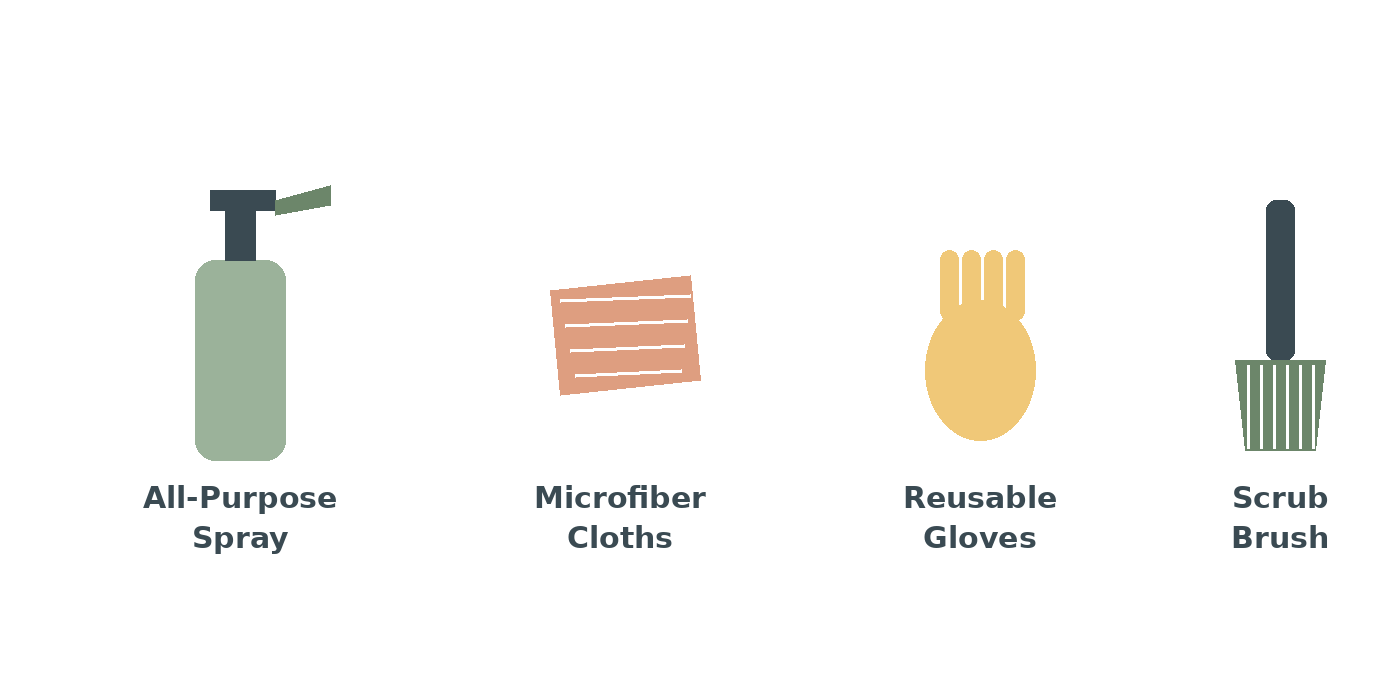
One of the biggest reasons cleaning routines fail is overcomplication — a cabinet with fifteen different specialty sprays, most of which get used once and then forgotten. This kit intentionally sticks to multi-purpose products that can each handle several jobs, so you spend less and store less.
Below is a full starter kit, with realistic average prices at a typical big-box or discount store. Prices will vary slightly by region and store, but this list is designed to land comfortably under $50 total, even with some buffer for local pricing differences.
|
Item |
Approximate Price |
What It’s For |
|---|---|---|
|
All-purpose cleaning spray (one large bottle or concentrate) |
$4 |
Counters, tables, most hard surfaces |
|
Glass and mirror cleaner |
$3 |
Windows, mirrors, glass shower doors |
|
Bathroom cleaner (tub/tile formula) |
$4 |
Tub, shower, tile, sink basin |
|
Toilet bowl cleaner |
$3 |
Toilets |
|
Disinfecting wipes (one canister) |
$5 |
Quick wipe-downs, high-touch surfaces, doorknobs |
|
Microfiber cloths (pack of 6–8) |
$6 |
Dusting, wiping, drying — reusable, cuts down on paper towel spend |
|
Dish soap |
$3 |
Dishes, and diluted for light general cleaning |
|
A sponge and a scrub brush |
$4 |
Dishes and scrubbing stuck-on grime |
|
Reusable rubber gloves |
$3 |
Protects hands during bathroom and dish duty |
|
Broom and dustpan |
$8 |
Daily floor sweeping |
|
A mop (or a mop pad/reusable flat mop) |
$10 |
Weekly floor mopping |
|
Small trash bags (multi-pack) |
$4 |
Bathroom and small bin liners |
|
Baking soda (one box) |
$1 |
Deodorizing, gentle scrubbing, fridge freshening |
|
White vinegar (one bottle) |
$2 |
Streak-free glass, descaling, natural deodorizer |
|
Estimated total |
≈ $47–$50 |
A few notes on this list:
-
Buy concentrates or multi-purpose formulas where you can. A single all-purpose spray can typically handle counters, appliance exteriors, tables, and most hard surfaces, which means you don’t need a separate “kitchen spray” and “living room spray.”
-
Vinegar and baking soda are the unsung heroes of a budget kit. Diluted white vinegar makes a streak-free glass cleaner, and baking soda works as a gentle abrasive for scrubbing sinks or as a fridge deodorizer — both cost next to nothing and last a long time.
-
Microfiber cloths pay for themselves quickly. They can be washed and reused hundreds of times, which means you stop buying paper towels or disposable wipes for routine dusting and wiping.
-
You likely already own some of this. Most households already have a broom or a bottle of dish soap. If so, your actual out-of-pocket cost for this kit will land well under the $50 estimate.
-
Skip single-use “specialty” products at first. Wood polish, stainless steel spray, stone cleaner — these are nice to have eventually, but they are optional upgrades, not starter-kit essentials. Add them later only if you find you genuinely need them for a specific surface in your home.
Optional add-ons, if budget allows later
Once the basics are in place and working for you, a few small additions can make certain tasks easier without breaking the bank:
-
A squeegee for shower glass (keeps water spots from building up)
-
A handheld vacuum for quick pet hair or crumb pickup between full vacuum sessions
-
A caddy or tote to carry supplies from room to room, which saves time and steps
-
Refillable spray bottles paired with concentrate, which is often cheaper per use than pre-mixed sprays
None of these are required to run the schedule below — they’re conveniences, not necessities.
The Five Zones of Your Home
This schedule divides a typical home into five zones. If your home has an unusual layout, feel free to adjust which rooms fall into which zone — the goal is five roughly balanced groupings, not a rigid mapping.
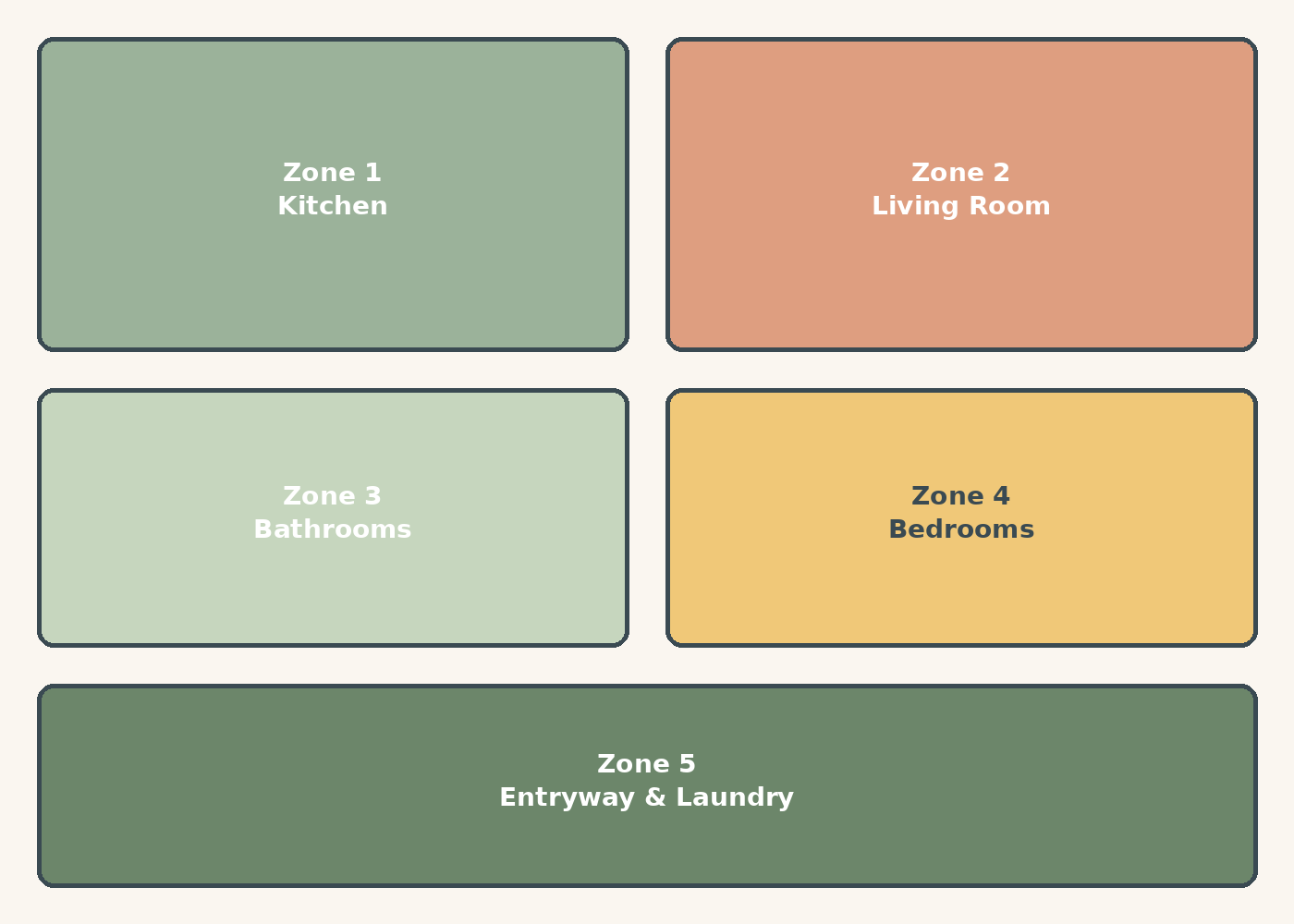
Zone 1 — Kitchen. The highest-traffic, highest-mess room in most homes. Counters, sink, stovetop, appliance exteriors, floor, and trash.
Zone 2 — Living Areas. Living room, family room, dining room — anywhere the household gathers, plays, and relaxes.
Zone 3 — Bathrooms. Every bathroom in the home. Because bathrooms harbor the most germs relative to their size, they get their own dedicated day rather than being lumped in with bedrooms.
Zone 4 — Bedrooms. All bedrooms, including closets and under-bed areas during deep-clean weeks.
Zone 5 — Entryway & Laundry. The transition spaces — front entry, mudroom, hallway, and the laundry room or laundry area — plus laundry itself, which is really its own ongoing task layered on top of the schedule.
The Daily Reset Routine (Under 20 Minutes)
Regardless of which zone is assigned to a given day, every single day includes this short reset. It’s the glue that holds the whole system together, and it’s short enough to do even on your hardest days.
Morning (about 10 minutes):
-
Make the bed. This single task has an outsized psychological effect — a made bed instantly makes a bedroom look tidier, and starting the day with one completed task builds momentum.
-
Start a load of laundry, if needed. Not folding, not putting away — just starting the wash so it’s running in the background while you do everything else.
-
Clear the kitchen sink. Load or start the dishwasher, or hand-wash the handful of dishes from breakfast so the kitchen doesn’t start the day already behind.
-
Quick surface wipe. One pass with a cloth or wipe over the kitchen counter and bathroom sink — the two surfaces that get dirty fastest.
Evening (about 10 minutes):
-
Ten-minute declutter. Walk through the main living areas and return stray items to where they belong — toys back in bins, shoes by the door, mail into its designated spot. This is not a deep clean, just a reset so tomorrow doesn’t start buried.
-
Reset the kitchen. Dishes done or loaded, counters wiped, table cleared.
-
Quick floor check. A fast sweep of the kitchen floor or a once-over with a handheld vacuum in high-traffic spots.
-
Set out tomorrow’s zone supplies. Takes thirty seconds and removes one more decision from tomorrow morning.
That’s the entire daily baseline — roughly twenty minutes split across morning and evening. Everything else below is layered on top of this, one zone at a time.
The Full Weekly Zone Schedule
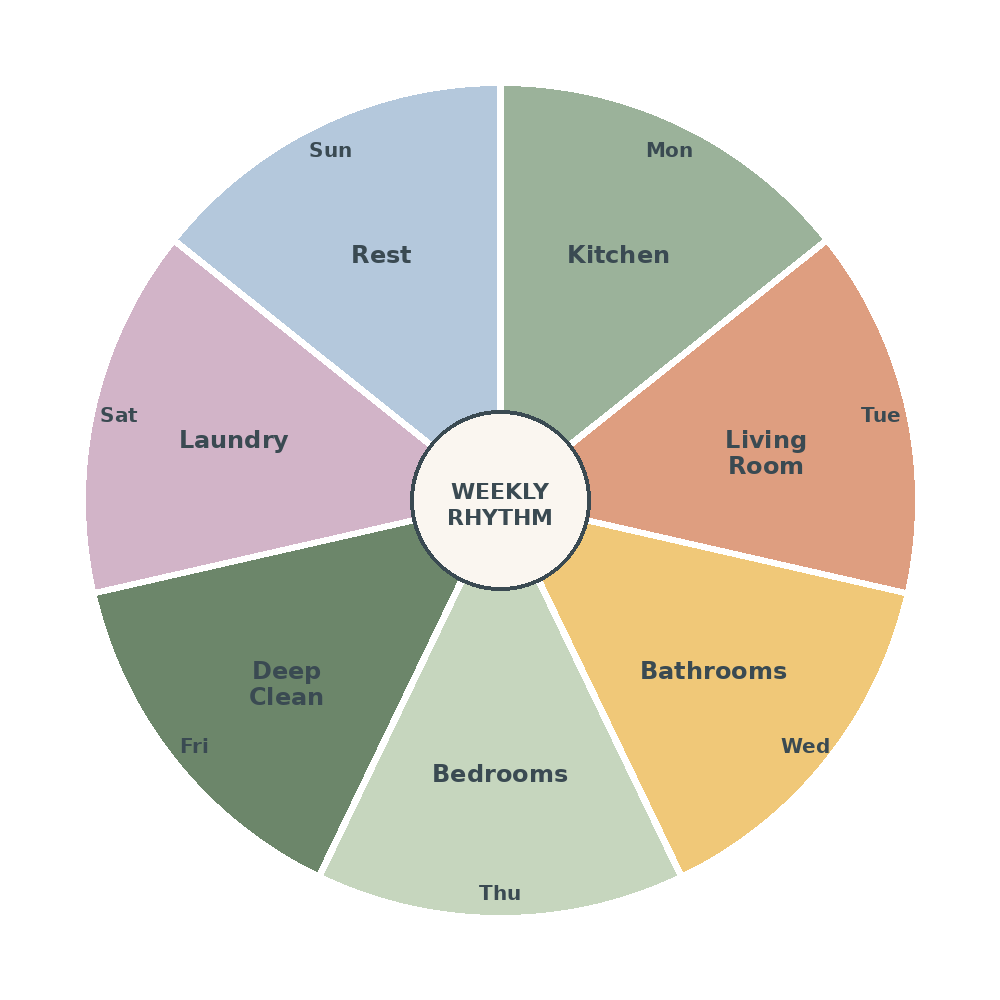
Here is the complete week, zone by zone. Each day’s task is designed to take 20–35 minutes on top of the daily reset above — realistically an hour of total cleaning time on an average day, most of which is quick, repetitive maintenance rather than heavy labor.
Monday — Kitchen
Monday sets the tone for the week, and the kitchen is the room that shows neglect the fastest, so it goes first.
-
Wipe down all counters, backsplash, and the stovetop
-
Clean the outside of major appliances (fridge, oven, microwave, dishwasher)
-
Wipe down small appliances (toaster, coffee maker, kettle)
-
Clean the sink and disinfect the drain area
-
Take out the kitchen trash and recycling, and wipe down the bins
-
Sweep and spot-mop the kitchen floor
-
Wipe cabinet fronts and handles, which accumulate fingerprints and grease over time
Tuesday — Living Areas
-
Dust all visible surfaces: shelves, TV stand, picture frames, lamps
-
Fluff and straighten couch cushions and throw pillows
-
Vacuum upholstered furniture, including crevices where crumbs collect
-
Vacuum or sweep the floor, including under furniture where reachable
-
Wipe down any glass surfaces (coffee table, TV screen with an appropriate cloth)
-
Organize books, remotes, and any accumulated clutter into designated spots
-
Wipe light switches and doorframes, which are touched constantly but rarely cleaned
Wednesday — Bathrooms
-
Scrub the toilet, inside and out, including the base and behind it
-
Clean the tub or shower, including tile grout lines where visible buildup occurs
-
Wipe down the sink, faucet, and counter
-
Clean the mirror with glass cleaner for a streak-free finish
-
Sweep and mop the bathroom floor
-
Empty the small trash bin and replace the liner
-
Restock hand soap, toilet paper, and towels as needed so nothing runs out mid-week
Thursday — Bedrooms
-
Change bed linens (or do this on whichever day works best for your laundry rhythm)
-
Dust dressers, nightstands, and any shelving
-
Vacuum floors, including under the bed if accessible
-
Sort through any surface clutter — clothes that need putting away, items that migrated in from elsewhere in the house
-
Wipe down light switches, doorknobs, and mirrors
-
Quick closet check: return anything that’s ended up on the floor to its hanger or shelf
Friday — Entryway, Laundry & Weekly Catch-Up
Friday is intentionally lighter and more flexible, because by the end of the week, energy is often lowest and unexpected tasks have usually piled up.
-
Wipe down the entryway table, shelf, or bench
-
Sweep or vacuum the entry floor, including under the shoe rack
-
Wipe down light switches and the front door itself, including the handle
-
Catch up on any laundry that’s fallen behind — folding and putting away
-
Wipe down the washer and dryer exterior, and clean the lint trap
-
Handle any task that got skipped earlier in the week — this day exists specifically as a buffer
Saturday — Family Reset (Optional, Shared Task Day)
If you have a partner, older children, or roommates, Saturday works well as a shared, lighter reset day rather than a solo deep-clean day.
-
A ten-to-fifteen minute whole-house tidy, involving everyone in the household
-
Trash and recycling taken out for the week
-
Vacuum any high-traffic areas that need a second pass
-
Wipe down any surfaces missed earlier in the week
Sunday — Rest and Light Planning
Sunday is a true rest day from cleaning. The only “task” is a five-minute glance at the week ahead — checking what groceries or supplies you’re low on, and mentally (or literally) noting anything on the calendar that will affect the coming week’s schedule. Building in a genuine day off is what makes the other six days sustainable; a schedule with no rest built in eventually gets abandoned.
The Monthly Deep-Clean Rotation
On top of the weekly zone schedule, certain tasks only need attention once a month rather than every week. Trying to do these weekly is unnecessary and exhausting; ignoring them entirely lets buildup accumulate. A simple monthly rotation solves this — tackle one deep-clean task per week, layered on top of your normal zone day, so that everything gets covered once a month without ever requiring a single overwhelming “spring cleaning” day.
Week 1 (paired with Kitchen day): – Clean inside the microwave and wipe down interior of the fridge – Wipe down cabinet interiors near the stove where grease tends to settle – Descale the coffee maker or kettle with a vinegar rinse
Week 2 (paired with Living Areas day): – Vacuum under couches and any furniture not moved during weekly cleaning – Dust ceiling fans, light fixtures, and the tops of picture frames or shelves – Wipe down baseboards and door frames in main living spaces
Week 3 (paired with Bathrooms day): – Deep-scrub grout lines with a baking soda paste – Clean the showerhead to clear mineral buildup (a vinegar soak works well) – Wash bathroom mats and shower curtain or liner
Week 4 (paired with Bedrooms day): – Flip or rotate mattresses if applicable, and vacuum the mattress surface – Wash pillows and any bedding not covered in weekly linen changes – Clean out from under the bed fully, including anything stored there – Wipe down window sills and blinds
This rotation means that over the course of a month, every “occasional” task in the house gets handled exactly once, without ever needing a dedicated deep-clean day that swallows your entire weekend.
Cleaning With Kids and Pets in the House
A schedule built for an empty, quiet house doesn’t survive contact with real family life. Here’s how to adapt the plan above when there are small humans and/or animals actively working against your progress.
Involve kids at every age
Even very young children can participate in some way, and involvement early on builds habits that make your job easier later.
-
Toddlers can put toys into a bin, even if imperfectly. The goal isn’t a perfect result — it’s establishing that cleanup is a normal, expected part of the day.
-
Preschool and early elementary age children can wipe low surfaces, help sort laundry by color, or be responsible for their own toy bin.
-
Older children can take on a full task from the schedule — sweeping, vacuuming a room, taking out trash — as an actual contribution rather than a token gesture.
A simple visual chart (even a hand-drawn one on the fridge) works better than verbal reminders for younger kids, since it removes the need for you to repeat instructions all day.
Build in a buffer for interruptions
If you have small children, assume every task will take longer than the “clean” time estimate above, because you will be interrupted. The fix isn’t to clean faster — it’s to build slack into your expectations. If Wednesday’s bathroom cleaning gets cut short by a meltdown or a feeding, finish it after nap time or push it to Friday’s catch-up slot rather than trying to power through in a stressful moment.
Manage pet hair with dedicated tools
Pets add a layer of maintenance that a generic schedule doesn’t account for:
-
A daily thirty-second pass with a handheld vacuum or a lint roller on upholstery keeps hair from building up between full vacuum days
-
Wash pet bedding on the same day as your household linens, so it’s one less thing to remember separately
-
Keep a small dedicated towel near entry points for muddy paws after walks, rather than reaching for whatever cloth is nearby
-
If shedding is heavy, consider adding Saturday’s family reset as a quick vacuum-only pass focused specifically on upholstery and rugs
Lower the bar during hard seasons
Illness, a new baby, a big life transition — there will be stretches where even the daily reset feels like too much. During those seasons, strip the routine down to two non-negotiables: keep the kitchen sink clear, and do a five-minute evening declutter of the main living space. Everything else can pause without the house spiraling into true chaos, and you can pick the full schedule back up once things stabilize.
Where to Find the Best Prices on Your Starter Kit
Staying under $50 is realistic almost anywhere, but where you shop changes how much cushion you have in that budget.
Discount and dollar-type stores are usually the cheapest source for basics like sponges, gloves, small trash bags, baking soda, and white vinegar. These items are simple enough that brand differences barely matter, so buying the cheapest version is rarely a compromise.
Big-box retailers tend to offer the best per-unit pricing on multi-packs — a bulk pack of microfiber cloths or a large bottle of all-purpose spray is typically cheaper per use here than buying single items elsewhere, even if the upfront price looks higher.
Warehouse clubs can be worth it if you already have a membership, particularly for items you’ll restock often, like dish soap or disinfecting wipes, since the cost per use drops significantly at that volume. They’re not worth joining for this list alone, though — the savings only make sense if you’re already a member for other reasons.
Store-brand or generic versions of name-brand cleaners perform comparably for the vast majority of routine tasks. The cleaning agents in generic all-purpose sprays, glass cleaners, and dish soap are usually similar enough to name brands that the difference in results is negligible, while the price difference is not.
Buying concentrates over ready-to-use sprays, where available, stretches your budget the furthest of any single choice on this list. A small bottle of concentrate diluted into a reusable spray bottle can replace several bottles of pre-mixed spray, which meaningfully lowers your ongoing monthly cost even after the initial $50 setup.
A practical approach: do one shopping trip to a big-box or discount store and pick up everything on the list in one pass. Trying to price-match every single item across multiple stores will cost you more in time than it saves you in money — the goal here is a functional, affordable kit, not the theoretically cheapest possible combination of products.
Room-by-Room Quick Reference
For a fast lookup without flipping back through the weekly breakdown, here is every task organized strictly by room.
Kitchen
-
Wipe counters, stovetop, and backsplash (daily light wipe, deeper clean weekly)
-
Clean sink and disinfect drain
-
Wipe appliance exteriors
-
Take out trash and recycling
-
Sweep and mop floor
-
Wipe cabinet fronts and handles
-
Monthly: clean microwave and fridge interior, descale coffee maker
Living Room / Family Room
-
Dust shelves, frames, and lamps
-
Vacuum upholstery and floors
-
Straighten cushions and throws
-
Wipe glass surfaces
-
Wipe light switches and doorframes
-
Monthly: vacuum under furniture, dust fans and fixtures, wipe baseboards
Bathrooms
-
Scrub toilet, tub/shower, and sink
-
Clean mirror and faucet
-
Sweep and mop floor
-
Empty trash and restock supplies
-
Monthly: deep-clean grout, clean showerhead, wash mats and curtain
Bedrooms
-
Make bed daily; change linens weekly
-
Dust surfaces and vacuum floor
-
Return stray items to their place
-
Wipe switches, knobs, and mirrors
-
Monthly: rotate mattress, wash pillows, clean under bed, wipe sills and blinds
Entryway & Laundry
-
Wipe entry surfaces and sweep floor
-
Wipe door and handle
-
Keep laundry moving daily; fully catch up weekly
-
Wipe washer/dryer exterior and clean lint trap
DIY Cleaning Solutions: Stretching Your $50 Even Further
Part of keeping this kit under $50 is leaning on a couple of pantry staples that double as effective cleaners. Vinegar and baking soda aren’t just cheap filler items on the list — they genuinely replace several specialty products you’d otherwise be buying separately. Here are a few simple mixes worth knowing.
All-purpose vinegar spray. Mix equal parts white vinegar and water in a spray bottle. This works well on counters, glass, and most sealed hard surfaces, and costs a fraction of a pre-made spray per use. Avoid it on natural stone (marble, granite) since the acidity can etch the surface over time — stick to your all-purpose spray there instead.
Baking soda scrub paste. Mix baking soda with a small amount of water until it forms a thick paste. This works as a gentle abrasive for scrubbing sinks, tubs, and grout without scratching most surfaces, and it’s especially useful for the monthly grout deep-clean.
Showerhead descaling soak. Fill a small bag with white vinegar, secure it around the showerhead with a rubber band so the head is fully submerged, and let it sit for an hour or two. This clears mineral buildup without any scrubbing at all.
Garbage disposal freshener. Freeze small amounts of vinegar in an ice cube tray, then run a few cubes through the disposal. It cleans blades and neutralizes odor at the same time.
Coffee maker descale. Run a cycle of equal parts water and vinegar through an empty coffee maker, followed by one or two cycles of plain water to rinse. This is the same task listed in the monthly rotation, and it costs essentially nothing to perform.
None of these replace your bathroom or toilet cleaner — some jobs genuinely benefit from a purpose-built formula, especially for disinfecting. But for a meaningful share of routine tasks, pantry staples can do real work, which is exactly how this kit stays under budget even in areas with higher retail prices.
Storing and Organizing Your Supplies
A cleaning kit that’s scattered across three different cabinets slows you down every single day, because half of your daily reset time gets eaten up just locating what you need. A little organization up front pays off immediately.
Keep one central location. Whether it’s a caddy, a bin under the kitchen sink, or a shelf in a hall closet, store the bulk of your supplies in one place. You’ll grab the whole kit and carry it zone to zone rather than hunting room by room.
Keep a small satellite kit in each bathroom. Since bathrooms need frequent quick wipes, a small container with a spray bottle and a cloth kept under each bathroom sink saves you a trip every time.
Store broom, mop, and vacuum together. Floor tools take up space and are annoying to search for; a designated corner — a closet, the back of a pantry, a mudroom nook — keeps them accessible instead of buried behind other items.
Label bins if multiple people use the kit. In a household where kids or a partner are pitching in, a simple label on the caddy (“bathroom kit,” “kitchen kit”) means anyone can grab the right supplies without asking you where things are, which quietly saves you dozens of small interruptions over a month.
Do a supply check every few weeks. Glance through your kit around the same time you’re restocking bathroom essentials (soap, toilet paper) and top up anything running low. Running out of all-purpose spray mid-week is a small thing, but it’s exactly the kind of small thing that derails a routine if you let it.
A Realistic Day in the Life of This Schedule
It can help to see how this actually plays out in a normal, imperfect day, rather than just reading the task list in the abstract. Here’s what a Wednesday — bathroom day — might genuinely look like in a home with young kids.
7:15 a.m. Bed gets made while a toddler “helps” by removing every pillow immediately afterward. It gets remade. A load of towels goes into the wash.
7:40 a.m. Breakfast dishes go straight into the dishwasher instead of sitting in the sink. Counter gets one quick wipe with a cloth that’s already out from the day before.
9:00 a.m. During a stretch of independent play, the toilet gets scrubbed and the tub gets a quick scrub with the baking soda paste left over from the weekend. This takes about eight minutes, interrupted once to referee a dispute over a toy.
11:30 a.m. During nap time, the bathroom mirror and sink get wiped, the floor gets swept and spot-mopped, and the trash bin liner gets replaced. Fifteen minutes, no interruptions, genuinely satisfying.
5:30 p.m. After dinner, the kitchen gets its evening reset — dishes loaded, counters wiped, table cleared. This happens regardless of what zone day it is, because it’s part of the daily baseline, not the weekly rotation.
7:45 p.m. The ten-minute evening declutter happens while a partner handles bedtime, or vice versa, depending on the night. Toys back in bins, shoes by the door, the living room reset for tomorrow.
Total dedicated cleaning time for the whole day: roughly thirty-five minutes, spread across five short windows rather than one long session. Nothing here required a quiet, empty house — it required short pockets of time and a plan for exactly what to do with them.
Seasonal Adjustments: Spring and Fall Resets
The weekly and monthly rotations above will keep a home consistently clean year-round, but two points in the year are worth a slightly bigger — though still manageable — push: a spring reset and a fall reset. Neither needs to be a marathon weekend; spread each one across a normal week by adding one extra task per day on top of your usual zone.
Spring reset ideas: – Wash windows inside and out, including screens – Wipe down and reorganize pantry and cabinet interiors – Rotate seasonal clothing — pack away heavy items, bring lighter ones forward – Deep-clean or replace air filters – Wipe down baseboards throughout the entire house, not just the living room – Wash curtains or blinds
Fall reset ideas: – Check and clean out gutters if applicable to your home – Deep-clean the oven interior – Wash heavier bedding and blankets before they go back into rotation – Wipe down entryway areas more thoroughly, anticipating muddy-weather traffic – Restock the cleaning kit fully ahead of the busier indoor season – Check smoke detectors and replace batteries while you’re already in a whole-home mindset
Treating these as light additions — one extra fifteen-minute task layered onto an existing zone day — keeps them from turning into the overwhelming “spring cleaning weekend” that most people dread and then avoid altogether.
Making the Schedule Stick: Practical Troubleshooting
Even a well-designed schedule falls apart without a plan for the moments it gets hard to follow. Here are the most common sticking points and how to work through them.
“I fell behind for a week and now I feel like starting over is pointless.” You don’t need to catch up on missed days — you need to resume today’s scheduled zone and let the rest go. A schedule is not a debt that accumulates; it’s a rhythm you can rejoin at any point without penalty.
“I don’t have time for even twenty minutes some days.” On those days, do only the two non-negotiables mentioned earlier — clear the kitchen sink and a five-minute evening declutter. Everything else waits until tomorrow. Missing one zone day doesn’t collapse the whole system; it just means that zone gets slightly more attention next week.
“My house never looks ‘done’ because someone messes it up right behind me.” This is normal, especially with young kids or pets, and it’s worth mentally separating two different goals: maintained versus magazine-ready. This schedule is designed to produce a maintained home — clean, functional, never spiraling — not a home that looks staged at every hour. Aiming for the wrong goal is what makes the right one feel like failure.
“I keep forgetting which zone is today’s.” Put the weekly wheel or a simple written list somewhere you’ll actually see it — the fridge, a kitchen cabinet, a note on your phone’s lock screen. The goal is zero mental effort to recall the plan; if you have to think hard about what today’s task is, the system has too much friction.
“Everyone else in the house ignores the schedule.” A schedule works best when it’s visible and shared, not something only one person carries silently. A simple posted chart, plus assigning even one small task to each household member, turns “my chore list” into “our routine” — which tends to get far more buy-in over time.
“I started strong but I’m losing steam a few weeks in.” This is one of the most common points where routines quietly fall apart, and it usually isn’t a sign the system has failed — it’s a sign the initial motivation has worn off and habit hasn’t fully taken its place yet. This is exactly the gap the daily reset is designed to bridge: it’s short enough to keep doing on momentum alone, even when enthusiasm has faded, and consistency through this stretch is usually what determines whether a routine sticks long-term or gets abandoned. If it helps, revisit the printable checklist and simply recommit to one week at a time rather than thinking about the schedule as a permanent lifestyle change you either succeed or fail at.
“I don’t know if I’m spending too much or too little on supplies.” If your total spend is creeping well past the $50 estimate, check whether you’ve drifted into buying single-purpose specialty products for jobs your all-purpose spray or vinegar solution could already handle. If you’re spending far less than $50 and running out of things constantly, you may be buying the smallest available size of everything — slightly larger bottles of your most-used items (all-purpose spray, dish soap) are usually a better value per use, even though the upfront price looks bigger on the shelf.
Frequently Asked Questions
Do I really need all the products on the supply list, or can I substitute what I already have? Substitute freely. The list is a type of product in each category (an all-purpose spray, a bathroom cleaner, a floor tool), not a specific brand requirement. If you already own something that serves the same function, use it and put the savings toward whatever you’re missing.
How long until this schedule starts to feel automatic? Most people report that a routine starts to feel like habit rather than effort somewhere around the three-to-four week mark, provided it’s followed consistently even in a scaled-down form on hard days. Consistency matters far more than intensity.
What if my home only has one or two bathrooms, or no separate laundry room — should I still use five zones? The five zones are a starting framework, not a fixed rule. If your home’s layout doesn’t map cleanly onto five balanced areas, combine or split zones so that each day’s workload feels roughly even. The goal is balance, not adherence to an exact number.
Should I clean the same zone on the same day every single week, forever? Sticking to a fixed day builds the automatic quality that makes a schedule sustainable, since you stop having to decide anything. That said, if a particular day consistently conflicts with your actual life (a recurring appointment, a specific errand day), swap it permanently rather than fighting the calendar every week.
Is it worth buying a robot vacuum or other cleaning gadgets to speed this up? Gadgets can help once your budget allows for them, but they are optional accelerators, not requirements. This entire schedule is designed to work with the basic under-$50 kit and manual effort; anything beyond that is a comfort upgrade, not a prerequisite for success.
What’s the single most important habit in this whole system? If only one habit survives a chaotic week, make it the evening ten-minute declutter. A home that’s merely tidy — even if it’s not deep-cleaned — feels dramatically calmer than a home that’s clean under the surface but visually chaotic on top. Clutter control has the highest impact-to-effort ratio of anything in this guide.
I have a larger home with more than five obvious “zones” — should I add more days? You can, but consider combining lighter zones instead of stretching the schedule past a seven-day week. For example, a home office or a formal dining room that rarely gets used can be folded into the living areas day rather than becoming its own dedicated zone. The point of five zones is balance and simplicity, not exact one-to-one matching with every room in the house.
Can this schedule work if I also work part-time or from home? Yes — the daily reset and weekly zone structure are intentionally short enough to fit around a partial work schedule. The main adjustment is usually shifting which time block (morning or evening) carries more of the load, depending on when you’re actually home and available. Some people front-load tasks before logging on for work; others push everything to the evening. The structure holds either way.
What if I genuinely hate cleaning and no schedule makes it enjoyable? That’s fair, and this system won’t manufacture enjoyment out of nothing. What it can do is shrink the task down to something small enough that it doesn’t require motivation — twenty minutes is short enough to do on autopilot, the way you might unload a dishwasher without particularly wanting to. Pairing tasks with something you do enjoy, like a podcast, playlist, or phone call with a friend, can also make the time pass without needing to “want” to clean in the first place.
Do I need to follow the days in this exact order — kitchen on Monday, bathrooms on Wednesday, and so on? No. The specific day-to-zone pairing here is a sensible default, not a rule. What actually matters is that each zone has one dedicated day and that the order repeats consistently week to week, so your brain stops having to decide and starts just following the pattern. Feel free to reorder the days to match your own rhythm — for instance, bathrooms on Monday if that’s when you have the most energy, or kitchen at the end of the week if that fits your grocery and meal-prep schedule better.
Should older kids get an allowance tied to their piece of this schedule? That’s a personal family decision rather than a cleaning one, but many households do find that tying a small chore from this list to an allowance increases follow-through, especially for tasks like taking out the trash or vacuuming a single room. If you go this route, keep the assigned task simple and consistent rather than rotating it constantly, for the same reason the whole schedule benefits from repetition — it removes the need for negotiation every single week.
How This Compares to Hiring Help
It’s worth putting the under-$50 number in context. Professional house cleaning services typically charge per visit based on square footage and the level of cleaning required, and a single visit from a professional cleaner commonly costs somewhere in the range of a hundred dollars or more, with deep cleans running higher still. Even a modest schedule of professional cleaning — say, once every few weeks — adds up to a recurring expense that most single-income or stay-at-home households would rather avoid or can’t fit into a budget at all.
This is where the math on a DIY kit becomes compelling. A one-time purchase of under $50 in supplies, most of which last for months, replaces an ongoing service that could otherwise cost hundreds of dollars a month. The tradeoff, of course, is time and effort rather than money — you’re doing the labor a professional would otherwise do. But because this schedule breaks that labor into short, spread-out sessions rather than one long cleaning day, the time cost per day is genuinely small: roughly an hour total, split across morning, daytime pockets, and evening, rather than a multi-hour block.
For households where budget is the primary constraint — which describes most single-income and stay-at-home arrangements — this trade of time for money is usually the only realistic option anyway. The value of a structured schedule is that it makes the time cost feel manageable rather than overwhelming, which is the difference between a routine you keep and one you eventually give up on and either let slide or begrudgingly pay someone else to handle.
If your budget ever does allow for occasional professional help, a hybrid approach works well: keep running your own weekly and monthly rotation, but bring in a professional deep clean once or twice a year for the heaviest tasks — carpets, upholstery steam cleaning, or exterior window washing — that benefit from equipment most households don’t own. This isn’t necessary to keep a clean home using this guide, but it’s a reasonable middle ground if and when it fits your budget.
Mindset: Letting Go of Comparison and Guilt
A large amount of the emotional weight around home cleanliness has nothing to do with the actual state of your house and everything to do with comparison — to a neighbor’s home, to a friend’s social media post, to an influencer’s staged “cleaning day” video, or simply to some imagined standard of what a “put-together” home is supposed to look like at all times.
It’s worth naming this directly: almost no one’s home looks consistently spotless behind closed doors, including the homes that appear that way online. Photos and videos capture a single staged moment, not a representative sample of a Tuesday afternoon with kids home from school. Measuring your actual, lived-in home against a curated image of someone else’s best five minutes is not a fair comparison, and it’s not a useful motivator — it tends to produce guilt and burnout rather than lasting change.
The schedule in this guide is designed around a more useful measure: is the home functional, reasonably clean, and not a source of ongoing stress? That’s a bar every household can realistically hit with consistent small effort, regardless of square footage, number of kids, or number of pets. It’s also a bar that holds up even on weeks when life gets in the way — sickness, travel, a busy work stretch, a new baby — because “functional and reasonably clean” bends without breaking, while “always spotless” collapses the moment anything goes wrong.
If you notice yourself feeling discouraged partway through adopting this routine, that’s a good moment to revisit the philosophy section near the beginning of this guide: zones instead of whole-house pressure, small and frequent instead of big and rare, and “good enough” as the actual, legitimate goal — not a consolation prize for falling short of something else.
Printable Weekly Checklist
If you’d like something simple to post on the fridge, here is the entire week condensed into a single checklist format. Print it, screenshot it, or copy it into your own notes app — whatever makes it most likely you’ll actually glance at it each morning.
|
Day |
Zone |
Key Tasks |
|---|---|---|
|
Daily (every day) |
Reset |
Make bed · start/handle laundry · clear kitchen sink · quick counter wipe · 10-minute evening declutter |
|
Monday |
Kitchen |
Wipe counters & stovetop · clean sink · appliance exteriors · trash out · sweep & mop floor |
|
Tuesday |
Living Areas |
Dust surfaces · vacuum upholstery & floors · straighten cushions · wipe glass & switches |
|
Wednesday |
Bathrooms |
Scrub toilet & tub/shower · clean sink & mirror · sweep & mop · empty trash · restock supplies |
|
Thursday |
Bedrooms |
Change linens · dust & vacuum · clear surface clutter · wipe switches & mirrors |
|
Friday |
Entryway & Laundry |
Wipe entry surfaces · sweep entry floor · catch up laundry · wipe washer/dryer & lint trap |
|
Saturday |
Family Reset |
Shared 10–15 minute whole-house tidy · trash out · high-traffic vacuum pass |
|
Sunday |
Rest |
Five-minute look-ahead at the week; no cleaning required |
Keep this checklist somewhere visible, and pair it with the weekly rhythm diagram from earlier in this guide if a visual, at-a-glance reminder works better for your household than a text list. Some people do best with both — a checklist for the details and a simple wheel or chart for the quick daily glance.
Final Thoughts: Consistency Over Perfection
A cleaning schedule is not a performance metric, and it’s not a measure of how good a homemaker, parent, or partner you are. It’s simply a tool — a way to remove decision fatigue, prevent small messes from snowballing into weekend-consuming projects, and keep your home functional without requiring hours of daily labor.
The version of this schedule that actually works for you might look a little different from the one laid out here, and that’s not just fine — it’s expected. Swap zones, shift days, lower the bar during hard weeks, and let the family reset day be genuinely shared rather than another item on your own plate. The framework matters more than the exact details: small, frequent effort; a simple and affordable supply kit; zones instead of whole-house overwhelm; and permission to have an off day without falling apart.
Start with the under-$50 kit, pick one zone to tackle first, and build from there. In a few weeks, you won’t be thinking about the schedule at all — you’ll just be doing it, the same way you brush your teeth without deliberating over whether today is a tooth-brushing day.