
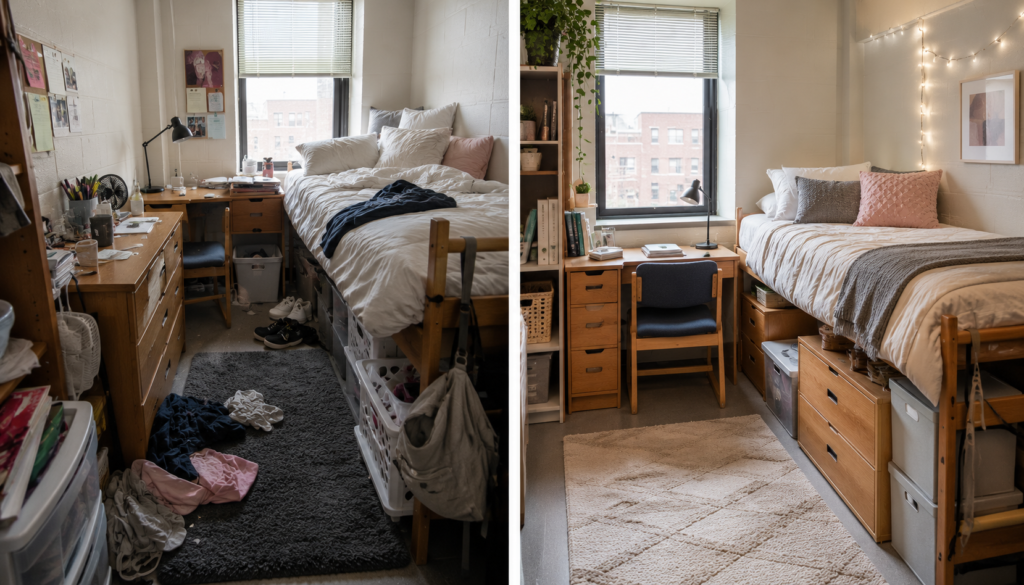
Most dorm rooms are somewhere between 130 and 180 square feet — shared with another person, packed with mandatory furniture you didn’t choose, and lit by a single overhead fixture that flatters absolutely no one. If you’ve searched college bedroom ideas or dorm bedroom ideas hoping for a magic layout trick, the honest truth is there’s no single hack that turns a tiny room into a spacious one. What there is, though, is a set of genuinely effective techniques — rooted in how the eye actually perceives space — that make a small room feel considerably larger, calmer, and more intentional than it did when you walked in on move-in day.
This guide focuses specifically on the bed, since it’s almost always the single largest object in a dorm room and therefore the biggest lever you have for changing how the whole space feels. We’ll cover color strategy, furniture placement, storage that doesn’t eat floor space, lighting tricks, and the specific small-space mistakes that make rooms feel more cramped than they need to. Everything here is genuinely achievable within standard dorm restrictions — no drilling, no permanent alterations, nothing that violates a typical housing agreement.
It’s worth saying upfront that a small room is not a design limitation to apologize for. Some of the coziest, most-loved dorm rooms are the tiniest ones, precisely because the scale forces intentional choices rather than filling space just because it’s available. The goal isn’t to trick anyone into thinking the room is bigger than it is — it’s to make the actual square footage you have feel calm, functional, and like a place you genuinely want to spend time in.
There’s also a practical reason to get this right beyond aesthetics: a genuinely well-organized, visually calm small room measurably reduces daily stress. Clutter and visual chaos have a documented effect on cognitive load, and a dorm room that feels like it’s fighting you every time you walk in — searching for a place to put your bag, tripping over something on the floor, unable to find a clear surface to study on — adds friction to an already demanding schedule. Every technique in this guide is doing double duty: making the room look better in photos, and making it function better in the mundane, unglamorous reality of daily college life.
Color Strategy for Small Rooms
Color is the single highest-leverage tool for changing how spacious a small room feels, and it costs nothing extra to use it correctly — you’re choosing a color either way, so choosing strategically is free.
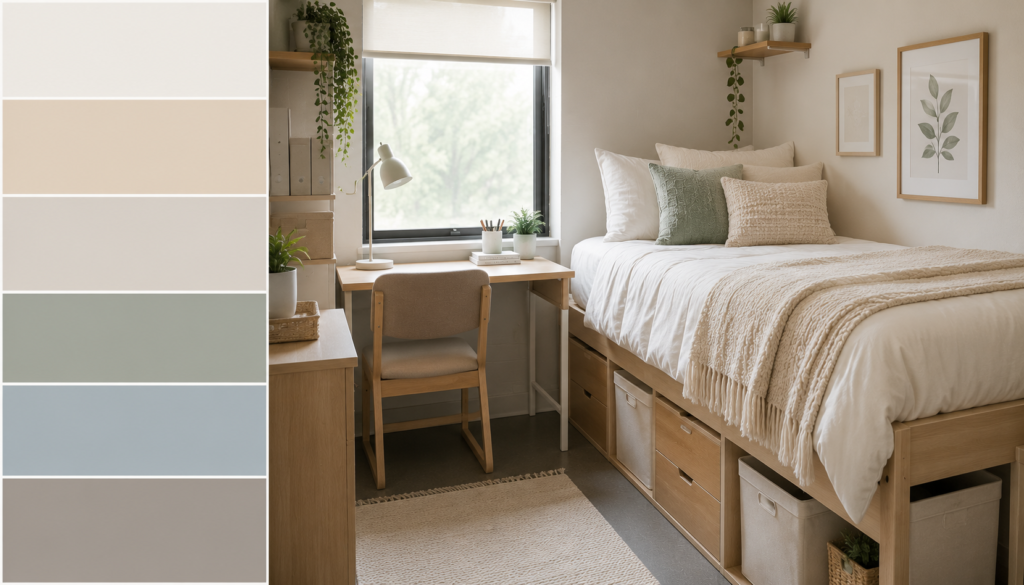
Lighter, warmer neutrals — cream, soft sand, warm white, pale sage — reflect more ambient light around a room than dark or highly saturated colors, which makes the space read as brighter and, by extension, larger. This doesn’t mean every piece needs to be white; it means your largest surface area (the bed, since it dominates the room’s visual field) benefits most from staying in this lighter range, while bolder colors work better concentrated into smaller accent pieces.
Color continuity matters just as much as color choice. A room where the bedding, curtains, and rug all pull from the same tight color family reads as significantly more spacious than a room with the same total amount of color spread across jarring, unrelated hues, even if the individual pieces are each perfectly nice on their own. The eye interprets visual busyness as complexity, and complexity in a small space reads as clutter, regardless of how expensive or well-made each individual piece actually is.
One genuinely underused trick: matching your bedding tone closely to your wall color (many dorms are painted a neutral cream, beige, or white) removes a visual boundary between the bed and the wall behind it, which makes the whole corner of the room blend together rather than reading as a distinct, boxed-in block of furniture. This is especially effective for beds pushed against a wall, which describes the vast majority of dorm bed placements.
It’s worth addressing the elephant in the room: cinderblock walls, which a huge percentage of older dorm buildings still have, are genuinely one of the hardest surfaces to design around, since their texture and often institutional gray or beige paint color actively works against the soft, warm palette that makes small rooms feel larger. If you’re stuck with visible cinderblock, leaning even more heavily into warm bedding tones and adding a floor-length curtain or fabric wall hanging to break up the hard, cold surface makes a disproportionately large difference compared to a dorm room with smoother, already-neutral walls.
Furniture Placement That Actually Works
Most dorm furniture is fixed or semi-fixed — you’re rarely choosing between wildly different layouts, but the small adjustments you can make matter more than they might seem to at first glance.
If your school allows lofting or bunking (many do, some require it), raising the bed to create usable floor space underneath is consistently the single highest-impact change you can make in a small room. Even a partial loft — risers that raise the bed twelve to eighteen inches rather than a full ceiling-height loft — opens up storage bins, a small ottoman, or simply visual breathing room underneath that a floor-level bed frame completely blocks off.
Positioning the bed to run along the longest wall, rather than the shortest one, generally preserves more usable open floor space in the center of the room, giving you a clearer walking path and more flexibility for other furniture. If you have any flexibility in where the desk, dresser, and bed sit relative to each other, grouping taller furniture pieces along one wall and keeping the opposite wall clearer creates a sense of visual balance that a room with furniture scattered on every wall doesn’t achieve.
Floating a piece of furniture away from the wall, even by a few inches, sometimes feels like it should save space by pushing everything as far to the perimeter as possible, but in genuinely tiny rooms this often backfires by creating awkward, unusable gaps. In an 8×12 room specifically, furniture flush against the walls almost always outperforms floating furniture for maximizing usable open space.
It’s also worth thinking about traffic flow, not just furniture placement in isolation. Walk through the actual physical path you’ll take multiple times a day — from the door to your bed, from your bed to your desk, from your desk to the closet — and make sure that path stays as straight and unobstructed as possible. A room that looks well-arranged in photos but forces you to awkwardly angle around furniture every time you move through it will feel more cramped in daily life than the visual layout alone would suggest.
Storage That Doesn’t Eat Floor Space
Floor space is the scarcest resource in a small dorm room, which means storage solutions that use vertical space or hidden pockets (under the bed, behind the door, on the wall) are dramatically more valuable than anything that takes up additional floor footprint.
-
Bed risers paired with fabric storage bins turn the space under your bed into genuine storage capacity without adding a single new floor-standing piece of furniture.
-
Over-the-door organizers use vertical space that’s otherwise completely wasted, and they work for shoes, toiletries, accessories, or even folded clothing in a pinch.
-
Command-hook wall organizers keep frequently used items (bags, jackets, a small mirror) off surfaces entirely, which visually declutters the room even though the physical items still exist somewhere in it.
-
A slim rolling cart that fits in the narrow gap between a bed frame and the wall adds functional storage in a space most students don’t even realize is usable.
-
Stackable storage cubes that double as a nightstand accomplish two jobs (storage and a flat surface) in the footprint of one, which matters enormously when every square foot is accounted for.
-
A hanging closet organizer with multiple shelves can meaningfully expand a standard dorm closet’s capacity without needing any additional floor-standing dresser at all.
A Note on Storage Overload
It’s worth flagging a common overcorrection: some students, once they discover how much storage capacity these solutions unlock, end up filling every single one of them and bringing far more physical belongings to school than the room can comfortably hold, even with every storage trick maximized. More storage capacity should generally translate into a calmer, less cluttered room — not simply an excuse to bring more stuff. If you find yourself needing every single storage solution in this section simultaneously, it’s worth honestly reconsidering how much you’re bringing in the first place, since a small room with too many possessions will feel cramped no matter how cleverly those possessions are stored.
Lighting Tricks for Small, Windowless-Feeling Rooms
Dorm room lighting is almost universally bad by default — a single harsh overhead fixture that casts flat, unflattering light across the entire room with no ability to adjust warmth or intensity. Fixing this is one of the most impactful, least expensive upgrades available for making a small room feel bigger and considerably more livable.
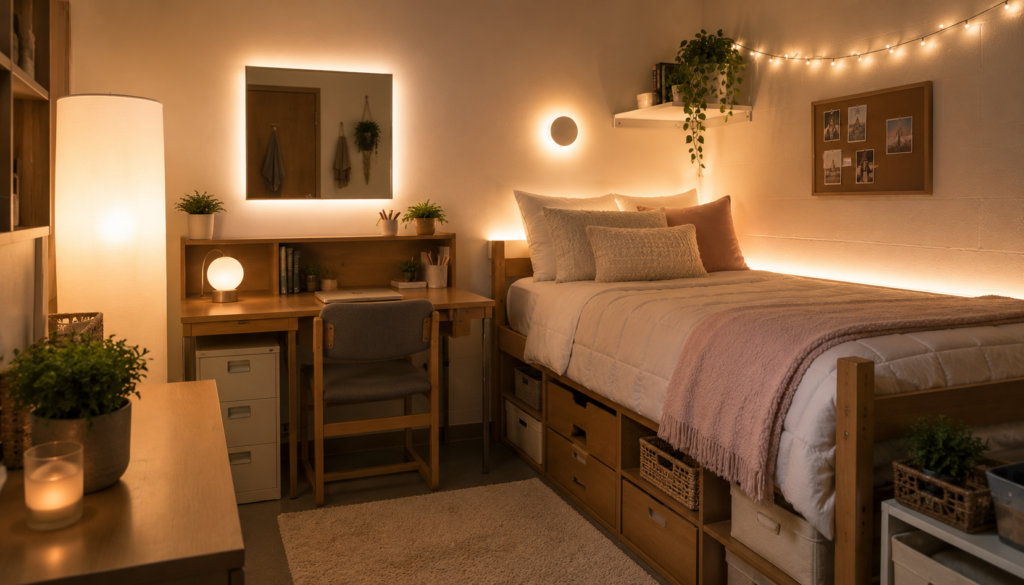
Layering multiple light sources at different heights (a floor or desk lamp, string lights along the bed frame, a small clip light near a reading nook) does more to make a room feel spacious than any single bright light source ever could, since varied lighting creates depth and shadow that a single flat overhead light flattens out entirely. Warm-toned bulbs (look for “soft white” or 2700K-3000K on the packaging) consistently read as cozier and more flattering than the cooler, bluer light many dorm-issued fixtures default to.
Mirrors placed to reflect a light source or a window meaningfully amplify how much light bounces around a small room, which is part of why a well-placed mirror is one of the most consistently recommended small-space tricks across every design tradition, not just dorm decorating specifically. A mirror positioned across from — rather than beside — your main window will reflect the most usable daylight back into the room.
Dimmable options, where available, add another layer of flexibility that fixed-brightness lighting can’t match — the ability to shift from bright, task-focused lighting during study sessions to soft, low lighting in the evening changes how the same physical room feels at different times of day, which is a genuinely underrated way to make one small space feel like it serves multiple different moods and functions without adding any new furniture or decor at all.
Scale: Why Smaller Isn’t Always Better
It’s a common instinct to assume that everything in a small room should be small, but this actually works against you more often than it helps. A room filled entirely with tiny decorative objects reads as busy and cluttered, since the eye has to process many small individual items rather than resting on a few larger, more cohesive ones.
One or two appropriately-scaled statement pieces — a full-size patterned duvet cover rather than five small mismatched accent pillows, for instance — almost always reads as calmer and more intentional than the same visual “weight” spread across many tiny items. This is part of why the minimalist aesthetic (covered in our dorm bed ideas by style guide) tends to perform especially well in small rooms specifically: fewer, larger, more considered pieces genuinely does make a tiny space feel bigger, not smaller.
The exception to this rule is pattern scale specifically — very large-scale patterns can visually overwhelm a small surface area, making a small room feel like it’s fighting against an oversized print. Small to medium-scale patterns generally translate better onto dorm-sized furniture than the large, bold prints that read beautifully in a full-size bedroom but can feel cramped and busy on a Twin XL bed in a tiny room.
This same scale logic extends to decorative objects beyond textiles. A single medium-to-large plant in a simple pot generally does more for a small room than a cluster of five tiny succulents scattered across different surfaces, even though the succulents might individually take up less space — the eye processes one larger object as one simple decision, while five small objects require five separate visual processing steps that add up to a busier, more effortful room to look at, even at a smaller total physical volume.
The Vertical Space You’re Probably Ignoring
Most students think exclusively in terms of floor space when problem-solving a small dorm room, but the walls and the space above eye level represent genuinely untapped square footage that doesn’t compete with anything else in the room.
A canopy or curtain draped above the bed draws the eye upward, which has a well-documented effect of making a room feel taller and more spacious than the actual ceiling height would suggest. This works even in dorms with standard eight-foot ceilings, since the trick relies on directing visual attention upward rather than requiring genuinely tall architecture to begin with.
Floating shelves above a desk or bed headboard area add storage and display space without consuming any floor footprint at all, and they’re one of the few storage solutions in a dorm room that can be installed with removable command-strip hardware, keeping your security deposit intact. Vertical striped patterns, whether in curtains, a rug, or bedding, subtly reinforce the same upward visual pull, making a room feel taller even though the actual dimensions haven’t changed.
It’s worth noting that vertical space strategies compound with each other rather than working in isolation — a room with both a canopy above the bed and floating shelves nearby creates a more pronounced height illusion than either element would on its own, since the eye picks up multiple consistent cues pulling attention upward rather than just one. If you’re only able to implement one vertical-space idea from this section, the canopy or curtain above the bed tends to produce the most noticeable single effect, simply because it sits directly above the room’s largest and most visually dominant piece of furniture.
Move-Out and End-of-Year Considerations
Small-space strategies that work beautifully during the school year should also be chosen with move-out day in mind, since a genuinely well-planned small room setup makes the end of the semester significantly less stressful than one built entirely around permanent-feeling solutions.
Every recommendation in this guide has been chosen specifically because it’s removable, portable, or genuinely reusable in a future dorm room or apartment — command-strip hardware peels away cleanly, bed risers and storage bins pack flat or nest inside each other for transport, and rugs, curtains, and bedding all travel easily between years. This matters more than it might seem to during the excitement of move-in, but it becomes very relevant during the chaotic, deadline-driven scramble of finals week move-out.
A small additional tip worth building into your routine from day one: keep the original packaging or a small parts bag for any command-strip hardware, tension rods, or shelf brackets somewhere accessible (a drawer, a labeled bin) rather than discarding it immediately. This makes reassembly the following year, or a mid-year adjustment if your needs change, considerably faster than starting the whole small-space setup process completely from scratch.
Rugs and Floor Treatment in Tiny Rooms
A rug seems like a small decorative afterthought, but it does real work in defining and expanding how a small room feels underfoot. A rug that’s too small for the room actually makes the space feel smaller and more disjointed, since it creates a visual island rather than grounding the furniture around it.
As a general rule, a rug should extend at least partially under the bed frame (or at minimum reach the front edge of the bed) rather than floating as a small, disconnected rectangle in the middle of open floor space. This creates a sense of a unified, larger floor plane rather than fragmenting the small square footage you do have into visually separate zones.
Lighter-toned, low-pile rugs read as more spacious than dark, high-pile ones, following the same color and texture logic covered in the earlier color strategy section. If your dorm doesn’t allow rugs or you’re concerned about the cost given how much of the floor a proper rug requires, even a smaller bath-mat-sized rug placed specifically at the side of the bed where your feet land each morning adds warmth and softness without needing to cover the entire floor.
Rug shape is also worth considering alongside size and color. A rectangular rug that echoes the room’s own proportions tends to look more intentional than a round or irregularly shaped rug dropped into a space that’s fundamentally rectangular, since the mismatched geometry creates a subtle visual tension most people notice without being able to identify why the room feels slightly off. Sticking with a rug shape that mirrors your room’s actual footprint is a small detail that consistently produces a more cohesive, put-together result.
Curtains, Room Dividers, and Softening Hard Edges
Dorm rooms are full of hard, institutional surfaces — cinderblock walls, laminate furniture, metal bed frames — and softening even a few of these edges with fabric makes a measurable difference in how cramped or cozy the space feels overall.
If your window comes with the standard, often slightly-too-short dorm blinds, adding a curtain rod (using a tension rod or removable brackets to stay within most housing agreements) and a floor-length curtain panel elongates the visual line of the wall and makes the ceiling feel taller by extension, similar to the canopy effect covered above.
For students sharing a room, a lightweight curtain or fabric room divider — even just a single panel on a tension rod between two beds — can create a sense of visual privacy and personal territory in a shared small space without requiring any actual construction or a physical partition, which most housing agreements prohibit anyway.
Curtain color and weight follow the same principles covered throughout this guide: lighter-weight, lighter-toned fabric generally supports a spacious feeling better than heavy, dark drapery, though a single heavier curtain panel can work well as an intentional accent if the rest of the room stays light. Sheer or semi-sheer curtain fabric is worth considering specifically for small rooms with limited natural light, since it softens the window without blocking as much daylight as a fully opaque, blackout-style curtain would.
Multi-Functional Furniture Choices
In a room this size, every piece of furniture should ideally do more than one job, since there simply isn’t room to dedicate separate objects to separate single functions the way you might in a larger space.
A storage ottoman at the foot of the bed works as extra seating for a friend, a footrest, and hidden storage all at once, doing the work of three separate objects in the footprint of one. A daybed-style bolster pillow arrangement lets your bed double convincingly as a couch during the day, which matters enormously in a room without space for a separate seating area.
A rolling cart or slim shelving unit that fits into an awkward gap (between the bed and the wall, or beside a desk) can serve as both storage and a nightstand, again consolidating multiple functions into a single footprint. When shopping for any new furniture or storage piece for a small dorm room, it’s worth explicitly asking whether it could serve a second purpose — that single question eliminates a huge number of single-function items that would otherwise eat up scarce floor space.
Fold-flat or collapsible furniture deserves special mention here, since it’s one of the only categories of furniture that can genuinely disappear from the room’s footprint entirely when not in use. A folding stool, a collapsible laundry hamper, or a fold-down wall desk (in dorms that allow this kind of installation) all offer full function when needed and near-zero footprint the rest of the time, which is a genuinely unique advantage that fixed furniture simply can’t match, regardless of how cleverly it’s designed.
Common Small-Room Mistakes to Avoid
-
Overcrowding the bed with too many decorative pillows, leaving no usable surface for sitting, studying, or hosting a friend.
-
Choosing an all-dark, heavily saturated color palette that makes an already small room feel dimmer and more closed-in.
-
Placing a rug that’s too small, creating a disconnected island rather than a unified floor plane.
-
Skipping vertical storage opportunities (over-the-door organizers, floating shelves) in favor of floor-standing pieces that eat up precious walking space.
-
Relying on a single harsh overhead light instead of layering warmer, varied light sources at different heights.
-
Buying furniture that serves only one function when a multi-functional alternative would free up meaningful floor space.
-
Pushing every piece of furniture away from the walls in an attempt to “spread out,” which usually creates awkward, unusable gaps in genuinely tiny rooms.
A Sample Small-Room Layout Plan
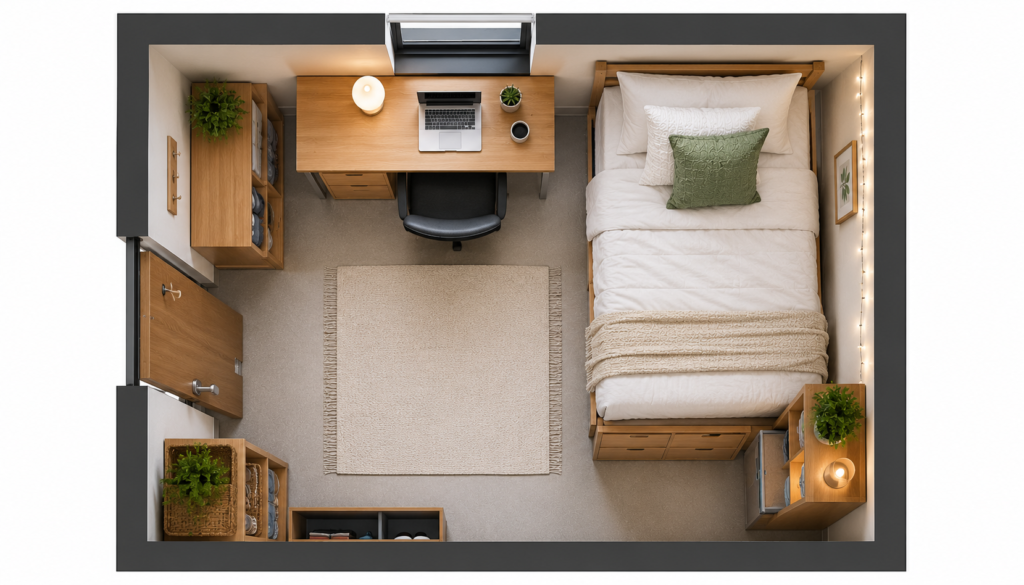
If you’re staring at an empty room trying to visualize how all of this comes together, here’s a concrete example layout for a typical 8×12 single-occupant dorm room with a bed, desk, and dresser as the required furniture.
Position the bed along the longest wall, ideally the one without the door, using risers to add six to twelve inches of clearance underneath for storage bins. Place the desk along the wall nearest the window to take advantage of natural light for studying, with a desk lamp providing warm supplemental light for evening work. Position the dresser near the closet, treating the space between them as your primary walking path through the room, kept as clear as possible.
Layer a light-toned rug that extends slightly under the bed frame and reaches toward the desk, visually connecting the two main functional zones of the room. Add a curtain or canopy above the bed if your school allows removable hardware, and finish with warm string lights along the headboard and a small mirror positioned to reflect the window’s natural light back into the room. This layout maximizes open floor space in the center of the room while keeping every functional zone (sleeping, studying, storage) clearly defined despite the limited square footage.
Small-Room Ideas by Aesthetic
Different aesthetics (covered in more depth in our dedicated dorm bed ideas by style guide) translate differently into genuinely tiny rooms, and it’s worth knowing which adjustments each style needs specifically for small-space success.
Boho, with its layered textures and abundance of decorative pieces, needs the most editing down for a small room — concentrate the boho elements on the bed itself rather than spreading them across every surface, and choose one or two statement pieces rather than the full layered look that works beautifully in a larger space. Minimalist translates almost effortlessly into small rooms, since its core philosophy of restraint already aligns with what small-space design requires.
Preppy’s crisp white-and-navy palette is genuinely one of the best-performing color combinations for small rooms specifically, since the high-contrast brightness reads as spacious and clean rather than cramped. Cottagecore benefits from keeping floral scale small and pastel saturation soft, since bold florals and saturated pastels can both visually shrink a tiny room in ways that more muted, small-scale versions of the same aesthetic avoid entirely.
Closet and Clothing Storage in a Tiny Room
Clothing storage deserves its own section because it’s consistently one of the biggest space challenges in a small dorm room, and it directly affects how the rest of the room — including the bed area — ends up looking, since overflow clothing has to go somewhere when the closet runs out of room.
Slim, velvet-coated hangers (rather than bulky plastic ones) can meaningfully increase closet capacity simply through their reduced width, letting you fit noticeably more garments into the same rod space without any structural changes. A hanging shelf organizer inside the closet adds folded-clothing storage in what’s otherwise wasted vertical space above where hanging garments end and the closet floor begins.
For out-of-season or bulkier items (winter coats during a warm month, or extra bedding during the season you’re not using it), under-bed storage bins are almost always the better answer than trying to force everything into an already-full closet. Keeping the closet reserved for current-season, frequently accessed clothing and moving everything else under the bed keeps the closet functioning efficiently rather than becoming a stuffed, hard-to-navigate mess that eventually spills into visible clutter elsewhere in the room.
A double hang rod, where your closet’s height allows it, can roughly double usable hanging space by adding a second rod beneath the existing one for shorter items like folded-over pants or shirts, leaving the original higher rod for longer garments like dresses and coats. This single addition is one of the most cost-effective closet upgrades available and works in the vast majority of standard dorm closet configurations without any tools or permanent installation required.
Desk and Study Zone Integration
In a tiny room, the desk and the bed are almost always in close proximity, and how well that relationship is designed affects the whole room’s sense of spaciousness more than people initially expect.
Keeping the desk surface itself as clear as possible — using wall-mounted or under-shelf storage for supplies rather than piling everything on the desktop — visually extends the sense of open space across the room, since a cluttered desk reads as an extension of the same visual chaos a cluttered bed does. A desk positioned to face the room rather than directly against a blank wall can also make the space feel more open and less like a series of disconnected functional zones crammed into one room.
If your desk chair is bulky, consider whether a slimmer alternative would free up meaningful floor space — desk chairs are often one of the largest volume objects in a dorm room relative to how much they’re actually used, and a slimmer, foldable, or stackable option can be tucked away entirely when not in use, opening up the floor for other purposes throughout the day.
The relationship between the desk and the bed is also worth thinking about in terms of sightlines specifically. If the desk sits directly in the path between the door and the bed, it can create a visual and physical bottleneck that makes the whole room feel more congested than the actual furniture footprint would suggest. Where possible, positioning the desk slightly off the main walking path — even by a foot or two — measurably improves both the room’s flow and its perceived openness.
The Psychology of Why These Tricks Actually Work
It’s worth understanding the underlying perceptual principles behind these small-space techniques, since knowing why something works makes it much easier to apply the same logic to situations this guide doesn’t specifically cover.
Human perception of spaciousness relies heavily on how far the eye can travel uninterrupted before hitting a visual boundary — a color change, a piece of furniture, a shadow line. Every technique in this guide, from color continuity to furniture placement to vertical lines, is fundamentally about extending that uninterrupted sightline as far as possible in a room where the actual physical distance is fixed and can’t be changed.
This is also why clutter has such an outsized effect on perceived spaciousness compared to its actual physical footprint. A small pile of items on the floor might occupy less than one square foot of actual space, but it creates a visual stopping point that breaks the eye’s ability to travel across the room, making the whole space register as smaller and more chaotic than the same room with that pile simply moved into a closed storage bin. Physical square footage and perceived square footage are related but genuinely different things, and small-space design is almost entirely about optimizing the second one.
Shared Small Rooms: Doubling Every Strategy
Everything in this guide becomes more important, not less, when you’re sharing an already-small room with another person, since the effective square footage per person is roughly cut in half compared to a single-occupancy room of the same total size.
Color continuity between two roommates’ areas matters even more in a shared small room than in a single one, since two competing, unrelated color schemes in close proximity read as visually chaotic in a way that the same mismatch might not in a larger, more spacious double. This doesn’t mean matching everything exactly (see our dorm bed ideas by style guide for how to coordinate without clashing), but it does mean the stakes for basic color harmony are higher in tight quarters.
Vertical and non-floor storage solutions also become proportionally more valuable in a shared room, since floor space genuinely needs to be divided fairly between two people, and every storage solution that doesn’t compete for that floor footprint effectively gives both roommates more usable room. A shared small room where both people commit to over-the-door organizers, under-bed bins, and wall-mounted storage will consistently feel less cramped than one where either person defaults to floor-standing furniture.
Real Room Case Studies
Sometimes it helps to see how these principles come together in a specific, grounded scenario rather than as abstract advice. Here are three brief case studies representing common small-room situations.
Case Study: A Windowless-Feeling Interior Room
For a room with a small or poorly placed window that lets in minimal natural light, layered warm artificial lighting becomes the single most important strategy on this entire list. Prioritizing a warm-toned floor or desk lamp alongside string lights, combined with a light, reflective color palette on the bed and walls, does more to compensate for limited natural light than any other single change. A large mirror positioned to reflect whatever light does enter the room, even from a small window, meaningfully amplifies the room’s overall brightness.
Case Study: An Oddly-Shaped Room With an Alcove
Some dorm rooms have an awkward alcove, angled wall, or built-in nook that doesn’t fit standard furniture well. Rather than fighting the odd shape, treating it as a dedicated single-function zone — a reading nook with a floor cushion, or a small desk tucked into the angle — often works better than trying to force standard rectangular furniture into a non-rectangular space. Custom-fit floating shelves can also make excellent use of an awkward alcove that would otherwise sit empty or become a dumping ground for loose items.
Case Study: A Room With Unusually Low Ceilings
In the rarer case of a dorm room with lower-than-standard ceilings, lofting the bed may not be a comfortable option, which means the vertical-space strategies (canopies, floor-length curtains, floating shelves) become even more important for creating the illusion of height, since actual vertical lofting is off the table. Horizontal striped elements should generally be avoided in this specific scenario, since they emphasize width at the expense of the height the room is already lacking.
Seasonal Adjustments for Small Rooms
Small rooms are particularly sensitive to seasonal changes in natural light, since they often have limited window area to begin with, and the strategies that work well in a bright September afternoon may need slight adjustment by the darker days of December.
In darker winter months, leaning more heavily on warm artificial lighting and slightly lighter bedding tones than you might otherwise choose can help compensate for the natural light the room is losing. In brighter spring and early fall months, this is a good window to lean into slightly bolder accent colors, since the increased natural light gives the room more visual breathing room to handle a bit more saturation without feeling cramped.
Budget-Friendly Small-Space Hacks
Small-space design has a reputation for requiring specialty, often expensive products, but most of the highest-impact strategies in this guide cost very little or, in the case of furniture rearrangement, nothing at all.
Command hooks and strips are genuinely the best dollar-for-dollar investment in this entire guide — a single pack unlocks wall-mounted storage, a hanging mirror, string lights, and curtain hardware, all without any drilling and all fully removable at move-out without damaging walls or violating a housing deposit agreement. Bed risers are similarly inexpensive relative to the storage capacity they unlock underneath the bed, often paying for themselves many times over in avoided clutter.
For lighting, a single warm-toned LED string light set is one of the cheapest transformations available, often costing less than a single textbook while meaningfully changing how the entire room feels in the evening. And for color continuity, it costs nothing to simply be intentional about which existing items go where — grouping your own already-owned warm-toned items together and storing cooler-toned mismatched pieces out of sight is a zero-cost version of the color strategy covered earlier in this guide.
Renter-Friendly, Damage-Free Solutions
Every dorm housing agreement includes restrictions on what you can and can’t do to the physical room, and it’s worth knowing which small-space solutions stay safely within those limits before you invest time or money into something that might cost you part of your deposit.
Removable command-strip hardware handles the vast majority of what this guide recommends — curtain rods, floating shelves rated for light loads, hooks, and mirrors are all available in versions specifically designed for temporary, damage-free installation. Tension rods, which use spring pressure rather than screws or adhesive, are another reliable renter-friendly option for curtains or even a lightweight room divider between two beds in a shared room.
It’s worth reading your specific housing agreement closely before installing anything, since policies do vary meaningfully between schools — some prohibit all wall-mounted items regardless of removability, while others allow command strips but not tension rods that press against door frames. When in doubt, a quick email to your resident advisor or housing office before move-in avoids any surprise charges at the end of the year.
Decorating the Wall Space Directly Around the Bed
The wall immediately behind and above the bed gets more visual attention than almost any other surface in the room, since it’s directly in frame every time someone looks at or photographs the bed itself. This makes it one of the highest-value, lowest-square-footage areas to get right in the entire room.
A single well-chosen piece — a large print, a fabric hanging, a cluster of three smaller frames arranged with intention rather than scattered randomly — reads as more considered than an unplanned accumulation of posters and photos added one at a time over the semester without an overall plan. This doesn’t mean you can’t add to the wall gradually; it means having a loose plan for the overall shape and boundaries of the display before you start pinning things up piece by piece.
Keeping at least some negative space visible around whatever you hang above the bed — rather than covering the wall edge-to-edge — actually makes the display itself more visually impactful, following the same less-is-more principle covered in the scale section earlier in this guide. A wall that’s completely covered competes with the bed for attention, while a wall with intentional breathing room lets both the display and the bed read clearly as separate, considered elements of the same cohesive room.
Making Peace With What You Genuinely Can’t Change
Not every small-room limitation has a workaround, and it’s worth being honest about that rather than promising every problem has a clever fix. Fixed furniture placement in some dorms genuinely can’t be rearranged due to bolted frames or electrical outlet placement. Some windows are simply too small to meaningfully brighten a room no matter how many mirrors you add. Some ceiling heights are too low for a canopy to work without feeling oppressive rather than elegant.
In these genuinely fixed-constraint situations, the better use of energy is usually accepting the specific limitation and doubling down on the strategies that are still available, rather than spending excessive time, money, or frustration fighting a constraint that isn’t actually going to change. A room with a permanently small window, for instance, is a genuinely good candidate for leaning hard into the warm artificial lighting strategy rather than continuing to search for a mirror placement or reflective surface that will meaningfully solve a problem mirrors alone can’t fully fix.
This isn’t meant to be discouraging — it’s meant to be practically useful. Most dorm rooms have at least a few genuinely fixed constraints alongside the many things that are fully within your control, and knowing which is which saves real time, money, and frustration over the course of the semester.
Frequently Asked Questions
Does lofting my bed really make that much difference in a small room? Yes — it’s consistently the single highest-impact change available, since it converts otherwise-wasted vertical space into genuinely usable floor area underneath, which matters enormously in a room where floor space is the scarcest resource.
Are dark colors ever okay in a small dorm room? Yes, in small doses as accent pieces rather than the dominant palette — a dark accent pillow or a single dark decorative object can add depth and contrast without shrinking the room the way an entirely dark color scheme would.
What’s the single cheapest change I can make to a small room? Rearranging existing furniture along the strategy in this guide (longest wall placement, minimizing floating pieces) costs nothing and often produces a noticeable improvement before you spend a single dollar on anything new.
How do I make a small shared room feel less cramped with two people’s stuff in it? Focus on shared color continuity (see the color strategy section) and vertical, non-floor storage solutions specifically, since a shared room has roughly half the per-person floor space of a single room and needs every space-saving trick doubled up.
Is it worth buying a rug if my room is really this small? Yes, even a small one — a rug, chosen at the right scale and light enough tone, does genuine work in unifying and softening a small room, and going without one often makes the hard flooring feel colder and the room feel less finished overall.
Will lofting my bed damage the frame or violate my housing agreement? Most dorm beds are specifically designed to be lofted or bunked using approved risers or the frame’s built-in adjustable height settings — check with your housing office if you’re unsure, but this is almost always an explicitly supported, approved use of standard dorm furniture rather than something that risks damage or violates policy.
How do I deal with a roommate who doesn’t care about any of this and just piles clutter everywhere? Focus on your own half of the room and any shared surfaces you can reasonably claim, using clearly defined storage (a labeled bin, a designated shelf) for your own items, and consider a friendly conversation early in the semester about keeping shared floor space clear, since that’s usually the specific issue that affects both people’s sense of the room’s spaciousness the most.
Do these small-space tricks still work in a room with absolutely no natural light at all? Yes, though the lighting section becomes even more critical — layered warm artificial lighting, reflective surfaces, and a lighter color palette can compensate significantly, even if they can’t fully replace genuine daylight.
What’s the very first change I should make if I can only do one thing this week? Rearranging existing furniture along the traffic-flow and wall-placement principles covered in this guide costs nothing and typically produces the most immediately noticeable improvement of any single change available.
Final Thoughts
A tiny dorm room is a real design constraint, not an obstacle to apologize for or hide. Every strategy in this guide — lighter colors, vertical storage, layered lighting, multi-functional furniture, and thoughtful scale — works because it respects the actual limitations of the space rather than fighting against them. Get these fundamentals right, and an 8×12 room can genuinely feel calm, spacious, and like a place you’re excited to come back to after a long day of classes, regardless of how many square feet it technically measures.
If you take away just one idea from everything covered here, let it be this: perceived spaciousness is about uninterrupted sightlines, color continuity, and intentional restraint far more than it’s about actual square footage. Two rooms with identical dimensions can feel dramatically different depending entirely on how thoughtfully they’re arranged — which means the room you’ve been assigned, however small it might feel on move-in day, has genuine potential to become one of the coziest, most functional spaces you’ll live in during your entire college experience.