
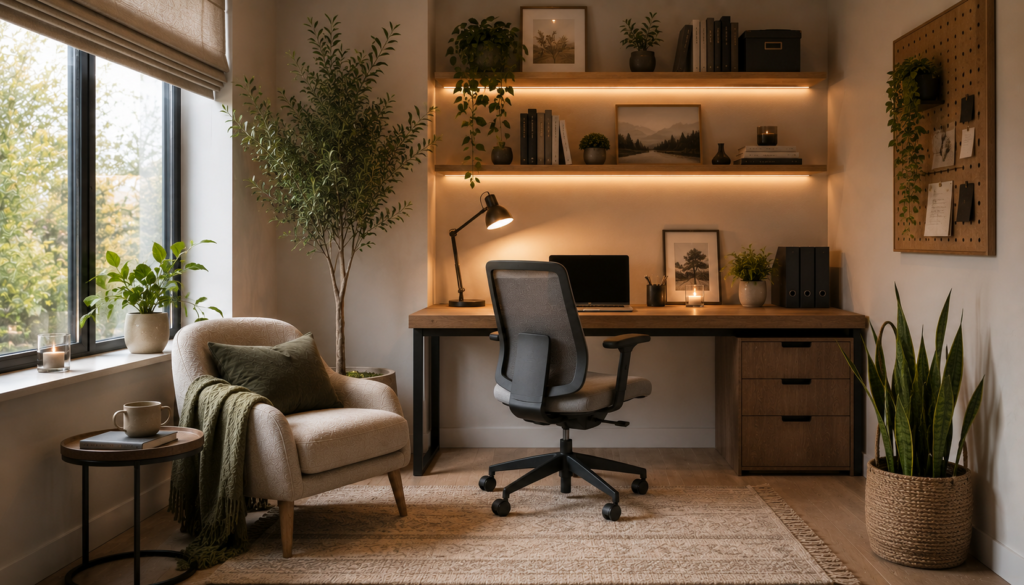
A love letter to tiny rooms — how to make ninety square feet feel like the most intentional corner of your home.
The Corner Nobody Wanted, Until I Did
My office is ninety-one square feet. I know the number exactly because I measured it three times before I let myself believe it, standing there with a tape measure and a small, stubborn hope that maybe it had grown since the last time I checked. It hadn’t. It’s a converted corner of what used to be a dining room nobody used, boxed in by a bay window on one side and a slightly awkward radiator on the other, and for the first year I owned this apartment, I treated it exactly like the leftover space it technically was. A folding table. A chair I borrowed from the kitchen and never gave back. A laptop charger taped to the wall because I hadn’t found a better solution and, frankly, hadn’t tried very hard to.
I want to tell you the moment it changed, because I think about it more than is probably normal for a decorating decision this small. It was a Tuesday, gray outside, the kind of afternoon where nothing dramatic happens and yet somehow everything does. I’d just gotten off a call that didn’t go the way I wanted, and I remember looking around that little corner — really looking, the way you look at a room when you’re upset and searching for somewhere to put the feeling — and thinking, quite clearly, *this space does not deserve to hold anything important*. It looked like a place things got stored, not a place things got created. And I realized, with the specific clarity that only shows up when you’re mildly annoyed at your own life choices, that I’d been blaming my focus, my mood, my motivation, for months, when actually I’d just never given this room permission to be beautiful.
So I fixed it. Not overnight, and not with a big budget — I want to be honest about that upfront, because I think there’s a version of this article that could make you feel like a “cozy office” requires a build-out and a design fee, and that is simply not true, certainly not for a space this size. What it required was attention. A little restraint. The same instinct I’d apply to editing an outfit down until it actually looks like me instead of like everything I own worn at once. And somewhere in that process, ninety-one square feet stopped feeling like a limitation and started feeling like the most intentional room in my entire apartment, because every single inch of it had to earn its place. There was no room for anything that didn’t.
That’s really what this whole piece is about. Small offices get treated like the consolation prize of home design — the room you settle for because you don’t have a spare bedroom, the corner you apologize for on a video call. I don’t think that’s fair, and more importantly, I don’t think it’s true. A small space, handled with the right eye, has an advantage a sprawling one doesn’t: it forces clarity. You can’t hide behind square footage. Every choice shows. And when you get those choices right, a tiny office can feel more considered, more *you*, than a home office three times its size ever could.
We’re going to walk through this properly — layout, color, furniture that earns its keep, lighting that actually flatters a small footprint instead of flattening it, the personal details that make a room feel lived in rather than just occupied, and the comfort layer most productivity advice skips entirely because it’s too busy talking about standing desks and monitor arms to notice that comfort is, itself, a productivity tool. Settle in. This one’s long, on purpose, because a room you’re going to spend real hours in deserves more than a quick list.
The Mindset Shift — Small Isn’t the Problem You Think It Is
Before we touch a single object in the room, I want to talk about the story you’re probably telling yourself about a small office, because I told myself the exact same one for far too long, and I think it’s the actual obstacle here, more than the square footage ever was.
The story goes something like this: a real office is spacious. A real office has room for a proper desk, a reading chair, maybe a little sofa in the corner for those aspirational “thinking sessions” we all picture and almost never actually have. A small office, by comparison, is what you settle for. It’s the placeholder version, the one you’ll upgrade eventually, once you have more space, more budget, more of whatever imaginary resource is currently standing between you and the office of your dreams. I want to gently dismantle that story, because I don’t think it’s serving you, and I definitely don’t think it’s true.
Here’s the thing about scarcity, whether we’re talking about a small closet or a small room: it forces editing, and editing is where actual style lives. Think about the woman whose capsule wardrobe looks more put-together than the woman with a closet stuffed floor to ceiling. It’s never about volume. It’s about the ratio of things you own to things you actually love and use, and a small space has an almost built-in advantage here, because it simply won’t tolerate excess the way a larger room will quietly absorb it. A big home office can hide a lot of half-considered decisions in its extra square footage. A small one can’t. Every single object either earns its spot or it becomes the thing you notice, the thing that makes the whole room feel slightly off, the way one wrong accessory can throw off an entire outfit even when everything else is right.
This is, not coincidentally, the exact philosophy underneath the quiet luxury conversation that’s been reshaping how a lot of us think about our whole lives lately — fewer things, chosen with real intention, allowed to actually be seen instead of buried under everything else. A small office is, in a strange way, the most natural canvas for that philosophy there is. You don’t have the square footage to overdo it even if you wanted to. The constraint does some of the taste-work for you, if you let it.
I’d also push back gently on the idea that “cozy” and “productive” are somehow in tension in a small room, because I hear that concern a lot, usually from people worried that softening a tiny space will just make it feel cluttered and unfocused. In my experience, it’s almost always the opposite. A small room that’s cold and under-decorated doesn’t feel more efficient — it feels like a room you’re trying to escape, which is its own kind of productivity killer, just a quieter, sneakier one than visual clutter. You find yourself taking your laptop to the kitchen table “just for a change of scenery” more often than you’d like to admit, and the office sits there, technically available, emotionally abandoned. A small room that’s warm, textured, and genuinely pleasant to sit in, on the other hand, becomes a room you actually want to be in, and wanting to be somewhere is most of the battle when it comes to sitting down and doing the work.
So here’s the reframe I’d ask you to sit with for the rest of this piece: your small office isn’t a compromised version of a real office. It’s a genre of its own, with its own rules, its own advantages, and — I’d argue — its own particular kind of charm that a sprawling room simply cannot replicate. A tiny, beautifully considered office has an intimacy to it, a sense of being tucked in, held, that a cavernous home office with a echo and too much empty floor space never quite achieves. Some of the most beautiful, most photographed home offices I’ve come across, the ones that make you stop scrolling and actually look, are small. That’s not despite the size. It’s because of it.
Finding Your Layout — Making Every Square Foot Work Twice
Layout matters more in a small room than almost anywhere else, because there’s so much less room for a bad decision to hide. Get the layout wrong and you’ll feel it every single day — a chair that bumps the wall every time you stand up, a desk angle that puts a glare directly on your screen from noon onward, a doorway that feels blocked the second you pull the chair out. Get it right, and the room will feel bigger than its actual measurements, which is really the whole goal here.
Start with light, the same way you would in a larger room, because it matters just as much, arguably more, when you’re working with less space to compensate. If there’s a window anywhere near your small office, orient the desk to work with it rather than against it — perpendicular if you can manage it, so light falls across the desk without glaring directly onto the screen or turning you into a silhouette on every video call. If natural light simply isn’t available, and for a lot of small offices tucked into corners or converted closets, it genuinely isn’t, don’t fight it. Compensate with layered lamp light instead, which we’ll get into properly in a bit, and focus your energy on the things you can actually control.
Next, think about traffic flow, which sounds like an odd term for a room this size but matters enormously in practice. You need to be able to pull your chair out, stand up, and move without your body colliding with a wall or a piece of furniture every time. This might mean your desk doesn’t go exactly where you first imagined it — the obvious wall, the one that seems most logical on paper — because that placement leaves you wedged into a corner every time you need to get up. Measure your actual movement, not just the furniture. Sit in the chair, pretend to stand, reach for an imaginary book on an imaginary shelf, and notice where your elbows and knees actually go. This five-minute exercise prevents more daily frustration than almost anything else on this list.
Vertical space becomes your best friend the moment your floor space runs out, and I mean that almost literally — in a small office, the wall above your desk is doing more work than the floor around it ever could. Shelving that climbs upward instead of spreading outward gives you storage and styling opportunities without eating into the room you need to actually move. A single floating shelf above the desk, styled with a little restraint, can hold everything a small side table would have held in a bigger room, freeing up that floor space for the chair to actually pull back comfortably.
Consider, too, whether your desk needs to face into the room or could instead face a wall, a decision that gets debated constantly in small-space design circles and genuinely depends on your personality more than any universal rule. Facing a wall in a tiny room can feel cocoon-like in the best way — a little private nook that shuts out visual distraction — but it only works if that wall has something worth looking at: a piece of art, a soft-toned mirror, even just a considered paint color rather than bare drywall. Facing into the room, by contrast, gives you a sense of openness even in a small footprint, at the cost of potentially having your back to a doorway, which some people find subtly unsettling over long stretches of focused work. Try both if you can, actually sit in each configuration for an afternoon before committing, because the “correct” answer here is really just whichever one makes your body relax rather than brace.
And don’t underestimate the psychological effect of a slight diagonal. Pushing a desk at a gentle angle into a corner, rather than flush against a single wall, is a trick worth trying if your room allows for it even slightly — it breaks up the boxiness that a small square room can otherwise fall into, and it tends to open up a little extra floor space in the process, since a diagonal placement often leaves usable triangles of room on either side that a flush placement would have wasted as dead, unusable space anyway.
The Palette That Makes Small Feel Expansive, Not Cramped
There’s a piece of decorating advice that gets repeated so often it’s practically folklore at this point: paint small rooms white to make them feel bigger. I understand where it comes from, and I’m not going to tell you it’s entirely wrong, but I do think it’s incomplete in a way that’s led a lot of small offices toward feeling sterile rather than spacious. White can expand a room. It can also make a small room feel like a waiting area if it’s not handled with any warmth alongside it, and a waiting area is the last feeling you want from the one room in your home where you’re supposed to actually create something.
What I’ve found works better, both in my own tiny office and in every genuinely gorgeous small space I’ve studied closely enough to understand why it works, is tonal cohesion rather than pure brightness. This means choosing a close family of colors — your walls, your furniture, your textiles — that all sit near each other on the color wheel, so the eye doesn’t hit hard boundaries anywhere in the room. Hard boundaries, a stark white wall against a dark wood desk against a bold colored chair, chop a small room visually into pieces, and a room chopped into visual pieces reads as smaller and busier than one where everything flows into everything else.
A soft, warm off-white or the gentlest oat tone as your base does the expanding work of white without the clinical chill, and then layering in one or two tones just slightly deeper in the same family — a warm taupe, a soft camel, a muted terracotta if you want a little more personality — keeps the room feeling grounded rather than washed out. The trick, and I really can’t overstate how much this matters in a small footprint specifically, is keeping the contrast between your palette choices gentle. Save your boldest contrast, if you want any at all, for one single small moment — a single accent object, a picture frame, the spine of one book angled just so — rather than spreading contrast across multiple large surfaces where it starts fighting for space that the room simply doesn’t have to spare.
Ceiling color is a detail almost nobody thinks about in a small room, and it’s worth a mention here because it can genuinely change how the whole space reads. A stark white ceiling against warm walls creates a visual “lid” that some people find makes a small room feel more boxed in, almost like your eye hits a hard stop the second it travels upward. Carrying your wall color, or a slightly lighter version of it, up onto the ceiling removes that visual stop entirely, and the room reads as taller and more continuous as a result. This is a trick professional small-space designers use constantly and almost nobody outside that world seems to know about, so consider this your invitation to try it, even just as an experiment on a single wall to see how it feels before committing the whole room to it.
I’d also gently steer you away from a palette built entirely around whatever’s currently trending on your feed, the same caution I’d offer for any room in your home, but it matters even more here because a small office doesn’t have the luxury of extra corners to update piecemeal as trends shift. Choose tones you’ve been drawn to for years, not months, and your tiny room will still feel right long after this particular color moment has passed. Sage was everywhere a couple of years back. Warm terracottas and muted rust tones are having their moment now. Both are lovely, genuinely, but only choose them if they’re actually *you*, not just because they’re the current answer to “what color should my office be” according to an algorithm that doesn’t know your actual taste.
One final thought on color, because I think it gets overlooked constantly: your view matters as much as your walls. If your small office looks out onto a window, whatever’s visible through that window is functionally part of your palette every single day, whether you’ve consciously accounted for it or not. A cool gray sky outside a warm-toned room can feel like a lovely contrast on a good day and a slightly jarring mismatch on a bad one. There’s no perfect fix for weather, obviously, but a sheer curtain in a tone that bridges your interior palette and the outside world softens that transition more than people expect from something this simple, and it’s worth considering as part of your overall color story rather than an afterthought tacked onto the window last.
Furniture That Multitasks Without Ever Looking Like It’s Trying
Small-space furniture shopping comes with its own particular anxiety, because every single piece is doing so much more visual and functional work than it would in a larger room, and choosing wrong feels higher-stakes as a result. I want to walk you through how I actually think about furniture for a space this size, because it’s a little different from how I’d approach furnishing a bigger room, and getting this part right changes everything else about how the space functions.
The desk is where I’d spend the most time deliberating, because it’s the single largest object in the room and it’s going to anchor everything else. Resist the urge to go smaller purely to save floor space — I made this mistake in my own office initially, choosing a narrow little desk because it looked tidier in the empty room, and then spent months with my laptop, a candle, and a notebook all fighting for the same eight inches of surface. What you actually want is a desk with enough depth to hold your work setup and one small personal object without everything crowding together, even if that means the desk itself takes up a slightly larger footprint than your first instinct suggested. The trade-off is almost always worth it. A desk with breathing room on its surface feels calmer to sit at than a larger room with a cramped desk ever could.
That said, in a genuinely tiny footprint, a desk with some built-in storage — drawers, a lower shelf, anything that lets the desk do double duty as both workspace and storage — earns its keep in a way it might not in a bigger room where you have the luxury of separate storage furniture elsewhere. Look for pieces where the storage feels integrated rather than bolted on, where the drawer pulls and proportions match the overall look of the desk rather than reading as a purely utilitarian add-on. This is where secondhand and vintage pieces genuinely shine, by the way — older desks were far more likely to be built with thoughtful, proportional storage than a lot of what’s mass-produced today, because efficient use of space used to be a design priority in a way fast furniture doesn’t always honor.
Your chair deserves more consideration than its size in the room might suggest, precisely because you’re going to spend more hours in direct contact with it than with almost anything else you own. In a small space specifically, look for a chair with a slimmer profile — not necessarily less comfortable, but visually lighter, so it doesn’t read as a heavy block sitting in the middle of an already tight room. A chair with visible legs rather than a solid, skirted base lets light and floor space show through underneath it, which does more for how spacious a small room feels than people expect from something this specific. This is a small detail with an outsized visual effect, genuinely worth prioritizing when you’re comparing options.
For storage beyond the desk itself, think vertical and think concealed. A tall, narrow bookshelf takes up far less floor footprint than a wide, low one while holding just as much, and it draws the eye upward in a way that makes the ceiling feel higher and the room feel larger as a byproduct. For the less attractive necessities — cables, spare supplies, the odds and ends every workspace accumulates — a single beautiful basket or a small cabinet with a door does more for the room’s calm than open shelving crammed with utilitarian objects ever will. Visible storage should be reserved for things worth looking at. Everything else goes behind a door, even in a room this size, maybe especially in a room this size, where every visible surface is working so much harder.
And a small note on multi-purpose furniture specifically, since it comes up constantly in small-space conversations: a piece that folds away, extends, or converts can be a genuine solution in the right circumstances, particularly if your office shares a room with another function entirely. But I’d caution against choosing every single piece in the room for its multi-purpose cleverness, because furniture designed primarily to transform often sacrifices a little bit of comfort or visual softness in service of its mechanism, and a room full of clever, transforming pieces can start to feel more like a showroom for space-saving gadgets than an actual home office. Choose one or two multi-functional heroes if you genuinely need them, and let the rest of the room simply be beautiful and still.
Lighting for a Tiny Room — Where It Matters Even More Than You Think
I’ve said this about larger offices too, but it bears repeating with extra emphasis here: lighting matters more in a small room than almost anywhere else, because there’s no extra square footage to distract from a mistake. A single harsh overhead bulb in a large office gets diluted by all that empty air around it. In a small office, that same harsh light bounces off every nearby surface almost immediately, and the whole tiny room ends up feeling flat, over-lit, and strangely exhausting to sit in for long stretches, even though objectively it’s plenty bright enough to work by.
The fix is the same layering principle from a larger space, just scaled down and, honestly, easier to execute given how little ground you actually need to cover. A warm-toned desk lamp handles your task lighting directly. A second, softer source — a small wall sconce, a tiny plug-in accent light tucked onto a shelf — fills in the shadows an overhead bulb alone would leave harsh and flat. Even in a room this size, two modest light sources working together will outperform one bright one every single time, both for how the room looks and for how your eyes feel by the end of a long working day.
Warm color temperature matters just as much here as it did in the larger conversation — anything in that cozy, roughly 2700K range reads as inviting rather than clinical, and in a small room, that warmth has nowhere to escape to, so it fills the whole space efficiently. This is one of the cheapest, fastest upgrades available to you, and in a room this size, the effect is almost immediate and startlingly noticeable, precisely because there’s so little square footage for the warm light to have to travel across.
Mirrors deserve a specific mention in a small-office lighting conversation, because they’re doing double duty that people often miss: a well-placed mirror doesn’t just make a room feel larger through reflection, which is the effect most people already know about — it also bounces whatever light is available, natural or lamp-lit, further into the room, effectively multiplying your light sources without adding a single new fixture. A mirror angled to catch window light, positioned somewhere it will reflect that light back into the room’s darker corners rather than straight back out the window, is one of the most underused tricks in small-space design, and it costs the same as any other decorative mirror you might have bought anyway.
If your small office genuinely lacks natural light entirely — an interior room, a closet conversion, a corner with no window access at all — don’t spend energy mourning what isn’t there. Lean fully into the layered lamp approach instead, and consider a light with a slightly wider, warmer glow as your primary source, almost standing in as a surrogate for the natural light the room doesn’t have access to. Full-spectrum bulbs, the kind designed to mimic daylight more closely than a standard warm bulb, can genuinely help here too, particularly if you find yourself feeling low-energy in a windowless space by mid-afternoon — a real, physiological response to a lack of natural light exposure that better lighting can meaningfully soften, even if it can’t fully replace the real thing.
Last thought on this, because it’s such a small addition with such an outsized emotional return: a candle or a small flameless alternative on your desk, lit during the quieter, slower parts of your day, does something in a tiny room that it simply can’t replicate in a larger one. In ninety-one square feet, that single small flame is genuinely warming the character of the entire space, not just one corner of it. Scale, in this one specific case, is actually working in your favor.
Personal Touches — Styling a Small Shelf Without Tipping Into Clutter
A small office has almost no room for decorative mistakes, which sounds intimidating until you realize it’s actually a gift. You don’t have the luxury of filling extra surfaces with things you don’t really love, the way a bigger room quietly allows you to. Every single object on display has to be worth the real estate it’s occupying, and once you start thinking that way, styling a tiny space actually becomes easier, not harder, than styling a sprawling one.
Start by accepting that you probably have room for one meaningful vignette, not five. In a larger office, you might style a bookshelf, a console table, a windowsill, and a desk corner all separately. In ninety square feet, you likely have one shelf, maybe one small ledge above the desk, and that’s genuinely it. Treat that single space the way you’d treat a single, perfect accessory choice for an outfit — not five competing pieces of jewelry, but the one necklace that actually elevates everything else you’re wearing. Choose your three or four most meaningful objects, the ones that would genuinely make you pause if you noticed them missing, and give them real room to be seen rather than crowding in everything you own that has any sentimental value at all.
A small stack of books, chosen not for their spine color but for the fact that you actually reference or love them, does more personality work per square inch than almost anything else you could put on a small shelf. Add one object with a little height variation next to the stack — a small vase, a single framed photo propped rather than mounted — and you’ve built a complete, considered moment without needing more surface area than a shelf sixteen inches wide can offer. This is exactly the kind of restraint the quiet luxury conversation keeps circling back to: not more, chosen better, and in a small room, “chosen better” isn’t optional the way it might feel in a bigger space. It’s the only way the room works at all.
Plants earn their keep here just as much as they do in a larger office, maybe more, because a single healthy plant in a small room reads as a genuinely significant presence rather than getting visually absorbed into a larger landscape of furniture the way it might in a bigger space. Choose one plant, size it thoughtfully to the room rather than grabbing whatever’s available, and let it do real work rather than adding two or three smaller ones that end up competing with each other for the same six square inches of shelf space. A single trailing plant on a high shelf, allowed to spill down along the wall, adds a sense of life and softness to a small room without eating into any actual floor space at all, which makes it one of the most efficient styling choices available to you here.
Art in a small office needs to be chosen with real intention, because you likely only have room for one piece, maybe two if your walls allow it, and that piece is going to be looked at constantly, for hours, day after day, in a way art in a hallway or a rarely used guest room never is. Choose something you’re genuinely drawn to rather than something that simply matches your palette on a technical level — you’re going to be staring at this piece far more than you’ll ever consciously register, and a piece you love quietly does something for your mood over months and years that a piece you merely thought “worked” with the room never will.
And here’s a small, specific trick for tiny spaces that I think doesn’t get mentioned enough: let one object be a little unexpected. A small office built entirely from a single coherent, matched palette can start to feel slightly flat after a while, precisely because the eye has nothing to catch on, nowhere unexpected to land. One object that breaks the pattern just slightly — an antique object with real history to it, a color that’s a touch bolder than everything around it, a texture that doesn’t quite match anything else in the room — gives the whole space a little personality and prevents it from reading as a showroom display rather than a room a real, specific person actually inhabits. Just one. Not five. The whole trick only works because it’s rare.
The Comfort Layer — Why It’s a Productivity Tool, Not a Distraction
I mentioned earlier that comfort and productivity aren’t actually in competition, and I want to make the case for that properly now, because I think it’s the piece of advice most small-office guides skip entirely, too busy talking about monitor height and cable management to notice that your actual physical and emotional comfort in a room determines how long you can sit in it before your focus starts to fray.
Temperature is the first thing worth addressing honestly, because small rooms, especially converted corners and closet offices, run colder or warmer than the rest of your home far more often than people expect. My own corner sits right by that awkward radiator I mentioned at the start, which means it swings from slightly too warm in winter to strangely drafty in the depths of a cold snap, depending entirely on the day. A small space heater or fan dedicated just to that room, rather than fighting your whole home’s central system to compensate for one difficult corner, solves this more reliably and more cheaply than almost any other fix available. Cold feet specifically are a shockingly effective way to undercut an otherwise beautiful, cozy room — a blanket over your lap and a pair of soft slippers by the desk do more for how “cozy” a small office actually feels than another decorative object ever could.
Your chair, again, deserves real consideration here, beyond the visual slimness I mentioned earlier. Genuine comfort, actual lumbar support, a seat depth that fits your body properly — these matter enormously in a room you’re sitting in for hours, and skimping here to save money rarely saves you anything in the long run, because discomfort shows up as restlessness, as an inability to focus, as constantly getting up not because you need to but because your body is quietly begging you to. If there’s one place in a small office worth genuinely stretching your budget, it’s here, even above the desk itself.
Sound matters more than people expect in a tiny room too, and it cuts both ways depending on your particular sensitivities. A small space with hard surfaces — bare walls, an uncovered floor, a glass-topped desk — tends to amplify every small noise, your own keyboard clicks included, in a way that can start to feel oddly grating over a long day, especially if you’re someone sensitive to sound to begin with. The same texture layering we’ve talked about elsewhere in this piece, a rug, curtains, some soft textiles, softens this considerably, absorbing sound rather than bouncing it back at you all day. If outside noise is a factor, a small white noise machine or a pair of good headphones does real work here too, and in a room this size, even a modest speaker fills the whole space with whatever sound you actually want to be surrounded by, without needing anything elaborate to do it.
Scent, one more time, because I genuinely think it’s underused everywhere but especially here: a small room holds a scent more completely and more quickly than a larger one does, which works entirely in your favor. A candle lit for twenty minutes in a ninety-square-foot office does more atmospheric work than the same candle would in an open-plan living room three times the size. Choose something warm, something that feels like *you* specifically rather than whatever’s trending in the candle aisle this particular month, and let it become a genuine cue, the scent equivalent of a morning coffee ritual, signaling to your whole body that it’s time to settle in and focus.
And a last, slightly softer point on comfort: give yourself permission to make the room emotionally comfortable, not just physically so. A small office that’s allowed to hold a little joy — a favorite mug, a specific playlist, five minutes with the door closed and nothing required of you before the workday officially starts — becomes a room your nervous system actually wants to enter, rather than one it merely tolerates. That distinction, more than any specific piece of furniture, is what actually determines whether you sit down and focus easily or find yourself putting it off for one more scroll through your phone first.
Staying Organized When There’s Nowhere for Things to Hide
This is the part where a lot of small-space advice gets a little too aggressive for my taste, all rigid systems and label makers, so I want to offer a gentler version, because I don’t think a cozy office and a ruthlessly optimized organizational system are actually the same goal, even though they get talked about as if they are.
The core truth of organizing a small room is this: there’s simply nowhere for excess to hide the way there is in a bigger space. A stray pile of mail on a large desk in a spacious office gets visually absorbed into everything else going on in the room. That same pile on a small desk in a ninety-square-foot office becomes the entire visual story of the room the second you glance at it. This isn’t a reason to panic. It’s just a reason to be a little more intentional about giving everything a home, because in a room this size, “a home for everything” isn’t a nice-to-have. It’s the difference between the room feeling calm and the room feeling like it’s closing in on you.
Start with cables, because they’re disproportionately disruptive in a small footprint — a tangle of cords under a desk reads as chaotic in any room, but in a tiny one, there’s nowhere for your eye to look instead, so the mess becomes the whole visual experience of sitting down to work. A simple cable clip along the desk’s edge and a small basket to corral the power strip solves most of this in under thirty minutes, and the payoff is disproportionate to the effort involved, especially in a room this size where every improvement reads as more significant simply because there’s less competing for attention.
For paper, supplies, and the general accumulation every workspace collects, lean hard into closed storage over open. This might feel counterintuitive if you’ve been told repeatedly that open shelving makes a small room feel more spacious, and there’s truth to that for the objects worth displaying, the ones we talked about in the personal touches section. But functional clutter — the loose pens, the spare notebooks, the odds and ends that don’t have an obvious category — belongs behind a door or inside a lidded basket, not out on a shelf where it will compete visually with the few meaningful objects you’ve chosen to actually show off. A single small cabinet or a drawer under the desk does more for how organized a tiny room feels than any open shelving system ever could, precisely because it lets your visible surfaces stay genuinely curated.
Vertical storage, mentioned already in the layout section, deserves a second mention here specifically for its organizational value, not just its visual one. A wall-mounted organizer, even something as simple as a small pegboard or a few hooks, gives frequently used items — headphones, a bag, a light jacket if your office doubles as a catch-all corner near an entryway — a defined spot off the floor and off the desk, freeing up your actual working surface for, well, actually working.
And build in a small weekly reset, the same idea from a larger office but even more essential here given how quickly a tiny room shows wear. Ten minutes, once a week, to clear whatever’s accumulated, return stray objects to their homes, and generally reset the room to the state you actually want to walk into each morning. This isn’t about perfectionism. It’s about maintenance, the same quiet, ongoing care you’d give a favorite piece of clothing to keep it looking good for years instead of months. A small office maintained this way stays feeling special far longer than one left to slowly, quietly fill up with everything that doesn’t have anywhere else to go.
The Small Mistakes That Make a Tiny Office Feel Smaller Than It Is
I want to close with a few honest confessions, the mistakes I made myself before I understood what I was actually doing wrong, because I think knowing what to avoid is just as valuable here as knowing what to reach for, and some of these are so easy to fall into without noticing.
The first is furniture sized for the room on paper but not for how the room actually gets used. I mentioned the too-small desk earlier, but this mistake shows up in other pieces too — a chair that looks proportionally correct in photos but turns out to bump the wall every time you push back from the desk, a shelf mounted at a height that seemed fine when the wall was empty but suddenly feels oppressive once it’s holding actual objects at eye level. The fix is always the same: sit in the actual space, move through it the way you actually will day to day, before committing to anything. A tape measure tells you the dimensions. Only your body, actually sitting there, tells you whether the room will feel right.
The second is over-correcting toward stark minimalism out of a fear that anything more will read as cluttered. I understand this instinct completely, and I fell into it myself for a while, convinced that a truly empty room was the only safe option in a footprint this small. But an office with nothing on the walls, nothing on the shelf, no texture anywhere, doesn’t read as elegantly restrained the way you’re hoping. It reads as unfinished, as a room still waiting for someone to actually move in. The goal was never zero. It was *edited*, which is a very different, much warmer thing.
The third is choosing everything in matching finishes and materials because it feels like the “safe,” coordinated choice for a small space — every piece of furniture in the same wood tone, every metal accent in the same brushed gold, nothing daring to be even slightly different from anything else in the room. This reads, ironically, as more sterile than eclectic in a room this size, because it removes any sense of a considered collection built over time and replaces it with the feeling of a single showroom purchase. A little variation, one piece with a slightly different wood tone, one metal finish that doesn’t perfectly match the rest, actually makes a small room feel more genuinely curated, not less, the same way a slightly imperfect, individually chosen accessory elevates an outfit more than a matched set from a single collection ever does.
The fourth is neglecting maintenance because the room is small enough that a little mess doesn’t seem like it should matter much. It matters more here, not less, precisely because there’s so little square footage to absorb it. A stack of mail that would disappear into the corner of a larger office becomes the dominant visual feature of a tiny one within about two days. The upkeep required for a small space is genuinely lower in absolute terms — there’s simply less room to tidy — but it needs to happen more consistently, because the room shows neglect faster than a bigger one ever would.
And the fifth, the one I think matters most emotionally even though it’s the hardest to quantify: treating the room as temporary. I did this for the better part of a year, telling myself I’d really invest in the space once I had a bigger apartment, a proper spare room, more of whatever imagined future resource was going to finally make this corner worth taking seriously. That mindset is, more than any single furniture mistake, the thing that keeps a small office feeling like an apology rather than an actual room. You don’t need more space to justify caring about the space you already have. The room you’re sitting in right now, however many square feet it happens to be, is worth finishing properly, worth the candle and the warm bulb and the one plant trailing down the shelf, whether or not a bigger version is ever coming. Waiting for permission from more square footage is, I promise you, a much longer wait than simply deciding the room matters now.
I’d rather you finish the small room today, imperfectly, than keep postponing it for a bigger one that may or may not ever arrive. Somewhere between the desk you already own and the one lamp you finally swap for a warmer bulb, the room starts to shift from a corner you tolerate into one you genuinely look forward to sitting in, and that shift, more than any single object on this entire list, is the whole point of everything we’ve walked through here.
How Small Offices Fit Into 2026’s Biggest Style Conversations
I think small spaces have quietly become the most interesting canvas in the whole interiors conversation right now, and I want to explain why, because understanding the underlying shift helps you make better choices than just following whatever’s trending this particular week.
Clean girl aesthetic, which started as a beauty and skincare conversation, has always been fundamentally about editing — fewer products, chosen deliberately, doing more for you than a crowded routine ever could. A small office is basically the architectural version of that same philosophy. You don’t have room for the twenty-step skincare equivalent of home decor, the shelf crammed with trinkets bought on impulse. You have room for the five genuinely excellent pieces, chosen with real care, and that constraint pushes you toward exactly the kind of considered, uncluttered space clean girl energy has been quietly asking all of us to build in every corner of our lives, not just our bathroom counters.
Quiet luxury, similarly, has always been less about the price tag and more about restraint used with real confidence — the sense that nothing needs to prove itself too loudly because the quality and the thought behind it are already obvious to anyone paying attention. A small office, done well, embodies that instinct almost by necessity. There’s no room to overcompensate with volume, so every choice has to actually be good on its own merits, which is, not coincidentally, the entire definition of quiet luxury in the first place.
Soft glam shows up here too, in smaller, more concentrated doses than it might in a larger room — a single brushed brass lamp, one mirror with a gently curved frame, a small dose of shimmer against all that warm, matte texture. In a tiny room, a little shimmer goes further than it would in a larger space, catching the eye and holding it in a way that would get lost across a bigger footprint, so you genuinely need less of it here to achieve the same soft, glowing effect.
And Pinterest, which I use constantly and have complicated feelings about in equal measure, has a specific role to play for small-space design particularly, because so much of what gets saved and shared under “cozy small office” or “tiny home office ideas” is genuinely useful reference material for a category of room that doesn’t get nearly as much dedicated design attention as bigger, more photogenic spaces. Use it the way I mentioned in my last piece — not to recreate a single saved image piece for piece, but to notice the threads running through everything you’re drawn to, the specific kind of warmth or specific era of furniture or specific color family that keeps showing up across dozens of saves. That thread, followed with intention, will get you somewhere far more personal and far more lasting than any single pinned photo ever could on its own.
What ties all of this together, small space or not, is the same underlying idea we keep circling back to throughout this whole piece: restraint isn’t a limitation. It’s a style choice, and right now, culturally, it’s a genuinely fashionable one. A tiny, beautifully edited office isn’t the consolation prize version of a proper home office. It might, honestly, be the version that best captures where a lot of women’s taste has been quietly heading all along.
The Room That Finally Feels Like Mine
I still sit in that ninety-one-square-foot corner most days, and I want to be honest with you about something before I let you go: it isn’t perfect. There’s a spot on the wall where the paint didn’t quite match, a cable I still haven’t fully tamed no matter how many clips I buy, a shelf that’s been “almost finished” for months because I haven’t found the exact right object to complete it and I’d rather leave the space empty than fill it with something that doesn’t actually earn its place. I’ve made my peace with all of it, mostly, because I think a room that feels finished down to the last detail on day one is usually a room that was staged rather than lived in, and I’d rather have the second thing.
What changed, in the end, wasn’t really about any single object on this very long list. It was the decision to stop treating a small room as something to apologize for and start treating it as something worth genuinely finishing, the same care I’d put into any outfit I actually wanted to feel good wearing, applied instead to ninety-one square feet of floor. The desk faces the window now. The light is warm. There’s a candle I actually love, a chair I’d choose again, a single plant trailing down from a shelf I’m still slowly filling in, one considered piece at a time.
If you’re sitting in your own small, slightly awkward corner right now, wondering whether it’s even worth the effort given how little space you actually have to work with — it is. More than worth it, honestly. A small office rewards attention in a way a bigger room, with all its extra square footage to dilute a bad decision or hide a good one, simply can’t match. Every choice you make in a room this size actually shows, actually matters, actually gets felt every single day you sit down in it. That’s not a limitation. Once you see it clearly, it starts to feel like exactly the opposite: a genuine advantage, hiding in plain sight, in the one room of your home everybody else assumed was too small to bother with.