
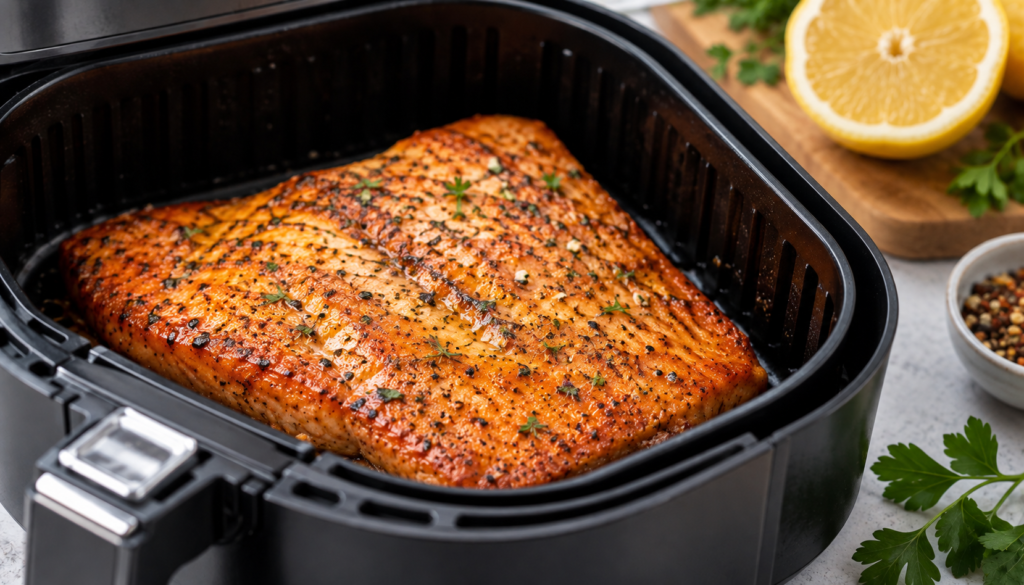
Meta description: This air fryer salmon recipe delivers a golden, flavorful crust and a moist, flaky center every time. Here’s the method, the reasoning, and how to make it your own. Primary keyword: best air fryer salmon recipe Secondary keywords: air fryer salmon recipe, easy air fryer salmon, air fryer salmon dinner, best salmon recipe air fryer, quick salmon recipe
I didn’t expect the air fryer to become my go-to for salmon. For years, a hot cast-iron pan felt like the only serious way to cook a fillet — the sizzle, the crackling skin, the slightly theatrical process of basting with butter at the end. But somewhere along the way, after one too many overcooked, dry attempts on a stovetop that runs hotter on one side than the other, I gave the air fryer a real shot. And it’s not an exaggeration to say it’s produced some of the best salmon I’ve ever made at home — more consistent, less fussy, and honestly, less likely to set off the smoke alarm.
This isn’t a claim I’m making lightly. This is the recipe and the reasoning behind it, built from a fair amount of trial, error, and a few genuinely disappointing dinners along the way, distilled into a method that’s become close to foolproof in my own kitchen.
What Makes an Excellent Air Fryer Salmon Recipe
The best air fryer salmon recipes share a few common traits, regardless of the specific seasoning or sauce involved. They account for fillet thickness rather than treating all salmon as identical. They rely on temperature verification rather than guessing based on time alone. They use just enough fat and seasoning to enhance the fish without masking it. And critically, they treat the resting period after cooking as part of the process, not an optional afterthought.
None of this is complicated, but all of it matters, and the difference between a mediocre and a genuinely excellent result usually comes down to these small details rather than any dramatic technique.
Choosing Quality Salmon
Good salmon starts at the store, and a few visual and tactile cues help identify quality regardless of whether you’re buying wild or farmed. The flesh should look vibrant and moist, not dull or discolored at the edges. It should smell like the ocean — clean and briny — rather than distinctly “fishy,” which is often a sign of age. If buying from a fish counter, ask when it arrived; a fishmonger worth their counter space will tell you honestly.
For this recipe, I generally reach for center-cut fillets, roughly 6 ounces each and about an inch thick — a size and thickness that cooks predictably and gives you that ideal balance of a well-browned exterior and a moist, barely-translucent center.
Preparing the Fillets
Preparation here is intentionally simple. Pat the fillets completely dry with paper towels — genuinely dry, not just a quick wipe — since this step does more for the final crust than almost anything else in the recipe. Check for pin bones by running a finger along the flesh, removing any with clean tweezers.
If the fillets have been in the refrigerator, let them sit out for about 10 minutes before cooking. Cooking fish straight from the fridge means the exterior can overcook slightly by the time the cold center catches up — a small adjustment that pays off in the final texture.
Seasoning Combinations
My go-to seasoning is deliberately restrained: kosher salt, freshly cracked black pepper, garlic powder, and a light drizzle of olive oil, rubbed gently into both sides of the fillet. That’s genuinely most of what the fish needs. Salmon has enough natural richness and flavor that it doesn’t require an elaborate spice rub to taste excellent — often, the simpler approach lets the fish itself be the star, rather than competing with a heavy-handed seasoning blend.
That said, part of what makes this recipe genuinely versatile is how well it takes to variation, several of which are detailed further down.
Marinades
For a slightly more involved version, I’ll sometimes marinate the fillets briefly — 15 to 20 minutes, no longer — in a mixture of olive oil, lemon juice, minced garlic, and a bit of Dijon mustard, which adds a subtle tang without overwhelming the fish. Longer marinating isn’t necessary and can actually start to affect the texture of the flesh, given the acidity from the lemon juice, so I’ve learned to resist the temptation to let it sit longer “for more flavor” — with salmon, that instinct usually backfires.
Creating Flavor Without Overwhelming the Salmon
The trick to seasoning salmon well is restraint paired with a couple of well-chosen accents. A squeeze of fresh lemon juice at the very end, after cooking, does more for brightness and flavor than almost any amount of dried herbs added before cooking. Fresh herbs (dill, parsley, chives), added as a finishing touch rather than cooked the whole time, retain more of their flavor and add visual freshness to the plate.
Getting the Outside Beautifully Cooked While Keeping the Inside Moist
This is really the whole challenge of cooking salmon well, and it comes down to two things working together: a hot enough temperature to develop color and texture on the surface before the interior overcooks, and pulling the fish at the right internal temperature rather than a fixed time. I cook at 400°F specifically because it’s hot enough to accomplish real browning within a short window — generally under 10 minutes for a standard fillet — which limits how much time the interior spends in the heat.
Temperature Recommendations
400°F (200°C) is my standard temperature for this recipe, and it’s the one I’d recommend defaulting to unless you’re working with an unusually thick fillet (over 1.5 inches), in which case dropping to 375°F and adding a couple of minutes gives the center more time to catch up without over-browning the exterior.
Cooking-Time Considerations
For a 1-inch-thick center-cut fillet at 400°F, I start checking at the 7-minute mark and typically pull the fish somewhere between 8 and 10 minutes, depending on the specific piece and how my particular air fryer happens to be running that day (even the same model can vary slightly over time, or between units). This is genuinely a “check, don’t guess” situation — I’d rather open the basket an extra time or two than serve a dry fillet.
Different Fillet Sizes
Smaller or thinner tail-end pieces (under an inch thick) will be done closer to 6 to 7 minutes; thicker portions, or a larger whole side of salmon if you’re cooking for a crowd, will need meaningfully more time and benefit from the lower-temperature adjustment mentioned above to avoid an overcooked exterior by the time the thick center is ready.
Fresh Salmon
Fresh salmon is my preference for this specific recipe, mostly because the texture, once cooked, is just slightly more supple than what I typically get from frozen — though the difference is genuinely subtle, and I wouldn’t discourage anyone from using good frozen salmon if that’s what’s accessible or budget-friendly.
Frozen Salmon
When working from frozen, I always thaw overnight in the refrigerator rather than rushing it, and I pat the fillets unusually thoroughly dry afterward, since thawed fish tends to release more surface moisture than fresh. Skipping this step with frozen fish is, in my experience, the single most common reason people end up with a pale, steamed-looking result rather than a nicely browned one.
Skin-On Salmon
When I can find good skin-on fillets, I lean toward them for this recipe specifically because the skin crisps up beautifully in the air fryer and adds a textural contrast that elevates the whole dish. Cooked skin-side down, dried thoroughly beforehand, it becomes genuinely crackly — one of my favorite parts of the finished plate.
Skinless Salmon
Skinless works perfectly well too, and it’s what I reach for when serving the salmon flaked into a salad or grain bowl, where the skin would otherwise just get discarded or become an awkward textural element mixed in with other ingredients.
How to Know When Salmon Is Done
I use an instant-read thermometer every time, without exception, inserted into the thickest part of the fillet. I pull mine around 128 to 130°F, then let it rest for 3 minutes, during which the temperature climbs a bit further from residual heat — landing somewhere close to what most people would consider ideal, tender, just-cooked-through salmon. If you prefer a more well-done result, or want to follow USDA guidance precisely, cooking to 145°F is the recommended safe internal temperature; this is simply a matter of personal preference regarding texture once you’re within a safe range.
Common Cooking Mistakes
The mistakes I made most often when I was still learning this method: not patting the fish dry enough, trusting a fixed cooking time instead of checking with a thermometer, and cutting into the fillet immediately instead of letting it rest even briefly. All three are easy, invisible mistakes until you see (and taste) the difference from fixing them.
How to Avoid Overcooking
The thermometer is genuinely the whole answer here. I know that sounds almost too simple, but in my experience, the vast majority of dry, disappointing salmon comes down to cooking by time alone rather than verifying doneness directly. A five-dollar instant-read thermometer solved more of my salmon problems than any technique adjustment I made before I started using one consistently.
How to Avoid Undercooking
Undercooking is a less common complaint than overcooking, but it happens, usually with unusually thick fillets cooked at too high a temperature for too short a time, leaving the center still translucent and cool. If you find yourself in this situation, simply return the fillet to the air fryer for another minute or two rather than assuming it needs to start over — salmon reheats quickly and evenly in the air fryer’s hot, circulating air.
Different Flavor Variations
Lemon herb: My most-repeated version — salt, pepper, olive oil, and a generous handful of chopped fresh dill and parsley added after cooking, along with a good squeeze of lemon.
Garlic butter: Melted butter mixed with minced garlic, brushed on about halfway through cooking so it doesn’t burn, finished with a little more fresh butter melted over the top at serving.
Honey mustard: A mixture of Dijon mustard, honey, and a touch of olive oil, brushed over the fillet before cooking — this one caramelizes beautifully in the air fryer’s heat.
Maple glaze: Real maple syrup combined with a splash of soy sauce and a little grated ginger, brushed on during the last few minutes of cooking to avoid burning the sugars too early.
Teriyaki: A quick homemade or store-bought teriyaki sauce, used both as a brief marinade and a finishing glaze.
Cajun-inspired: A blend of paprika, cayenne, garlic powder, onion powder, and dried thyme, rubbed onto the fillet before cooking for a smoky, slightly spicy crust.
Mediterranean: Topped after cooking with a quick relish of chopped olives, sun-dried tomatoes, and a drizzle of good olive oil.
Spicy: A rub of chili powder, smoked paprika, and a pinch of cayenne, finished with a squeeze of lime rather than lemon for a slightly different citrus note.
Side-Dish Combinations
I almost always pair this salmon with something that can cook alongside or shortly before it in the same air fryer — asparagus or broccoli tossed with olive oil and salt take about the same amount of time and can go in right after the salmon comes out, needing only a couple of extra minutes since the basket is already hot.
Complete Dinner Ideas
A full meal built around this salmon might include the fillet itself, air-fried asparagus, and a simple lemon rice — a combination that comes together in well under 30 minutes total, most of it hands-off.
High-Protein Meal Ideas
Each fillet in this recipe delivers around 30 grams of protein on its own, making it an easy way to build a genuinely high-protein dinner without much effort — pairing it with a protein-containing grain like quinoa pushes the total meal well past 35 to 40 grams per serving.
Meal Prep
I’ll sometimes cook a double batch of this salmon specifically for the following day’s lunch, flaked over greens with a simple vinaigrette. It holds up well cold, and honestly, cold leftover salmon flaked into a salad is one of my favorite lunches, not just a consolation for having leftovers.
Storage
Leftovers keep well in an airtight container in the refrigerator for up to 3 days.
Reheating
For reheating, a low oven or a brief, gentle stint back in the air fryer at a reduced temperature (around 300°F for a few minutes) does a better job of preserving moisture than a microwave, which tends to overcook the edges of already-cooked fish quickly.
Leftover Salmon Ideas
Beyond simply reheating, leftover salmon flakes beautifully into salads, folds into a quick pasta with lemon and olive oil, or gets tucked into a wrap with greens and a bit of sauce for an easy next-day lunch.
The Core Recipe
Air Fryer Salmon Serves 2 | Prep time: 5 minutes | Cook time: 8–10 minutes
Ingredients:
-
2 salmon fillets (about 6 ounces each, 1 inch thick), skin-on or skinless
-
1 tablespoon olive oil
-
½ teaspoon kosher salt
-
¼ teaspoon black pepper
-
¼ teaspoon garlic powder
-
1 lemon, cut into wedges
-
Fresh dill or parsley for garnish (optional)
Instructions:
-
Pat the salmon fillets completely dry with paper towels.
-
Rub both sides of each fillet with olive oil, then season evenly with salt, pepper, and garlic powder.
-
Preheat the air fryer to 400°F for about 3 minutes, if your model benefits from preheating.
-
Place the fillets in the basket in a single layer, skin-side down if applicable, leaving space between them.
-
Cook for 7 minutes, then check the internal temperature with an instant-read thermometer. Continue cooking in 1-minute increments until the fish reaches your preferred doneness — around 128–130°F for a more tender result, or 145°F per USDA guidance for well-done fish.
-
Remove from the air fryer and let rest for 2 to 3 minutes.
-
Squeeze fresh lemon over the top and garnish with herbs before serving.
Storage: Refrigerate leftovers in an airtight container for up to 3 days. Reheating: Warm gently in a 300°F air fryer or oven for a few minutes, or enjoy cold in a salad. Substitutions: Any neutral or mild oil (avocado oil, melted butter) can replace olive oil. Fresh herbs can be swapped for whatever you have on hand — chives and tarragon both work nicely.
Cooking times are approximate, since air fryer models and fillet thickness vary; always verify doneness with a thermometer rather than relying on time alone, especially the first few times you make this recipe in your own machine.
Key Takeaways
-
Patting salmon thoroughly dry before cooking is one of the simplest, highest-impact steps for good browning.
-
An instant-read thermometer, more than any specific technique, is what separates consistently good results from occasional lucky ones.
-
400°F for 8 to 10 minutes works well for a standard 1-inch fillet, adjusted for thickness and personal doneness preference.
-
Simple seasoning, finished with fresh herbs and citrus after cooking, tends to let salmon’s natural flavor shine.
-
This base recipe adapts easily to a wide range of flavor profiles without changing the underlying technique.
Frequently Asked Questions
What’s the best temperature for air fryer salmon? 400°F works well for most standard fillets. Thicker cuts (over 1.5 inches) may benefit from a slightly lower temperature, around 375°F, with a bit more cooking time.
Do I need to marinate salmon before air frying? No — a simple oil and seasoning rub produces excellent results. Marinating adds a flavor variation but isn’t necessary for a great outcome.
How can I tell if my salmon is done without cutting into it? An instant-read thermometer inserted into the thickest part is the most reliable method, without needing to cut into the fillet and lose juices.
Can I make this recipe with frozen salmon? Yes, though thawing overnight in the refrigerator first, and patting the fillets very dry afterward, will produce more consistent browning than cooking from frozen.
How do I keep the salmon from sticking to the air fryer basket? A light coating of oil on both the fish and the basket itself generally prevents sticking.
Final Thoughts
This recipe earned its place as a regular in my kitchen not because it’s fancy, but because it’s dependable — dependable in a way that stovetop salmon, for me at least, never quite managed to be. The technique is simple enough to remember without notes, forgiving enough to survive a distracted weeknight, and good enough that I’ve stopped feeling like I need to reserve salmon for special occasions. If you’ve had a run of disappointing salmon dinners, I’d genuinely encourage giving this specific approach an honest try before writing off the fish, or the method, entirely.