
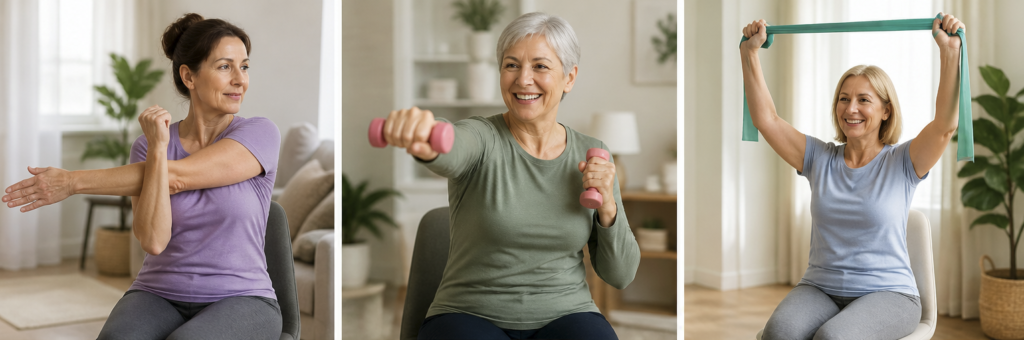
There was a time when I believed that a “real” workout had to leave me breathless, sweaty, and slightly annoyed at my own life choices. You know the type—jumping, running, pushing through something that feels more like punishment than care. And if I’m being completely honest, for a long time I equated intensity with worth. If I wasn’t exhausted, I thought I hadn’t done enough.
That belief quietly started to shift the first time I tried a chair workout.
It wasn’t dramatic. There was no cinematic moment, no instant transformation. In fact, I remember sitting there thinking, “How hard can this actually be?” I had this assumption—like many people do—that seated workouts are somehow “less than.” Easier. Softer. Maybe even unnecessary.
I was wrong.
Not in a loud, embarrassing way—but in that subtle, humbling way where your body teaches you something your mind hasn’t caught up to yet.
Because within minutes, I felt my muscles waking up in a completely different way. My core was engaged without me even realizing it. My arms started to burn. My heart rate climbed steadily. And perhaps most surprisingly, my mind had to stay present. There was coordination involved, rhythm, memory. It wasn’t just movement—it was connection.
That’s when something clicked for me.
We tend to think of fitness as something that happens when we push our bodies harder. But what if, sometimes, it’s about meeting our bodies where they are—and still finding challenge, strength, and even joy there?
Chair workouts became that space for me. Not a compromise. Not a fallback. But a different kind of strength.
And I’ve come to realize they’re especially powerful for women—because so many of us are navigating seasons where our bodies are changing, healing, adapting, or simply asking for something more sustainable.
Maybe you’re dealing with joint pain, or recovering from an injury. Maybe your balance isn’t what it used to be. Maybe you’re pregnant, postpartum, or just tired of workouts that feel aggressive instead of supportive. Or maybe you live in an apartment and don’t want to sound like you’re reenacting a stampede every morning.
Whatever your reason—this matters: choosing a chair workout doesn’t mean choosing less.
If anything, it often means choosing smarter.
There’s something deeply grounding about being seated. It removes the pressure to “perform” in the traditional sense and allows you to focus on how movement actually feels. You notice your posture more. You become aware of how your core supports you. You start to move with intention instead of momentum.
And intention changes everything.
One of the things I’ve grown to love most is how adaptable chair workouts are. On days when I feel strong, I can add resistance—light weights, a resistance band, even just increasing the tempo. On days when my energy is low, I can slow things down, focus on mobility, breathing, and gentle strength.
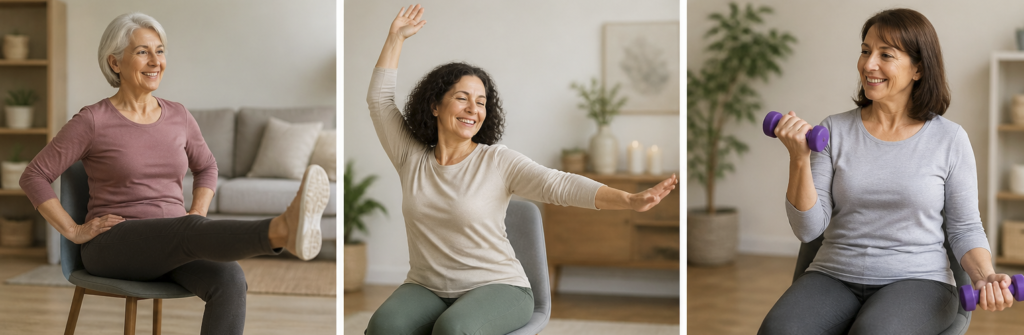
Both count.
That’s something we don’t talk about enough in fitness. That consistency doesn’t come from always pushing harder—it comes from having options that meet you in every version of your day.
What surprised me even more was how much these workouts challenged my brain.
There’s this beautiful interplay between movement and cognition that happens when you’re doing coordinated, rhythmic exercises—especially when you add music or patterns. You’re not just lifting your arms; you’re following sequences, switching directions, staying in sync.
It sounds simple, but it’s incredibly powerful.
This kind of movement supports something called neuroplasticity—the brain’s ability to adapt, grow, and form new connections. And while that might sound technical, in practice it just feels like becoming more aware, more responsive, more connected to your body.
You feel sharper. More present.
And honestly? In a world where we’re constantly distracted, that alone is worth it.
I started incorporating small “brain challenges” into my routine without even thinking about it. Alternating arm patterns. Adding a rhythm change. Moving one way with my upper body and another with my lower. At first, it felt awkward—like patting your head and rubbing your stomach at the same time.
But that awkwardness? That’s where growth happens.
Over time, it becomes smoother. More natural. And you realize you’re not just building strength—you’re building coordination, balance, and confidence.
Another unexpected favorite of mine is seated dance.
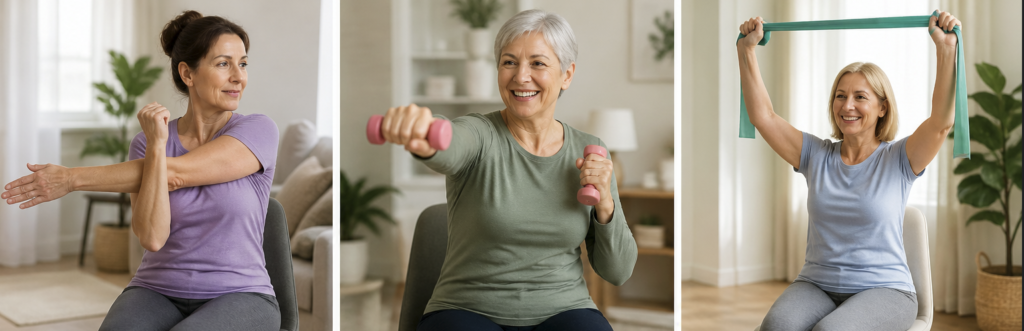
I didn’t expect to enjoy it as much as I do. There’s something incredibly freeing about moving to music without worrying about how it looks. When you’re seated, the focus shifts. It’s not about big, dramatic steps—it’s about expression. Flow. Feeling the music in your shoulders, your arms, your spine.
Some days, it feels playful. Other days, almost meditative.
But it always leaves me feeling better than when I started.
And that’s become my new measure of a “good” workout.
Not how many calories I burned. Not how sore I am the next day. But how I feel—in my body and in my mind.
There’s also a quiet kind of strength that develops through these workouts.
It’s not the loud, visible kind we often celebrate. It’s more subtle. More internal. It’s the strength of stability, of control, of being able to move with awareness and intention.
You start to notice it in everyday life. Sitting up straighter without thinking. Reaching for something with more ease. Feeling more balanced when you stand.
These small shifts add up.
And if you’re someone who’s ever felt intimidated by traditional fitness spaces, chair workouts can feel like a gentle invitation back into movement. There’s no pressure to keep up with anyone else. No comparison. Just you, your body, and the choice to move.
Of course, like anything, safety matters.
Having a stable chair—preferably without wheels—is a good place to start. Making sure your feet are grounded, your posture is supported, and you’re moving within a range that feels comfortable for you. Pain isn’t a requirement for progress, no matter what old fitness narratives might say.
And it’s okay to modify.
In fact, it’s encouraged.
That’s something I wish more people understood: modification isn’t a sign of weakness. It’s a sign of awareness. Of respecting your body enough to work with it instead of against it.
If you want to build a simple routine, it doesn’t have to be complicated.
You might start with a few minutes of gentle movement—shoulder rolls, neck stretches, slow arm raises. Then gradually add in some strength work. Maybe seated punches, controlled leg lifts, resistance band pulls. You can build intensity by increasing speed, adding repetitions, or incorporating light weights.
And if you feel like it, finish with music.
Let yourself move a little more freely. Loosen the structure. Enjoy it.
Because that’s another thing I’ve learned—movement doesn’t always have to be structured to be effective. Sometimes, the most powerful thing you can do is simply move in a way that feels good.
Especially as women, we’re often taught to approach our bodies with criticism. To fix, tone, shrink, improve. Chair workouts gently shift that narrative.
They invite you to listen instead.
To support your body. To strengthen it without punishing it. To create a relationship with movement that feels sustainable, not stressful.
And maybe that’s the real transformation.
Not just becoming stronger—but becoming kinder to yourself in the process.
If you’ve been curious about trying something different, or if traditional workouts just aren’t feeling right anymore, this might be your sign to explore a new approach.
Sit down. Take a breath. Start small.
You might be surprised by how powerful it feels.